The match is not “biased against” older grads. It is biased against disorganized older grads in SOAP week.
If you graduated more than two years ago and you’re in SOAP, you are starting with a real handicap. Not fatal. But real. Programs will not say this politely. They will call it “time since graduation” or “clinical currency” or “concerns about knowledge decay.” You need to walk into SOAP assuming you have to overcome that, not pretend it doesn’t matter.
Here is how you do that, step by step, in the exact week and situation you’re in.
1. Get brutally clear on your starting position
Before you click a single SOAP application, you need a cold, honest snapshot of where you stand. Not vibes. Facts.
Make a 1-page “situation sheet” for yourself with:
- Year of graduation
- Where you graduated (US MD, DO, US-IMG, non-US IMG)
- Gaps since graduation (what years, what you did)
- Exam status (Step 1, Step 2 CK, COMLEX – dates taken, passes/fails, scores if available)
- Recent clinical activity (last hands-on clinical month, type of setting, US vs abroad)
- Visa status if relevant
Then force yourself to answer three questions on that sheet:
- What is the biggest red flag an honest PD will see in 10 seconds?
- What single fact helps them trust you anyway?
- What am I actually willing to do this year? (Any specialty? Any location? Prelim? Transitional? Community only? No surgery? Etc.)
You cannot strategize SOAP if you are clinging to a fantasy version of your application. I’ve seen too many older grads in SOAP blow their only real shot because they were “still aiming for” a specialty that already moved on at 10:01 a.m.
You are not aiming this week. You are surviving.
2. Understand how “older grad in SOAP” looks from the PD side
Programs in SOAP are busy and a little desperate. They’re filling empty spots while still trying not to blow up their resident culture.
When they see “Graduated 2019” in SOAP, three things run through their head:
- Are they rusty? Can this person function in July without being a danger?
- Why were they not taken already? What am I missing?
- Is there some professionalism/communication/visa, etc. mess hiding here?
Your entire SOAP strategy is about answering those three fears fast:
- Show recent, credible clinical activity
- Show a clean, coherent story of what happened since graduation
- Show someone vouching for you who is recent and believable
If you do not explicitly solve those three, you’re gambling. If you’re more than two years out, gambling is not your friend.
3. Target specialties where an older grad in SOAP actually has a lane
You do not have 45 viable specialty choices in SOAP if you’re more than two years out. You probably have 3–5 realistic buckets.
Here’s the uncomfortable truth: the more competitive and procedural the field, the less tolerant they are of older grads with gaps. SOAP makes that worse, not better.
Use this as a rough reality check:
| Specialty Type | Older Grads in SOAP | Realistic? |
|---|---|---|
| Derm, Ortho, Plastics | Almost never | No |
| Gas, Rad, EM, Neuro | Rare, possible | Low |
| Categorical Surgery | Very rare | Very low |
| Internal Med, Family Med | Common | Yes |
| Psych, Peds, Neuro (small) | Variable by program | Maybe |
If you’re 3+ years out and still trying to SOAP into a competitive specialty, you’re using lottery logic during a fire drill.
Practical rule:
- Anchor your SOAP list in IM/FM/psych/peds, biased heavily toward community hospitals, lower-name institutions, and geographic regions that historically struggle to fill (Midwest, some South, sometimes rural Northeast).
- If you’re an IMG or on a visa, double-down on those programs that have previously sponsored visas and clearly state it.
SOAP is not the time to prove people wrong about your dream specialty. It is the time to get a US residency spot that keeps your career alive.
4. Fix your narrative: why you’re >2 years out and still safe to hire
Older grad is not the problem. Unexplained older grad is the problem.
You need a 3–5 sentence “SOAP narrative” that:
- Explains the time gap simply and without drama
- Connects what you did to skills, maturity, or persistence
- Ends with “I am clinically ready now” backed by something recent
Write this down. You will use versions of it in:
- ERAS supplemental comments / messages
- Emails to PDs/PCs (if allowed)
- Phone calls if someone actually talks to you
- Any last-minute LORs or updates
Example – bad:
“I graduated in 2019 and have been trying to match since then while also dealing with some personal issues and family obligations, but I am very passionate about medicine.”
Example – usable:
“I graduated in 2019 from X University overseas. From 2020–2022 I worked as a clinical physician in internal medicine in [country], managing inpatient and outpatient care. I then relocated to the US to pursue residency, completed USMLE Step 2 CK in 2023, and have been working in US clinical environments through observerships and a paid clinical assistant role in 2024. I’m clinically active and ready to step into an intern year in July.”
If you had serious issues (illness, family death, war, etc.), you can state them briefly and concretely. One line. Then focus on what you’re doing now and your recent clinical readiness.
SOAP programs are scanning for: “Is this going to be a problem?” Your narrative must say: “I had X, Y happened, now here’s how I’ve stabilized and stayed current.”
5. Rewrite your application with “older grad” in mind
You cannot rewrite your whole ERAS during SOAP, but you can tune the parts that matter.
A. Personal statement: cut the fluff, emphasize recency
If you only have time to update one thing, fix your personal statement so it works for “older grad in SOAP,” not “fresh grad in September.”
Focus on three things:
- Very brief origin story – why this specialty, but short.
- Heavy emphasis on what you did in the last 2–3 years – concrete roles, responsibilities, systems.
- One explicit paragraph addressing your path and your readiness now.
Something like:
“Since graduation in 2019, I have focused on maintaining and advancing my clinical skills. For two years, I worked as a general physician at [hospital], managing high-acuity internal medicine patients under limited resources. Over the last year in the US, I have completed observerships in [institution] and [clinic], where I participated in rounds, presented cases, and learned US documentation and EMR workflows. These experiences have kept me clinically engaged and prepared me to contribute immediately as an intern in July.”
Do not rehash every rotation from 2017. That screams “stuck in the past.”
B. Experiences: bring the recent to the top
Older grads often have 10+ experiences scattered. During SOAP:
- Put the most recent clinical experiences first, especially anything in the last 24 months.
- If you have non-clinical jobs (research assistant, scribe, teaching), keep them but shorten the text, and make them backup, not center stage.
- If there is a big “blank” year, either fill it with something honest (family caregiver, exam preparation plus part-time work) or acknowledge it briefly in your description of the adjacent experience.
Programs understand life happens. They do not understand unexplained blanks.
C. Letters of recommendation: prioritize recency and relevance
Best-case scenario: you already have at least one LOR from the last 1–2 years.
Hierarchy for an older grad in SOAP:
- US-based attending who supervised you clinically in the past 2 years
- Home-country attending who supervised you clinically in the last 3–4 years
- Research or teaching letters that comment on work ethic, reliability, and professionalism
If your best letter is from 2017 and everything else is “To Whom It May Concern” fluff, that’s hurting you. Even in SOAP, some attendings will fire off a short but recent supportive email or letter in 24–48 hours if you ask clearly.
6. Apply strategically inside SOAP’s constraints
SOAP has strict rules. No cold-calling before you’re allowed. Limited numbers of programs per round. Time pressure.
So you plan like a triage doc, not a tourist.
A. Build a tiered list before the portal opens
Before Round 1, make three lists (on paper or spreadsheet):
- Tier 1 – Programs where your profile fits: older grads accepted, IM/FM/psych/peds, community or lower-name academic, historically IMG-friendly if you’re IMG, visa-friendly if needed.
- Tier 2 – Programs you’d be okay with but less ideal: maybe further location, slightly more competitive, or less clear about older grads.
- Tier 3 – Programs you’d take if desperate: prelim years, places with rough reputations, locations you’d rather avoid but would still show up to in July if matched.
During SOAP you don’t have time to “research” everything from scratch. You should already know which specialty and geographic buckets make sense for someone in your position.
B. Rank reality over preference in early rounds
Round 1 is where people blow it. They use half their applications on long-shot academic programs in cities they like.
If you’re 2+ years out, do the opposite:
- Heavy-weight Tier 1 (safest, most realistic fits) in Round 1.
- Use Tier 2 to fill your quotas.
- Save some Tier 3 for later rounds if you need them, or for prelim options if categorical fails.
You’d rather have three interviews from “less sexy” community programs than zero from dream programs that already rejected 50 people just like you all week.
7. Communicating as an older grad during SOAP (without being annoying)
SOAP communication rules change slightly year to year and programs differ in how reachable they are. But the pattern is similar: some will accept emails from SOAP applicants once applications are in, some will ignore you no matter what.
Your job: be visible, short, and professionally persistent—without spamming.
Basic contact email template
Once applications are submitted and if communication is allowed:
Subject: SOAP Applicant – [Your Name], MD, 2019 Grad – Interest in [Program Name]
Dear Dr. X / Program Coordinator,
My name is [Name]. I am a 2019 graduate of [School], currently participating in SOAP and have applied to your [Specialty] program.
I recognize that my graduation year is earlier than many applicants, but I have remained clinically active through [recent clinical roles], most recently at [US or current institution]. I am ECFMG certified / have passed Step 1 and Step 2 CK, and I am fully available to begin training in July.
I would be grateful for consideration and would welcome the chance to speak with your team if interviews are offered.
Sincerely,
[Name]
AAMC ID: [ ]
Short. Direct. Addresses the “older grad” concern head on.
Do not write a manifesto. Do not send follow-up emails every 6 hours. Once, maybe twice total, is enough.
8. Use prelim and transitional years as a deliberate bridge, not an accident
If categorical options do not materialize, an older grad sometimes should consider prelim internal medicine or surgery, or a transitional year, as a strategic move.
That only works if you go in with eyes open:
When a prelim year can help you:
- You will be in a US clinical environment in July, proving you can function.
- You gain fresh US-based LORs, hopefully strong ones.
- You reset the “time since graduation” concern because you’re now a current trainee.
When it backfires:
- You pick a brutal prelim surgery spot with zero academic support and no time to reapply.
- You do not lock in a strong plan to reapply (no meetings with PD, no research, no networking).
- You treat it as “I’ll figure it out after intern year” and then you’re drowning in 80-hour weeks with no time to build a stronger application.
If you SOAP into a prelim year as an older grad, your next goal starts the day you arrive: impress people, collect advocates, and start planning the Step 2/residency re-application timeline with your PD in the fall.
9. Mental game: not panicking yourself into terrible decisions
SOAP week is emotional whiplash. Being an older grad adds shame and fear on top of that. If you’re not careful, you’ll swing between two bad extremes:
- “I will only take a spot in X specialty in Y cities because I deserve it.”
- “I will accept literally anything anywhere at any cost just not to be unmatched.”
You need a middle ground framework. Here’s one I like, fast and dirty:
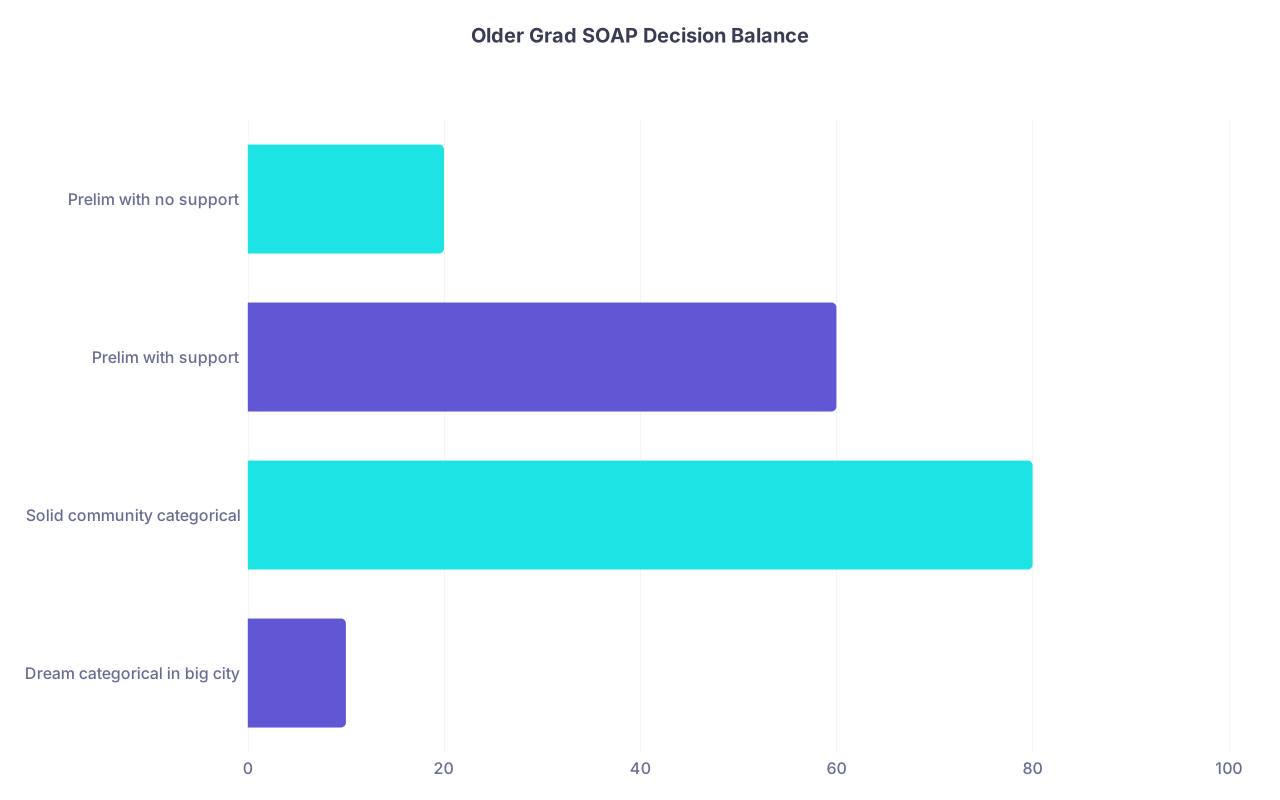
| Category | Value |
|---|---|
| Dream categorical in big city | 10 |
| Solid community categorical | 80 |
| Prelim with support | 60 |
| Prelim with no support | 20 |
Think in terms of future option value:
- A less glamorous but solid categorical IM/FM/psych spot in a small town usually gives you 90% of what you need: board eligibility, training, potential fellowships later.
- A prelim year in a malignant environment with no academic connections gives you maybe 20%: you survive, but barely, and you do not meaningfully improve your odds.
- A prelim with clear potential for categorical conversion or strong PD support can be 60–70%: decent bridge.
- Holding out for the perfect specialty when you already struck out in the main match is usually 10% or less: fantasy, not strategy.
Write down before Round 1: what are you actually willing to accept? What is truly off the table? Then stick to that, so you’re not making life decisions at 1 a.m. on cortisol alone.
10. If SOAP fails: what older grads do in the next 6–12 months
You may do everything right and still come out of SOAP unmatched. Being older makes the margin thinner.
If that happens, your next 6–12 months need to be focused and ruthless. Not random.
Here’s the basic flow:

| Step | Description |
|---|---|
| Step 1 | Unmatched after SOAP |
| Step 2 | Find paid clinical role or research position |
| Step 3 | Plan US relocation and visa options |
| Step 4 | Secure recent US letters |
| Step 5 | Arrange US observerships or externships |
| Step 6 | Retake or complete exams if needed |
| Step 7 | Refocus on realistic specialties |
| Step 8 | Apply early next cycle |
| Step 9 | US-based? |
Your priorities as an older grad:
- Get into a clinical environment – paid if possible (hospitalist assistant, research fellow with clinical exposure, advanced practice scribe, clinical instructor abroad with real responsibility). Observerships help but are weaker than hands-on roles.
- Refresh your application – new LORs from this year, updated personal statement with recent activity, any exam retakes or Step 3 if that genuinely strengthens your profile.
- Tighten your specialty strategy – commit to specialties where older grads actually match. Stop treating ultra-competitive fields as plausible defaults.
If you are 5+ years out and still unmatched after multiple cycles, you are in a different conversation: alternate pathways (non-residency clinical roles, public health, research careers, or relocating to a system that values your prior training). That’s harsh, but pretending you have unlimited cycles to try the same thing is worse.
11. What to do tonight
You are in SOAP. You’re more than two years out from graduation. You don’t have time for a treatise. You need a punch list.
Here’s what you do in the next 24 hours:
- Write your 3–5 sentence “older grad narrative” and paste it into a document you can reuse.
- Open ERAS and reorder your experiences so your last 2–3 years of clinical activity sit at the top. Trim old fluff.
- Rewrite your personal statement focus to highlight recent clinical work and explicitly address your graduation year and current readiness.
- Build a spreadsheet with three tabs: IM/FM, psych/peds/others, prelim/transitional. Mark which are realistically older-grad friendly (community, IMG-friendly, visa sponsorship).
- Draft one short email template to PD/PC for use after you apply, customized slightly per program.
Then set a timer and sleep. Even 4–5 hours is better than trying to “optimize” until 3 a.m. while your brain melts.
When you wake up, open your program list and ask one question:
“Which of these programs would actually take a clinically active, older graduate if I put my best self forward?”
Apply to those first.