
It’s Monday of Match Week. You’ve already lived this once: you were unmatched last cycle, you retooled your application, and you came back. Today you opened your email, saw “We are sorry to inform you…” again, and now you’re staring at the SOAP portal like it’s a bad sequel.
You’re not just in SOAP. You’re in SOAP as a reapplicant with a prior unmatched cycle on your record. Different game. Different stakes. And if you try to play it like last year, there’s a real chance you end this week in the exact same place.
Let’s talk about what has to change now—this week—and what has to change going forward if this ends with no spot again.
1. Face the Big Reality: The Second Unmatched Cycle Is a Red Flag
You already know programs can see you’re a reapplicant. They know you went unmatched before. Faking that this is “just bad luck” is a waste of time. This is the frame you’re operating in:
- To programs, “unmatched once” = possible issue.
- “Unmatched twice” = probably a serious issue.
- SOAP as a reapplicant = extremely short runway to prove you’re not a risky choice.
So your mindset this week cannot be: “How do I get someone to see how great I am?” It has to be: “How do I remove risk from my profile and make it stupidly easy for a PD to justify picking me over someone else?”
That means three moves:
- Widening what you’re willing to take.
- Sharpening your story in a way that directly addresses being unmatched twice.
- Making your application cleaner and more focused than it was last time—not just “slightly updated.”
2. Fix Your Targets: Where You Apply in SOAP Has to Change
If you’re in SOAP again, your target list is almost certainly part of the problem.
Last time, what I see over and over is something like:
- Aiming only at categorical spots in a single specialty (say, categorical IM, no prelim, no FM, no psych).
- Geographic fantasies (must be NY/CA, near partner, etc.).
- Avoiding programs with heavy service loads or “bad reputations.”
That mentality cannot survive a second unmatched cycle.
Be brutally honest about your current leverage
| Tier | Example Positions | Realistic for SOAP Reapplicant? |
|---|---|---|
| 1 | Top-tier university categorical IM, Derm, Ortho | Almost never |
| 2 | Mid-tier university categorical IM, EM, Gen Surg | Rare, selective |
| 3 | Community categorical IM, FM, Psych | Possible if app is solid |
| 4 | Prelim medicine/surgery, transitional year | Often your best entry |
| 5 | Off-cycle, unfilled community programs (post-SOAP) | Very realistic |
If you’re a SOAP reapplicant, your most realistic doors in SOAP are usually:
- Community FM
- Community IM (especially in less popular states)
- Prelim medicine / prelim surgery
- Transitional years
- Some community psych programs
You can still apply to better things. But your priority list needs to reflect reality, not hope.
Concrete target changes to make today
Drop your “only categorical” rule.
A prelim or TY year gets you U.S. training, letters, and a live PD who can advocate for you. From there, you can reapply or transition into advanced positions. Is it ideal? No. Is it better than sitting unmatched again? Absolutely.Open your geography. For real this time.
If you did not apply to places like:- Rural Midwest
- Deep South
- Smaller community hospitals in states you have never visited
then you were not actually wide. Programs in those areas fill with people who are flexible. Make yourself one of them.
Look at specialties that SOAP regularly fills.
Family Med, IM, Psych, Peds, Path, sometimes Neuro. If this is your second unmatched cycle in, say, Gen Surg or EM, you have to seriously consider a categorical slot in one of these instead of clinging to raw specialty loyalty.
3. Rewrite Your Story: You Cannot Use the Same Personal Statement / Letters
You cannot just resubmit last year’s personal statement with a few tweaks and a new paragraph. Programs can tell when something is recycled or generic. More importantly, your situation is different now.
You’re a reapplicant who went unmatched again and is now in SOAP. That demands a new narrative.
How to frame being unmatched (without sounding defensive)
You need one clear, honest, and concise explanation of your path that:
- Acknowledges the prior unmatched cycle.
- States what changed between then and now.
- Signals insight and maturity, not self-pity.
Something like:
“I first applied to residency in 2023 focused solely on categorical general surgery. I did not match. Over the past year I completed a surgical prelim year / dedicated research year / clinical observerships in X and Y, and received additional mentorship. Through this process I recognized that my strengths and long-term goals align more closely with internal medicine, particularly in [specific interest]. I have worked to address the gaps in my prior application by [concrete change], and I’m ready to commit fully to contributing as a resident.”
Do not write three paragraphs unpacking your pain. One or two clean sentences about the prior attempt, followed by specific growth and concrete changes. Then move on.
If you’re staying in the same specialty
You’re reapplying to, say, IM after going unmatched last cycle and now ending up in SOAP again. You need to answer one question in your head: what’s different now that makes you a better bet?
Examples:
- You finished a prelim year with strong clinical evaluations.
- You improved Step 2 from 216 to 238.
- You added real U.S. clinical experience + fresh letters from that time.
- You addressed professionalism / communication feedback and can prove it with specific changes and trusted references.
If nothing is significantly different, then your explanation becomes: “I didn’t change much but I hope for a better outcome.” That does not sell in SOAP.
Letters of recommendation: you can’t be lazy here
This late in the game, it’s hard to get new letters, but if your letters are:
- From >2 years ago only
- From a single institution and specialty not aligned with your SOAP targets
- Generic template letters from a research PI who barely knows you
they’re hurting you.
What to do right now:
- If you did any new clinical work (prelim year, observership, externship, strong sub-I) in the last 12–18 months, urgently contact 1–2 attendings. Ask for a brief but strong letter highlighting your clinical reliability, work ethic, and teachability.
- Prioritize letters from U.S. clinical supervisors in the specialty you’re targeting in SOAP. FM letters for FM, IM for IM, etc. A glowing recent clinical letter can rescue a mediocre test score.
4. Fix the Core Weakness, Not Just the Cosmetics
SOAP is not just about spinning your story. If you’re a second-time unmatched applicant, there’s usually one of a few core problems underneath.
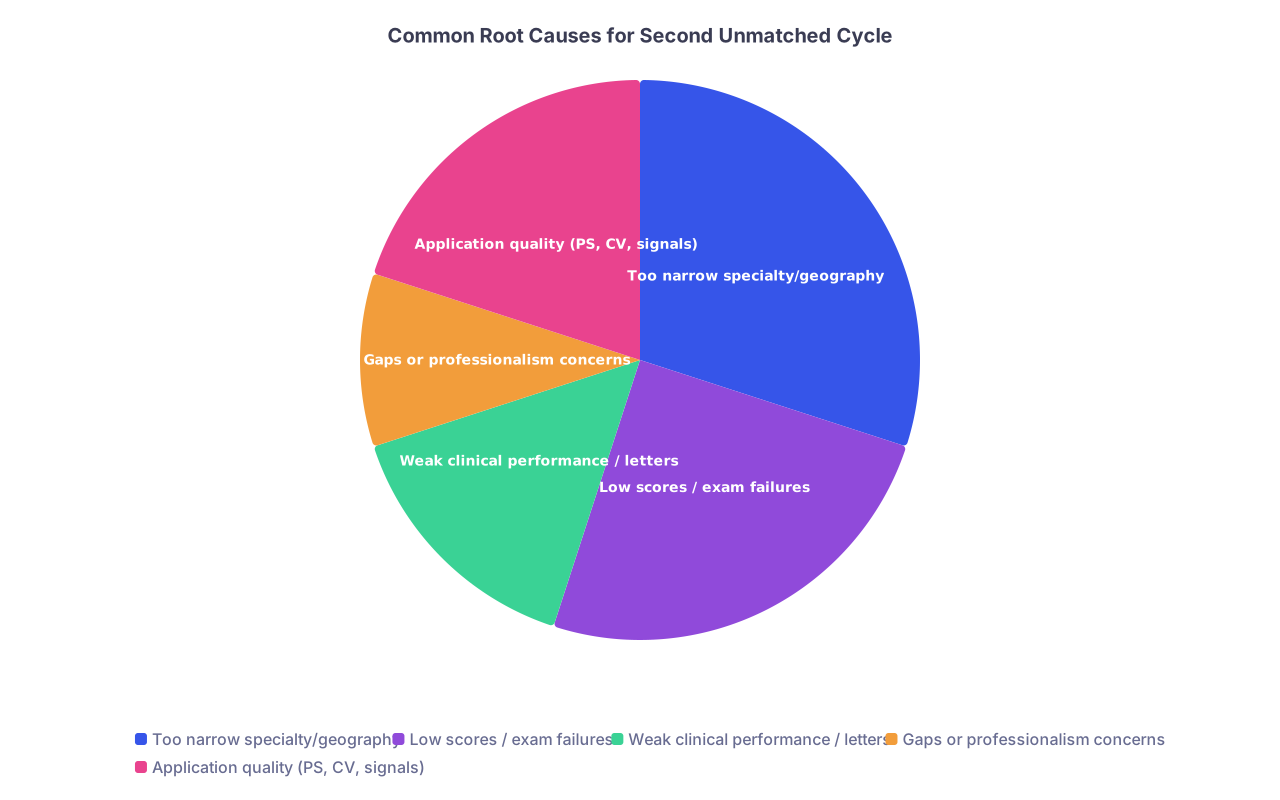
| Category | Value |
|---|---|
| Too narrow specialty/geography | 30 |
| Low scores / exam failures | 25 |
| Weak clinical performance / letters | 15 |
| Gaps or professionalism concerns | 10 |
| Application quality (PS, CV, signals) | 20 |
This week you don’t have time to fix everything, but you do have time to stop repeating the same mistake.
If your issue is scores / exam failures
Programs are risk-averse with exams. If you:
- Failed Step 1 or Step 2
- Have very low scores relative to your specialty
you need to stop applying like you don’t.
Concrete changes:
- Push toward specialties that historically accept lower scores: FM, psych, some IM, path.
- Target programs that explicitly state they accept attempts / lower scores on their websites or FREIDA profiles.
- In your application text, frame your score issue briefly, then highlight later improvement (e.g., Shelf exams, in-service exam, strong Step 2 after weak Step 1).
Do not pretend your scores don’t matter. Programs definitely are not pretending.
If your issue is clinical performance / professionalism
If you got:
- A marginal dean’s letter / MSPE comments
- Narrative concerns like “needs closer supervision,” “communication issues,” “professionalism concern noted”
then your main job this week is to present fresh evidence that you’re safe and reliable now.
That means:
- Up-to-date evaluations from a prelim year or recent rotations.
- A strong letter from a supervising physician explicitly endorsing your professionalism and growth.
- A brief, owned explanation if asked in interviews: what happened, what you changed, and what’s different now.
Blaming your school, an attending you didn’t like, or “toxic culture” will sink you faster than the original issue.
If your issue is overshooting and rigidity
This is the one I see most. Applicant with decent but not amazing stats only applied to competitive specialties, big cities, or brand-name programs. Went unmatched. Reapplied with basically the same strategy plus “more research” or “better away rotation.” Now they’re in SOAP again.
The fix is unglamorous:
- Stop chasing prestige.
- Accept that the next step is getting a job as a physician, not the perfect job.
- Apply broadly to any reasonable path that gets you training: prelims, community categorical, small programs.
You don’t have to love every part of the plan. You just have to pick a path that gets you moving.
5. Change Your SOAP Strategy: Application, Calls, and Interviews
You don’t have time for a full reinvention. But you do have time to be smarter than last year.
Application tweaks you can make in 24–48 hours
Rewrite your personal statement specifically for SOAP.
Shorter. Sharper. Calmly addresses your journey. Emphasizes reliability and readiness more than abstract passion.Clean up your experiences section.
- Put your most recent clinical or relevant work at the top.
- If you’ve done a gap year or non-clinical work, frame it in terms of skills relevant to residency: time management, communication, responsibility.
- Remove fluff that screams “padding” (random clubs from M1 that you never engaged with again).
Update your CV dates and statuses.
An outdated CV with “anticipated 2023” still on it or missing your most recent position looks sloppy. SOAP is ruthless about small details.
How you or your advocates should reach out
Some programs pay more attention to direct contact in SOAP, others less. But if you’re a reapplicant, you need to create real human connections wherever possible.
Who can reach out:
- Your current PD (if in a prelim program)
- A trusted attending who knows you well
- A mentor with prior PD/APD experience
Their message should be short and specific:
- Confirm you’re safe to work with clinically.
- Highlight that you improved from last year.
- Explain why you’d be a good fit for that specific program (geographic ties, background, interest in their population or mission).
You, personally, should not be spamming programs with “please review my app” emails. One or two targeted, thoughtful emails if there’s a legitimate connection are fine. Mass blasts are annoying and usually ignored.
Interview behavior must show growth
If you get SOAP interviews this time, assume they’ve looked at your history and thought: “Why should I take a risk on someone who went unmatched twice?”
Your job in the room (or on Zoom):
- Be straightforward: “Yes, I applied previously and did not match. Here’s what I did this year, what I learned, and why I’m better prepared now.”
- No victim narrative. Even if the system was unfair, complaining about it to a PD is a disaster.
- Emphasize stability: you show up, do the work, handle feedback, and stick with commitments.
Programs picking in SOAP are not looking for the most “impressive” candidate. They’re looking for someone who will not blow up their call schedule or cause trouble.
6. If You Don’t Match in SOAP Again: What Has to Change for Next Year
I hope you grab something this week. But you asked for situation handling, not fantasy, so we need to talk about the other path too.
If you end this week without a spot:
You cannot just hit “repeat” on the same application next year.
You need a deliberate bridge year with one of these goals:
- U.S. clinical experience + letters (prelim, research year with clinical duties, hospitalist scribe with strong MD mentors).
- Marked academic improvement (Step 3 done with a solid score, stronger in-service type assessments if in prelim year).
- Addressing any professionalism / communication flag with hard evidence (evaluations, remediation completion, etc.).
And you may need to reconsider your specialty entirely.
If you’re a two-time unmatched Derm / Ortho / ENT / NSG applicant still hoping the third time is magic without changing anything? That’s not a plan. That’s denial.
7. Visualizing a Smarter Next Year (If It Comes to That)
Here’s what a purposeful year between cycles often looks like when done right vs wrong:

| Aspect | Done Right | Done Wrong |
|---|---|---|
| Clinical Work | Prelim/TY, observership with strong evals | Unrelated non-clinical job |
| Exams | Step 3 completed, solid pass/improvement | No new scores, avoids tests |
| Letters | New, specific US clinical letters | Reuses old vague letters |
| Specialty | Adjusted to realistic target | Same ultra-competitive specialty |
| Geography | Open nationwide | Same 1–2 dream cities only |
8. Common SOAP Reapplicant Traps to Avoid This Week
Let me be blunt about a few things I’ve watched sink people:
- Writing a personal statement that reads like a therapy session. Programs are not your therapist.
- Saying in interviews, “I think I just had bad luck last year.” It makes you sound unaware.
- Refusing prelim / TY positions out of pride, then regretting it in October.
- Not telling your current PD or mentors you went unmatched (again) because you’re embarrassed, and then missing out on their advocacy.
- Doubling down on a specialty that clearly will not take you given your metrics and track record.
You’re allowed to be upset. Privately. But your strategic brain still has to drive the bus.
9. A Simple Decision Flow for You Right Now
Let’s map your next 24–48 hours so you stop spinning.

| Step | Description |
|---|---|
| Step 1 | Unmatched again in SOAP week |
| Step 2 | Add more realistic specialties |
| Step 3 | Broaden programs and geography |
| Step 4 | Rewrite PS with new specialty focus |
| Step 5 | Request updated letters and advocacy |
| Step 6 | Optimize existing documents and targets |
| Step 7 | Submit SOAP apps widely incl. prelims |
| Step 8 | Address prior unmatched directly, show growth |
| Step 9 | Plan structured bridge year with advisor |
| Step 10 | Current specialty realistic? |
| Step 11 | Any new clinical work or mentors since last cycle? |
| Step 12 | Receive SOAP interviews? |
10. What You Should Change Right Now (Condensed)
If you skimmed everything, here’s the non-fluffy list:
- Change your targets: Add FM/IM/psych, rural/community, prelim/TY. Drop the “prestige or nothing” mindset.
- Rewrite your personal statement: One paragraph acknowledging prior unmatched + specific growth, then shift focus to what you offer now.
- Update letters if at all possible: Recent, U.S., clinical, specialty-aligned.
- Clean up your application: Current dates, clear experiences, no outdated fluff.
- Use your people: Tell your PD/mentors you’re unmatched again. Ask them to advocate at specific programs where you’re a reasonable fit.
- Be direct in interviews: Own your history. No self-pity, no excuses, clear growth.

FAQ (Exactly 4 Questions)
1. Should I take a prelim or transitional year if what I really want is a categorical spot?
If this is your second unmatched cycle, I’d say yes almost every time, assuming the prelim/TY program is legitimate and has reasonable training conditions. A prelim year gives you U.S. clinical experience, fresh letters, and a PD who can vouch for you. From there, you can reapply to categorical spots with a much stronger story. Turning down a prelim year because it is “not categorical” and then going unmatched again is one of the most avoidable self-inflicted wounds I see.
2. Do programs see that I’m a reapplicant and does it really hurt me?
Yes, they see it. And yes, it matters, especially if nothing has changed. Being a reapplicant by itself is not fatal—lots of people match on a second attempt—but being a reapplicant with essentially the same application and the same unrealistic targets is a huge red flag. Programs think: “If nobody picked them last year and nothing is different, why should we be the first?” Your job is to make the “what’s different” painfully obvious.
3. Is it worth switching specialties during SOAP as a reapplicant?
If you’re in a highly competitive field (Derm, Ortho, ENT, NSG, Rad Onc) or even mid-competitive (EM, Anes, Gen Surg) with marginal stats, then yes, switching to a more achievable specialty in SOAP—especially FM, IM, Psych—can absolutely be the move. Your prior unmatched history plus a competitive specialty is a bad combo. You’re not betraying your dream by pivoting; you’re making sure you actually become a practicing physician with options later.
4. How do I explain two unmatched cycles in an interview without torpedoing myself?
You keep it short, honest, and focused on growth. For example: “I first applied narrowly to [specialty] in 2023 and did not match. I realized I had over-focused on a small set of programs and had limited clinical exposure. Over the last year I [completed a prelim year / gained U.S. clinical experience / addressed X gap] and broadened my applications. This cycle I again did not secure a spot prior to SOAP, but I’ve learned from that process as well and I’m now fully committed to contributing in a program like yours, where my strengths in [specific qualities] can be put to work.” Then stop. Answer follow-ups directly, but don’t spiral into over-explaining.

Action step for today: Open your personal statement file right now and add one clear, honest paragraph that briefly acknowledges your prior unmatched cycle(s) and concretely states what’s different about you as an applicant this year. Then cut any sentence that sounds like an excuse.