
It’s late February. You’re a US MD or DO. ERAS is closed, interview season is basically over, and your email inbox is a graveyard. No invites. Or you had one that turned into a polite rejection.
Now you’re looking at the calendar doing the match math in your head and realizing: you’re almost certainly going to be SOAP-eligible.
You’re not thinking big-picture “career dreams” right now. You’re thinking: “How do I not be completely screwed in March?”
This is where we work. Right here.
You have limited time, limited emotional bandwidth, and one job: reposition yourself for SOAP as fast and as intelligently as possible.
Let’s do it.
1. Reality Check: Why You Likely Have No Interviews
You cannot fix what you will not name. Spend one honest hour on this and you’ll save yourself a lot of wasted scrambling.
Here’s what usually puts a US MD/DO into “no interview” territory:
- Step/COMLEX scores on the lower side for your target specialty
- IMG-level competitiveness specialty (derm, optho, ortho, ENT, plastics, neurosurg, rad onc) without matching CV
- Late application, missing Step 2, or weak letters
- Few/no geographic ties to where you applied
- Major red flags (failed exam, professionalism issue, unaddressed leave of absence)
- Unrealistic list (40 applications to 1–2 specialties, mostly reach programs)
You probably know your issue already. Stop sugarcoating it.
Now classify your main problem in one sentence:
| Profile Type | Short Description |
|---|---|
| Score-Limited | Step/COMLEX on the low end for chosen field |
| Specialty-Mismatch | Overly competitive specialty vs your CV |
| Application-Quality | Weak PS, letters, late app, sloppy ERAS |
| Red-Flag | Failures, LOA, professionalism concerns |
| List-Strategy Problem | Too few programs or wrong mix of programs |
Write down which one (or combo) you are. That will dictate how aggressive you must be in SOAP.
Because here’s the unvarnished truth: SOAP is not “second chance dermatology.” SOAP is “job triage.” Your goal is an MD/DO-appropriate residency position that keeps your career alive and gets you trained.
If you’re still thinking, “Maybe I’ll get radiology or ortho in SOAP,” stop. That’s fantasy. The people who do best in SOAP are extremely clear-eyed and adaptable.
2. Know the SOAP Battlefield and Timeline
You need to understand the structure, because SOAP has its own weird rules and timing. If you’ve never been through it, it blindsides you.
Basic structure (NRMP SOAP):
Monday of Match Week:
- 10:00 AM ET: You get your “Did I match?” email. If you’re in this article, assume that answer is “No.”
- A bit later: List of unfilled programs is released to SOAP-eligible applicants.
- You and your school scramble.
Monday–Thursday:
- Four Rounds of offers.
- You submit applications through ERAS (up to 45 programs total in SOAP).
- Programs can contact you by phone or video. It feels like speed dating mixed with a hostage negotiation.
Thursday:
- SOAP ends. Any unfilled positions after that are “scramble,” and it’s absolute chaos.
You’re not going to “figure it out” during SOAP week if you walk into Monday blind and unprepared. You’ll lock up, click randomly, and waste your 45 applications.
Your job: front-load the thinking now so SOAP week is execution, not strategy.
Here’s where your time actually goes in SOAP:
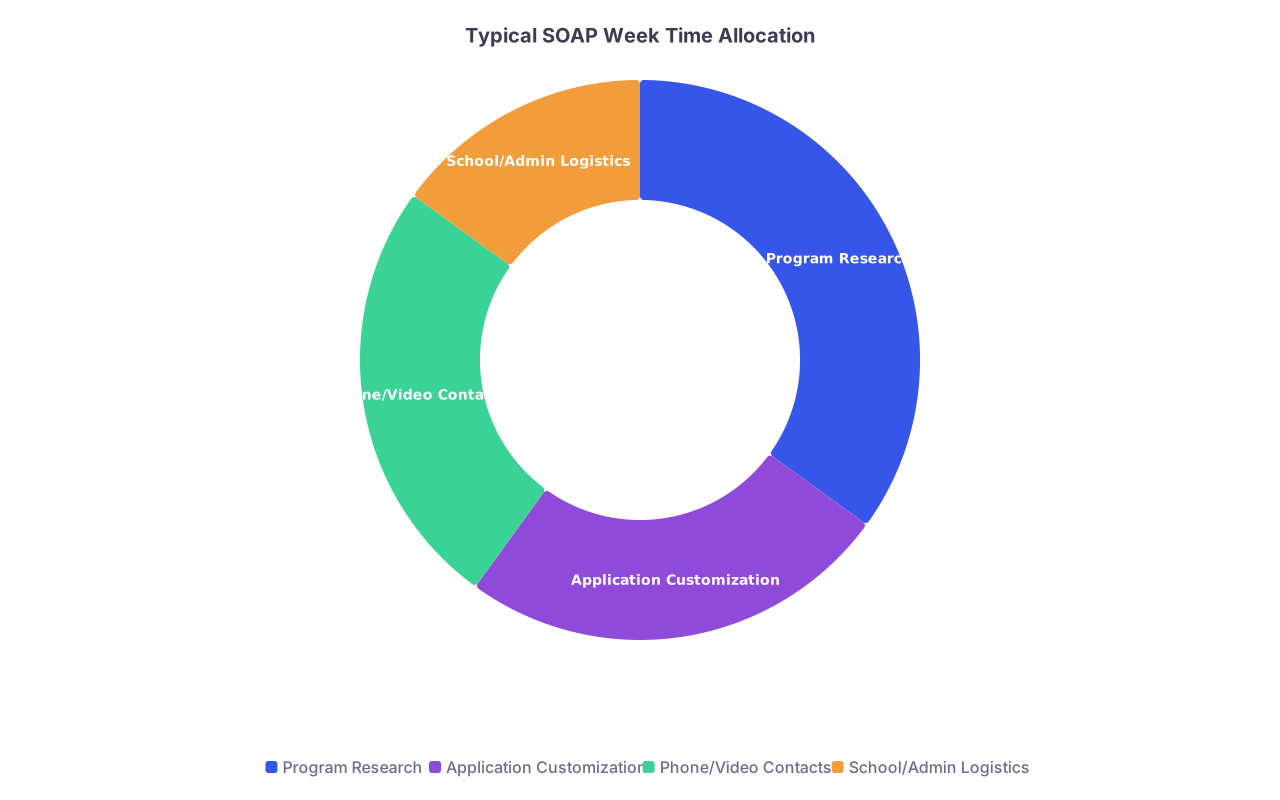
| Category | Value |
|---|---|
| Program Research | 35 |
| Application Customization | 25 |
| Phone/Video Contacts | 25 |
| School/Admin Logistics | 15 |
Most people screw this up. They spend 80% panicking and texting classmates, 20% actually doing anything. You’re going to flip that.
3. Decide Your SOAP Strategy: Fields You Will Actually Apply To
You need a pre-built decision tree before Monday of Match Week. Not some vibe-based “I’ll see what’s open.” A real, written-down plan.
Here’s how to approach it.
Step 1: Decide what is on the table
Ask yourself bluntly:
“If I don’t get a spot in SOAP, am I realistically willing and able to take a year off and try again?”
For most US MD/DOs, the honest answer is no. Not financially, not psychologically, not logistically. If that’s you, you need to be open to:
- Preliminary or transitional year programs
- Less competitive fields than your original choice
- Undersubscribed locations (rural, smaller cities, less desirable regions)
Fields that frequently have SOAP positions for US MD/DOs (varies year to year, but patterns repeat):
- Internal Medicine (community, lower-tier university affiliates)
- Family Medicine
- Pediatrics (some years more, some less)
- Psychiatry (less and less, but still occasionally)
- Transitional Year / Preliminary IM / Preliminary Surgery
If you were going for something like ortho, derm, ENT, rads, whatever — in SOAP you should be thinking:
- “I will SOAP into IM/FM/Psych/Peds or a prelim year, keep my career alive, and then re-evaluate after PGY1.”
Not: “Maybe there’ll be an unfilled derm spot.”
Derm in SOAP is like seeing a unicorn in the parking lot. It theoretically happens; it probably will not happen to you.
Step 2: Build your specialty hierarchy
Write down three clear tiers, now, before you’re emotional.
Tier 1 – “Ideal but realistic SOAP targets”
Example: Categorical IM, FM, Psych, Peds.
Tier 2 – “Acceptable step to keep career alive”
Example: TY, prelim IM, prelim surgery in decent programs.
Tier 3 – “If nothing else, I will still do this rather than be unmatched”
Example: Any ACGME prelim year at a functioning hospital where you will not be abused.
Make sure Tier 3 actually exists. Too many US MD/DOs say, “I’d rather go unmatched than do prelim surgery in [insert place].” Then March comes and they panic-regret that line in about 3 seconds.
Get honest with yourself now, when you’re a little calmer.
4. Fix Your Documents Fast: SOAP-Focused ERAS Clean-Up
Your ERAS is written for your original specialty. SOAP needs a much broader, sometimes different pitch.
You do not have months. You might have days. So we’re going for “good and tailored” not “perfect”.
Personal statement(s)
You need at least one generalist-friendly PS, likely more.
If you’re targeting:
- IM + FM + Peds → You can often use one core PS and lightly tweak openings.
- Psych → Needs its own tone; don’t reuse your surgery PS and just change the word “surgery” to “psychiatry.”
Bare minimum:
Create a fresh “generalist-core” PS that:
- Acknowledges your current pivot without sounding desperate.
- Emphasizes:
- Breadth of clinical interest
- Teamwork
- Reliability
- Teachability
- Willingness to work in underserved or less glamorous settings
I’ve seen applicants literally copy their “I’m passionate about orthopedic innovation” PS and submit it to FM in SOAP. That’s how you waste your shot.
Experiences and descriptions
You do not need to rewrite every bullet, but you should:
- Move generalist-relevant experiences higher (IM sub-I, FM clinic, psych inpatient, etc.).
- De-emphasize hyper-specialty stuff in SOAP-target apps (that 2-week derm observership in Monaco can slide down).
- Add or update any recent rotations that show you can function independently at the PGY1 level.
Letters of recommendation (LORs)
You won’t be able to conjure up brand-new letters during SOAP week. But you can:
- Make sure your most flexible letters are uploaded and assigned (IM attendings, sub-I supervisors).
- Use your specialty-specific letters (e.g., ortho, derm) only if they strongly highlight your general clinical abilities and if you’re applying to prelims where that’s still relevant.
If you have a choice between:
- An okay letter from your dream specialty, and
- A strong letter from a generalist field (IM/FM) describing real work ethic and reliability
For SOAP, I’d pick the strong generalist letter 9 times out of 10.
5. Build a SOAP Program Target List Before Match Week
Your 45 SOAP applications are a currency. Spend them like they matter.
You cannot see the official SOAP vacancy list yet, but you can pre-build:
- Categories of programs you’d apply to
- Regions you’re willing to live in
- A “hard no” list (places or situations you absolutely will not accept, for sanity or safety reasons)
Use past years’ unfilled lists (NRMP publishes data, and people post patterns) to make a rough map:
- IM – often unfilled in:
- Smaller community hospitals
- Rural Midwest/South
- FM – more widely distributed openings
- Peds – some community spots
- Psych – fewer each year, but still a handful, often in less popular geographies
- Transitional year – very hit-or-miss, but usually a few scattered
You’re not hunting for prestige. You’re hunting for:
- ACGME accreditation
- Reasonable work environment (you can often sniff out nightmares via online reviews, word of mouth)
- Solid training volume (you actually learn something)
Create a simple worksheet or spreadsheet with:
- Program name
- City/state
- Specialty (IM/FM/Peds/Psych/TY/Prelim)
- Rough preference rank (1–3)
- Any notes/contacts/geographic ties
Then when the SOAP list drops, you’re plugging real vacancies into this skeleton, not starting from zero.
6. Prepare Your Story: Why You’re SOAPing and What You Want Now
SOAP calls are short. Sometimes 5–10 minutes. You don’t get a full-blown interview. You get a vibe check and a couple key questions.
You need a clean, honest, non-whiny narrative ready.
Core points you must be able to state calmly:
- Why you think you didn’t match / got no interviews
- Why you’re now interested in this specialty/program
- Why you’d be a safe, low-drama, hard-working intern
- What you plan to do long-term (without sounding like you’re just using them as a pit stop)
Example script for someone pivoting from Ortho to IM/FM in SOAP:
“I originally applied to orthopedic surgery. I was very interested in hands-on, procedural work, but my application was not competitive enough for that match this cycle. I had solid clinical evaluations and feedback in my core rotations, particularly in internal medicine and family medicine, and I’ve realized I really value continuity of care and breadth of pathology.”
“At this point, my priority is to begin training as a physician, to serve patients and grow clinically. I’m excited about the chance to do that in a community-focused IM/FM program like yours, especially given your patient population and the autonomy your interns get.”
Nothing defensive. No bitterness. No, “The match is broken” rants. Programs want someone who’ll show up July 1 and function, not someone still mourning their lost plastic surgery career.
7. Use Your School and Network Like a Grown-Up, Not a Victim
SOAP is not the time to be proud and “independent.”
Your med school has:
- A Dean of Students or Student Affairs office
- Possibly a dedicated Match/SOAP advisor
- Alumni in a bunch of residencies
- PDs/APDs who know other PDs/APDs
Leverage that.
Between now and Match Week:
Schedule a blunt meeting with your dean or advisor.
- Ask: “If I go into SOAP, what are my realistic best options as a US MD/DO with my stats and record?”
- Make them say it out loud. Then plan from there.
Identify 2–3 faculty who like you and are somewhat influential.
- Ask if they’d be willing to:
- Take a quick look at your revised PS
- Put in a quiet word at programs they know might be unfilled in IM/FM/Peds/Psych
- Ask if they’d be willing to:
Talk to recent grads who SOAPed successfully.
- Ask specific questions:
- “How did you choose where to apply?”
- “What did you wish you had done before SOAP week started?”
- Ask specific questions:
You’re not asking for miracles. You’re asking for information and quiet advocacy. That’s how adults in this system survive.
8. During SOAP Week: How to Execute Without Losing Your Mind
Let me outline the basic flow you should follow when the list drops.

| Step | Description |
|---|---|
| Step 1 | Monday - Get Unmatched Notice |
| Step 2 | Confirm SOAP Eligibility with School |
| Step 3 | Receive Unfilled List |
| Step 4 | Filter by Specialty Tiers |
| Step 5 | Filter by Location and Program Type |
| Step 6 | Prioritize Top 45 Targets |
| Step 7 | Customize PS and Assign LORs |
| Step 8 | Submit ERAS SOAP Apps |
| Step 9 | Answer Calls and Do Mini Interviews |
| Step 10 | Update Preferences if Needed |
| Step 11 | Accept Best Offer in SOAP Round |
When the unfilled list drops
You and half the planet will be trying to scroll that PDF at once. Stay calm.
Your steps:
- Immediately filter for your Tier 1 specialties (IM/FM/Peds/Psych/TY as planned).
- Cross-reference with your pre-built spreadsheet:
- Location you can live in
- Program type that makes sense for your long-term plan
- Narrow to about 60–70 potential programs.
- From that, rank down to 45 you’ll actually apply to. Aggressively. Don’t spread yourself too thin.
If you have a strong geographic tie, bump those programs up the list. People underestimate how much “I grew up 40 minutes from here and want to stay near family” moves the needle when everything else is chaos.
Customization level
You will not be writing 45 perfectly tailored PSs. That’s fantasy.
Realistic approach:
- 1–2 core PS templates:
- Generalist (IM/FM/Peds)
- Psych or TY/prelim if needed
Then you do micro-customization:
- Insert 1–2 sentences in paragraph 2 with:
- The program’s focus (rural health, underserved, academic)
- A regional tie you have
Do not waste 30 minutes customizing for a single program when you have 40+ apps to send.
9. If You SOAP Into a Prelim or Non-Dream Specialty
This part nobody talks about honestly. So I will.
If you SOAP into:
- A prelim year (IM or surgery)
- A categorical slot in a less competitive field than your dream
- A location you never wanted but accepted to avoid being unmatched
Here’s the correct mindset:
You are not “stuck forever.” You are not “a failure.” You are a doctor in training with an MD/DO who secured PGY1 training. That alone separates you from a lot of unmatched colleagues.
But you must treat that year like:
- A live audition
- A salvage operation
- A professional bootcamp
Things I’ve seen work:
- PGY1 crushes it in IM prelim → picks up an open categorical IM spot at same or nearby program.
- FM SOAP match, applicant discovers they actually like outpatient continuity and stays happily.
- Prelim surgery → re-applies to anesthesia/EM/IM with strong PD letter and better story.
Things that fail:
- PGY1 sulking about “being too good for this place”
- Blowing off scut work
- Telling everyone they’re “just here until I get into ortho”
Be honest with yourself privately and with close mentors. With your program, you show up and act like this is your chosen path. That’s professional.
10. If You Strike Out in SOAP: Don’t Let Panic Make Permanent Decisions
I hope you do not need this section. But you might. So let’s talk about it now, while your brain is still online.
If Thursday comes and you:
- Have no SOAP position, and
- Scramble doesn’t produce anything viable
You are not done. You are just in a more complex game.
Core questions:
- Can you afford (financially and emotionally) a dedicated year to re-apply?
- Do you have a home institution that will help you:
- Get a research position
- Arrange additional clinical experiences
- Strengthen letters and narrative
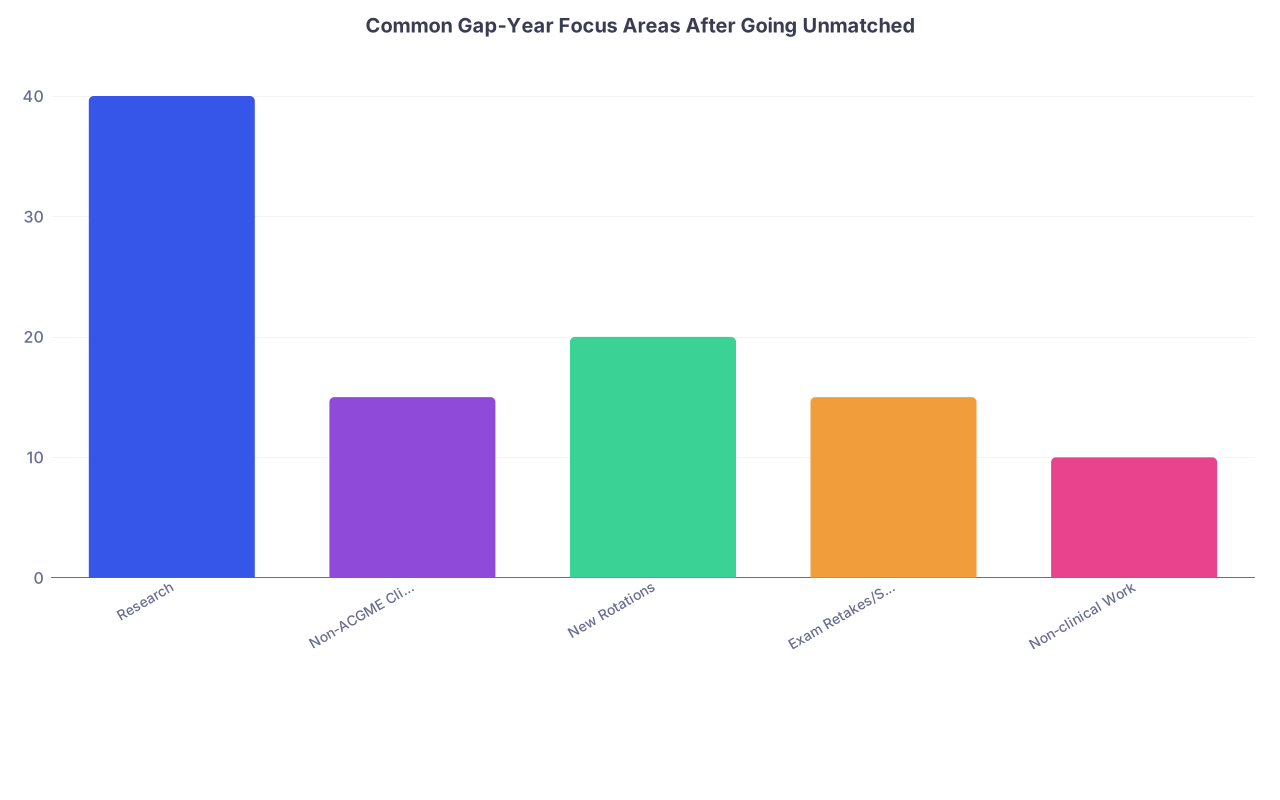
| Category | Value |
|---|---|
| Research | 40 |
| Non-ACGME Clinical Work | 15 |
| New Rotations | 20 |
| Exam Retakes/Step 3 | 15 |
| Non-clinical Work | 10 |
Do not rush into:
- Unaccredited “residency-like” programs that are basically cheap labor
- International work that doesn’t translate back to US training
- Burning bridges with your school out of humiliation
You regroup, you get a brutally honest strategic plan from your dean/PD mentors, and you decide:
- New specialty?
- Same specialty but with a very different application?
- Or a different career trajectory using your MD/DO?
But that’s a separate battle. Right now, your focus is SOAP prep.
11. Quick Checklist: What To Do This Week
Stop reading and actually do these:
| Task | Time Needed |
|---|---|
| Honest problem assessment | 30–60 min |
| Meeting with dean/advisor | 30–45 min |
| Draft generalist-focused PS | 2–3 hours |
| Build specialty tier plan | 30 min |
| Create SOAP program spreadsheet | 1–2 hours |
| Identify key faculty allies | 30 min |
And yes, this is several hours of real work. Do it now, when you still have some emotional fuel left.
FAQ (Exactly 5 Questions)
1. I’m a US MD with Step 1 fail but passed on retake and have no interviews. Can I still get something decent in SOAP?
Yes, but “decent” needs a realistic definition. A Step 1 fail is a real red flag. Programs willing to take you are more likely to be in community IM/FM, possibly Peds or Psych in less desirable locations, or prelim positions. Your job is to highlight your later consistency (Step 2, clerkships), own the failure without excuses, and show you have structures in place to not repeat it. You’re not out; you’re just not negotiating from strength.
2. Should I still aim for my original specialty in SOAP at all?
In most competitive specialties (ortho, derm, ENT, urology, plastics, neurosurg, rad onc, optho), the answer is essentially no. If a rare spot opens, it will be fought over by people who were already strong in that field. You can throw 1–2 of your 45 apps at them if it helps you sleep at night, but don’t structure your SOAP strategy around that fantasy. Use 90%+ of your apps on realistic fields that routinely have unfilled positions.
3. How many personal statements should I realistically have ready for SOAP?
For most US MD/DOs: 1–2 is enough. One generalist PS that works for IM/FM/Peds, and a second if you’re including Psych or TY/prelim. Over-optimizing 5 different PS versions is a trap; you’ll waste time and introduce more errors. Put your effort into one or two strong, adaptable statements and a clear spoken narrative for calls.
4. Do programs hold it against me that I’m in SOAP as a US grad?
Some do. Many do not. What they care about most in SOAP is: Will this person show up on July 1, work hard, not melt down, and not make me regret offering them a spot in 48 hours? As a US MD/DO with no professionalism disasters, you often look safer than a complete unknown. Your job is to project stability and realism, not neediness or entitlement.
5. Is it ever better to go unmatched than to accept a SOAP position I really do not want?
Sometimes. If the program has a genuine reputation for abuse, unsafe training, or there’s a personal reason you cannot function in that location (family, immigration, major health constraints), then yes — walking away can be smarter long-term. But people throw around “I don’t want to be stuck there” too casually. Training somewhere less prestigious or less fun for 3 years is almost always better for your career than having “chronically unmatched” next to your name. Talk to a dean or trusted PD before refusing anything.
Open your ERAS personal statement section right now. Duplicate your current specialty PS into a new document and start rewriting the first two paragraphs as if you’re applying to internal medicine or family medicine instead. That single action gets you out of vague anxiety and into actual SOAP preparation.