
The worst thing you can do right now is pretend this is normal. It is not.
You failed a board exam and landed in SOAP. The margin for error is basically gone—but the path forward is not.
I’m going to walk you through a damage-control plan that assumes three things:
- You’re short on time.
- You’re emotionally wrecked but still functional.
- You still want a residency this year.
If that’s you, keep reading. If you want soft comfort instead of strategy, this is not the right piece for you.
1. Get Your Head Straight in 24 Hours
You cannot execute SOAP in panic mode. Programs smell desperation and disorganization. You do not have to be “okay”; you just have to be operational.
Here’s your first 24-hour reset, step by step.
Step 1: Name exactly what happened
Write this down, one sentence each:
- Which exam and result: “Failed Step 2 CK with a 206; cutoff 209.”
- Match status: “Unmatched, in SOAP.”
- Current limitation: “Cannot retake before SOAP / score will not be back in time.”
That’s the reality. Not the story in your head about being a failure, just the facts. You’ll need this clarity for emails and calls.
Step 2: Contain the emotional bleed
You’re probably dealing with:
- Shame about telling your school, mentors, family
- Fear you’ll never match
- Anger at yourself, your school, the exam, the universe
You do not need to “fix” any of that today. You just need guardrails so it does not wreck your execution.
Do this today:
Decide who actually needs to know in the next week:
- Dean’s office / student affairs or GME liaison
- One or two honest mentors
- Anyone you live with (because your schedule is about to get weird)
Set a rule: no doom-scrolling, no forums, no anonymous Reddit “advice” until SOAP is done. Those places are crack for anxiety.
Sleep window: Commit to a hard sleep window of at least 5–6 hours. No, you are not the one magical human who performs better on 2 hours and panic.
Step 3: Loop in your school immediately
Your Dean’s office / student affairs / GME support has:
- Historical data on where SOAP placements actually happened
- Direct contacts at programs that have taken your grads before
- Sometimes, quiet back-channel influence
Go to them with:
- One-page summary (bullet points only):
- Board history (passes, fail, planned retake)
- Clinical grades, any honors
- Research or notable experiences
- Your target fields for SOAP (realistic ones)
And then say this out loud:
“I failed [Step/COMLEX] and I’m in SOAP. I want a realistic plan to maximize my chances of matching THIS week. I’m open to prelim and less competitive fields. What has worked for students like me from this school?”
You’re not asking if your life is over. You’re asking for tactics.
2. Understand How Programs Actually See Your Failure
Failing a board exam is not an abstract moral judgment. To a program, it means three specific risks:
- You might struggle with in-training exams and board pass rates (which hit their accreditation metrics).
- You might struggle with clinical reasoning under pressure.
- You might require extra faculty time, remediation, and monitoring.
That’s it. Not “you’re dumb.” Risk. And risk can be mitigated or made worse by how you present yourself.

How your situation looks from their side
Here’s what they see on your ERAS:
- A failed Step or COMLEX attempt
- Possibly a borderline pass on the other exam(s)
- You’re now in SOAP—a sign you were not ranked to match
Then there are modifiers. These shift you from “automatic reject” to “maybe.”
Helpful modifiers:
- Strong clinical evals, especially comments like “reads a lot,” “hard worker,” “excellent team member.”
- Upward trend: weak preclinical, stronger clinical, or low Step 1, higher Step 2 CK (if your fail is on an earlier attempt).
- Clear commitment to a specialty that matches your SOAP choices (e.g., FM rotations, community health projects if you’re SOAPing into FM).
- Supportive emails or calls from faculty vouching you’re reliable and teachable.
Harmful modifiers:
- Multiple red flags: professionalism write-ups, LOA, remediation without clear explanation.
- Vague or evasive language in your application about the failure.
- Applying in SOAP to a field that does not match your history at all (e.g., zero psych exposure, suddenly SOAPing only into psych).
Your damage control is about turning a scary unknown into a contained risk with a plan.
You need to look like: “Yes, this happened. Yes, it’s serious. Here’s what I’ve already changed.”
3. Pick Your SOAP Targets Like a Strategist, Not a Romantic
SOAP is not where you “chase the dream.” SOAP is where you defend your career. Ruthlessly.
You do not have the luxury of magical thinking here. You need to understand where someone with a board failure can realistically land.
| Specialty Tier | Examples | Feasibility With a Board Failure |
|---|---|---|
| Very Competitive | Derm, Plastics, Ortho, ENT | Essentially zero |
| Competitive | EM, Anesthesia, Radiology | Very low |
| Mid | IM categorical, OB/GYN, Gen Surg categorical | Low to moderate (context-dependent) |
| Less Competitive | FM, Psych, Peds, IM prelim, TY | Moderate if application is otherwise solid |
Step 1: Accept what’s off the table
If you failed a board exam and went unmatched, stop wasting SOAP choices on:
- Derm
- Ortho
- Neurosurgery
- ENT
- Plastics
- Integrated vascular / CT / IR pathways
Those spots in SOAP are either unicorn-level rare or basically pre-allocated via backchannels.
Step 2: Decide your real priorities
You need to answer this honestly:
- Is your absolute #1 priority to match into something this year, even if it’s not your dream field?
- Or is your priority a specific specialty, even if it means being unmatched again and reapplying?
If you are reading a “damage control” piece, I’m going to assume the priority is: get a residency this year.
That means your SOAP list should heavily feature:
- Family Medicine
- Internal Medicine prelim and transitional year
- Pediatrics (for some candidates)
- Psychiatry (but note: this has become more competitive)
- Possibly Path, Neurology, PM&R depending on the year and your background
Step 3: Build tiers within SOAP
You’re not just listing 45 random programs. You’re creating clusters:
- Tier A: Programs where your school has matched before, especially with weaker applicants.
- Tier B: Programs in less desirable locations (geographically or lifestyle-wise) but solid training.
- Tier C: Any program with a reputation for giving second chances, taking IMGs, or having a history of applicants with red flags.
Your Dean’s office or GME liaison should help with a “Tier A” list based on historical data. If they won’t, ask upperclassmen who matched from your school in less popular locations.
Do not make your SOAP list from Google alone. That’s amateur-hour.
4. Rewrite Your Story: How to Address the Failure Directly
You do not hide a failed board score. Ever. You control the framing.
Programs that are willing to consider you will want to know two things:
- What actually happened (not the 10-minute sob story, the professional explanation).
- What’s different now that makes you safe to bet on.
You’ll reflect this in:
- Your updated personal statement (if the system lets you change it for SOAP—many schools recommend a shorter, more direct one).
- Any email communication with program coordinators or directors.
- Your interview responses.
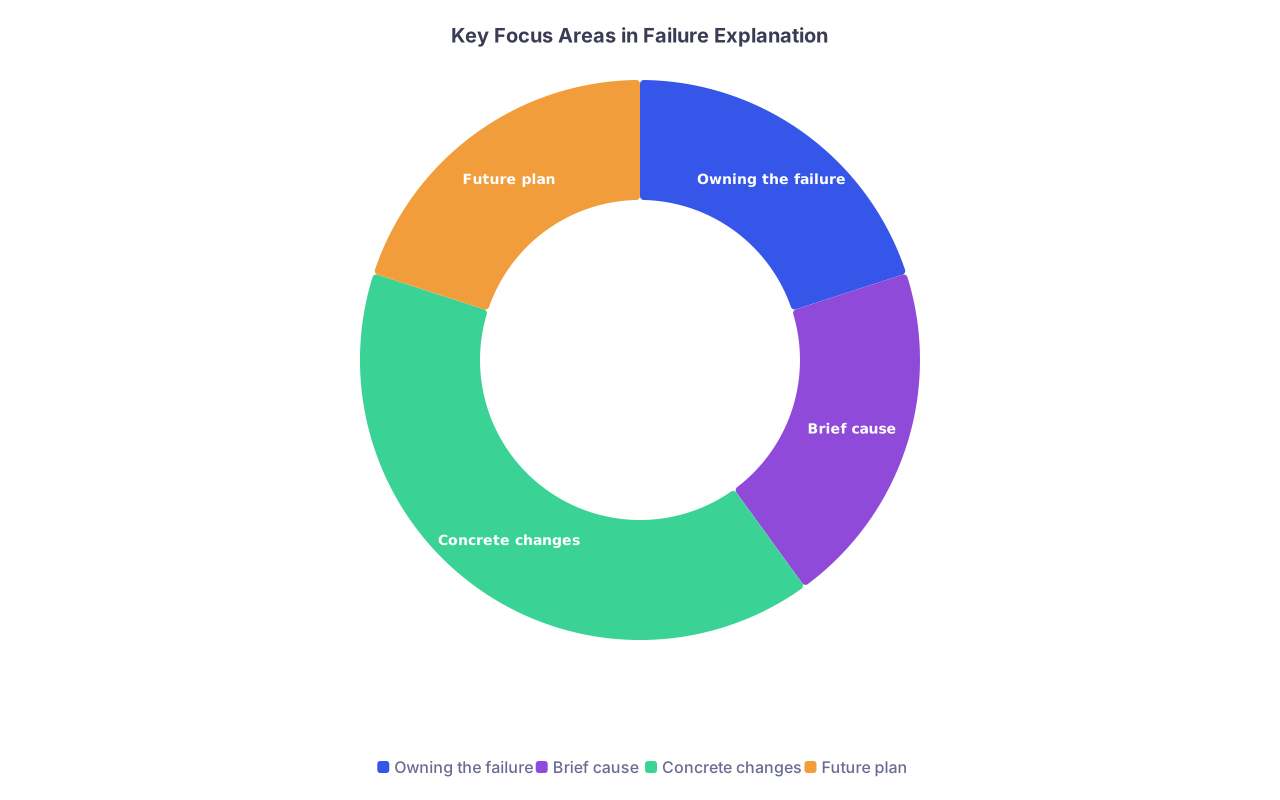
| Category | Value |
|---|---|
| Owning the failure | 20 |
| Brief cause | 20 |
| Concrete changes | 40 |
| Future plan | 20 |
A simple structure to explain your failure
Keep it brutally concise. Example for a failed Step 2 CK:
Own it without drama
“I failed Step 2 CK on my first attempt.”Give a brief, specific cause (not an excuse)
“I underestimated the exam and spread myself thin between rotations, family obligations, and studying. My study plan lacked structure and high-yield practice.”Describe concrete changes you’ve already made
“Since then, I’ve:- Completed a structured UWorld-based study plan with weekly faculty check-ins.
- Increased my practice scores from the low 200s to consistent mid-230s on NBME practice exams.
- Built a weekly schedule that protects focused study time and tracks progress.”
State your future plan clearly
“I am scheduled to retake the exam on [date] and am on track to pass. I understand the seriousness of this failure and have already changed how I study and how I ask for help.”
You don’t ramble. You don’t cry in the explanation. You stay matter-of-fact. Then you pivot back to your clinical strengths, teamwork, and reliability.
5. SOAP Week: Hour-by-Hour Priorities
SOAP isn’t just “submit and pray.” The candidates who claw their way into spots are:
- Fast
- Organized
- Annoyingly persistent (but respectful)
Here’s how to think about the actual SOAP window.

| Step | Description |
|---|---|
| Step 1 | Unmatched and in SOAP |
| Step 2 | Meet with Dean or advisor |
| Step 3 | Build realistic program list |
| Step 4 | Update personal statement and CV |
| Step 5 | Submit SOAP applications |
| Step 6 | Prepare 3 concise failure explanations |
| Step 7 | Monitor email and phone constantly |
| Step 8 | Immediate schedule and confirm |
| Step 9 | Follow up with programs via coordinator |
| Step 10 | Short targeted thank you email |
| Step 11 | Adjust expectations and expand list if allowed |
| Step 12 | Rank programs realistically |
| Step 13 | Await SOAP offers |
| Step 14 | Interview invite? |
Before applications open
Draft 2–3 versions of a short updated personal statement tailored to:
- IM/FM/Peds
- Psych/Neuro/PM&R if relevant
- Prelim/TY focusing on your work ethic and being a solid team member
Prepare a 1–2 paragraph email template you can customize quickly to programs for:
- Expressing interest
- Briefly addressing the board failure
- Highlighting one or two specific reasons you’d fit their program (location, patient population, mission)
Get your phone and email situation under control:
- Voicemail set up, box empty
- Professional VM greeting
- Email notifications on
- Calendar clear enough to drop everything for a same-day interview
While applications are live
You are doing three things in parallel:
Submitting and double-checking applications
- No typos. No wrong specialty labels. No missing experiences.
- Make sure your exam status is accurately reflected (do not “forget” to check the failed attempt).
Coordinating with your school
- Ask if they can make any calls on your behalf to key programs.
- Provide them a short “talking points” sheet: your strengths, what you’re looking for, how you’re handling the failure.
Preparing for rapid-fire interviews
- You will not have time for a 3-day deep dive on each program.
- Have a generic but solid interview framework ready (we’ll get to that next).
6. Interview Strategy When You Have a Board Failure and No Leverage
You are not interviewing like a top-of-class, 260-260 applicant. You are interviewing like someone who needs to prove they’re a safe, low-drama, high-work-ethic choice.
Programs will be asking themselves:
“If we take this person, are we going to regret it? Or did we just get a humble, hardworking resident other programs overlooked?”
Your job is to make them feel relieved they invited you.

Core talking points you must nail
You should be able to answer, cleanly and consistently:
“Tell me about yourself.”
- 60–90 seconds, max.
- Emphasize your path, your clinical strengths, and your interest in that specialty.
- Do not launch into the failure story here.
“What happened with your exam?” (or “I see you had a failed attempt—can you tell me more?”)
Use the 4-part structure above. No improvising. No oversharing.“Why our program?”
- Have 2–3 specific, program-based reasons:
- Community they serve
- Their patient population (rural, underserved, urban, immigrant)
- NICHE: osteopathic focus, community-integrated, heavy outpatient, strong teaching culture
- Everyone says “I love your focus on education.” You need to sound like you read their website and rotations list for at least 10 minutes.
- Have 2–3 specific, program-based reasons:
“Tell me about a time you struggled or failed.”
Do not re-tell your board failure here if you’ve already addressed it. Use a different story that shows growth, accountability, and resilience.
Behaviors that help offset your red flag
- Calm, steady tone. Not robotic, not frantic.
- Clear examples of reading ahead, staying late, helping the team without whining.
- Stories that show you don’t get defensive when corrected.
- A very realistic attitude: “I know I am not the strongest paper applicant, but I know how to work, learn, and contribute.”
After a SOAP interview, if they seemed even mildly interested, a short thank-you email is fine:
Subject: Thank you – [Your Name], SOAP Applicant
Dear Dr. [X],
Thank you for speaking with me today about the [Specialty] position at [Program Name]. I appreciated learning more about your residents’ role in [specific detail].
I remain very interested in the opportunity to train at [Program Name] and would be grateful for the chance to contribute to your team.
Sincerely,
[Name, AAMC ID]
Done. No novels. No emotional begging.
7. Parallel Track: If You End Up Unmatched After SOAP
This is the part no one wants to talk about during SOAP week. You need a shadow plan.
My rule:
Hope for SOAP, prepare as if it will not happen, so you’re not starting from zero if you don’t match.
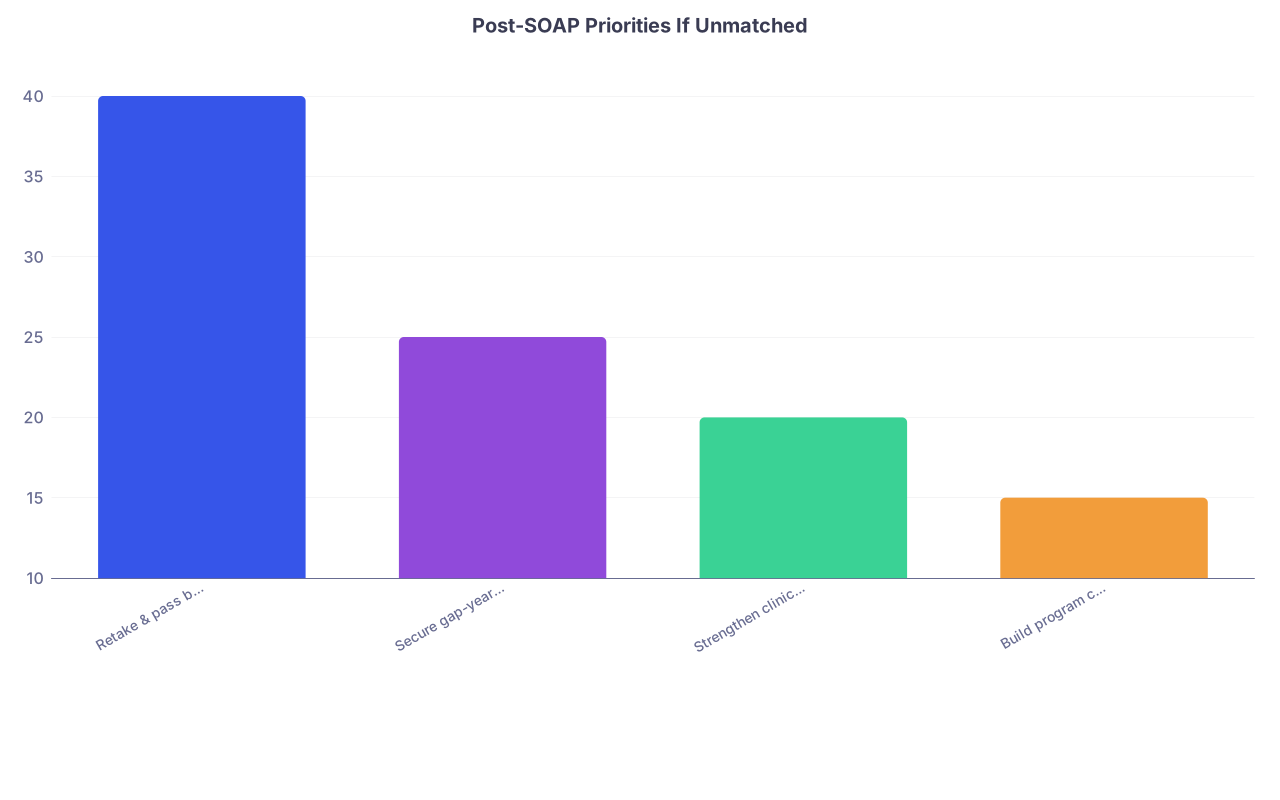
| Category | Value |
|---|---|
| Retake & pass boards | 40 |
| Secure gap-year position | 25 |
| Strengthen clinical exposure | 20 |
| Build program connections | 15 |
If Thursday hits and you don’t have an offer, you shift immediately to:
Board retake plan (non-negotiable)
- This becomes your full-time job until you pass.
- You need a documented, structured remediation plan:
- Faculty or tutoring support
- Weekly progress checks
- Practice scores tracked and improving
- Programs next cycle will ask, “What changed?” You want a clean, data-backed answer.
Meaningful gap-year work
You do not want: “random scribe job with no supervision or growth.”You want roles like:
- Research assistant with clinical exposure, especially in your target field
- Clinical instructor / simulation aide at your med school
- Hospital-based job that gives you letters from physicians (not just admin)
- Preliminary or non-ACGME fellowships in some cases
Targeted networking for next cycle
- Email programs where you interviewed or had any interest this cycle.
- Tell them you’re remediating, retaking, and interested in applying in the next season.
- Ask if there’s any way to do an observership / research / volunteer role with them.
Clean, professional narrative
Your story for next year can’t just be “I failed and it sucked.” It has to be:- I failed.
- I fixed my approach.
- I passed.
- I spent the year proving I am teachable, reliable, and prepared.
8. What Not to Do (The Stuff That Quietly Destroys Your Chances)
Let me be blunt. I’ve watched people tank their trajectory not because of the failure itself, but because of how they handled the weeks after.
Avoid these:
- Lying or “forgetting” to disclose a failed attempt. This ends careers. Programs can and will find out.
- Over-explaining or trauma-dumping in interviews. You’re not in therapy; you’re at a job interview.
- Arguing with programs about their concerns. If they say, “We’re worried about in-training exams,” you respond with your plan and data, not defensiveness.
- Soap-opera emails (“This is my dream, I’ll do anything, my life is over if I don’t match”). You look unstable, not dedicated.
- Ignoring your mental health to “grind.” Burned-out, panicked residents are not attractive hires. Get support—counseling, peers, whatever you can access.

9. The Hard Truth and the Real Opportunity
Failing a board exam and landing in SOAP is a real hit. You’re not imagining that. Some doors are closed. Some are just harder to push.
But here’s the part no one advertises:
Programs that are willing to take you already know you’re not a perfect-on-paper candidate. They are looking for humility and work ethic. If you show up like a slightly bruised but honest adult who learns fast and shows up early, you can absolutely build a solid career from a SOAP match.
Plenty of attendings started from:
- Community FM in nowhere-ville
- Categorical IM after a prelim year
- SOAP into TY, then switching next year
You’re not done. You’re just not taking the brochure path.
Do this today:
Open a blank document and write three things:
- A 4–5 sentence explanation of your board failure using the structure above.
- A realistic SOAP target list of 2–3 specialties you’re actually willing to train in.
- The name of one person at your school you will email or call today to review your SOAP strategy.
Then send that email. That single move will do more for your future than another hour of staring at your score report.