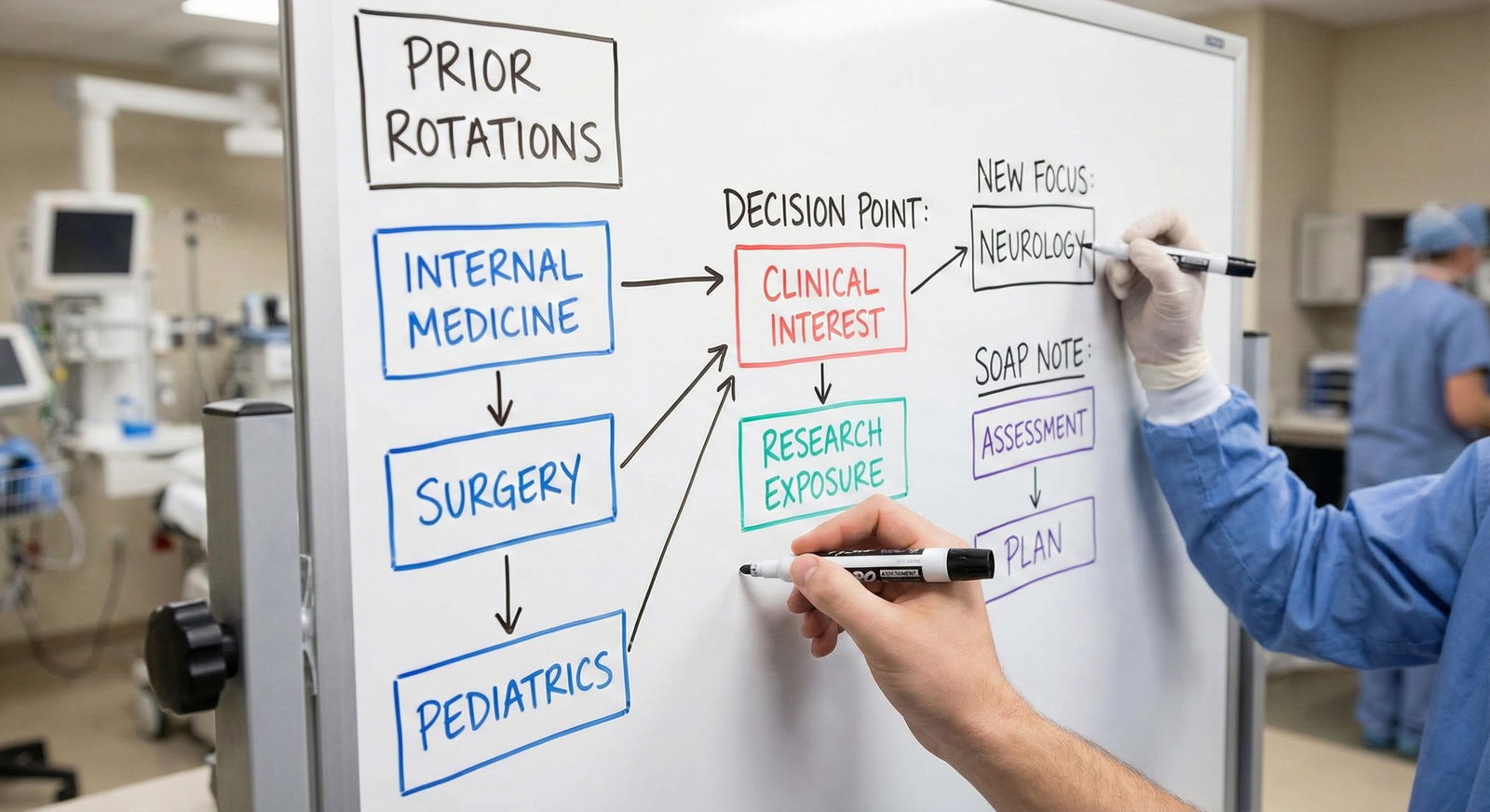
It is Monday of Match Week, 10:59 a.m. Eastern. You are staring at the NRMP screen that will tell you if you matched. Your phone is face down. Your co‑students are pretending to make small talk in the lounge.
11:00 a.m. You did not match.
At this point you do not need motivation. You need a clock. SOAP is about to compress all your decision‑making into a brutal 48–72 hour window. The single most dangerous mistake I see? Clinging to your original specialty too long, and pivoting when it is already mathematically over.
Here is a time‑sensitive framework. Day by day, hour by hour. When to hold your specialty line. When to widen it. And when you must pivot.
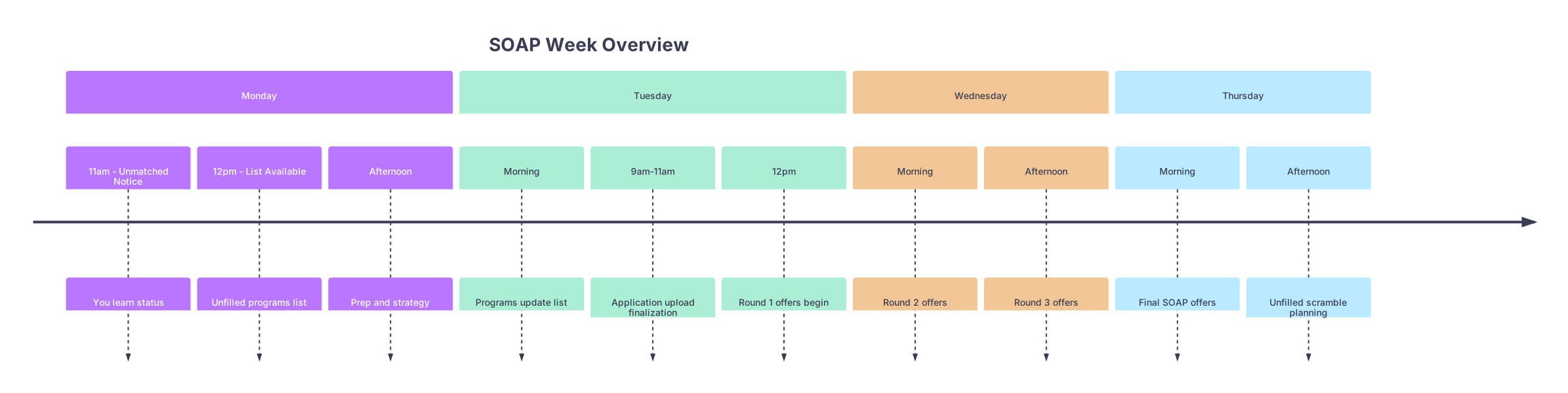
Big Picture: The SOAP Time Box (Monday–Thursday)
First, anchor the actual calendar. You cannot make smart pivot calls if you do not know exactly when the doors open and close.
| Period | Event |
|---|---|
| Monday - 11am - Unmatched Notice | You learn status |
| Monday - 12pm - List Available | Unfilled programs list |
| Monday - Afternoon | Prep and strategy |
| Tuesday - Morning | Programs update list |
| Tuesday - 9am-11am | Application upload finalization |
| Tuesday - 12pm | Round 1 offers begin |
| Wednesday - Morning | Round 2 offers |
| Wednesday - Afternoon | Round 3 offers |
| Thursday - Morning | Final SOAP offers |
| Thursday - Afternoon | Unfilled scramble planning |
NRMP adjusts some exact times year to year, but the structure is consistent:
Monday
- 11:00 a.m. – You learn you did not match / partially matched.
- 12:00 p.m. – List of unfilled programs opens.
- Rest of day – You revise ERAS, build your SOAP list (up to 45 programs), contact advisors.
Tuesday–Thursday
- Several SOAP “offer rounds” in defined blocks.
- Between rounds you either:
- Accept an offer and you are done.
- Or you re‑target / reshuffle and hope for the next round.
Your specialty pivot decisions live inside this box. You do not have weeks. You have… basically a day to decide your strategy, and a few brief pauses between offer rounds to admit reality and adjust.
Phase 1: Monday 11:00 a.m. – 12:00 p.m. — Shock, Then Triage
You see “You did not match.” For about 10–20 minutes, you will not be capable of rational planning. Fine. Take those minutes. Then immediately switch to triage mode.
At this point you should:
Clarify your actual situation
- Fully unmatched?
- Prelim only? (e.g., you matched prelim surgery but not categorical)
- Advanced only? (rare in SOAP context, but matters)
- Did you withdraw from some specialties midway?
Pull your numbers
- Step 1 (pass/fail but still used informally), Step 2 CK score.
- Class rank/quartile or MSPE language.
- Number and type of failed courses or repeats.
- Red flags: professionalism issues, LoR gaps, big time off.
Identify your primary specialty goal
- What did you apply to in the main Match?
- How many interviews did you get?
- How many ranked programs?
If you applied to derm with a 225 and no home program and ranked 3 places… you already know the answer. You are not SOAPing into derm.
If you applied to family medicine with 12 interviews and still did not match, there is a different problem, and you may still have realistic FM SOAP chances.
You do not pivot yet. But you are about to decide how pivot‑ready you need to be.
Phase 2: Monday 12:00 p.m. – 2:00 p.m. — Read the Unfilled List Like a Hawk
At noon Eastern, the unfilled programs list drops. This is the single most important document for your pivot decision.
At this point you should:
Scan for your specialty first, but fast
- Count unfilled positions in your specialty.
- Identify program types:
- University vs community.
- Geographic spread.
- Categorical vs prelim/transition.
- Compare to your competitiveness.
Do a quick reality check by specialty
Here is a brutally honest rough sense of SOAP competitiveness:
| Specialty | Typical SOAP Feasibility | Comment |
|---|---|---|
| Dermatology | Nearly zero | Do not plan on SOAPing in |
| Ortho/Neurosurg | Nearly zero | Outliers only |
| ENT/Urology/Plastics | Nearly zero | Assume no SOAP path |
| EM (recent cycles) | Very limited | Highly variable by year |
| Diagnostic Radiology | Very limited | Some chances with strong metrics |
| Anesthesiology | Limited but possible | Depends on year and score |
| Internal Medicine | Good | Major SOAP target |
| Family Medicine | Very good | Most reliable |
| Pediatrics | Good | Often many open spots |
| Psychiatry | Getting tighter | Some SOAP chances, not many |
| General Surgery | Limited categorical | More prelim than categorical |
If your chosen specialty shows few positions and they are all in highly desirable locations (California, East Coast big cities, big‑name academic centers), your odds are bad unless you are an extremely strong candidate.
- Classify yourself into one of three buckets
Bucket A – Hold the line
- Your specialty has lots of SOAP positions (e.g., IM, FM, Peds).
- Your application is at least average for that specialty.
- You are relatively clean academically.
Bucket B – Dual strategy
- Your specialty has some spots, but not many.
- You have borderline stats or red flags.
- You are willing to train in a more broadly available field (IM/FM/Prelim) if needed.
Bucket C – Pivot‑dominant
- Your specialty has almost zero unfilled positions.
- Or your application is far below the usual threshold.
- You need a realistic path to being a physician at all this cycle.
By 2:00 p.m. Monday, you should know which bucket you are in. If you are in B or C, you must start planning a real pivot now, not “if things go badly tomorrow.”
Phase 3: Monday 2:00 p.m. – 6:00 p.m. — Build Your SOAP List and Pivot Options
This is the core work block. You will build your ERAS SOAP list (up to 45 programs). Your pivot decisions are encoded in how you allocate those 45 slots.
At this point you should:
1. Decide your primary vs backup specialties
For each bucket, here is a concrete pattern that usually works:
Bucket A – Hold the line (no pivot yet)
- 70–90 % of your 45 slots: your original specialty.
- 10–30 %: closely related or prelim options.
- Example: Categorical IM + a few Transitional Year / Prelim IM.
Bucket B – Dual strategy (soft pivot)
- 40–60 %: your original specialty.
- 40–60 %: a more attainable specialty.
- Common pivot: EM → IM, Surgery → Prelim + IM/FM, Psych → IM/FM, Rads → IM.
- Goal: You give your original specialty a shot, but you have real volume in the backup.
Bucket C – Pivot‑dominant (hard pivot)
- 10–20 %: original specialty “hail Mary” if you must.
- 80–90 %: pivot specialty (IM / FM / Peds / Psych / Transitional / Prelim).
- Your main job now is to match into something, build a record, and reposition later.
2. Choose realistic pivot specialties
This is where people get delusional. A realistic SOAP pivot specialty has:
- Open seats on the unfilled list.
- A track record of filling SOAP spots with broad ranges of applicants.
- Training that will not trap you if you later reapply or switch.
Concrete examples that usually work:
- Surgery applicant with weak Step 2:
- Pivot to: Prelim Surgery + Prelim IM + Categorical IM.
- Derm/Ortho/ENT/Neurosurg aspirant with weak numbers:
- Pivot to: IM, FM, Peds, or possibly path depending on your interests.
- Psych applicant in a tight year:
- Pivot to: IM, FM, Peds, with long‑term plan to re‑enter psych if truly committed.
Do not pivot from derm to rads to gas thinking they are all “competitive but a bit easier.” That is not how SOAP behaves. By SOAP, the higher‑prestige specialties are functionally closed for the vast majority of applicants.
3. Adjust your documents to match the pivot
You do not have time to write masterpieces. You do have time to avoid obvious mismatches.
At this point you should:
Create one additional personal statement aligned to your pivot specialty:
- If your main PS is 100 % neurosurgery, write a new one for Internal Medicine or FM.
- You can keep general themes (patient care, continuity, critical thinking), but change the specialty language and examples.
Re‑label or reorder experiences:
- Promote generalist strengths: continuity clinic, primary care electives, leadership, teaching.
- Downplay hyper‑subspecialty neurosurg‑only flavor unless it genuinely translates.
You have limited time, but you can produce a solid, specialty‑appropriate statement in 1–2 hours. That is worth it.
Phase 4: Late Monday Evening – Reality Check with Mentors
Around 6–9 p.m. Monday is when programs are reviewing, and you should already have your main SOAP list mostly assembled. Now you sanity‑check.
At this point you should:
Run your plan by two people minimum
- A dean or advising dean.
- A trusted faculty member in your pivot target specialty, not just your original one.
Ask three blunt questions
- “Given the current unfilled list, would you take my stats for this specialty?”
- “Is my primary specialty strategy delusional, borderline, or reasonable?”
- “If I were your own student or kid, how would you split my 45 slots?”
If both advisors independently say, “You need to dedicate most of your list to IM/FM,” and you are still planning to send 40 applications to neurosurgery… you are not listening.
This is your last good window to re‑weight your list before Day 2.
Phase 5: Tuesday Morning – First Program Responses and Micro‑Pivots
By Tuesday morning, programs have seen your application. Some will do brief phone or Zoom screens. Others will not interact until offers. But signals start to appear.
At this point you should:
- Track contact patterns
- Are you getting calls/emails from your original specialty?
- Or are all early nibbles from the pivot specialty?
If you applied to 25 IM and 20 EM programs and by late Tuesday morning every contact is IM, that is data. EM has probably moved on.
- Prepare for the first offer round
- Know your priority order:
- “If I get an IM offer at X and a prelim at Y, I will take X.”
- Decide ahead of time how willing you are to take a pivot specialty if your dream specialty appears unlikely.
- Know your priority order:
The most painful mistake I see: people decline a realistic pivot offer in Round 1 waiting for a fantasy original‑specialty offer that never comes. Then Round 2 and 3 bring nothing.
Phase 6: Between Offer Rounds — When to Hard Pivot
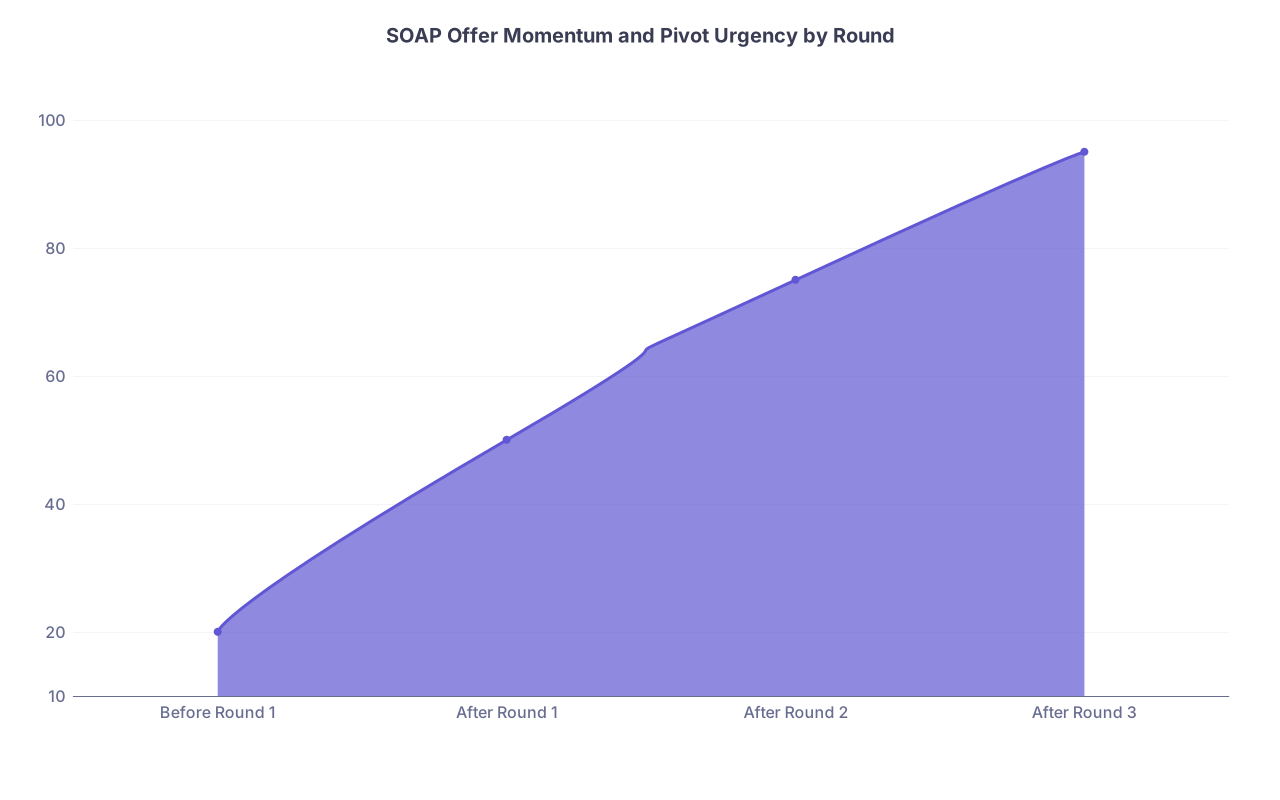
This is the real decision point. After each SOAP offer round, there is a short gap. This is when you must re‑evaluate.
| Category | Value |
|---|---|
| Before Round 1 | 20 |
| After Round 1 | 50 |
| After Round 2 | 75 |
| After Round 3 | 95 |
Think of “pivot urgency” as the percentage of people who should have already pivoted if things are going badly.
After Round 1 (Tuesday)
At this point you should:
If you got no interviews/calls/offers in your original specialty and:
- You are in a competitive field (Ortho, Derm, ENT, etc.) → You are done for that specialty this year. Period. Hard pivot to IM/FM/Peds/Prelim if any options remain.
- You are in moderately competitive fields (Psych, Anes, EM in a tight year) → Move most of your remaining hope to a pivot.
If you got interest and maybe one or two low‑tier offers in your original specialty:
- Decide if that offer is acceptable long‑term (location, support, vibe).
- If yes, take it. SOAP is not the moment for fantasy geographic preferences.
- If no, you must be brutally honest about the risk of ending unmatched.
After Round 2 (Wednesday morning)
By now, it is almost too late to cling to a failing strategy.
At this point you should:
- Accept that lack of any offers or interviews from your original specialty across two rounds is a near‑certain “no” for this year.
- If you still have pivot options on the table, aggressively prioritize them.
- If there are only prelim / transitional offers, strongly consider them:
- A good prelim year (especially in IM or surgery) can keep you in the game for a reapplication.
After Round 3 (Wednesday afternoon)
This is where fear drives bad decisions. People will decline prelim or IM offers, convinced that Thursday will magically bring a categorical match in their dream field. It almost never does.
At this point you should:
- Assume Round 3 is your last meaningful chance at a stable match.
- Only decline an offer if:
- You have a clearly better offer in hand, not hypothetical.
- Or you have a well‑supported plan to reapply next year (research year, strong mentor, funding, visas sorted).
By late Wednesday, the rational move for most people whose dream specialty has shown zero interest is to take the best pivot option available.
Phase 7: Thursday – Final Offers and Post‑SOAP Reality
Thursday morning is cleanup. A final, small set of offers, then the SOAP window closes.
At this point you should:
Triage your final options
- Categorical in pivot specialty (IM/FM/Peds/Psych) → Usually yes.
- Prelim only:
- Surgery prelim → Useful if you are genuinely planning surgery or need a clinical year.
- IM prelim → Flexible; keeps options open.
- Transitional year → Great if you still hope for a few different fields.
If you end SOAP unmatched
- You are now in post‑SOAP scramble / next‑cycle planning mode.
- Hard question: Do you reapply in the same specialty or pivot before next September?
- Often, a planned pivot before the next ERAS (with research, new letters, maybe a prelim year) works better than endless reapplications to an unrealistic field.
When You Should Have Pivoted: A Quick Retrospective Framework
To keep this concrete, here is a blunt reference summary.
| Situation | When You Should Pivot |
|---|---|
| Applying to Derm/Ortho/ENT with weak stats | Before SOAP even starts – build IM/FM list mainly |
| No unfilled spots in your specialty on Monday | Monday afternoon – pivot your entire SOAP list |
| 5–10 spots nationwide, you are below average | Soft pivot Monday; hard pivot after Round 1 |
| Moderate specialty, many spots, good stats | Hold line through Round 2, reconsider after |
| Zero contact or interviews by end of Round 1 | Hard pivot for remaining rounds |
| Only prelim/IM/FM interest all week | Accept pivot by Round 3 at the latest |
If you are reading this before Match Week, use it to pre‑decide your thresholds. Do not trust yourself to be completely rational when the screen says “You did not match.”
One More Thing People Forget: Long‑Term Strategy
SOAP feels like the end of everything. It is not. It is just an awful, compressed market.
Two hard truths:
Your long‑term career happiness is more about where and how you train than whether you hit your first‑choice specialty name. A solid IM program where you are supported beats a toxic neurosurgery position you barely scraped into.
A clean, strong year in a pivot specialty (IM/FM/Prelim) can reopen doors. I have seen:
- A prelim surgery intern re‑match into categorical general surgery.
- An IM intern later move into cards or GI and forget they ever mourned ortho.
- A SOAPed FM resident become a respected community proceduralist doing scopes and OB who is very glad they did not keep banging their head against EM.
SOAP is not the place for grandiose “I’ll just keep trying for five years” fantasies. It is the place to secure training, income, and a platform to grow from.
Your Action Step Today
Open a blank document and write three headers:
- “My Original Specialty”
- “My Realistic Pivot Specialty”
- “My Red‑Line Threshold to Pivot (During SOAP)”
Under #3, put specific triggers with times. For example:
- “If there are <10 unfilled spots nationwide in EM on Monday at noon, I will dedicate at least 70 % of my SOAP list to IM/FM.”
- “If I get zero EM interest by the end of Round 1, I will treat EM as closed and accept the best IM/FM offer I receive.”
Write them now, while your head is clear. During SOAP, you will not trust your emotions. You will trust your own pre‑set rules.