
The most dangerous ERAS mistake with a delayed Step 2 CK is doing nothing and “waiting to see what happens.”
You do not have that luxury. Programs move. Filters run. Files get sorted. If your Step 2 CK is delayed this cycle, you have to play offense with timing, not sit on defense hoping the score posts before everyone else hits submit.
I’m going to walk you through exactly how to time your ERAS submission depending on three things:
- When you took Step 2
- How competitive your specialty is
- What’s on your current transcript (especially Step 1 status)
I’ll assume you already know the ERAS basics; I’m not going to waste your time explaining what ERAS is.
Step 1: Get Honest About Your Actual Timeline
First, anchor yourself in reality, not vibes.
Look at three dates:
- Step 2 CK test date
- Prometric “score report date” estimate (usually 3–4 weeks, longer if you hit a known delay period)
- ERAS “application release” date to programs this year
Now ask one question:
Will my Step 2 CK likely be available by the time programs download applications, or will it trail weeks behind?
To make it concrete, here’s a rough pattern based on typical timelines (you need to confirm against the current NBME score release schedule this year):
| Step 2 CK Test Date | Likely Score Release | Visibility at ERAS Release* |
|---|---|---|
| Late June | Late July | Yes |
| Mid July | Mid August | Probably |
| Early August | Early September | 50/50 |
| Late August | Late September | Unlikely |
*“ERAS release” = the date programs can first download apps and most start their initial filter.
If your exam was:
- Before mid-July → your score delay is annoying but probably not catastrophic.
- Mid-July to early August → true gray zone. You need a deliberate strategy.
- After early August → assume your Step 2 CK will not be in your file when programs are initially sorting applications.
Now let’s overlay your situation.
Step 2: Identify Your Risk Category (This Changes Everything)
Your best timing strategy depends heavily on who you are on paper. I’ll split this into realistic buckets.
Category A: Step 1 Pass (no red flags), Solid CV, Competitive but Not Top 1%
Example:
- Step 1: Pass (first attempt)
- Mid B’s/Honors mix, ordinary letters, normal research for the specialty
- Specialty: IM, peds, FM, psych, neurology, prelim medicine, etc. Not derm/plastics/ortho/neurosurg.
If your Step 2 is delayed, you submit on time, with or without it.
Why? Programs in these “mid-competitiveness” specialties:
- Heavily value early applications
- Use Step 2 CK more as a tie-breaker or confirmation, not the entire story
- Often review in waves; you want to be in the first or second wave, not the fifth
So if you’re in Category A and your Step 2 is delayed beyond ERAS release:
You do not hold the whole application hostage waiting for the score. You submit by the recommended “early window” (usually by opening week or within a few days) and let the score auto-update when it posts.
Category B: Step 1 Pass but WEAK Application Without Step 2
This is the “I really need a strong Step 2 to redeem myself” group.
Common patterns:
- Step 1: Pass, but barely; or pass after a close call
- No research in a moderately competitive specialty
- Mediocre or below-average clinical comments
- Specialty: mid-competitive (IM with academic hopes, EM, OB/GYN, anesthesia, etc.)
Here, Step 2 CK might be the only clear “proof” that you’ve turned the corner academically. For you, timing decisions actually matter.
Rule of thumb:
- If your Step 2 is expected within 1–2 weeks of ERAS release, submit on time. Do not delay your entire file over a week or two.
- If your Step 2 is expected 3–5+ weeks after ERAS release, then you need a tiered strategy (I'll outline this in a minute).
Category C: Step 1 = FAIL (then Pass), or Step 1 Missing for IMGs
If you’ve got a Step 1 failure on record, or you’re an IMG whose Step 1 isn’t strong and you’re banking on Step 2, your Step 2 CK is not “nice to have.” It’s your lifeline.
Programs look at you and immediately think:
“Did they fix it on Step 2?”
If your answer is “I will, I promise, just trust me,” that’s a problem.
For Category C, timing strategy is more aggressive and more surgical. You should not blindly submit all programs before Step 2 is in, if most of those programs will auto-screen you out without it.
We’ll do specific playbooks for each category.
Step 3: Understand How Programs Actually See Your File
Here’s the part no one tells you clearly.
Programs typically:
- Download a huge batch of apps as soon as ERAS opens
- Use filters: USMD vs IMG, Step scores, etc.
- Many use Step 2 filters only if present but may still auto-reject if Step 1 is weak and Step 2 is absent
Two key realities:
Once your application is downloaded and tagged “reviewed/rejected,” a later Step 2 score usually does not resurrect it.
There’s no ping that forces them to look again unless a human deliberately does so.But many programs do staged reviewing.
- First wave: strongest applicants early
- Later waves: others, including late-complete files
This is why being early with a partial but acceptable file can still be better than being late with a perfect one—if your base file isn’t a hard no.
Step 4: Concrete Timing Playbooks by Situation
Now the part you actually need: what to do.
Scenario 1: US MD/DO, Step 1 Pass, Took Step 2 by Early August
You’re in good shape.
If your score is expected:
- On or before ERAS release date → Submit on day 1 with USMLE transcript authorized. The score will either be on the file on release or within a few days. You’re early and complete.
- 1–2 weeks after ERAS release → Still submit on day 1. Programs will start seeing your file; by the time many are doing serious holistic review for mid-tier applicants, your Step 2 will appear. You do not try to game this by waiting.
In this scenario, delaying ERAS hurts you more than the missing Step 2 ever would.
What you should do in addition:
- Mention in your personal statement or program signals (where appropriate): “Step 2 CK taken on [date], score pending. Confident performance and eager to share results.”
- Make sure your MSPE and clinical comments are as strong as possible. If Step 2 is slightly late, strong clinical evals offset some anxiety.
Scenario 2: US MD/DO, Step 1 Pass but Weak File, Step 2 After Mid-August
This is trickier.
Say:
- You took Step 2 on August 25
- ERAS release is mid-September
- Expected Step 2 score release: late September or early October
What I recommend in this specific scenario:
- Submit ERAS by the main release date to avoid the “late applicant” label.
- BUT be strategic with how many programs you assign USMLE transcript to immediately.
Tactical move:
- On day 1, submit ERAS + assign USMLE transcript to a core subset of programs you’re most likely to get traction with even without Step 2 (home program, places where you rotated, less competitive programs, community-heavy programs).
- Once Step 2 posts and your score is good, then assign your transcript and apply to a wider set of programs, including more competitive ones.
Why?
You let some programs start reviewing you early, but you don’t burn all your chances at more competitive programs with a half-baked file that’s missing the thing that might redeem you.
This avoids two extremes:
- Not applying at all until October (too late), or
- Applying to 80 programs on day 1 with a file that will be filtered out immediately.
Scenario 3: Step 1 Fail on Record, Step 2 CK Delayed
This is the “do not autopilot” group.
If you have:
- Step 1: Fail → Pass
- Or Step 1: low pass you’re trying to overcome
Programs are going to screen you more strictly. Many will have an internal or explicit rule:
“No Step 2 CK yet + Step 1 fail = do not invite.”
So if your Step 2 release is after ERAS release, do this:
- Submit ERAS on time, but be extremely selective about which programs you send the USMLE transcript to before Step 2 posts.
- Focus early transcript assignment on:
- Home program
- Programs where you did an away rotation / sub-I
- Programs with historically lower score thresholds or that publicly state holistic review
- Once your Step 2 CK comes back and it’s strong (e.g., clearly above that specialty’s informal cutoff), then expand:
- Assign transcript and apply to many more programs that same day
- Email a very short, professional update to a small number of priority programs (especially where you have some connection) noting the improved performance.
On the flip side:
If Step 2 comes back and it’s mediocre or still low, you pivot. You may apply to more community or less competitive programs and adjust expectations fast.
This isn’t fun, but it’s realistic.
Step 5: Specialty-Specific Aggressiveness
Your ability to “wait” even a little depends heavily on specialty.
Here’s the blunt version:
| Specialty Type | Tolerance for Missing Step 2 at Release |
|---|---|
| Hyper-competitive (Derm, Ortho, PRS, NSG) | Very low |
| Competitive (EM, Anes, Rad, OB/GYN) | Low–moderate |
| Mid (IM, Peds, Psych, Neuro) | Moderate |
| Less competitive (FM, Path, PM&R, Prelim) | Higher |
Hyper-competitive specialties
If you’re going into derm, ortho, plastics, neurosurgery, ENT, etc. and your Step 2 is delayed:
- If you already have a stellar Step 1 (old scored system) and a ridiculous CV, you can submit on time and not panic. They already know you’re strong.
- If you need Step 2 to prove you’re not a risk, then waiting long past ERAS release is almost always fatal. These specialties fill interviews early. Very early.
For most of you in these specialties:
Submit ERAS on time; let Step 2 come when it comes; don’t delay your file hoping to magically align everything. If you took Step 2 too late, the damage is already done—don’t make it worse by being late with ERAS too.
Step 6: Handling Programs That “Require” Step 2 CK
Some programs explicitly say: “We require Step 2 CK at time of application” or “We do not review applications without Step 2 CK.”
If your score will be late, you have three choices:
- Skip them. If they’re ultra-competitive or far above your realistic range, this is often the correct move.
- Apply anyway and accept you might be auto-rejected. Sometimes still reasonable if:
- It’s your home program
- You rotated there and have strong advocates
- Time your application to them specifically for after your score posts.
- Submit your general ERAS on time
- Wait to assign that specific program until Step 2 CK is in and the transcript updated
Option 3 is underrated. You don’t have to apply to every single program on day 1. You can hold a few targeted apps back a couple weeks and send a complete file when it matters.
Step 7: What to Actually Click and When (Mechanics)
The mechanics matter. Here’s a concrete sequence that works well when your Step 2 is delayed but you don’t want to be late overall.
Baseline approach (most US MD/DO in non-hyper-competitive specialties)
By ERAS opening / initial release date:
- Finalize and submit ERAS application
- Authorize USMLE transcript
- Apply to the majority of your programs list
When Step 2 CK posts:
- Confirm NBME sent updated score to ERAS (usually automatic within a couple days)
- No need to re-submit application; programs see updated transcript when they re-open your file
“Tiered” approach (weak Step 1, Step 1 fail, or heavy Step 2 reliance)
By ERAS release date:
- Submit full ERAS application (this matters for MSPE integration and timestamp)
- Authorize USMLE transcript, but initially assign it and apply to a smaller, safer subset of programs (maybe 20–40% of your final list)
Once Step 2 CK score is in and is strong:
- Same day:
- Assign transcript to remaining programs
- Apply to the remaining programs on your target list
- Optional: brief update email to a few top-priority programs where you already applied but know they care about Step 2
If score is weaker than hoped:
- You may still expand, but shift more towards less competitive programs and be realistic about interview expectations.
Step 8: What to Say (and Not Say) in Communication
You’re going to be tempted to send long, apologetic essays about your delayed Step 2. Do not.
If you have to acknowledge it (for example, to a PD you know well or a home program), keep it brutally short:
“I took Step 2 CK on [date]; my score is expected [approx date range]. I feel I performed well and will ensure ERAS updates my USMLE transcript as soon as it’s released.”
That’s it. No saga about Prometric, reschedules, illness—unless they directly ask and the story actually helps you (for example, if there was a documented acute illness and you rescheduled responsibly).
Step 9: Red Flags That Should Change Your Plan
There are a few situations where normal timing advice breaks.
You barely passed practice tests and might fail Step 2.
If there’s a real risk of failing, it can be better to delay the test and take a gap year rather than taking it late, failing, and then trying to scramble through this cycle. If you’ve already taken it, you don’t control that anymore—just don’t compound it by being late with ERAS too.Your school’s MSPE will include narrative about exam struggles.
If your dean’s letter is going to subtly scream “academic concerns,” then a strong Step 2 becomes your only shield. For you, I’d lean toward a tiered approach and strongly consider more safety programs.IMG status + late Step 2.
For IMGs, late Step 2 is more dangerous. Many programs filter IMGs hard by Step 2 score. If you’re IMG with a delayed Step 2:- Submit ERAS early
- If your application without Step 2 is weak, strongly consider limiting early applied programs, then expanding once score is in.
Step 10: A Simple Timeline Template You Can Adapt
Here’s a rough planning template you can tweak.
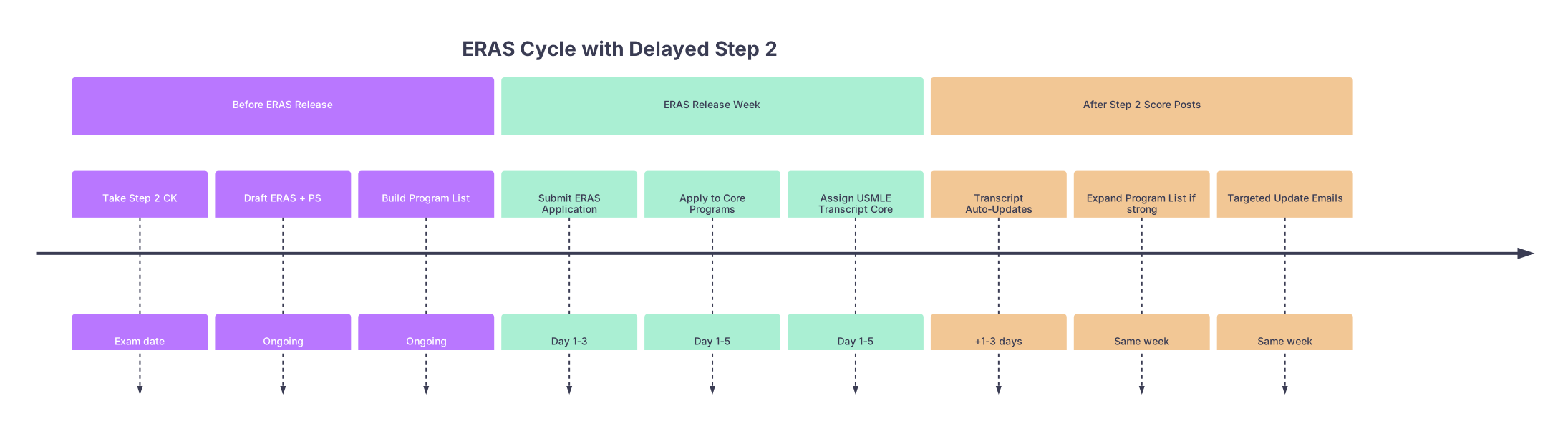
| Period | Event |
|---|---|
| Before ERAS Release - Take Step 2 CK | Exam date |
| Before ERAS Release - Draft ERAS + PS | Ongoing |
| Before ERAS Release - Build Program List | Ongoing |
| ERAS Release Week - Submit ERAS Application | Day 1-3 |
| ERAS Release Week - Apply to Core Programs | Day 1-5 |
| ERAS Release Week - Assign USMLE Transcript Core | Day 1-5 |
| After Step 2 Score Posts - Transcript Auto-Updates | +1-3 days |
| After Step 2 Score Posts - Expand Program List if strong | Same week |
| After Step 2 Score Posts - Targeted Update Emails | Same week |
Modify:
- “Core programs” = home + places you have connections + safer programs
- “Expand” = more competitive or reach programs after you have the Step 2 proof in hand
One More Thing: Don’t Sacrifice Application Quality for One Week of Timing
I’ve seen people rush garbage personal statements, half-baked experiences, and sloppy program lists just to hit “submit” on day 1.
That’s stupid.
If taking 3–4 extra days (not weeks) after ERAS opens means:
- Your personal statement becomes coherent
- Your experiences are actually well written
- Your program list is not random
Then take those days. Being “early” by 72 hours doesn’t outweigh being obviously careless.
But do not drift into “I’ll just wait until my Step 2 comes out in three weeks and then submit everything.” That’s how you end up as the late applicant they never seriously consider.
Key Takeaways
- You almost always submit ERAS on time, even if Step 2 CK is delayed. The exception is not the rule.
- If Step 2 is crucial for you (Step 1 fail, weak file, IMG), use a tiered approach: early app to core/safe programs, expand after score posts.
- Do not burn the entire cycle trying to perfectly align score release with ERAS submission. Perfect timing does not fix a weak application; smart, timely strategy can at least keep you in the game.