
You’re staring at your email at 11:47 p.m. on September 14.
ERAS opens to programs tomorrow. Your application is basically ready… but your situation is not. Your ECFMG certification is still “in progress.” Your USMLE transcript will not be released until a late Step result posts. Or your immigration lawyer just told you your visa category may not be confirmed until November.
Everyone keeps saying: “Submit on time or you’re done.”
You’re thinking: “Should I even bother applying this year?”
Here’s the reality: late ECFMG or visa issues do not automatically kill your match chances, but they absolutely change your ERAS timing and strategy. If you treat yourself like a typical US grad, you will make bad decisions. You’re not in a normal lane. You need a different playbook.
This is that playbook.
First, get brutally clear on your actual constraint
Do not lump “visa + ECFMG stuff” into one vague stress ball. Programs care about specific, concrete things with specific deadlines. You need to name exactly which bottleneck(s) you have.
Common ones:
ECFMG certification delayed
- Missing Step exam result
- Pending verification from your med school
- OET not done or not passed (for the EPIC/OET pathway years)
- Paperwork/ID issues
USMLE transcript / scores delayed
- You just took Step 2 CK late and the score report comes in October
- You’re waiting on a score recheck or irregular behavior investigation
- You failed an exam and are retaking, score won’t come until November/December
Visa status unclear or late
- You need J-1 and haven’t received final sponsorship documentation
- You’re on/need H-1B and Step 3 is not done yet
- You’re on another status (F-1 OPT, etc.) and the transition timing is fuzzy
Each of these affects different parts of ERAS. So your first move is to diagnose precisely what’s missing and what programs actually see.
What programs see, and when it really starts to matter
There’s a lot of mythology around “September 15 or you’re dead.” For IMGs or anyone with visa/ECFMG complications, that’s just not accurate.
Here’s the rough timeline of how programs behave (varies by specialty, but this is what I see repeatedly):
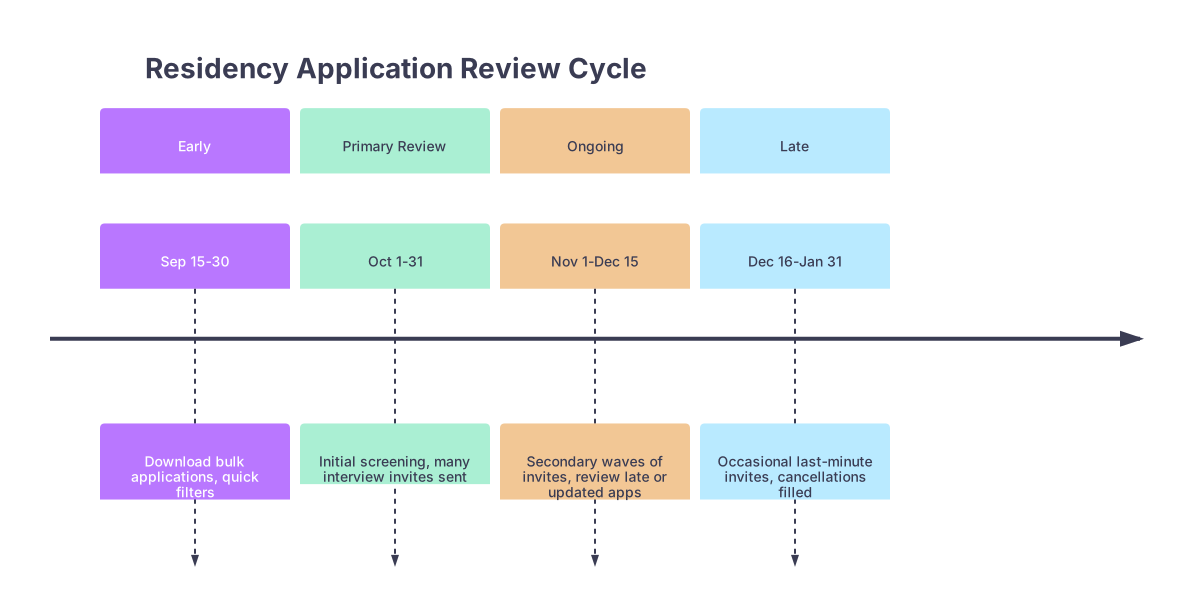
| Period | Event |
|---|---|
| Early - Sep 15-30 | Download bulk applications, quick filters |
| Primary Review - Oct 1-31 | Initial screening, many interview invites sent |
| Ongoing - Nov 1-Dec 15 | Secondary waves of invites, review late or updated apps |
| Late - Dec 16-Jan 31 | Occasional last-minute invites, cancellations filled |
Key things programs care about at different stages:
Early (Sept–early Oct):
- Is the app submitted?
- Are USMLE scores visible?
- Is there at least an ECFMG ID and some sign you’re progressing?
Mid (Oct–Nov):
- Is ECFMG certification likely by rank list time?
- Visa category: does the program sponsor your kind of visa at all?
Late (Dec–Feb):
- Are you fully ECFMG-certified?
- Can you realistically be credentialed and visa-arranged to start by July 1?
So no, you do not need everything perfect by Sept 15. That’s a myth designed for US grads who don’t deal with half the bureaucracy you do.
What you cannot do: still be uncertified and unclear on visa with no realistic plan by late January. That’s how you get dropped even if you somehow get an interview.
Submit timing strategy: apply early vs wait vs skip?
Let’s walk through scenarios. This is where people usually blow it—either panic-submit a half-baked ERAS, or self-eliminate by skipping the cycle when they did not actually need to.
Scenario 1: ECFMG delayed, but scores are in and solid
Example:
- You passed Step 1 and Step 2 CK already
- Your school is slow with primary source verification, or some ECFMG admin step is dragging
- Your ECFMG status: “Certification not yet issued” but exams done
In this situation:
- You should submit ERAS on time (or within 1–2 weeks of Sept 15).
- You list your exams and scores as usual.
- You do not lie about certification; you just indicate the current status.
- In your personal statement or ERAS experiences, you do not obsess about it—but you can add a short line in an email to programs after submitting: “All exams passed, ECFMG certification in progress, expected this fall.”
Programs know ECFMG can be slow. What they care about is: will you be certified before they finalize the rank list and before GME onboarding (March–June).
Your play: apply this cycle, early, like everyone else. The “late” part is in the paperwork, not your ERAS timing.
Scenario 2: Step score pending, but you have at least one passing score
Example:
- You passed Step 1 (if taken before pass/fail transition)
- You just took Step 2 CK in early/late September, score due in October
- You’re an IMG; many programs want Step 2 CK before interview
Here, the trap is waiting to submit until the new score appears. Do not do that.
Your move:
- Submit ERAS as soon as the system allows you (ideally by late September).
- Authorize USMLE transcript release so that when the new score drops, it auto-updates to programs.
- In ERAS, you can list “Step 2 CK: taken on [date], awaiting result” in the experiences or additional comments section if appropriate.
Programs often do an initial filter in late September/early October, but they keep reviewing into November. Your application sitting in their system, “incomplete but present,” is better than not existing yet.
Once your Step 2 CK posts and the transcript updates, many programs will then give your application a second look. Especially community programs and IMG-friendly places.
Scenario 3: You failed an exam and are retaking late
Example:
- Step 2 CK fail in July
- Retake in October or November
- Score not available until November/December
Here’s where timing becomes more brutal, but there’s still a path.
You have three choices:
- Apply this cycle, submit early, accept that early invites will be rare
- Apply this cycle but with a limited list, mainly IMG-friendly/community, and plan on being a “late season” candidate once your pass result posts
- Skip this cycle and fix your profile for next year
When I’d still apply this cycle:
- Your prior scores weren’t disastrous (e.g., Step 1 225, Step 2 failed once but strong prep for retake)
- You can retake by October so scores are back by mid-late November
- You’re financially able to apply to a targeted but decent number of programs (not 300; more like 80–120 well-chosen ones in IM/FM/psych, etc.)
When I’d seriously consider skipping:
- Multiple exam failures
- Retake not scheduled until November or later
- You’re targeting a competitive specialty that already hates red flags (Derm, Ortho, etc.)
- You don’t have the money to waste on a “Hail Mary” cycle
If you do apply:
- Submit ERAS on time. You want your app in their system, clock started.
- In your personal statement or a short email to PDs, own the fail, outline what changed in your prep, and state your retake date. One clear paragraph, not a full sob story.
- Once you pass, email a short update to programs that have not rejected you yet: new score, improved performance, readiness to start.
You’re aiming to catch that November–January window when programs are still filling slots and adjusting interview schedules.
Scenario 4: ECFMG will be very late, but likely before Match
Example:
- You will not be certified until Dec/Jan because of late document verification
- Exams are passed, but paperwork is dragging
- You’re otherwise a reasonable candidate for your specialty
This is annoying but manageable.
Programs care about:
- Can they rank you? (They usually can even if certification is technically pending, as long as you’re on track.)
- Will GME/HR be able to onboard you in time for July 1?
So:
- Again, submit ERAS early. Do not wait for the certification to finalize.
- In your email updates to programs: “All exams passed; ECFMG verification in progress; ECFMG estimates completion by [month].”
- If your med school is the bottleneck, be on them weekly. I’ve seen people lose entire cycles because they were “polite” and waited.
Is it ideal? No. Is it still possible to match? Yes, especially in IM/FM/psych/peds and at IMG-friendly institutions.
Scenario 5: Visa is the main problem
This one splits into two big groups: J-1 and H-1B.
| Factor | J-1 Visa | H-1B Visa |
|---|---|---|
| Step 3 Required | No | Usually Yes |
| Common Deadline | Spring before July 1 | Earlier due to cap/timing |
| Program Flexibility | Higher | Lower, fewer sponsors |
| Impact on ERAS Submit | Usually none | May need later application |
If you need a J-1
Most IMG-friendly programs already sponsor J-1. They do not need your final J-1 paperwork during ERAS season. They need to know:
- You’re ECFMG-certified (or will be)
- You’ve got no obvious immigration ineligibility
- They can process your DS-2019 in time once you match
For J-1:
- Apply on a normal ERAS timeline.
- Use program websites / FREIDA to filter: “Accepts J-1.” Do not waste money on programs that clearly say “No visas.”
- You do not need to delay ERAS for J-1 reasons.
If you’re aiming for H-1B
This gets ugly fast.
Many programs either:
- Do not sponsor H-1B at all
- Or require Step 3 passed before they even consider you
If:
- You do not have Step 3 yet
- And you’re counting on H-1B
- And you’re an IMG
Then your match odds drop significantly unless you’re an exceptional candidate.
Your options:
- Take Step 3 ASAP and get a score back before or during interview season
- Accept J-1 now, deal with waiver later
- Delay the match cycle until your Step 3 and H-1B story are strong
Let me be blunt: most people in this exact spot overestimate how many H-1B-friendly programs will look at an IMG with no Step 3. They apply broadly, spend thousands, and get 1–2 interviews at best.
If you’re set on H-1B and can’t get Step 3 done before October/November, I would seriously consider:
- Doing observerships, research, or prelim year alternatives
- Then reapplying next year with Step 3 done and a stronger US profile
If you’re open to J-1, your ERAS timing doesn’t change. You just filter your program list aggressively.
Choosing where to apply when you’re late or “complicated”
If your paperwork is messy or late, you can’t afford a fantasy list.
You should be strategically biased toward:
- Community programs
- University-affiliated community programs (e.g., “X Hospital / Y University” IM programs that take a lot of IMGs)
- Programs with a clear history of interviewing/certifying IMGs and sponsoring visas
Skip or heavily de-prioritize:
- Purely university, big-name academic programs (unless your profile is stellar)
- Programs explicitly saying “Must be ECFMG-certified at time of application” on their site
- Programs with a reputation for filling early and fully from US grads
Where do you find data? Three places:
- FREIDA: filter by “IMG %,” “visa sponsorship,” etc.
- Program websites: check “Eligibility” or “International Applicants” page
- Recent match lists / Reddit / forums: where IMGs with your stats and timing actually matched
If your timing is off (late scores, late certification), you’re fishing in a smaller pond. That’s not fatal, but you have to stop pretending you’re competing in the same lane as a US MD with everything ready on Sept 15.
How late is too late to submit ERAS?
People ask this constantly. Short answer: it depends on specialty and your profile, but here’s how I’d think about it:
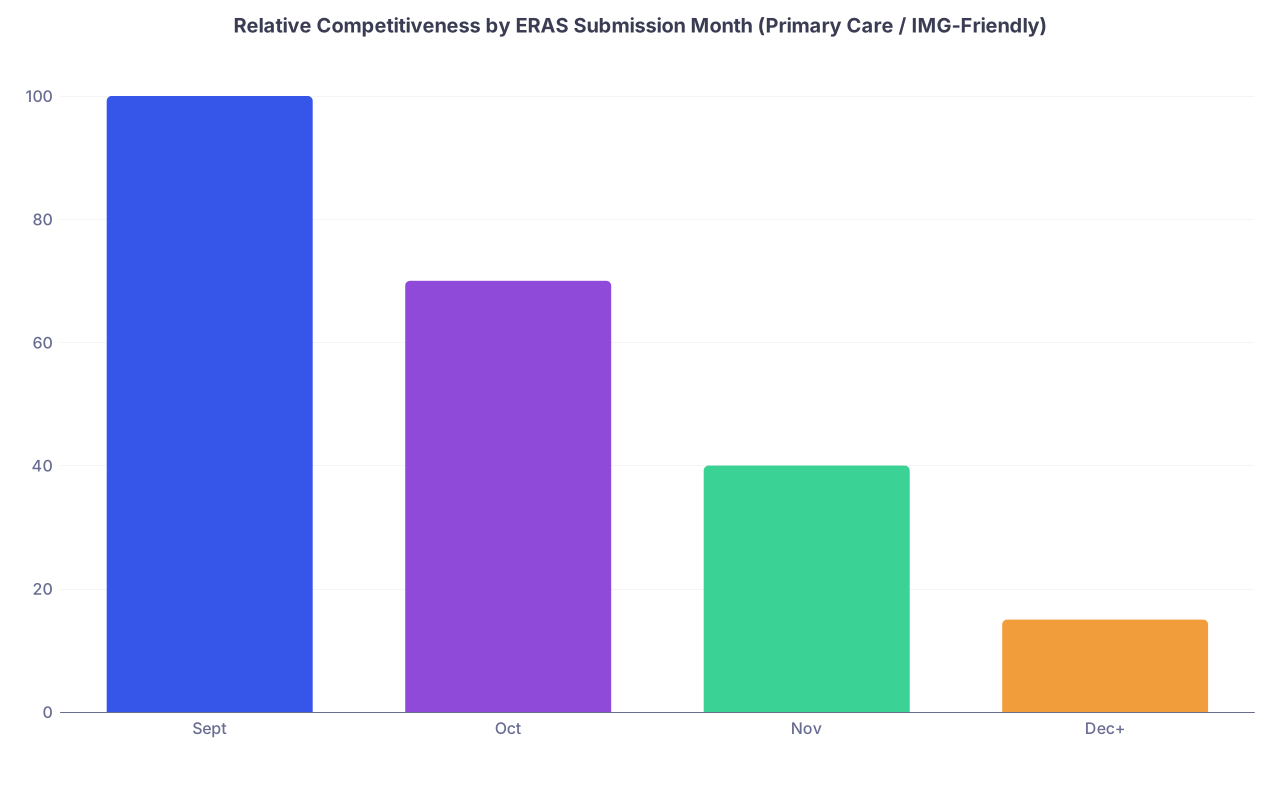
| Category | Value |
|---|---|
| Sept | 100 |
| Oct | 70 |
| Nov | 40 |
| Dec+ | 15 |
Interpretation: for primary care / IMG-friendly specialties, if “full competitiveness” is 100 when you submit in September, here’s roughly how your chances erode if everything else is the same and you only shift the submission month.
My personal cutoffs for IMGs with visa/ECFMG issues:
- Submitting by:
- Sept 15–30: Good. On time enough.
- Oct 1–31: Still fine, especially if your missing piece (score/certification) resolves in Oct/Nov.
- Nov 1–15: Now you are a late applicant. Needs strong reason + strong profile. Worth it only if your newly-available score/cert drastically changes your candidacy.
- After Nov 15: Typically not worth applying fresh, unless you’re in a very niche situation (e.g., SOAP planning, or a specific program told you to apply even if late).
If you already submitted in September/October and your score/certification becomes available later—that’s different. You’re not “submitting late”; you’re updating an existing application. That’s far better.
How to communicate updates without annoying programs
You’re going to be tempted to blast every program with every micro-update. Do not.
Here’s a sane, professional structure:
Submit ERAS first.
Wait until you have a substantive update:
- New Step score posted
- ECFMG certification granted
- Visa-relevant progress (e.g., Step 3 passed, now H-1B eligible)
Send a short, targeted email to the program’s main residency email (not 50 individual faculty) with:
- Subject: “ERAS Application Update – [Your Name], [Specialty]”
- 3–5 sentences max:
- Who you are (name, AAMC ID, applicant type)
- What’s new (specific score / certification granted / date)
- One line reaffirming interest in the program
- That’s it.
Example:
Dear Dr. X and Residency Selection Committee,
My name is [Name], an IMG applicant to your Internal Medicine program (AAMC ID: XXXXX). Since submitting my ERAS application, I have received my Step 2 CK result (242, passed) and my ECFMG certification was issued on [date].
I remain very interested in your program given its strong record of training and supporting IMGs. Thank you for considering my updated application.
Sincerely,
[Name]
Send this once per meaningful milestone. Not weekly. You’re giving them ammunition to reconsider you, not spamming.
When you should seriously consider delaying a whole cycle
Nobody wants to hear this, but sometimes the adult move is to sit a cycle out.
I would lean toward delaying if you have a combination of:
- Major exam red flags (multiple fails, very low scores)
- No US clinical experience and no time to get it before apps
- ECFMG issues that clearly will not resolve until very late (after January)
- Visa requirements that almost no programs can meet (H-1B with no Step 3, for instance)
- Financial strain that makes a “long shot” cycle risky
- Cleanly pass remaining Steps
- Get ECFMG wrapped up early
- Build 3–6 months of strong US clinical or research experience
- Clarify and strengthen your visa pathway
…is often smarter than burning thousands on a cycle where your core problems are still in place.
I’ve seen people match beautifully after doing exactly that. And I’ve seen others grind through 3 failed cycles because they refused to hit pause once.
Today’s move: build your actual timing map
Enough theory. You need a concrete picture for yourself.
Grab a piece of paper (yes, paper) and write three columns:
- Exams / ECFMG
- Visa
- ERAS / Programs
Under each, fill in:
- What’s already done
- What’s pending
- The realistic date each pending item will resolve
Then, for each pending item, answer:
- Will this be done by:
- Oct 1
- Nov 1
- Jan 1
- Match Day (March)
That gives you your real landscape.
Now ask yourself, honestly:
- Can I submit ERAS in September/October with enough substance that programs will at least keep my file alive until my late pieces arrive?
- Or am I trying to patch over fundamental, unfixable issues this cycle?
If, after doing that, you decide to proceed this year:
Your next step today:
Open your ERAS application and set a hard internal submit date (e.g., “Submit by October 5”). Then, list the 10 things you must finish before that date—personal statement finalization, LOR reminders, program list, etc.—and start with the one that scares you most.
If, after this exercise, you realize this cycle is just too weak:
Your next step today:
Email one mentor (or find one—alumni, attending from an observership, etc.), explain you’re considering delaying a cycle because of [specific ECFMG/visa issue], and ask for a 15-minute call to sanity-check your plan. Do not disappear. Build a deliberate “gap year” plan instead of drifting.
Either way, you stop spinning in vague anxiety and move to a specific, timed plan. That’s how you manage ERAS timing when the visa and ECFMG gods aren’t cooperating.