
The panic about a “late” MSPE is wildly overblown—if you handle it correctly.
You are not the first student whose school likes to play games with the MSPE release date. Some schools are meticulous and on time. Others are disorganized, overcautious, or just stuck in a bureaucratic rut that ignores what applicants actually need. You cannot fix your dean’s office. But you can absolutely protect your ERAS timeline and your application.
Let’s walk through what to do if your school releases the MSPE late—or later than most other schools—and how to prevent that from tanking your interview season.
First, understand what “late” actually means
Most students say “late” when they really mean “not early.”
Here’s the reality:
- ERAS opens for applicants to start filling in: usually in June.
- Programs can start reviewing applications: mid-late September.
- MSPEs are released to residency programs on October 1 (or the first business day after) by design.
Your MSPE is always “late” relative to your initial application review. That’s how the system is built.
What really matters is this:
- When does your school finalize and upload your MSPE to ERAS?
- Does your school miss the national Oct 1 release and end up posting your MSPE later than everyone else’s?
Those are not the same problem.
If your school uploads on Sept 28 and it goes out Oct 1 with everyone else? Totally fine.
If your school uploads on Oct 10 and programs cannot see it until then? That can hurt you—especially in competitive specialties.
So the first move: stop using “late” as a vague fear term and get specific.
Ask your dean’s office (in writing, politely but directly):
“On what date will our MSPEs be uploaded to ERAS this year, and will they be included in the national October 1 MSPE release to programs?”
You want a clear statement of:
- Upload date to ERAS
- Whether you’ll be in the Oct 1 release
Everything else you do will depend on that answer.
Map your real risk: specialty + stats + timing
Not every applicant is equally vulnerable to a late MSPE. Some of you will be mildly inconvenienced. Some of you could lose early interview spots if you do nothing.
Here’s the rough hierarchy of how sensitive specialties are to missing/late MSPEs:
| Specialty Type | Sensitivity to Late MSPE |
|---|---|
| Derm, Ortho, ENT, Plastics | Very High |
| Neurosurgery, Urology | High |
| EM, Radiology, Anesthesia | Moderate |
| IM, Peds, OB/GYN | Low–Moderate |
| FM, Psych, Neuro | Low |
Now layer your own profile on top:
If you’re:
- Applying to highly competitive specialties
- With borderline board scores or class rank
- And your home school isn’t a big name in that specialty
…then a late MSPE can matter more, because programs may use every little signal to decide who gets early looks.
On the other hand, if you’re:
- In a less competitive specialty
- With solid or strong scores
- And good letters + early ERAS submission
…a week or two delay in MSPE rarely kills you.
So do this honestly:
- Write down your specialty (or dual-apply specialties).
- Write down your Step 2 score and rough class performance (top/middle/bottom).
- Ask yourself: “Would I be a clear auto-interview at this program if they like my numbers and letters alone?”
If yes, late MSPE is an annoyance. If no, you need to work harder on managing damage and communication.
Your ERAS timeline when the MSPE is late
Your MSPE timing does not change when you should submit ERAS.
You still aim for:
- ERAS application submitted: as early as allowed in September (or whenever ERAS starts accepting submissions that year).
- Letters of recommendation: 3–4 uploaded and assigned by submission or shortly after.
- Personal statement(s), experiences, and program list: all finalized before submission.
Then the MSPE sits in a separate lane. It joins the party on Oct 1…or whenever your school finally uploads it.
Here’s the key:
You should not delay submitting ERAS just because your MSPE is behind.
Programs will start screening your app based on:
- Step 2 score (and Step 1 if available, even if pass/fail)
- Transcript summary (if uploaded)
- Personal statement
- Letters of recommendation
- Experiences and any meaningful research or leadership
They don’t sit around twiddling their thumbs waiting for your MSPE to decide whether to even look at you.
Submit early. Let the MSPE catch up later.
Scenario 1: Your school is on-time for Oct 1 (you’re fine)
This is the “fake problem” scenario that still stresses people out.
What’s happening:
- Your dean’s office says: “We upload in late September. MSPEs go out Oct 1 with everyone else.”
- You think: “But I submit ERAS in early September… programs will judge me without my MSPE…”
Reality: This is standard. This is how it works for everyone. Almost all initial triage happens before the MSPE arrives. Programs know that.
What to do:
- Submit your ERAS application early, as usual.
- Make sure:
- You have at least 2–3 solid specialty-specific letters in by then.
- Your personal statement and experiences actually tell a coherent story.
- Stop worrying about the MSPE in this case. Your energy is better spent:
- Targeting programs wisely.
- Preparing for interviews.
- Cleaning up any red flags elsewhere.
If your MSPE is dramatically out of sync with your application (e.g., it includes a remediation you never contextualized), that’s a different problem—about content, not timing.
Scenario 2: Your school misses the Oct 1 MSPE release
Now we’re in real territory. School tells you, “Our MSPEs will be uploaded October 10” (or later). That means:
- When all other applicants’ MSPEs arrive in program inboxes on Oct 1…
- Yours does not.
- Some programs will flag your application as “incomplete” if they rely on MSPE for certain decisions.
This is where you stop hoping it will be fine and start protecting yourself.
Step 1: Get exact dates and put them on paper
Do not operate off rumors or “I heard from a friend.” Get an email from your Dean’s Office or Student Affairs with something like:
“Our expected MSPE upload date to ERAS this year is October 12. This means your MSPEs will not be available to programs on October 1.”
Once you have this, you can plan. And you have proof if programs ask.
Step 2: Adjust your strategy by specialty
If you’re in:
- Derm, Ortho, ENT, Plastics, Neurosurgery, Urology, EM
You should:
- Assume some programs will start offering interviews before your MSPE arrives.
- Make the rest of your application so strong and complete that they are willing to interview you without it—or at least hold your file for later review.
That means:
- Submit ERAS on day 1 for your cycle.
- Ensure your letters are in early and from credible people in the specialty.
- Use your personal statement and experiences to clearly address any gaps that would normally be clarified by the MSPE (leaves, failures, weird rotations).
If you’re in:
- IM, Peds, FM, Psych, Neurology
You still submit early, but the harm from a late MSPE tends to be smaller. You’ll mostly need to handle communication cleanly (more on that below).
How to compensate for a late MSPE
You can’t create an MSPE yourself. But you can reduce how much programs need it to make decisions.
1. Max out your letters of recommendation
This is your single best defense.
Aim for:
- 3–4 letters already in ERAS by the time programs first see your app.
- At least 2 in the specialty you’re applying for.
- A department chair or equivalent if your specialty strongly prefers/“requires” it.
If your MSPE is late but your letters are strong, some programs will happily move forward.
If you’re weak on both letters and timing, you get pushed to the later pile. That’s where interviews go to die.
2. Use your personal statement strategically
Do not waste the personal statement on generic “I love internal medicine because…” copy.
If there’s anything in your record that would show up in the MSPE and cause concern:
- A leave of absence
- A failed course or shelf
- Rotations moved around for personal reasons
- A disciplinary issue that’s been resolved
You preempt it. Briefly. Calmly. Without sounding defensive.
For example:
“During my second year I took a one-semester leave to address a family health crisis. I returned to full-time coursework afterward and have had no further interruptions. The experience matured me quickly and made me more deliberate about how I spend my time and energy.”
That way, when the MSPE finally shows up and confirms the leave, it’s old news. Programs already heard it from you.
3. Make sure your transcript and experiences are clean and clear
If your school uploads transcripts on time, those give programs some of the MSPE’s function.
You can help by:
- Making your ERAS experiences specific and outcome-focused, so reviewers see evidence of growth and impact.
- Avoiding vague fluff like “I gained valuable skills…” and instead describing what you actually did.
If your grades trend upward after a weak start, highlight that in an experience description or your PS. Do not wait for the MSPE to tell that story.
Communicating with programs about a late MSPE
You can’t spam every program with “My MSPE is late!!” messages. That just annoys coordinators and doesn’t help you.
Here’s how to handle communication like an adult.
When to say nothing
If:
- Your school is on-time for Oct 1, or
- Your MSPE is delayed by less than a week, and
- You’re not in an ultra-competitive field
You usually do not need to email programs about it. They will see it when it arrives. They are used to minor delays and institutional quirks.
When to send a brief explanation
If:
- Your MSPE will be uploaded significantly after Oct 1 (say, more than 7–10 days), and
- You’re targeting competitive specialties or highly selective programs
Then a short, factual note can help, especially to top-choice programs.
You send something like this after your application has been submitted and before or just after Oct 1:
Subject: MSPE Timing – [Your Name], [Specialty] Applicant
Dear [Program Coordinator/Program Director],
I wanted to briefly note that my medical school, [School Name], has informed our class that MSPEs will be uploaded to ERAS on [date], and therefore will not be available on the national October 1 release.
My ERAS application, exam scores, transcript, and letters of recommendation are all complete and available for your review. I remain very interested in [Program Name] and appreciate your consideration of my application despite this institutional delay.
Sincerely,
[Your Name], [AAMC ID]
Short. Professional. No venting about your dean’s office.
You send this only to:
- Your realistic top-choice programs.
- Maybe 10–20 total, depending on your specialty and list size.
Not 80. Not everyone.
Talking to your Dean’s Office without burning bridges
You’re frustrated. That’s normal. But marching into Student Affairs furious usually backfires. You want them on your side.
Here’s how to be direct but not destructive:
Get clarity:
- “What is our exact MSPE upload date to ERAS this cycle?”
- “Will it be part of the national Oct 1 MSPE release?”
Ask about advocacy:
- “For programs that ask about my MSPE, is there a standard letter or template explaining our timeline that I can share?”
- “Would you be willing to send a note to certain programs if needed?”
Request confirmation:
- “Could you please email this timeline to our class, so we have written confirmation if programs ask?”
Some schools will offer:
- A generic explanation letter you can attach or quote.
- A willingness to email specific PDs for students with particularly affected applications.
If they do: use it. Calmly.
If your MSPE is delayed and you have academic concerns
Now we’re dealing with compounded risk. Two categories:
- You have concerning content in the MSPE (failures, professionalism concerns, leaves).
- That MSPE is also delayed, meaning those issues surface later, potentially after some initial screening.
The temptation here is to hope programs don’t notice or that the MSPE will be irrelevant. That’s magical thinking.
Instead:
- You proactively address the major issue once in your personal statement or an experience description.
- You prepare a clear, honest, concise explanation for interviews. Same story every time, no improvising emotional monologues.
- If there’s a true error in the MSPE draft, fight to fix it early with your dean’s office before upload.
A late MSPE with bad content is survivable if the rest of your application and your explanations are strong. I’ve seen people match IM and even anesthesia with remediations, as long as their narrative matches what’s on paper.
What kills applicants is inconsistency: MSPE says one thing, your story says another, and timelines don’t line up.
Managing your own expectations and stress
You will hear classmates say things like:
- “If your MSPE is late you’re screwed.”
- “Programs won’t even look at you without it.”
- “My advisor said I might as well reapply next year.”
Most of that is either:
- Coming from people who don’t understand how programs actually read applications, or
- Advisors using fear to get students to take things seriously.
Look at the actual inputs programs use early:
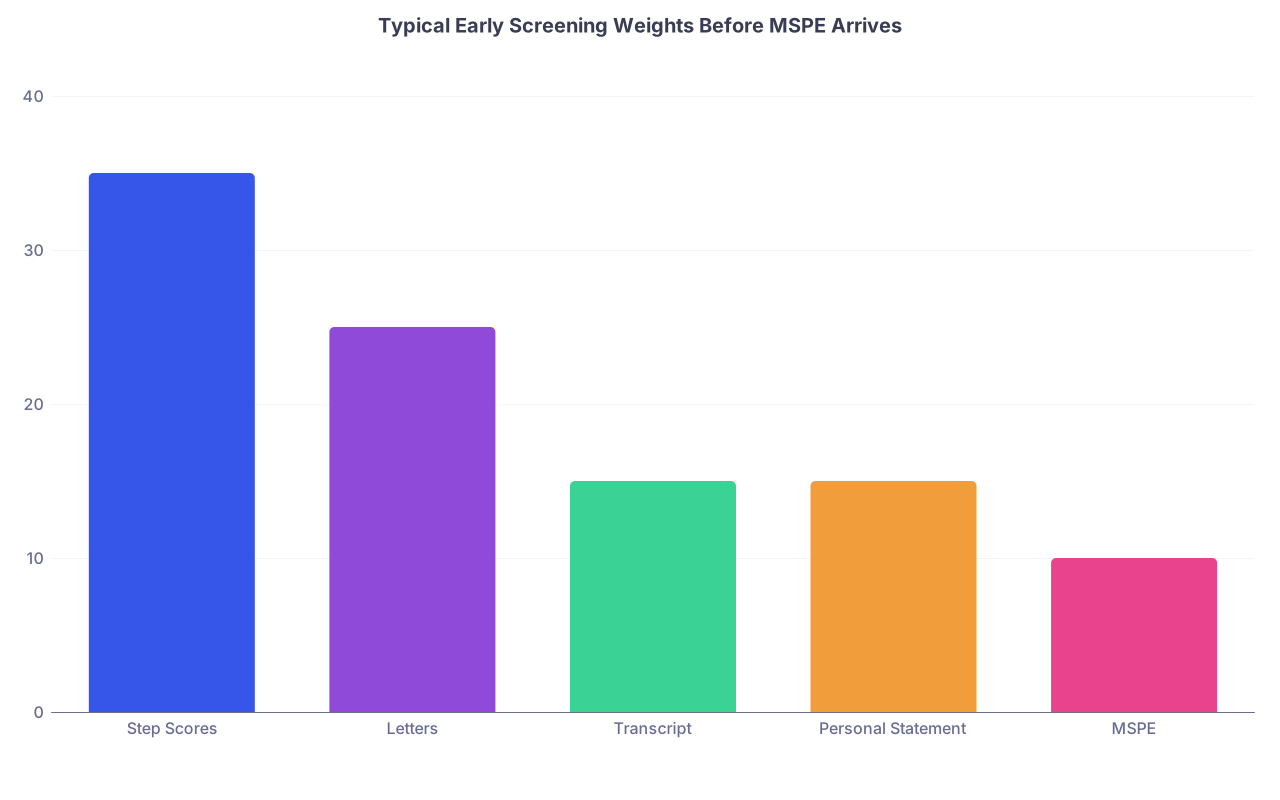
| Category | Value |
|---|---|
| Step Scores | 35 |
| Letters | 25 |
| Transcript | 15 |
| Personal Statement | 15 |
| MSPE | 10 |
Yes, this is approximate. But it reflects reality: the MSPE is a factor, not the factor—especially before Oct 1.
Your job is to:
- Maximize everything that is visible early (scores, letters, ERAS content).
- Minimize surprise in the MSPE by aligning your own narrative with what it will say.
- Use targeted communication—not panic spam—to keep top programs aware of institutional delays.
Do that, and a late MSPE becomes a manageable handicap, not a fatal blow.
A simple action plan if your school is late
If you want the short “do this now” version, here it is.

| Step | Description |
|---|---|
| Step 1 | Confirm MSPE Upload Date with School |
| Step 2 | Submit ERAS Early, Ignore MSPE Timing |
| Step 3 | Competitive Specialty? |
| Step 4 | Submit ERAS Early, Strengthen Letters |
| Step 5 | Submit ERAS Day 1 + Max Letters |
| Step 6 | Address Issues in Personal Statement |
| Step 7 | Email Top Programs Brief MSPE Delay Note |
| Step 8 | After Oct 1? |
If you follow that flow and actually check each box, you’ll be ahead of 90% of your classmates who just sit and stew.
You’re not going to fix your school’s calendar. That fight is bigger than you and will outlast your graduation date. But you can absolutely protect your ERAS timeline from a late MSPE by being earlier, clearer, and more strategic than everyone else.
Handle this well, and by the time interviews are rolling, the MSPE timing will be a footnote in your story, not the headline. From there, your focus shifts to something entirely different: performing on interview day, reading programs as hard as they’re reading you, and building a rank list that actually matches how you want to live. But that’s a problem for a slightly more rested version of you.