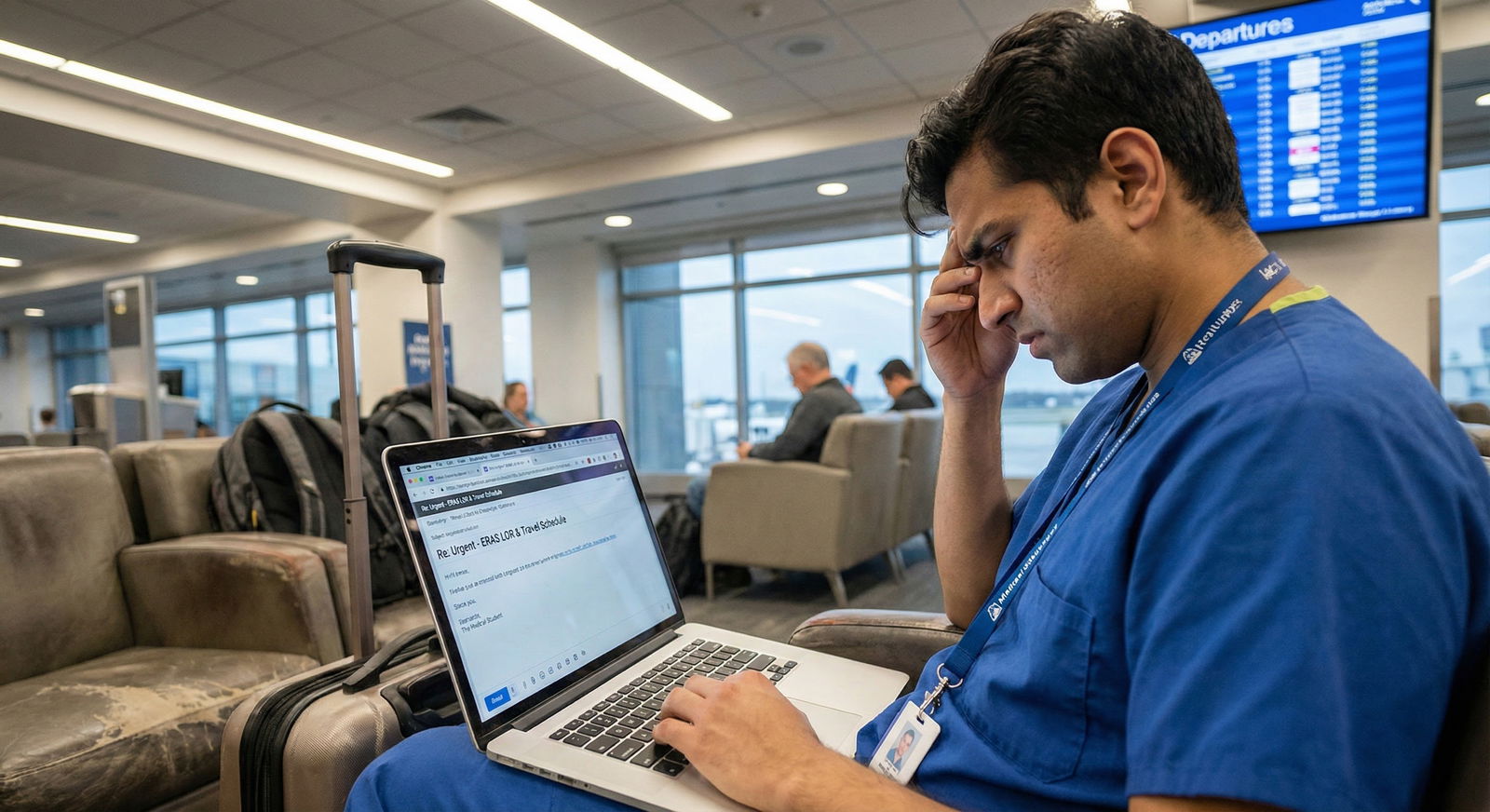
The calendar is not your enemy. Silence from a traveling letter writer is.
If your LOR writer is on vacation, at a conference, or bouncing between time zones while you are staring down the ERAS “Submit” button, you are not in a rare situation. I see this every cycle. And I also see people either panic-submit too late or harass their letter writers into awkward territory. Both options cost you.
Here is how to time your ERAS submission without burning bridges when your LOR writer is out of town, slow to respond, or both.
First reality check: ERAS timing vs LOR timing
Let me cut through the folklore you hear from classmates.
There are two different clocks:
They are not the same.
For most specialties:
- Programs start getting access to apps on the official ERAS release date.
- You want your application submitted by that date or within a few days.
- Your letters do not all need to be in before you hit submit. ERAS lets letters arrive later and programs see them as they get uploaded.
So the question is not “Can I submit without this letter?”
The real question is “For this specific letter and this specific writer, is waiting worth it?”
That depends on:
- How strong this writer is (name, reputation, how well they know you).
- Your specialty competitiveness.
- Your current LOR lineup without them.
- How late “late” actually is.
We’ll walk through specific scenarios. But first, get your mental model straight:
| Item | What Actually Matters |
|---|---|
| ERAS submit date | By program download date or very shortly after |
| LOR upload date | Within first 2–3 weeks after download |
| Number of letters at submit | At least 2–3 uploaded for most programs |
If you are waiting six weeks because a letter writer is “traveling a lot this fall” and you have zero other strong letters, that is a problem. If you have three solid letters already and this is your dream “name” writer who will upload in 10–14 days? Very different story.
Map out your exact situation (no hand-waving)
Most students stay vague: “My chair is away; I’m worried.” That is useless. You need hard data.
Answer these, on paper:
- How many letters do you already have uploaded to ERAS?
- How many are committed but not uploaded?
- For each missing letter:
- Who is the writer? (title, specialty, how well they know you)
- How critical is their letter for your specific specialty? (e.g., EM SLOE vs random internist)
- What exactly do you know about their travel and timeline? (dates, not vibes)
Now plug your situation into something like this:
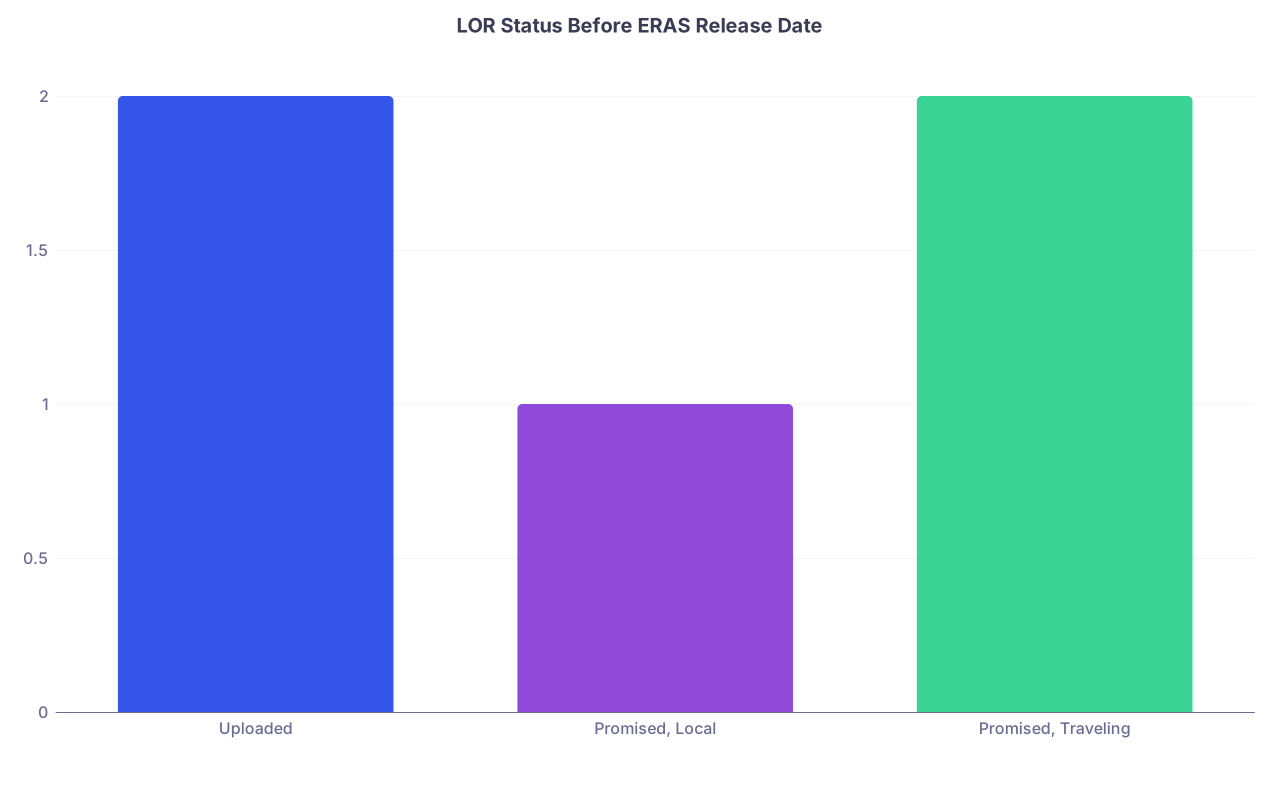
| Category | Value |
|---|---|
| Uploaded | 2 |
| Promised, Local | 1 |
| Promised, Traveling | 2 |
If your “promised, traveling” bucket is where your main specialty letters live, you need a real strategy, not hope.
Scenario 1: Your dream LOR writer is traveling, but you already have 3 letters
This is the easiest situation, yet people stress the most here.
Let’s say:
- You are applying IM.
- You already have:
- One strong IM ward attending letter.
- One sub-I letter.
- One research PI letter.
- Your department chair (traveling constantly for conferences) agreed to write but is “on the road a lot in September.”
What to do:
Submit ERAS on time with your three existing letters assigned.
Do not wait to submit because of one traveling chair. Programs can see your app and the existing letters.Keep the chair letter as a “bonus upgrade.”
Once it arrives, you can:- Swap it into programs where you’re weaker.
- Add it to programs that allow four letters.
Email your chair with a clean, low-friction packet.
This matters because they are traveling.
Here’s a template that works, especially for busy department chairs:
Subject: Residency LOR – [Your Name], [Specialty], Due Date & Materials
Dear Dr. [Name],
Thank you again for agreeing to write a letter on my behalf for [Specialty] residency. I know you are traveling frequently this month, so I wanted to make this as easy as possible.
• ERAS release date: [Date]
• Ideal upload window: [Date range – usually within 1–2 weeks of release]
• Programs: [# of programs], primarily [academic/community, region, etc.]I have attached a brief packet in case it’s helpful:
– Updated CV
– ERAS personal statement
– Short paragraph reminding you of our work together on [rotation/project]
– My AAMC ID: [ID]The ERAS system will send you a link to upload the letter directly. Please let me know if there’s anything else I can provide that would be useful.
Thank you again for your support,
[Your Name]
[Medical school, expected graduation year]
You are not nagging. You are making it easy. Huge difference.
Timing rule in this scenario:
Do not delay initial ERAS submission for this kind of “nice-to-have but not essential” letter, especially if you already have three.
Scenario 2: You need this letter for your specialty and they’re overseas
This is where it gets trickier.
Example:
- You’re applying EM or Ortho.
- You have only:
- One decent letter from an off-service rotation.
- One generic IM letter.
- Your main SLOE or key orthopaedic attending is in Europe for 3 weeks, responding slowly.
Here’s how I’d handle it step by step.
Step 1: Clarify the actual dates
You cannot work off rumors like “they’re traveling a lot.” Get specifics.
Email (brief, focused):
Subject: Quick question about residency letter timing
Dear Dr. [Name],
I hope your travels are going well. Thank you again for agreeing to write on my behalf for [Specialty]. I wanted to clarify timing so I can plan my ERAS submission appropriately.
When do you anticipate being able to upload the letter to ERAS? Even a rough estimate (e.g., “by mid-September”) would be very helpful.
I’ve attached my updated CV and personal statement for reference.
Thank you again for your support,
[Your Name]
If they reply: “I can upload by September 20” and ERAS opens programs’ access on Sept 15?
That’s fine. Submit on time, let the letter follow.
If they say: “Probably October, I’m slammed with travel”?
Now you have a problem, especially in competitive fields.
Step 2: Decide if you need a backup letter
Here is the rule I use:
- If your specialty expects 2+ specialty-specific letters (e.g., EM SLOEs, Ortho, Derm)
- And you won’t have at least 2 uploaded within the first 2–3 weeks after ERAS opens…
- You need a backup.
That means:
- Reach out to another attending who knows you reasonably well.
- Ask for a general support letter to avoid having a single point of failure.
Here’s how to do that without insulting your main writer:
Dear Dr. [Backup],
I’m applying to [Specialty] this cycle and am very grateful that Dr. [Traveling] has agreed to write on my behalf. Because their schedule is very busy with travel in September, I’m hoping to have an additional letter in place so that my ERAS file is not delayed for programs.
Would you be willing to write a letter supporting my application? We worked together on [rotation/dates], and I especially appreciated your feedback on [specific case/skill]. I’d be happy to send my CV, personal statement, and anything else that would be helpful.
I understand this is a busy time of year, so I completely understand if your schedule does not allow for it.
Sincerely,
[Your Name]
You are not saying, “My real writer is flaking,” you are saying, “I need to make sure my app is complete.” That is professional, not disloyal.
Step 3: Don’t threaten timelines in your emails
Do not send emails like, “If I do not hear from you by X date I will need to ask someone else.” That sounds transactional and passive-aggressive unless you have a close relationship and know they’d respond well to that level of directness.
You can think that way in your own head. Just don’t write it.
Scenario 3: You already submitted ERAS and your traveling writer has gone silent
This is common. ERAS is in. Letters are still missing. Writer is “in Switzerland for two weeks.”
Here is how to handle it without being the annoying student everyone talks about at dinner.
Week 1 after ERAS opens to programs
- If you already sent a clear, detailed email pre-ERAS:
Wait. Do nothing. - If you never sent a proper packet:
Fix that now with a single concise email + attachments.
Week 2–3 after ERAS opens
If still no upload and no response, then you send a polite, short nudge.
Subject: Friendly reminder – ERAS letter for [Your Name]
Dear Dr. [Name],
I hope your travels are going smoothly. I wanted to send a brief reminder regarding the residency letter you kindly agreed to submit on my behalf.
Programs have started reviewing applications, so having your letter uploaded in the next week or two would be very helpful. The ERAS system should have sent you a direct link, but I can have it re-sent if needed.
Thank you again for supporting my application,
[Your Name]
Then you leave it. If they upload, great. If they don’t, you shift to backup strategies rather than sending five more emails and ruining the relationship.
Week 4–5 after ERAS opens
If by now your letter is still missing and this writer is not your only hope, emotionally let it go. Reassign your other letters to programs where this one was “planned,” and stop counting on it.
You can keep the door open with a final non-demanding note:
Dear Dr. [Name],
I know this is an especially busy period with your travel and clinical responsibilities, so I just wanted to say thank you again for initially agreeing to support my residency applications.
If you’re still able to submit the letter later in the season, programs will continue to accept updates, but I completely understand if your schedule no longer allows for it.
I really appreciated the opportunity to work with you on [rotation/project], and I’ve learned a great deal from your teaching.
Best regards,
[Your Name]
That message preserves the relationship. No guilt. No pressure.
How late is “too late” for a traveling LOR?
This is where people get surprisingly irrational.
Here is the general window I’ve seen work across many cycles:
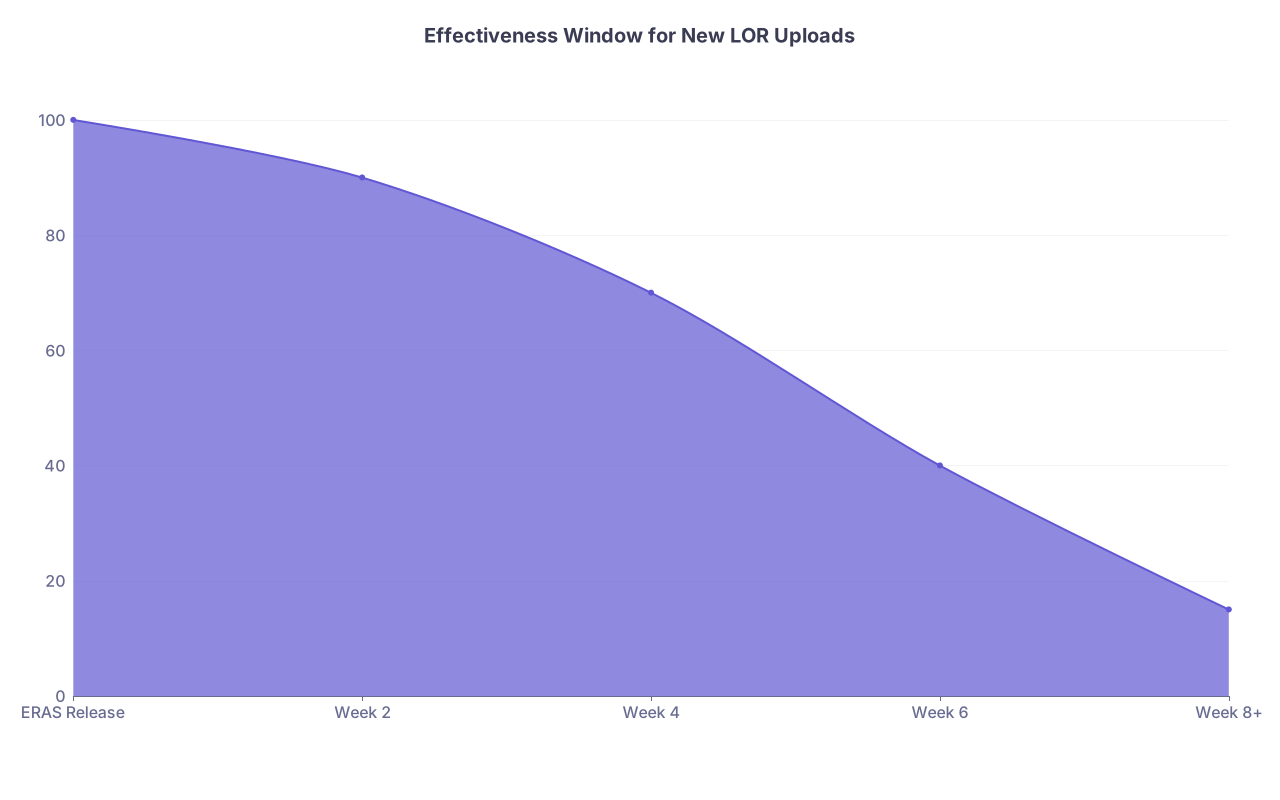
| Category | Value |
|---|---|
| ERAS Release | 100 |
| Week 2 | 90 |
| Week 4 | 70 |
| Week 6 | 40 |
| Week 8+ | 15 |
Rough interpretation:
- ERAS release to Week 2: Ideal. Programs are starting their first passes.
- Weeks 3–4: Still very helpful. Many programs are still screening.
- Weeks 5–6: Mixed. Some programs have already screened; some are still reviewing.
- After Week 8: Low impact for most programs, especially competitive ones. Some community or later-reviewing programs may still notice, but you cannot rely on it.
So if your letter writer says, “I’ll do it in November,” translate that in your head as, “Nice if it happens, but I’m applying as if it does not exist.”
What to say when you see them in person later
Here is where people freeze. They run into the traveling attending months later and think, “Do I pretend it never happened?”
No. You take the long view.
If they never uploaded the letter, say something like:
“Dr. [Name], I really appreciated your willingness to write on my behalf this fall. I know the timing with travel and clinical work was rough. I still learned a ton on your service and I’m grateful for that.”
That’s it. No edge in your voice. You are giving them an easy exit and signaling you are not keeping a grudge ledger.
If they did upload it late (even if it barely helped):
“Thank you again for submitting that letter. I know you were juggling a lot with travel; I really appreciate you taking the time.”
You are investing in your long-term relationship capital. This person may matter later for fellowships, jobs, niche recommendations. Do not burn that for one late ERAS cycle.
How early you should ask if you know they travel
Future you will thank present you if you stop doing this part last minute.
If your school culture is that everyone asks for chair letters or big-name specialty letters, assume they’re over-committed and traveling.
You should:
- Ask at least 6–8 weeks before ERAS opens to programs.
- Confirm they know ERAS release date and your preferred upload window.
- Send a one-page “brag sheet” or bullet list of:
- Key patients you cared for together.
- Projects or presentations under them.
- 3–5 traits you hope they can comment on specifically (work ethic, clinical reasoning, etc.).
This is both respectful and tactical. It moves your letter from the “generic” pile to the “I can actually say something concrete about this student” pile.
When you really should wait for a traveling LOR
There are rare times when you actually adjust your timing because of a writer. I am talking about things like:
- You are applying to a hyper-competitive specialty.
- Your Step/scores or grades are borderline.
- This letter is from:
- Program director or
- Nationally known name in your specialty or
- The exact department you want to match into.
- They have explicitly said they will write a strong letter and given you a specific early upload date (for example: “I’ll upload by September 10” and programs get access on the 15th).
In that case, I would:
- Submit ERAS as early as allowed, but
- Consider holding assignment of other letters to a few key programs until theirs is in, if you’re worried about the cap or mix.
I would not delay initial ERAS submission itself more than a couple days. The cost of a later submission date is often higher than the marginal benefit of one extra letter being visible on day one.
The line you do not cross: nagging vs professionalism
If you want to keep respect, here are the rules I’d stick to:
- One clear ask.
- One reminder around the time window you discussed.
- Maybe one “no-pressure thank you” if they never complete it.
That’s it.
What you do not do:
- Weekly “just checking in!” emails.
- Guilt-tripping (“This is really important to me and I’m getting anxious…”).
- Using their assistant as a pressure tool (“Dr. So-and-So still hasn’t uploaded my letter; can you remind them?”).
You are entering a small professional world. People talk. The student who sent five reminder emails gets remembered—for the wrong reasons.
Quick recap: What actually matters
You can obsess over dates and portals or you can control what’s controllable.
Focus on these:
- Submit ERAS on time with what you have. Do not hold your entire application hostage to one traveling writer unless they are absolutely pivotal and you have a concrete date from them.
- Have backups and clarity, not blind faith. If a crucial letter is uncertain, secure another reasonable LOR so your file is not empty while someone is on the other side of the world.
- Protect the relationship more than the letter. Use one solid ask, one polite reminder, and then emotionally let it go. Preserve that attending’s goodwill for the next 5–10 years of your career, not just this one application season.