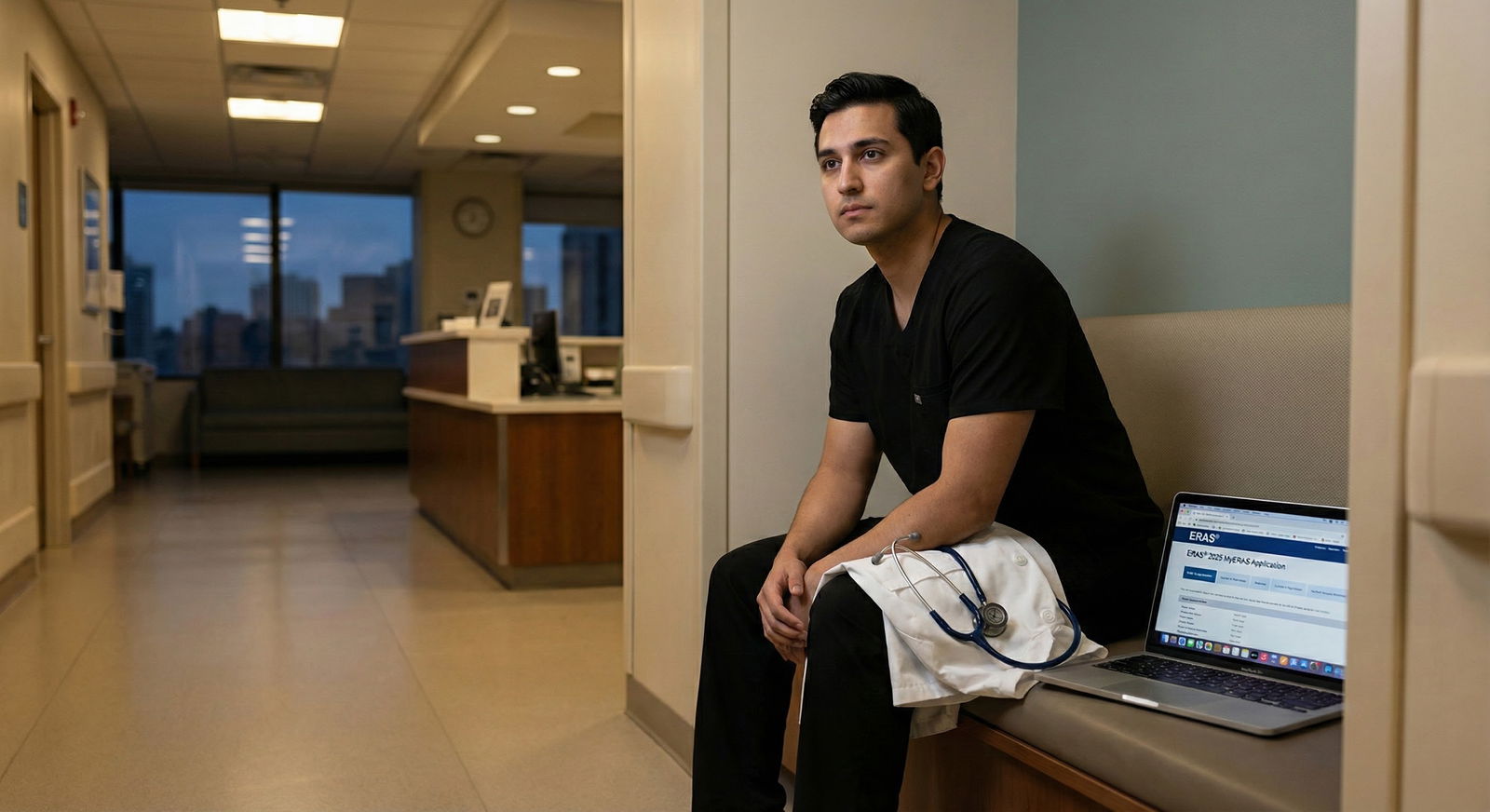
The worst timing for a clerkship failure is exactly when it usually happens: right before ERAS is due.
You failed a core rotation late in third year or early fourth. ERAS opens in a few weeks (or has just opened). People are yelling, “Submit on day one or you’re dead in the Match.” Your dean is “concerned.” You’re wondering if you should delay ERAS to fix this, or submit on time and hope no one notices.
Let me be blunt: the wrong timing decision can hurt you more than the actual failure.
Here’s how to think about this like a grown-up applicant instead of a panicked M3/M4.
Step 1: Get Clear on Your Exact Situation
“Failed a clerkship late” is too vague. Programs will judge you based on specifics. You need to do the same.
Ask and answer these, in writing:
What exactly did you fail?
Core? Elective? Sub-I? Shelf vs clinical vs both?Where are you in the remediation process?
Scheduled? In progress? Already completed and passed? No plan yet?What’s your ERAS timeline?
- Are we:
- 4–8 weeks before ERAS submission starts?
- ERAS just opened but MSPE not released yet?
- After ERAS submission deadline but before MSPE release?
- Already submitted, now you failed?
- Are we:
What specialty are you applying to?
Family med vs derm vs gen surg are not the same problem.Is this your only red flag?
Or do you also have:- Step 1/COMLEX failures or low scores
- Professionalism concerns
- Multiple shelf failures
- LOA / remediation year
Now, let’s tackle the actual question: delay ERAS, or submit on time?
Step 2: The Core Tradeoff You’re Actually Facing
You’re juggling two competing truths:
Earlier ERAS submission helps
Programs (especially competitive ones) often review and send interview invites in batches. “Submitted on day 1” is not magic, but “submitted 6 weeks late” absolutely hurts.Unaddressed red flags scare programs more than late apps
A clearly failed clerkship with no remediation yet looks worse than a slightly later application with a documented successful remediation and an explanation.
So the real question is:
Is it better for you to be early with a glaring, unresolved failure,
or a bit later with a fixed and contextualized failure?
The answer depends heavily on what you failed and when you can show you fixed it.
Step 3: Common Scenarios – What To Do
Here’s where most people actually land. Find your situation and follow the playbook.
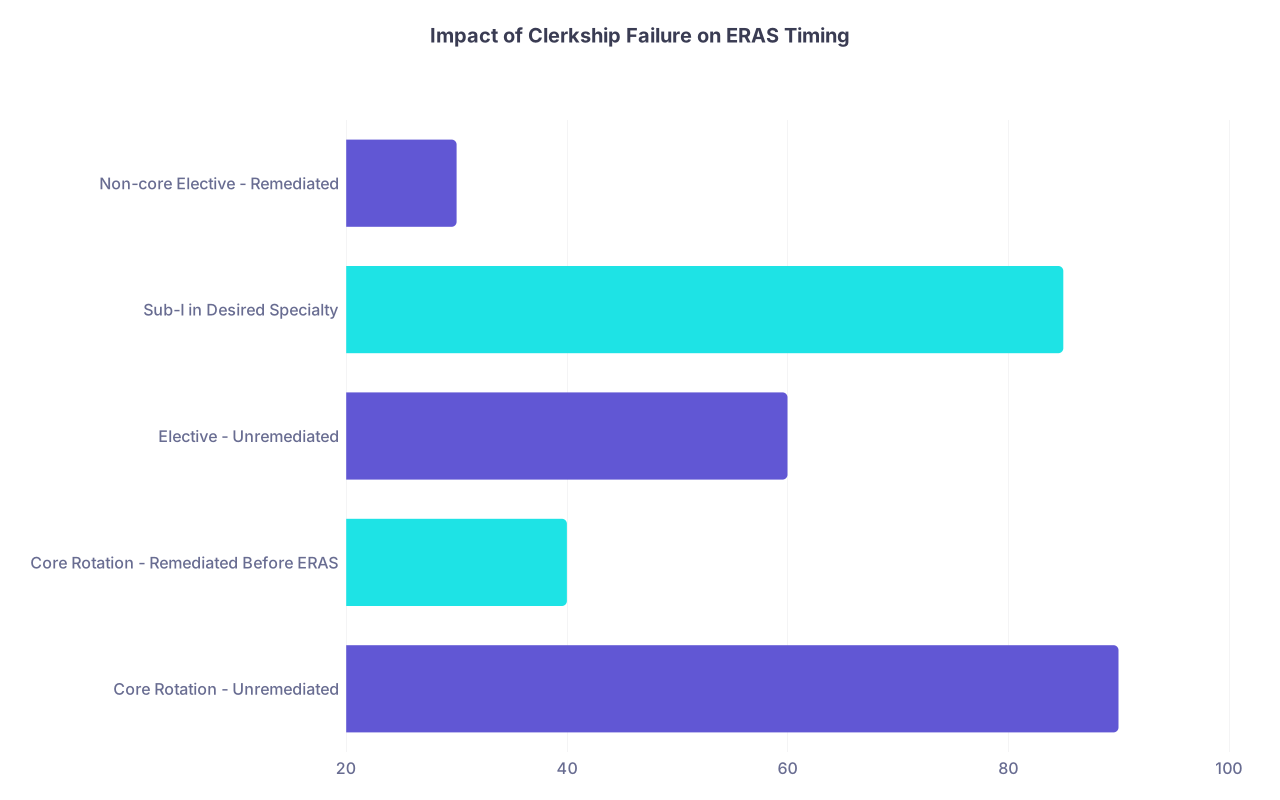
| Category | Value |
|---|---|
| Core Rotation - Unremediated | 90 |
| Core Rotation - Remediated Before ERAS | 40 |
| Elective - Unremediated | 60 |
| Sub-I in Desired Specialty | 85 |
| Non-core Elective - Remediated | 30 |
(Scale is “risk of hurting your application if not addressed before ERAS” out of 100.)
Scenario 1: You Failed a Core Clerkship, Remediation Will Finish Before ERAS Submission
Example: You failed IM in May. Remediation is scheduled in July. ERAS opens in early September.
In this case, 9 times out of 10, you do NOT delay ERAS beyond the standard “submit within the first 1–2 weeks” window.
What to do:
Push hard to:
- Complete remediation before ERAS submission deadline
- Get the grade updated in your transcript
- Ensure the dean’s office knows you passed remediation so MSPE can reflect it
Submit ERAS as soon as:
- The remediation grade posts, or
- Your school confirms the MSPE will clearly state the failure and the successful remediation
Why not delay?
Because by the time you’re actually submitting, your story is: “I failed, I fixed it, it’s documented.” Programs can live with that. What they hate is uncertainty.
You’ll still need:
- A clear explanation in your personal statement or ERAS “explanations” section (not both unless it’s really ugly)
- Your advisor or dean aligned on the narrative, so the MSPE does not contradict you
Scenario 2: You Failed a Core Clerkship and Remediation Will Finish After ERAS Submission
Example: You failed Surgery in August. Remediation won’t be until November. ERAS submission is September.
Now we have a real tension point.
If you apply “on time”:
- Your transcript/MSPE shows a failed core rotation with no recorded remediation.
- Programs see unresolved failure.
- You might lose out on early interview invites, especially in competitive specialties.
If you delay significantly (like 4–6 weeks late):
- Some programs will already be deep into interview selection.
- For competitive specialties, you may be essentially out of the running at many places.
So which is worse?
Here’s the rule:
For highly competitive specialties (derm, ortho, plastics, ENT, neurosurg, rad onc):
Delaying ERAS by a month or more is usually lethal. Submit on time, own the failure, and broaden your list like crazy. You’re already in damage control territory; losing weeks on timing makes it worse.For moderate/less competitive specialties (FM, psych, peds, IM at mid-tier/community programs):
A short delay (1–2 weeks after “day 1”) to get clarity on remediation plans and update the dean/MSPE language may be reasonable.
A 4–6 week delay? Generally not worth it. Apply on time, explain the plan.
In almost all cases here: submit ERAS within the first 1–2 weeks of opening. Do NOT wait months hoping the remediation finishes.
What you absolutely must do:
- Get your school to:
- Document that remediation is scheduled
- Include language in the MSPE about your active remediation and attitude
- Prepare a crisp, non-dramatic explanation:
- What happened (brief, factual)
- What you changed
- How you’re addressing it now
And widen your net. More programs. More community programs. Less delusion.
Step 4: Should You Ever Delay ERAS Intentionally Because of a Failure?
Yes. Rarely. But yes.
Here are the only situations where I’ve seen delayed ERAS actually help:
Failure was mis-graded / under appeal AND will likely be reversed before mid-September
Example: Preceptor documented passing evals, shelf was borderline, administration misapplied policy, appeal already moving, school expects reversal by early September.
In this very narrow situation, waiting a week or two for your record to show “pass” instead of “fail + remediation” may be worth it. This is uncommon.
You failed a sub-I in the specialty you’re applying to, and remediation is scheduled in the next month, with a strong attending advocate lined up
If your entire specialty choice is hanging on showing programs:
“I had a rough sub-I, but I remediated and got Honors with Dr. X vouching for me,”
and that remediation will complete very soon, then a short delay can be defensible.You’re pivoting specialties because of the failure, and need 1–2 weeks to secure new letters and revise your ERAS
Example: Failed Surgery, decide to abandon gen surg for IM. You need:
- A new personal statement
- New letter requests
- An updated experiences section matching IM
In this case, a 1–2 week delay is strategic. You’re rebranding. Submitting a half-baked application on day 1 is worse than a well-built pivot on day 10.
What’s NOT reasonable:
- “I’m going to wait until November so my remediation is complete before I apply”
- “I’ll skip this cycle and try next year just because of one late failure” (without talking to multiple advisors)
Those moves usually hurt more than help.
Step 5: How Different Specialties React to a Late Failure
Not all fields care equally about one bad clerkship grade.
| Specialty Type | Impact of Late Core Failure | Typical Tolerance |
|---|---|---|
| Ultra-competitive (Derm, Ortho, ENT, Plastics) | Very High | Very Low |
| Surgical (Gen Surg, Neurosurg, Urology) | High | Low |
| IM / EM / Anesthesia | Moderate-High | Moderate |
| Psych / Peds | Moderate | Moderate-High |
| FM / Path / PM&R | Lower-Moderate | Higher |
General patterns I’ve seen:
Surgical specialties
Hate failures in surgery or core rotations. A failed surgery rotation late? You need:- Strong later performances
- Clear advocacy from faculty
- Early, honest discussion with your specialty advisor about whether to pivot
IM / EM / Anesthesia
Will look at the whole record. One failure with later remediation and consistent improvement can be survivable, especially if your Step/COMLEX and letters are strong.Psych / Peds / FM
Care more about your trajectory and professionalism than perfection. They will read your explanation. They care about whether you learned from it.If you failed in the specialty you’re applying to
This must be addressed head-on. You do not hide it. You do not “hope they miss it.”
Whether you delay ERAS or not matters less than whether your story makes sense.
Step 6: What You Should Actually Be Doing This Week
Forget the abstract debate about early vs late for a minute. Here’s the concrete to-do list.

| Step | Description |
|---|---|
| Step 1 | Failed Clerkship Late |
| Step 2 | Likely Do Not Delay |
| Step 3 | Do Not Delay; Finish Remediation |
| Step 4 | Submit On Time, Widen List |
| Step 5 | Consider 1-2 Week Delay Max |
| Step 6 | Core or Sub-I? |
| Step 7 | Remediation Before ERAS? |
| Step 8 | Competitive Specialty? |
This week, you should:
Meet with three people:
- Your dean or student affairs advisor
- A faculty advisor in your target specialty
- The clerkship director where you failed (if not already done)
Ask each directly:
“Given my failure and timing, do you recommend I submit ERAS on day 1, within the first 1–2 weeks, or significantly later? And why?”Clarify what will be in your MSPE:
- Exact language about the failure
- Whether remediation will be mentioned
- Whether any professionalism concern is recorded
You cannot plan timing intelligently if you do not know what’s going in that letter.
Decide where to explain the failure: You generally get one main place:
- Personal statement or
- ERAS “Additional Information” section
(Sometimes a short note in both, but keep it consistent.)
Your explanation should:
- Be concise (3–6 sentences)
- Own responsibility without self-destruction
- Show specific changes you made
Adjust your school list based on reality, not hope: If you have:
- One core failure
- Average scores
- Applying to a moderately competitive specialty
Then you need:
- More programs
- More community and mid-tier options
- Fewer “dream” reaches
Step 7: How to Talk About the Failure in Interviews
Because here’s the part people forget: ERAS timing is step one. You still have to survive the interview question.
You will almost certainly get:
“I see you had to remediate [rotation]. Can you tell me about that?”
Don’t overcomplicate this. Your structure:
- Brief context
- What went wrong (specific, but not dramatic)
- What you did to fix it
- How you’re different now
Example:
“I failed my Internal Medicine clerkship at the end of third year. I struggled with time management and prioritizing tasks on a busy inpatient service, and I didn’t communicate early when I was falling behind on notes and pre-rounding.
After that, I met with my clerkship director and dean, and together we set up remediation on a different IM team. Before that started, I worked with a resident mentor on pre-rounding strategies and note templates, and I began using a structured checklist for each patient.
On remediation, I implemented those changes and my attending commented specifically on my improved organization and reliability. Since then, I’ve completed [subsequent rotations] with strong evaluations, and I’m much more proactive about asking for feedback early rather than waiting until there’s a problem.”
Short. Clear. Grown-up.
Do that, and your timing decision matters a little less, because you’re actually addressing the underlying concern: “Will this person be dangerous or difficult as a resident?”
Step 8: The Bottom Line Answer to Your Question
You failed a clerkship late. You’re staring at ERAS deadlines. Here’s the honest summary.
Most of the time, you should NOT significantly delay ERAS.
Aim to submit in the standard early window (day 1 to day 10-ish), even with a failure, as long as:- Remediation is done or scheduled
- Your MSPE accurately reflects the situation
- You have a coherent explanation
A short, strategic delay (1–2 weeks) can make sense if:
- You’re pivoting specialties and need to rebuild your app
- Your school is actively fixing a clear grading error
- A near-term remediation will dramatically change how your record looks
A long delay (4+ weeks) almost never improves your chances.
It just makes you late and still “the student who failed.” Programs won’t wait around for you.
Your job now is not to chase the “perfect timing.” It’s to:
- Get your story straight
- Get your support (dean, advisors) aligned
- Submit a complete, honest, and reality-based application in the early part of the season
You cannot undo the failure. You can absolutely tank your cycle by panicking about timing instead of fixing the narrative.
FAQ (Exactly 5 Questions)
1. Will submitting ERAS a few days after opening hurt me if I’m waiting on a remediation grade?
Almost never in a meaningful way. Programs do not usually distinguish between applications submitted on day 1 vs day 5–7. They do care if your file is incomplete or confusing. If waiting a few days gets your transcript/MSPE cleaned up or at least clarifies the remediation status, that’s often a smart trade.
2. Should I mention the failed clerkship in my personal statement or only if asked?
If it’s a core failure, especially recent, assume programs will notice. Preempt it. Usually, a brief explanation in the ERAS “Additional Information” or a short paragraph in the personal statement works. Leaving it completely unaddressed and hoping no one cares is wishful thinking and makes you look evasive.
3. Does a failed clerkship automatically mean I should switch to a less competitive specialty?
Not automatically. But it should trigger a serious reality check. If you were already on the edge for a highly competitive specialty (average scores, limited research, no home program) and now you’ve added a late failure, your odds drop. Talk to multiple advisors in that specialty and in a backup specialty. Sometimes the right move is to apply broadly in your original field with a strong backup; sometimes it’s to pivot fully.
4. How many more programs should I add if I have a late clerkship failure?
There’s no magic number, but I generally tell people to expand by 25–50% in most competitive or mid-competitive fields. Example: if a typical applicant in your situation would apply to 40 IM programs, you might target 60. Weight more toward community and mid-tier academic programs. But don’t just throw apps blind—use your school’s match list and advisors to build a targeted expanded list.
5. What if I failed after I already submitted ERAS—should I update programs?
Yes. You cannot hide a post-submission failure; it will show on updated transcripts and MSPE addenda. Work with your dean’s office on how they’re documenting it, then send a short, professional update to programs once the failure and remediation plan are official. Own it, explain briefly, and outline the remediation plan. Programs hate surprises more than they hate imperfection.