
What do you actually do when you step out for a research year, and suddenly the ERAS calendar you knew no longer fits your life?
You’re not just “taking a year off.” You’re stepping off a moving treadmill, and if you want to land back on it without face-planting, you have to re-time everything: letters, exams, program list, application submission, interview availability. The works.
This isn’t theoretical. I’ve watched people do this well and match way up. I’ve watched others drift, miss key dates, and end up re-applying again. The difference wasn’t how smart they were; it was how deliberately they treated the timing.
Let’s walk through what to do if you’re in (or planning) a research year and you want to come back to the Match with a stronger, not weaker, ERAS.
First: Know Which Calendar You’re Now Living On
If you’re taking a research year, you’re basically shifting from the “MS4 calendar” to the “bridge year” calendar. Different rules.
Most people fall into one of these:
- You finished MS3, decided to take a research year, and will apply during that year
- You did not match or partially matched (SOAP, prelim only) and are taking a research year before re-applying
- You’re a current resident planning to switch specialties and using a research year as cover
The ERAS mechanics are similar, but the timing pressure is different.
To make this concrete, here’s what your year should roughly look like if you’re applying in the same specialty after a research year.
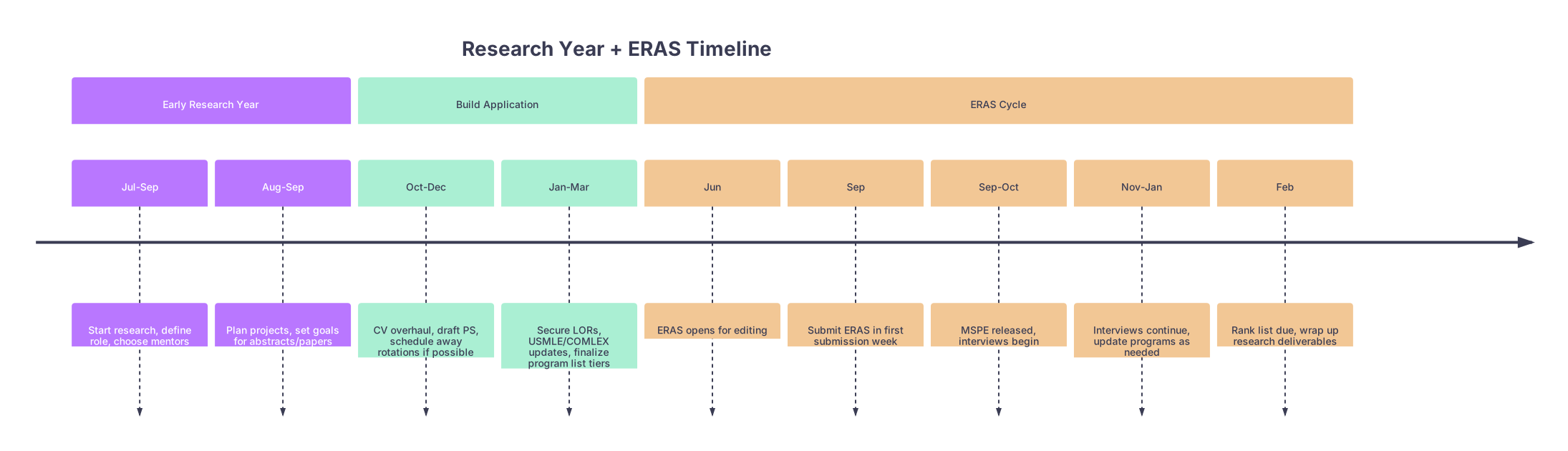
| Period | Event |
|---|---|
| Early Research Year - Jul-Sep | Start research, define role, choose mentors |
| Early Research Year - Aug-Sep | Plan projects, set goals for abstracts/papers |
| Build Application - Oct-Dec | CV overhaul, draft PS, schedule away rotations if possible |
| Build Application - Jan-Mar | Secure LORs, USMLE/COMLEX updates, finalize program list tiers |
| ERAS Cycle - Jun | ERAS opens for editing |
| ERAS Cycle - Sep | Submit ERAS in first submission week |
| ERAS Cycle - Sep-Oct | MSPE released, interviews begin |
| ERAS Cycle - Nov-Jan | Interviews continue, update programs as needed |
| ERAS Cycle - Feb | Rank list due, wrap up research deliverables |
The mistake people make? Acting like the research year is a warm, fuzzy “gap year” and then waking up in August with:
- No updated letters
- No clear story for why they left and came back
- A half-baked ERAS they submit late “because I’m still waiting on X”
You can’t do that. Not if you want a better outcome than you would’ve had without the year.
The Core Question: When Should You Actually Hit “Submit” on ERAS?
You’re taking a research year, so the real issue is: should you rush to submit ERAS on day one, or wait until pieces (letters, publications, scores) are stronger?
Here’s the blunt answer:
You still want your application functionally complete in time for the first wave of reviews. For most specialties, that means:
- ERAS submitted within the first 3–5 days after it opens for submissions
- At least 2–3 letters already in (4 for more competitive surgical/derm/rads-type fields)
- Personal statement, experiences, and CV fully polished
Taking a research year doesn’t buy you permission to be late. It just changes what you’re doing in the months before ERAS opens.
Here’s where “best time to submit ERAS” intersects with your research timeline:
| Period | Goal for ERAS Readiness |
|---|---|
| Jul–Sep (start) | Clarify story, identify letter writers |
| Oct–Dec | Draft PS, update CV, track achievements |
| Jan–Mar | Lock in main LORs, confirm specialty choice |
| Apr–May | Finalize program list strategy |
| Jun–Aug | ERAS build, polish, and early submission |
If you’re thinking, “I’ll wait until my abstract is accepted in November, then I’ll submit ERAS,” that’s how you quietly destroy your chances. Update programs later. Apply on time.
Month-by-Month: How to Re-Time Your Year Around ERAS
Let’s say you start your research year in July and will apply that upcoming cycle. Here’s what to actually do by month so ERAS timing lines up with your research life.
July–August: Set the Foundation, Not Just “Start the Job”
This is where most people screw up. They act like this is just an on-boarding phase. It’s not. It’s positioning.
What you do:
Sit down with your PI and say, explicitly:
“I’m planning to apply to [X specialty] in this upcoming ERAS cycle. I’d like to make sure by next spring I have [abstracts / posters / manuscripts] that can go on my application and that you’d feel comfortable writing me a strong letter if things go well.”Get assigned to 2–3 concrete projects: at least one with a realistic chance of submission before September, and others that will be “in progress” for your CV.
Start documenting everything:
File with titles, project roles, dates, co-authors. If you wait until August to reconstruct this, you’ll forget half of it.
ERAS timing impact:
By the end of August, you want to know who your primary research LOR writer will be and what your main projects are. That way you can already be shaping your eventual narrative and letters.
September–December: Build Your Narrative While the Work Is Still Fresh
This is where you balance: research grind vs application prep.
What you do:
Now that you’ve seen some of the work, draft a rough personal statement. Even if it’s trash. You need to figure out how this research year fits into your story:
“I stepped out to gain [skill/experience] that I didn’t have time for during MS3,”
NOT
“I was lost and just did research because people said it helps.”Update your CV with ongoing projects:
- “Manuscript in preparation”
- “Data collection phase”
- “Abstract submitted to [Conference]”
Quietly track tangible outcomes: presentations, posters, IRB approvals, new techniques you’ve learned, responsibilities you’ve taken on (leading a subproject, mentoring a student, coordinating a manuscript).
ERAS timing impact:
By December, you want a clear, coherent narrative of your research year, even if the outcomes are still maturing. That lets you move fast once ERAS opens instead of trying to “reinvent” your story under pressure.
Letters of Recommendation: Re-Timing and Re-Balancing
This is the biggest timing trap for research-year applicants.
You now have two “eras” of letters:
- Clinical letters from MS3/MS4 (or prior residency)
- Research letters from your gap year
The right mix depends on what specialty you’re applying to and why you took the research year.
Here’s the general structure I recommend for a single specialty, research-focused return applicant:
- 1–2 strong clinical letters in the specialty (or close proximity)
- 1 major research letter (your PI or main research mentor)
- Optional: 1 additional letter (subspecialty or department chair if required)
Timing-wise:
- Tell your research PI by January–February that you’ll need a letter for ERAS.
- Ask them explicitly what they’ll need from you: CV, draft paragraph about your role, list of projects.
- For older clinical letters (from MS3/MS4), decide: reuse or refresh?
If you graduated and then did research, programs know your clinical letters are older. That’s fine. What’s not fine is having:
- Only old letters
- Or only research letters and no one who can talk about your clinical performance
So how does this affect when you submit ERAS?
You want at least 2–3 letters already uploaded by the time you submit, but you do NOT need all of them there on day one. ERAS lets you assign letters later. Programs will still see updates.
So here’s a working rule:
- Aim to have core clinical letters + your main research letter in by early September
- You can submit ERAS once 2–3 letters are in, if the rest are guaranteed and coming soon
Don’t delay ERAS submission waiting for a “perfect” letter set. Submit early with a functional set; let the latecomers be a bonus.
Publications, Abstracts, and “Waiting for the Line on My CV”
Another classic mistake: “I’ll submit ERAS later once this paper is accepted.”
No. Stop that.
You list research like this on ERAS:
- Published: full citation as usual
- Accepted: “In press”
- Submitted: “Submitted to [journal]”
- In preparation: “Manuscript in preparation” (sparingly, and only for real work, not wishes)
Programs know the research pipeline. They understand timing. No one expects 5 JAMA papers from a one-year research fellow. They expect:
- Evidence you actually did work
- Some output — even if it’s posters or abstracts
- A PI who says, “This person made real contributions”
Re-timing strategy:
- Plan project milestones backward from August/September:
- Poster submissions by winter/spring conferences
- Manuscript submissions aimed for late spring/early summer
- That way, by ERAS time, you have something more concrete than “I joined this lab.”
You can also update programs after application submission:
- Email updates in November/December:
“Since my ERAS submission, our manuscript titled [X] was accepted in [Journal]; I wanted to share this update and reiterate my strong interest in your program.”
That only works if you didn’t wait for the acceptance to submit your application.
How Competitive Specialty Changes Your ERAS Timing Risk
The more competitive the specialty, the less wiggle room you have on timing. For example:
- Derm, plastics, ortho, ENT, neurosurg, IR, rad onc: you should treat “later than first week” as a serious self-inflicted wound
- Mid-competitive fields (gen surg, EM, rads, anesth, neuro): you still want to be early, but a few days’ delay for a key letter isn’t fatal
- Less competitive fields or re-entry to IM/FM/psych after a rough year: your story and letters matter more than the exact day you submit, but early is still better
If you’re switching specialties during a research year, this is even more delicate. You now need:
- Letters in the new specialty
- A believable explanation for the switch
- Enough time to do some clinical work in that new specialty (observerships, electives, call shifts, something) before ERAS
That might mean you need to:
- Front-load research early in the year
- Then build in a month or two of clinical exposure in the new field before ERAS opens
In other words, your research year calendar isn’t “twelve generic months.” You’re carving out windows for:
- Research ramp-up
- Peak productivity
- Clinical re-exposure
- ERAS building and submission
- Interview season availability
Interviews: How Your Research Year Affects Availability and Scheduling
You’re not a regular MS4. You don’t have an admin office that blocks off months for interviews. You have a PI who still wants results and a lab that doesn’t pause because you’re in Chicago for 48 hours.
So, plan this explicitly.
By August, before you submit ERAS, talk to your PI:
Phrase it like this:
“Interviews typically fall between October and January. Some specialties are heavier in November and December. I’ll likely need time away for travel and virtual interviews. Can we agree on how much flexibility I’ll have and how to handle scheduling so it doesn’t blindside the team?”
Work out:
- Whether you can do virtual interviews from your office
- Whether you’ll need full days off for travel
- Whether there are blackout dates (grant deadlines, big experiments, key conferences)
Then, when ERAS asks for your availability, you don’t overcommit. Nothing looks worse than canceling interviews because “my lab needs me that week.” Programs don’t care about your lab; they care if you’re unreliable.
If You’re Re-Applying After Not Matching
Different situation, same need for ruthless timing.
You’re not just “taking a research year.” You’re repairing a prior failed application. For you, timing is even more critical because programs will want to see clear, early improvements.
Here’s what you absolutely must align with the ERAS cycle:
- Step scores (if you needed to improve Step 2 or complete a missing exam)
- New letters that speak directly to your growth since the last cycle
- A re-worked PS that doesn’t read like a warmed-over version of last year’s
Your timeline:
By January–March:
- Understand exactly why your last cycle failed (numbers, letters, red flags, late submission, weak list, etc.)
- Start fixing the root issues, not cosmetic ones
By June:
- All major repairs are either done (retaken exams) or clearly in motion (new letters from people who’ve actually seen you this year)
Then, when ERAS opens, you submit early and you’re ready to answer the inevitable:
“Walk me through how you’ve grown since last year.”
If you’re still “waiting” for something big by August, that’s a problem.
A Quick Reality Check: How Programs Actually See Your Year
From the program side, they’re asking:
- Did this research year add value, or did you just disappear?
- Are you more mature, more skilled, and more focused than you were before?
- Did you handle timing like an adult or like a drifting student?
Your ERAS timing is one of the few objective signals of that last point.
They look at:
- When you submitted
- Whether your letters are coherent and up to date
- How your research is presented (real work vs fluff)
- Whether your story fits the timeline or feels improvised
A well-timed research year application looks like:
- Early submission
- Clear narrative in PS and experiences: “This was intentional, and here’s what I did with it.”
- Strong letter from PI that is specific, not generic fluff
- At least some measurable outcomes
A badly timed one looks like:
- Late ERAS
- Vague experiences: “Research assistant in Dr. X’s lab” with no depth
- Last-minute letters
- Research framed as a weird detour you barely talk about
You decide which file you hand them.
If You’re Still Planning Whether to Take a Research Year
One last angle. You might be reading this before you even start the year, trying to decide if it’s worth it.
Ask yourself:
- Can I realistically produce meaningful work in 9–12 months that will be ready to show by next ERAS?
- Will I have someone willing to write me a truly strong letter from this year?
- Is there a specific weakness I’m fixing (lack of research, lack of mentorship, a weak prior cycle), or am I just delaying?
If the answer to those is mostly yes, a research year can be a solid move. But only if you treat the ERAS calendar as part of the job, not an afterthought.
Key Takeaways
- A research year doesn’t change the basic rule: submit ERAS early, ideally in the first 3–5 days, with a mostly complete application. Don’t hold your application hostage waiting for the “perfect” paper or letter.
- Use a month-by-month plan: early in the year you secure projects and mentors, mid-year you craft your story and letters, late-year you lock in ERAS details and keep your research pipeline flowing.
- Programs judge whether your research year was intentional and productive largely through your timing, letters, and how you frame the year. If you respect the ERAS timeline and plan around it, the year helps you. If you drift and scramble late, it hurts you.