
The fear that you’re already behind the second your friends click “Submit” on ERAS is exaggerated. But it feels very, very real.
Let’s be blunt: watching your classmates post “ERAS SUBMITTED!!” on Instagram and in group chats while you’re still editing your personal statement at 1:17 a.m. is brutal. It feels like everyone else just secured their futures and you’re…tweaking commas.
You start thinking:
- “Programs are going to fill up before mine even gets there.”
- “I waited two extra days and now I’ve ruined my chances at my top choices.”
- “They’re going to see the timestamp and think I’m disorganized.”
I’ve heard all of that. I’ve thought all of that. I’ve seen people spiral so hard over a 24–48 hour ERAS timing difference that they stop actually improving their application and just panic-submit.
Let’s talk about what’s actually true, what’s pure anxiety, and where timing really matters.
The Hard Truth About ERAS Timing (That No One Explains Clearly)
Here’s the part everyone muddies with vague “submit early!” advice:
There’s a huge difference between:
- Being late to the party, and
- Being two hours behind your friends in the same car.
You’re terrified of the first one. What’s actually happening is usually the second.
For most specialties and most programs, here’s the reality:
- If you submit before or on the date ERAS first releases applications to programs, you’re considered on time and essentially “early.”
- Submitting within the first 24–72 hours after that release? Still functionally fine for the vast majority of places.
- Submitting weeks later? Now we’re talking about real impact.
- Submitting months later (like November)? That’s when the doors really start closing.
But what your anxious brain is doing is treating:
“my friend submitted at 8:03 a.m. on opening day and I submitted at 4:40 p.m.”
as equivalent to
“my friend submitted in September and I submitted in November.”
Those are not the same universe.
What Actually Happens When Programs Get ERAS Apps
You’re imagining some poor PD at 8:01 a.m. on application release day:
“Ah yes, the first 40 apps. These are the chosen ones. After this, trash.”
No. That’s not how it works.
Most programs get hundreds to thousands of applications. They can’t even physically read them all in real-time.
Common internal pattern (yes, I’ve heard this straight from residents and faculty at places like IM programs at big academic centers):
- They get a massive dump of applications on the first release day.
- They use filters:
- US vs IMG
- Step scores / Pass vs Fail cutoffs
- Visa status
- Home school vs others
- Maybe research, maybe AOA, etc
- They generate batches for actual review over days to weeks.
- Interview invites don’t go out instantly; they go out in waves.
Notice what’s not in those filters:
“submitted at 9:03 a.m. vs 11:47 a.m. on opening day.”
Is there some advantage to being there when that first big batch is processed? Yes. But that means “submitted by the time they start reviewing,” not “my friend sent it two hours before me.”
So when your friends start flexing “I submitted the second the portal opened,” you think they just grabbed the last life jackets on the boat. They didn’t. They just gave themselves the same advantage you’ll have if you submit that day or shortly after.
How Much Does a Few Days Actually Matter?
Let’s put numbers to this before your brain fills in the gaps with disaster scenarios.
, 1–2 Months After](https://cdn.residencyadvisor.com/images/articles_svg/chart-relative-impact-of-eras-submission-timing-3698.svg "Relative Impact of ERAS Submission Timing")
| Category | Value |
|---|---|
| Release Day | 100 |
| 1–3 Days After | 95 |
| [1–2 Weeks After](https://residencyadvisor.com/resources/best-time-submit-eras/what-really-happens-to-eras-filed-after-interview-invites-start) | 80 |
| 1–2 Months After | 40 |
Interpretation like a human, not like a statistician:
- Release Day (100%) – This is your “ideal” baseline.
- 1–3 Days After (95%) – Slight drop in theoretical advantage, but programs are still drowning in the initial wave. You’re essentially in the same bucket.
- 1–2 Weeks After (80%) – Now some programs have started building interview lists. You’re still in the running, especially for less competitive specialties and mid-tier places, but you’ve lost some “first look” shine.
- 1–2 Months After (40%) – Now you’re legitimately late. Some programs are basically full or nearly full on interview slots.
Your fear: “My friend hit submit at 7:59 a.m., I hit it at 3:12 p.m. I’m done.”
Reality: That’s the same bar on that chart.
When You Should Actually Panic (and When You Shouldn’t)
Let me be direct: some timing panic is rational. Most of what you’re feeling isn’t.
You do NOT need to panic if:
- You’re submitting on the ERAS release day, even if it’s evening.
- You’re done within the first 2–3 days after applications open to programs.
- You took an extra day or two to:
- Fix a sloppy personal statement
- Correct a wrong publication date
- Clean up a janky experiences section
- Double-check program lists and filters
In that scenario, panicking is basically punishing yourself for not being a robot.
You should start getting uncomfortable if:
- It’s been 1–2 weeks after apps opened to programs, and:
- You haven’t finalized your personal statement at all
- You haven’t requested all your letters
- You’re still building your entire program list
Now your “I just need another day” story is more like “I haven’t started running and the race began an hour ago.”
Even then, you’re not automatically doomed. You just lost margin.
The FOMO Trap: Comparing Your Timeline to Everyone Else’s
The worst part isn’t the timing itself. It’s the comparison.
You see:
- Group chat: “Submitted to 120 programs! So relieved!!!”
- Instagram story: Screenshot of “ERAS Application Status: Submitted.”
- Classmate in the hallway: “I submitted yesterday, now I can finally relax.”
You feel:
- “They’re responsible, I’m behind.”
- “Programs will see my app last.”
- “I must be the only one still working on this.”
You don’t see:
- The person who hit submit with a typo in their personal statement title.
- The person who left off their most recent publication because they were rushing.
- The person who applied to the wrong program track by accident.
- The person who hit submit early but didn’t have all their letters uploaded yet.
I’ve watched people:
- Submit EM apps without SLOEs uploaded.
- Forget to update their Step 2 CK score.
- Leave a red-flag gap unexplained because “I just wanted to be early.”
Being “first” with a sloppy, incomplete, or misdirected application isn’t a flex. It’s just louder anxiety.
When Waiting Helps Your Application More Than It Hurts
Here’s the uncomfortable tension:
You’re scared that any delay = worse outcome. But there are times where waiting one more day actually makes your app measurably better.
Examples where the wait is absolutely worth it:
You realize your personal statement basically says nothing and could actively hurt you.
One extra night to rewrite? Worth it.You notice you forgot a significant leadership role or publication.
Fixing that before submission? Worth it.You discover you miscategorized a bunch of programs (categorical vs prelim, wrong specialty subtrack).
Avoiding that disaster? Absolutely worth it.Your letter writer tells you, “I’ll upload the letter by tomorrow.”
Submitting one day later when a strong letter is actually in ERAS? Worth it.
Programs don’t bonus points you for: “submitted on opening day but missing half the good stuff.”
A Simple Sanity Check: Ready vs Stalling
At some point you’re not “perfecting.” You’re hiding from the button.
Quick gut-check questions:
- Have you proofread your personal statement and had at least one sane human read it?
- Are your experiences entered, complete, and not full of obvious typos?
- Do you have a reasonable program list that isn’t obviously reckless?
- Are your scores, exams, and major entries correct?
- Are your core letters either uploaded or clearly on the way soon?
If you can honestly say “yes” to those, and you’re just thinking:
- “But what if I rearrange the order of my experiences?”
- “Maybe I should say ‘passion’ instead of ‘interest’ in paragraph 3.”
Then you’re not refining. You’re delaying out of fear.
At that point, hitting submit today is almost always smarter than trying to brute-force your anxiety down to zero by editing it to death.
How to Handle Your Friends Flexing Their Submission
Let’s deal with the social part, because that’s half the anxiety.
You don’t have to say this out loud, but keep this script in your head:
Friend: “I submitted to 85 programs at 7 a.m. this morning!”
You, internally: “Cool. I’ll submit tonight with an application that doesn’t have missing info.”
Or externally, if you feel like it:
- “Nice, I’m just giving mine one last proofread and then I’m sending it today.”
- “I’m just finalizing a couple details—want mine to be clean before I hit submit.”
You are not required to:
- Announce your exact submission time.
- Justify your timing to anyone.
- Match their neurotic “I submitted the second it opened!” energy.
If being in the group chat is making your heart rate spike, mute it. For 24 hours. For a week if you have to. Protect your brain.
Timeline Visual: What “Too Late” Actually Looks Like
Let’s put this into a picture so your brain can stop catastrophizing everything into one big blob of “late.”
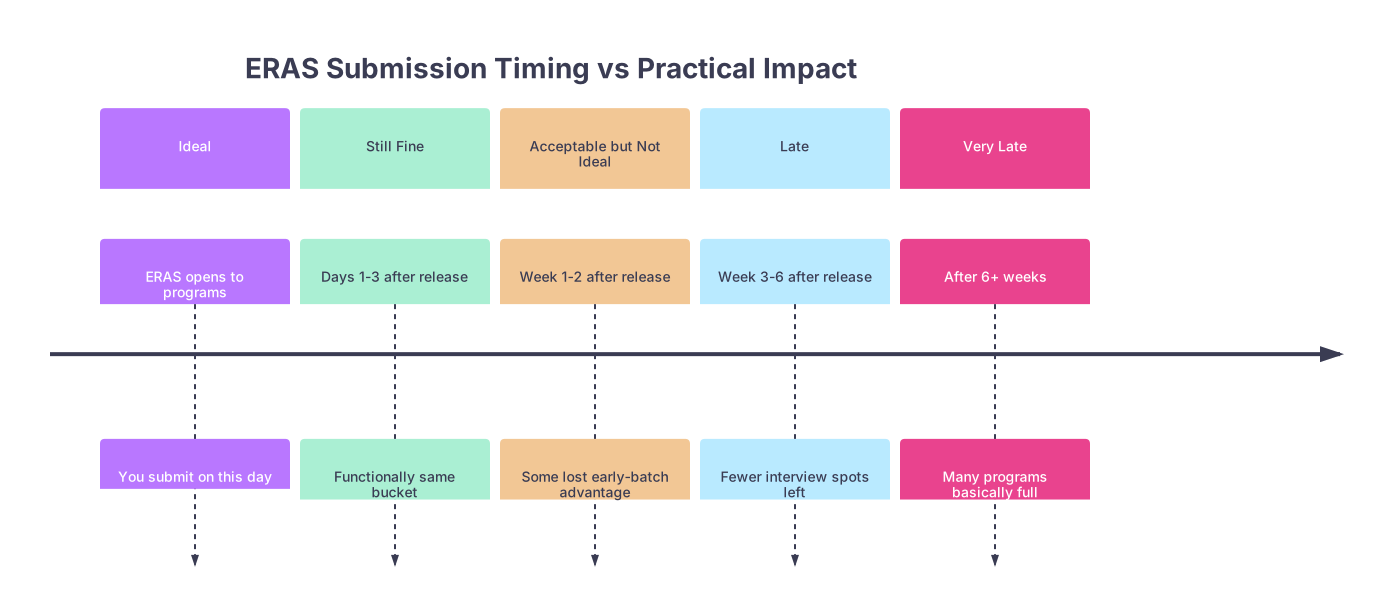
| Period | Event |
|---|---|
| Ideal - ERAS opens to programs | You submit on this day |
| Still Fine - Days 1-3 after release | Functionally same bucket |
| Acceptable but Not Ideal - Week 1-2 after release | Some lost early-batch advantage |
| Late - Week 3-6 after release | Fewer interview spots left |
| Very Late - After 6+ weeks | Many programs basically full |
If you’re in “Ideal” or “Still Fine,” the panic you’re feeling is not proportionate to the reality. That doesn’t mean your feelings are fake. It means your brain is lying to you about what they mean.
Quick ERAS Timing Trade-Off Table
| Submission Window | Pros | Cons |
|---|---|---|
| Release Day | Max early-batch advantage | Higher risk of rushing errors |
| 1–3 Days After | Almost same advantage | Slight FOMO |
| 1–2 Weeks After | More time to polish | Some lost interview chances |
| 3–6 Weeks After | Thorough app possible | Noticeably fewer invites |
| 6+ Weeks After | Last-resort submission | Many programs already filled |
Stick yourself in the right row. Not the row your anxiety wants to shove you into.
How to Calm Down Enough to Submit
You’re probably not asking for a full therapy session, but here’s a short, practical sequence so you don’t sit there frozen at 2 a.m. staring at the “Submit” button.
Set a hard deadline for yourself.
“I will submit by tonight at 10 p.m.” Not “sometime soon.”Do one structured pass:
- Check personal info
- Check exam scores
- Check experiences
- Check program list
- Skim personal statement
Fix only real issues, not hypothetical “maybe this word is better” noise.
Walk away for 20 minutes. Move. Shower. Breathe.
Come back, do a final 5–10 minute glance.
Then. Hit. Submit.
Not because you feel ready. You won’t. Because it’s time.
You’re not supposed to feel zero anxiety when you submit. You’re supposed to submit with anxiety anyway.
FAQ: ERAS Timing, FOMO, and “Am I Too Late?”
1. If my friends submitted on opening day and I submit 2 days later, did I hurt my chances?
Very, very minimally, if at all. For most programs, your application arrives in the same early wave. They’re not checking timestamps down to the hour or even the exact day for the first few days. Your anxiety wants to call this a disaster. Reality calls it “basically the same situation.”
2. Is it better to submit a slightly messy application on release day or a cleaner one 2–3 days later?
Cleaner one, 2–3 days later. Every time. A rushed app with mistakes, missing roles, or unclear red flags hurts you more than a 48–72 hour “delay” in the context of a months-long review and interview season. Don’t use that as an excuse to procrastinate for weeks. But a couple days to fix real issues is not reckless.
3. Do competitive specialties care more about exact submission timing?
They care more about your board scores, letters, research, and actual fit. That said, for ultra-competitive fields (Derm, Ortho, ENT, etc.), you really want to be in that initial batch when apps first release or shortly after—ideally day-of or within the first few days. But again, that’s days vs weeks. Not 8:00 a.m. vs 1:00 p.m.
4. Can I add programs after my initial ERAS submission, or do I only get “one shot”?
You can absolutely add programs later. People do this all the time, especially once they see how interview invites are (or aren’t) coming in. Those later-added programs see your application when you send it to them, and yes, at that point timing matters more. But your initial submission doesn’t lock you out of making adjustments.
5. Will programs know if I submitted “late”? Is there a visible timestamp they judge?
Programs can see when they receive your application, but they’re not sitting there comparing: “Applicant A: 7:04 a.m. vs Applicant B: 2:12 p.m.” What matters more: whether your app is in the pool before they seriously get into building interview lists. That’s about general timing (days/weeks), not exact timestamps. No one is rejecting you because you submitted at 4 p.m. instead of 9 a.m.
Years from now, you won’t remember the exact hour you hit “Submit” on ERAS or who bragged first in the group chat. You’ll remember whether you let fear dictate your decisions—or whether you learned to act, carefully but decisively, even while your hands were still shaking.