
What if those three stupid days are the reason you don’t match?
That’s the thought, right? You hit “submit” on ERAS, you realized the “opening day” already passed, and now you’re sitting there doing the mental math: “Programs start downloading apps on X date… I’m three days behind… there are 45,000 applicants… I’m dead.”
Let’s pick this apart like someone who’s also lying awake at 2 a.m. replaying every decision.
You submitted ERAS three days late. Not three weeks. Not after rank lists are due. Three days.
Did you hurt yourself a little? Maybe. Did you ruin your chances? No. Not unless your application was already hanging by a thread for other reasons.
I’m going to be blunt and concrete about where this actually matters and where your brain is just catastrophizing. Because right now you probably can’t tell the difference.
How “Late” Is Three Days, Really?
First thing: you have to define late the way programs define late, not the way your classmates on Reddit do.
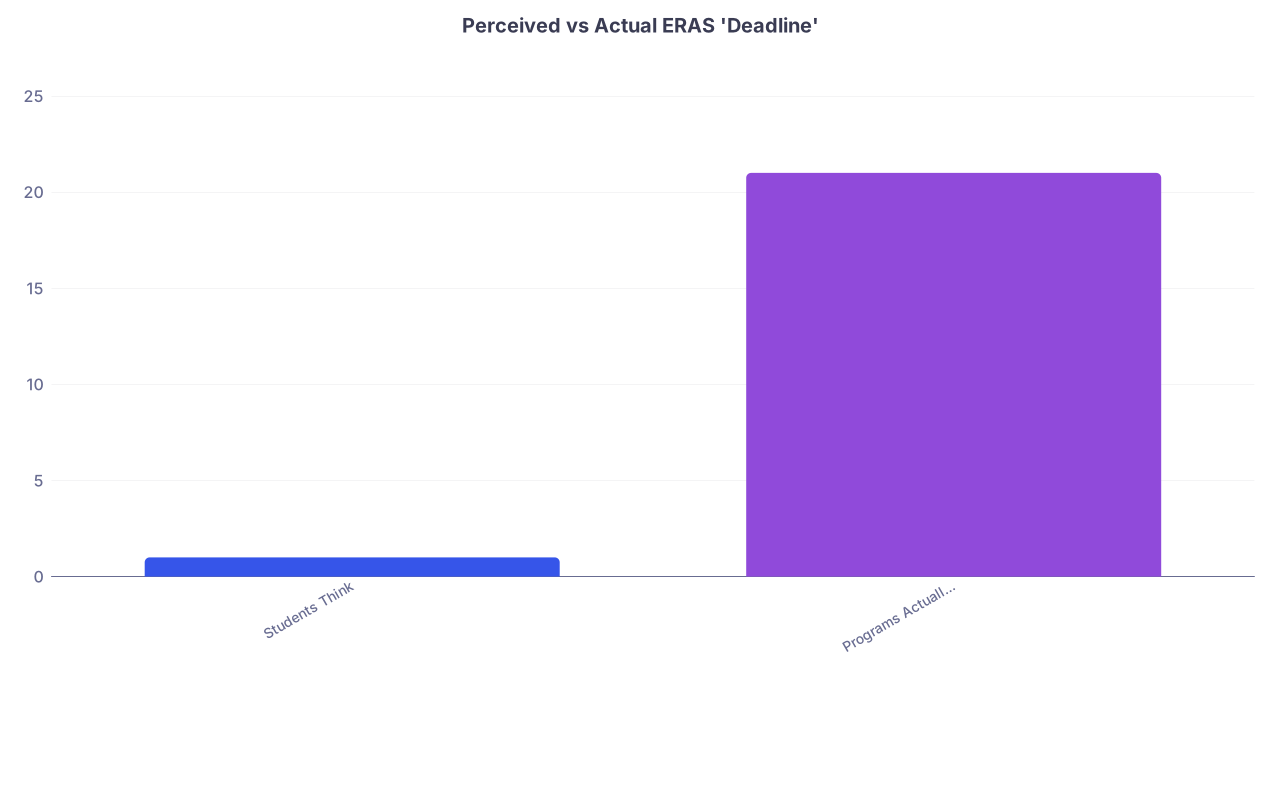
| Category | Value |
|---|---|
| Students Think | 1 |
| Programs Actually Do | 21 |
Most students think:
“If I don’t submit the minute ERAS opens or on the first download date, I’m finished.”
Most programs function more like:
“We get a giant flood of apps the first few days. Then we spend weeks sifting, sorting, auto-screening, and glancing at PDFs between cases and clinic.”
So three questions actually matter:
- Did you submit before programs could start downloading applications?
- If not, how many days after that first download day did you submit?
- How competitive is your specialty and your own app?
You said three days late. I’m going to assume this means:
Programs could start accessing ERAS on Day 0, and you submitted on Day 3.
That is not “late” in any meaningful operational sense. It’s “not optimized early,” sure. But this is not you applying in November for a September-October interview season.
I’ve seen people submit:
- One week after download day → still match at solid university programs.
- Two to three weeks after → fewer interviews but still matched in primary care and mid-competitive specialties.
- In November/December → yes, that’s when things really start to hurt.
Three days is annoying. Not catastrophic.
What Programs Actually Do During Those First Days
Here’s the part social media doesn’t explain: programs do not sit there at 9:00 a.m. on download day and hand out all the interview spots in 48 hours.
I’ve watched PDs and coordinators during this stretch. It’s chaos.
They:
- Download a mountain of apps.
- Turn on filters (Step cutoffs, US vs IMG, red flags, geographic preferences).
- Let ERAS or Thalamus or whatever software pre-screen half the list.
- Skim the top group first when they have time, not linearly in the order received.
There’s no inbox that sorts by “timestamp of submission” and then they invite the first 80 people and auto-reject everyone else.
So if you’re imagining some program coordinator saying, “Oh, this one is stamped 3 days later, trash” — that’s just not how it works.
Most programs have some kind of rough timeline like this:
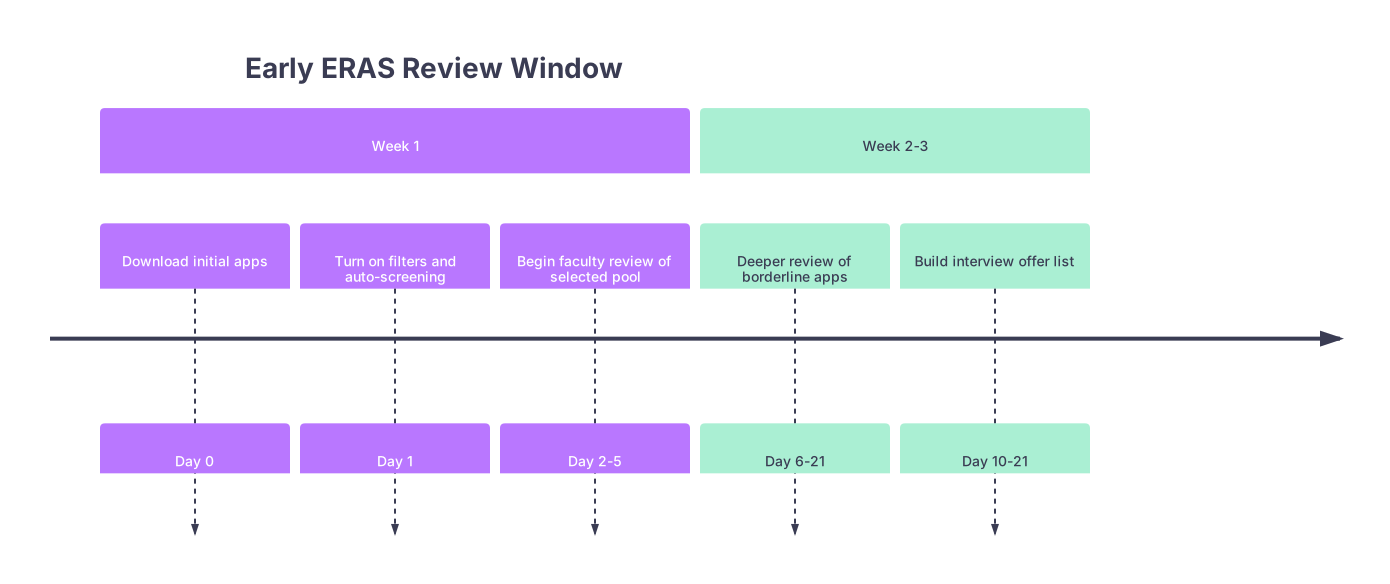
| Period | Event |
|---|---|
| Week 1 - Download initial apps | Day 0 |
| Week 1 - Turn on filters and auto-screening | Day 1 |
| Week 1 - Begin faculty review of selected pool | Day 2-5 |
| Week 2-3 - Deeper review of borderline apps | Day 6-21 |
| Week 2-3 - Build interview offer list | Day 10-21 |
Now, think about where “three days” fits in that mess.
You’re still at the very, very beginning of their review process. Your application is in the same early blob as everyone else who submitted on the dot or one day “late.” The people who are actually in trouble are the ones showing up once the first two waves of interview invites are already out.
When Three Days Does Matter More
Okay, let’s not sugarcoat everything. There are scenarios where even a small delay stings a bit.
Three days matters more when:
- You’re applying to a hyper-competitive specialty (Derm, Ortho, Plastic, ENT, NSGY, some competitive EM/Anes in certain regions).
- You’re a borderline applicant: low Step 2, no AOA, weak home institution, no research, or multiple red flags.
- You’re relying on very small, elite programs where they truly might look at every single app and move quickly.
- You submitted late and your letters or Step 2 are also pending, so your app looks incomplete at first glance.
Even then, it’s usually not “you’re done.” It’s “you might lose a couple of marginal interviews you would’ve gotten if everything were perfect and early.”
Here’s the uncomfortable truth: if your app is strong, three days won’t bury you. If your app is weak, submitting on the first second of eligibility also wouldn’t save you. Timing is an edge, not a miracle.
Incomplete vs Late: Big Difference
Something people blend together: the date you hit “submit” vs the date your application is actually complete in a program’s eyes.
If you:
- Submitted three days after download day
- But your USMLE/COMLEX scores, letters, and transcript were already in or followed quickly
you’re fine. Programs can review you almost right away.
If you:
- Submitted on time
- But your Step 2 wasn’t in for another month
- Or a key letter never arrived until late October
that can hurt more than the difference between Day 0 and Day 3.
Programs are often hesitant to invite without Step 2 (now that Step 1 is P/F) or without at least 2–3 letters. So if your “three-day late” submission was actually complete early, you might be ahead of classmates who clicked submit on time but dragged their letters and scores.
Specialty Reality Check: Where Timing Hurts vs Where It Doesn’t
Some specialties are extremely timing sensitive. Others really aren’t—at least not at the day-level.
Here’s a rough sense of how obsessed you should be with “three days late” by specialty competitiveness:
| Specialty Tier | Examples | Impact of 3-Day Delay |
|---|---|---|
| Ultra-competitive | Derm, Plastics, ENT, Ortho, NSGY | Minor negative edge, not fatal |
| Mid-competitive | EM (varies), Anes, Rad, OB/GYN, Gas-heavy IM | Slight, usually negligible |
| Less competitive / more spots | FM, IM, Peds, Psych, Neuro | Essentially negligible |
I’ve watched applicants in FM/IM/Peds submit one to two weeks after opening and still get more interviews than they could attend, as long as their apps were solid.
Where I’ve seen timing hurt more is:
- Derm applicant with strong stats, but Step 2 and major letter late → got fewer interviews than expected.
- Ortho applicant submitting everything late October → survived with a prelim spot but it was dicey.
- EM applicant submitting very late in a rough EM market year → had to SOAP.
Your situation? Three days? That’s not that.
The Real Question: Are You Using This as a Scapegoat?
Anxiety loves simple villains.
“Three days late” is clean and easy to blame. It’s way simpler than facing:
- Maybe my Step 2 is a 219 and that matters more.
- Maybe I didn’t get a strong letter from my home department.
- Maybe my personal statement feels generic.
- Maybe I applied to too few places.
If your brain is pinning everything on timing, of course it feels like you “ruined” your chances. It gives you a single moment you can point to and hate.
Be honest: if you’d submitted on time, would you really be calm? Or would you just be spiraling about something else right now—your personal statement, your away rotation, the PD who seemed cold, your lack of research?
You’re not anxious because of the three days. You’re anxious because the Match is brutal, numbers are opaque, and there are no guarantees. And your brain picked “three days” as a target it can grab onto.
What You Can Still Control (Yes, Right Now)
You can’t time travel. You can’t un-click submit and redo it on Day 0.
So what’s actually left?
A lot more than your panic is telling you.
First: make sure your application is maximally complete and clean now.
- Are all your letters uploaded and assigned correctly?
- Is Step 2 in (if you’ve taken it)? If not, is your test date reasonable for this cycle?
- Are there any obvious typos or missing bits you can still fix (within what ERAS allows)?
Second: apply smart, not stubborn.
If you’re worried timing plus a borderline app is an issue, you can still:
- Add a few more safety programs, especially in less competitive locations.
- Be realistic about your list: a top-heavy list + slightly late + average stats is a risk.
Third: absolutely nail the part of this process that still has huge variance:
- Interview performance.
- Post-interview communications (where appropriate and non-creepy).
- Ranking strategy.
People obsess over submission timing and then bomb interviews after sleeping 3 hours and over-caffeinating. That will cost you way more than three days ever will.
The Myth Of “If I Don’t Match, It’s Because Of X”
Here’s what I hate about how we talk about this stuff: everyone wants a clean story.
“If I don’t match, it’s because I didn’t submit on the first day.”
“If I don’t match, it’s because of that one C on my transcript.”
“If I don’t match, it’s because I didn’t do an away at Big Name University.”
Reality is messier.
Match outcome = cumulative pile of:
- Scores, grades, letters, school reputation.
- Specialty choice and year-specific weirdness (like a sudden drop in EM spots or program closures).
- How many places you applied.
- Where you applied (geography can quietly destroy otherwise good applications).
- Interview vibes—yes, the intangible “did they like you” thing.
- And yes, timing… but as one factor, not the only one.
Your brain is trying to reduce that to a single villain: “three days.” It feels safer to be mad at a date than to accept that the system is chaotic and sometimes unfair.
If you don’t match, people will happily backfit a story for you:
“Oh yeah, it’s because you submitted late” or “it’s because you didn’t apply to X region.”
Don’t let yourself buy that simple narrative right now. Not when you’re still in the middle of the process and can actually influence what happens next.
Concrete Reassurance, Not Just Vibes
Let me anchor this with what I’ve actually seen:
- IM applicant, mid-tier MD school, Step 2: 232, ERAS submitted 1 week after download day → 18 interviews, matched at solid university IM program.
- Peds applicant, DO, average scores, ERAS submitted 10 days after download day → 12 interviews, matched comfortably.
- Psych applicant, MD, strong letters, ERAS submitted on time but Step 2 came in late October → fewer interviews than expected, but still matched.
- Derm applicant, MD, high Step 2 but letters and ERAS both late → very few interviews, did prelim IM, re-applied.
The pattern: three days is noise. Strength of app, specialty, and completeness timing are signal.
If someone told me, “I submitted ERAS three days late, did I ruin my Match?” I’d say:
No. If you’re going to struggle to match, it won’t be because of that.
What To Do With The Anxiety Now
You can’t logic your way out of all the anxiety. You’re in a process where you can do “everything right” and still feel sick for months.
But you can:
- Acknowledge that “three days late” is you trying to control the uncontrollable.
- Double-check your application materials once more, then stop re-opening ERAS like a compulsion.
- Shift your energy to interview prep, reading about programs, and making a realistic program list.
And then, honestly? You sit with the discomfort. Because this entire year is one giant waiting game, and your brain will keep picking new things to worry about the second this one calms down.
You didn’t ruin your Match by submitting ERAS three days late.
You did give your anxiety a catchy headline to scream at you about.
Key Takeaways
- A three-day delay after ERAS opens is not what makes or breaks your Match; it’s a minor factor at most, especially outside the ultra-competitive specialties.
- Programs don’t hand out all interviews on day one; they review applications over weeks, using filters and batches where a three-day difference is basically noise.
- Your time is better spent making your application complete, realistic, and preparing for interviews than replaying the submission date in your head.