
Last September, a classmate of mine hit “Certify and Submit” on ERAS at 9:13 a.m. At 9:30, her phone buzzed: “Your Step 2 CK score is now available.” She literally put her head down on the table and said, “You’ve got to be kidding me.”
If you’re here, you’re probably living in that exact mental space: what if my Step 2 CK posts right after I submit ERAS? Did I just destroy my chances? Did I submit “too early”? Should I have waited?
Let’s walk through this the way your anxious brain is doing it, but with the actual rules and consequences laid on top.
First: What Actually Happens If Step 2 CK Posts After You Submit?
Let me rip off the band-aid: ERAS does not magically freeze your USMLE scores the moment you submit.
Programs see whatever scores are available when they download your USMLE transcript. Your transcript is a separate document that gets attached to ERAS; you authorize its release when you submit, but it can be updated.
Here’s what this means in real life:
- You submit ERAS on, say, September 5.
- Your Step 2 CK posts September 6.
- Your USMLE transcript gets updated at the NBME/ECFMG side.
- Once you re-release / retransmit your USMLE transcript in ERAS (one-click, no extra fee), programs that haven’t yet downloaded it will see the updated version with Step 2.
So no, you did not lock in some Step-2-less version of yourself forever.
The real questions are:
- Will programs see your Step 2?
- Will they see it in time to impact interviews?
- What if it’s lower than you hoped?
Different answers, different levels of panic.
The timing game: Did I mess up by submitting before my Step 2 posted?
The classic anxiety: “Everyone said submit day 1. But my Step 2 score wouldn’t be back until a week later. Did I basically submit a half-finished application?”
Short answer: No. You did the right thing.
Programs care about three timing buckets:
- Primary application timing – When you hit submit / when ERAS releases your app.
- USMLE transcript content – Which scores exist when they pull it.
- When they actually start screening – Which is not always day 1.
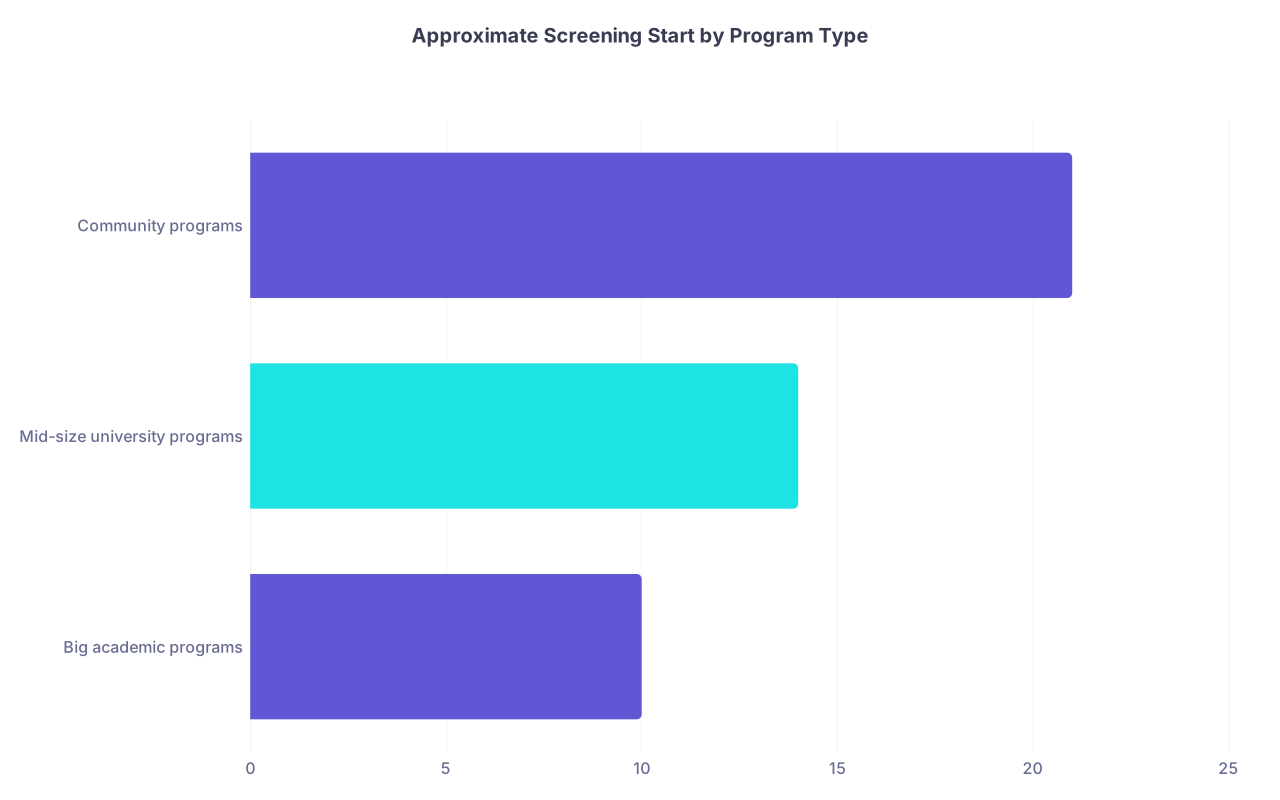
To give you a sense of how this plays out:
| Category | Value |
|---|---|
| Big academic programs | 10 |
| Mid-size university programs | 14 |
| Community programs | 21 |
This is not official data, but it’s what I’ve seen over and over: big-name places often start screening earlier, some even within the first week. Smaller or community programs sometimes don’t dig in until a bit later.
So if your Step 2 CK posts within a week or two of ERAS opening, and you:
- Immediately retransmit your USMLE transcript in ERAS, and
- Your score is not a complete disaster relative to your Step 1 and specialty…
…then a lot of programs will still either see it before finalizing interview invites or at least before ranking.
Would it have been “perfect” to have your score ready on day 1? Sure.
Is applying day 1 without Step 2 the kiss of death? No. And honestly, waiting to submit just to see your score would’ve been a bigger risk.
The nightmare scenario your brain is spinning: What if my Step 2 is bad?
Here’s the version that keeps people awake:
- You applied to something competitive (derm, ortho, ENT, gas, etc.).
- You had a decent Step 1 (even if it’s pass/fail now, programs still see pass/fail timing, context, and sometimes old scores).
- You were banking on Step 2 to “save” you.
- You submit ERAS.
- Step 2 posts the next day and it’s… not great. Maybe below your target specialty average. Maybe just average. Maybe actually low.
So you’re thinking: “If I had waited a day, I could have just not released Step 2 at all for now. Now it’s too late. Programs will see this and toss my app.”
Let me be blunt: this situation sucks. But it’s not game over.
Here’s how the logic actually works from the program side:
- Programs don’t get a separate “Step 1 only” vs “Step 1 + Step 2” transcript. They just get whatever is current when they pull it.
- If you don’t retransmit your transcript after Step 2 posts, some programs will still pick up your updated score later when they refresh transcripts for ranking, credentialing, or completeness checks.
- Hiding Step 2 indefinitely is basically not realistic if you’re going to match in the U.S. You’ll need it eventually.
So the real choice is not “show the bad score vs hide it forever.” It’s more like:
- Do I update early so programs can evaluate my full picture when selecting interviews?
- Or do I delay updating and risk:
- Being filtered out for “missing Step 2” at programs that want it early
- Having Step 2 show up late in the cycle, after many decisions are already made?
For most people, if the score is passing and not catastrophically low, updating earlier is actually better. Programs can then see the story:
- Maybe your Step 1 was borderline but Step 2 is solid → upward trend.
- Or Step 1 was strong and Step 2 is a bit lower → they still see you can pass everything.
The only time I’d even hesitate is if:
- You applied to a hyper-competitive specialty, and
- Your Step 2 is way below that specialty’s usual range, and
- You have a reasonable backup specialty you already applied to as well.
Even then, most programs in both specialties will want Step 2 before ranking. You’re delaying the inevitable more than you’re saving yourself.
How this interacts with “best time to submit ERAS”
Your brain is probably trying to solve an impossible puzzle:
- “Everyone says early is best.”
- “But what if my Step 2 score is crucial?”
- “But if I wait for Step 2, I’ll be late.”
- “If I don’t wait, my application looks incomplete.”
Here’s the hierarchy of what actually matters:
- Submitting your primary ERAS early (or at least not late)
- Having a complete-enough application to not be auto-screened out
- Fine-tuning with Step 2 / letters / updates
Programs can, and do, make early cuts based on:
- Missing documents
- Step score filters
- Gross mismatches (like applying to neurosurgery with zero neuro anything)
But “you submitted without Step 2 and then added it a week later” is not this catastrophic event you’re imagining. Especially in less hyper-competitive specialties like internal medicine, peds, family, psych, even EM at many places.
Here’s how I’d rank the scenarios, from best to worst, if we’re being brutally honest:
| Scenario | Competitiveness Impact |
|---|---|
| Submit ERAS early, Step 2 already posted and solid | Best |
| Submit ERAS early, Step 2 posts within 1–2 weeks, retransmit quickly | Very good |
| Submit ERAS on-time, Step 2 pending, posts mid-late Sept, you retransmit | Fine/neutral |
| Delay ERAS submission until Step 2 returns, submit late | Worse than submitting early without Step 2 |
| Submit early, Step 2 posts quickly and is very low, never update transcript | Risky, often worse long term |
So if you already submitted ERAS and your Step 2 is posting “right after”… you’re actually sitting in one of the better buckets. Annoying timing, yes. Fatal error, no.
Step 2 posts. Now what the hell do I do?
Picture it: you refresh your NBME account, your score pops up, your stomach drops or maybe just sort of sags. Now what?
Here’s the sequence I’d follow (yes, this is where a flowchart helps):

| Step | Description |
|---|---|
| Step 1 | Step 2 CK score posts |
| Step 2 | Talk to dean/advisor ASAP |
| Step 3 | Retransmit USMLE transcript within 24-48h |
| Step 4 | Discuss with advisor, likely still retransmit |
| Step 5 | Consider targeted emails, address in PS/LOI |
| Step 6 | Retransmit, focus on other strengths |
| Step 7 | Score passing? |
| Step 8 | Roughly in line with Step 1 & specialty? |
| Step 9 | Applying to very competitive specialty only? |
Some nuance:
If you failed Step 2:
This is a different beast. You need to talk to your dean’s office and a real human advisor immediately. You may need to:
- Pause sending updated transcripts temporarily
- Decide whether to keep this application cycle going
- Consider a formal plan for retaking, maybe postponing graduation, etc.
But if your score is passing, even if it’s not your dream number, your default move is almost always:
- Retransmit your USMLE transcript in ERAS within a day or two.
- Don’t send a panicked email to every PD explaining your feelings about it.
If there’s a significant discrepancy (like Step 1 fail, Step 2 pass; or a known extenuating circumstance during Step 2), then you might later address it strategically in a PD email, personal statement revision for a few programs, or at interviews. But not in a frantic mass-blast.
What if programs already saw my app before Step 2 posted?
Another favorite anxiety loop:
“Programs downloaded my application the minute ERAS opened. They screened me with no Step 2. Now if I add it, it’s too late.”
Couple reality checks:
- Many programs do multiple waves of review. They don’t finalize everything on day 1. Updates can still matter.
- Some programs run automated filters that update when your transcript updates. For example, if they require passing Step 2 by ranking time.
- Even if you don’t get extra interviews from the Step 2 update, it can still help how they rank you if you do get interviewed.
Think of it like this: your early submission got you “in the door” timing-wise. Your Step 2 update is more like bringing an extra document to the table. Not ideal to have it late, but still better than never.
And yes, some programs will never care. Some will barely look. Others will quietly bump you up a bit because they like seeing all green checkmarks before ranking.
Specialty reality check: does this matter more for some than others?
Absolutely. Your level of panic should be… calibrated.
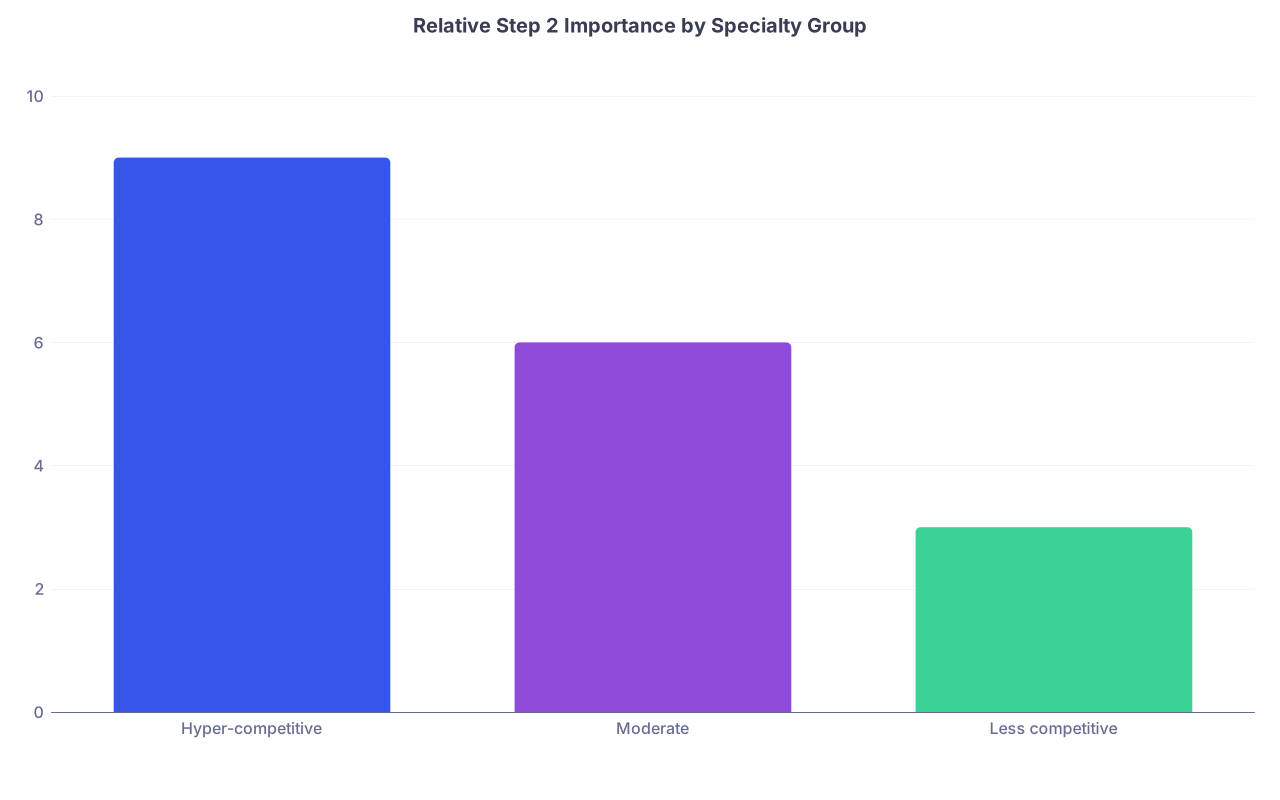
Here’s a rough sense of how heavily Step 2 timing and scores hit different buckets:
| Category | Value |
|---|---|
| Hyper-competitive | 9 |
| Moderate | 6 |
| Less competitive | 3 |
Hyper-competitive (ortho, derm, plastics, ENT, neurosurg, some rads/anesthesia):
- Programs care a lot about board metrics.
- Late or weak Step 2 can absolutely hurt.
- But submitting ERAS late just to wait for Step 2 usually hurts more.
Moderate (EM, anesthesia widely, rads, OB/GYN, gen surg at solid but not insane places):
- Step 2 still matters, especially if Step 1 was pass/fail or weak.
- Posting a week or two after submission is usually survivable if you retransmit quickly.
Less competitive (FM, IM [non-elite], peds, psych at many programs):
- Being complete-ish and on-time matters more than exact Step 2 timing.
- A passing Step 2 that shows up a bit late is usually no big deal.
If you’re in the super-competitive bucket and your Step 2 comes back disappointing, that’s when you start thinking about:
- Backup specialties
- Reframing your narrative (research-focused, niche interest, strong letters)
- Possibly planning for a re-application cycle if things go badly
But that’s a bigger, longer conversation. Not something you fix in 24 hours by wishing you’d timed ERAS differently.
So did I ruin my chances by submitting ERAS before Step 2 posted?
No. You didn’t.
You might have made things messier or less than ideal, but that’s not the same as fatal. The whole ERAS process is basically: everybody submitting imperfect applications at imperfect times with imperfect scores, and programs choosing the humans they think they can work with.
What saves people in this situation over and over again isn’t perfect timing. It’s:
- They submitted on time
- They updated their transcript when scores came out
- They didn’t panic-email themselves into red-flag territory
- Their overall story (letters, experiences, personal statement, interview performance) carried more weight than one number posting 3 days “too late”
You’re allowed to be frustrated. The timing does suck. But you didn’t commit some fatal strategic error by not freezing all scores in place before hitting submit.
One thing you can do today
Log in to ERAS and check your documents.
If your Step 2 CK score is available, make sure your USMLE transcript has been retransmitted to programs. If it hasn’t, do that now. Then close the tab.
No doom-scrolling, no constant refreshing to see if interviews magically appear the same afternoon. Just that one concrete step to make sure programs can see the full version of you that actually exists today, not last week’s version you’re still beating yourself up over.