
The obsession with “Day 1 perfect ERAS” is wildly overblown—and it’s stressing you out for no good reason.
Let me be clear: timing matters. But not in the ridiculous, catastrophic way you’re imagining at 2 a.m. while staring at your unfinished experiences section for the 47th time.
You’re probably running through the same horror scenarios in your head:
- “If I don’t submit at 8:00:00 AM on opening day, all the interview spots will be gone.”
- “If I submit with anything less than a flawless, copy-edited-by-10-people, Pulitzer-level application, I’ll look unprofessional.”
- “If I wait to perfect it, I’ll submit late and automatically be filtered out.”
So you’re frozen. Cursor hovering over “Certify and Submit,” heart pounding, convinced that one wrong move will ruin your entire career.
Let’s dismantle that.
What “Day One” Actually Means (vs. What Your Brain Thinks It Means)
You’re imagining this like concert tickets: the people who click first get the seats, and after that, it’s standing room only.
Residency programs do not work like Ticketmaster.
ERAS has two big “timing” pieces you’re conflating:
- When applicants can submit applications
- When programs actually receive and can start reviewing those applications
Those are not always the same day.
Most years, there’s a window where you can work on ERAS and even “submit,” but programs don’t get anything until a designated release date. On that release date, every application submitted before that time drops into their inbox at once. No one who submitted three days earlier is “higher” in the pile than someone who submitted an hour before the release.
So your panic about being 30 minutes “late” on day one? Completely detached from reality.
For the vast majority of applicants:
- Being “ready on or near the program release date” is what matters.
- Not “I submitted at 8:00 AM Eastern on the first possible day or my life is over.”
Could there be tiny edge cases at hyper-competitive programs that pre-screen insanely early? Sure. But you’re not losing all your interviews because you hit submit at lunch instead of sunrise.
How Perfect Does ERAS Need to Be on That First Day?
Here’s the part that’s really messing with your head: you’re treating ERAS like a one-shot, nuclear launch code document that must be flawless from line one to the last period.
It doesn’t need to be perfect.
It needs to be:
- Competent
- Coherent
- Honest
- Mostly clean
That’s it.
Let me walk through the parts you’re most scared about and how “perfect” they honestly need to be on day one.
Personal Statement
You’re convinced your personal statement will either:
A) Secure you every interview, or
B) Single-handedly tank your entire application
Reality: It’s usually neither. For most applicants, the PS is a supporting document, not the star.
Good enough on day one means:
- Clear why you chose this specialty
- Concrete examples of your interest/experience
- No major spelling/grammar disasters
- Not obviously generic, robotic, or plagiarized
Is it okay if:
- It’s not the best thing you’ve ever written? Yes.
- You think your friend’s is more impressive? Still yes.
- You read it and feel mildly unhappy because you’re a perfectionist? Absolutely yes.
Could a terrible statement hurt you? Sure—like wildly unprofessional, offensive, or completely irrelevant content. But “not poetic enough” is not what kills applications.
Experiences Section
You’re terrified that:
- One awkwardly worded bullet will make you look incompetent
- Listing something as “20 hours” instead of “30 hours” will be “lying”
- Not having every experience perfectly quantified will make programs think you’re lazy
Relax.
Programs skim this section. They’re looking for:
- Evidence of sustained commitment (not 100 one-off things)
- Leadership, teamwork, communication, responsibility
- That your story matches what you say you care about
What they are not doing:
- Counting hours with a calculator
- Cross-checking that your description sounds like polished LinkedIn corporate speak
- Rejecting you because one bullet point uses a weak verb
If your experiences are accurate, generally well organized, and not full of typos, you’re fine. That’s “day-one ready.”
The Stuff That Actually Needs to Be Right Before You Hit Submit
Okay, here’s where I stop being comforting and get a little harsh: there are things you absolutely can’t mess around with.
These need to be correct and ready when you submit:
BIOGRAPHIC / IDENTIFYING INFO
Your name, AAMC ID, contact info, citizenship/visa status. If a program can’t reach you or thinks you misrepresented your status, that’s bad.PROGRAM LIST
Double-check you’re applying to the correct specialty and the correct institution. People do accidentally apply to prelim-only programs when they needed categorical. I’ve seen that. It’s not fun.USMLE / COMLEX SCORES
Whatever is available at submission should be correctly entered and released. Don’t play weird games with hiding scores unless you’ve thought it through and understand the risks.MSPE / Transcript Release
That’s handled through your school, but make sure your side is done so nothing is held up when they’re released.Certifying the Application
Once you certify, you can’t change certain fields. You don’t have to panic about micro details, but don’t rush through and check boxes randomly.
This is the stuff that can create actual problems if wrong. This is worth your anxiety. Not whether your third experience bullet uses “collaborated” or “worked with.”
Early vs. Perfect: What Programs Actually Care About
Here’s how most programs function behind the scenes—not the mythology you hear on Reddit.
On the application release day, programs are suddenly staring at hundreds or thousands of files. Do they read every single one front to back? No shot.
They:
- Apply filters (exam scores, graduation year, sometimes geographic ties)
- Have coordinators or residents screen a chunk of apps
- Flag strong/interesting applicants for faculty to review more closely
- Start sending interview offers in waves
Nowhere in there is: “Reject anyone who didn’t submit the exact minute ERAS opened.”
You want to understand the trade-off like this:
- Submitting by the time programs realistically start reviewing = important
- Obsessively perfecting for weeks after program review has started = risky
- Making yourself sick trying to be first in line by 3 hours = useless
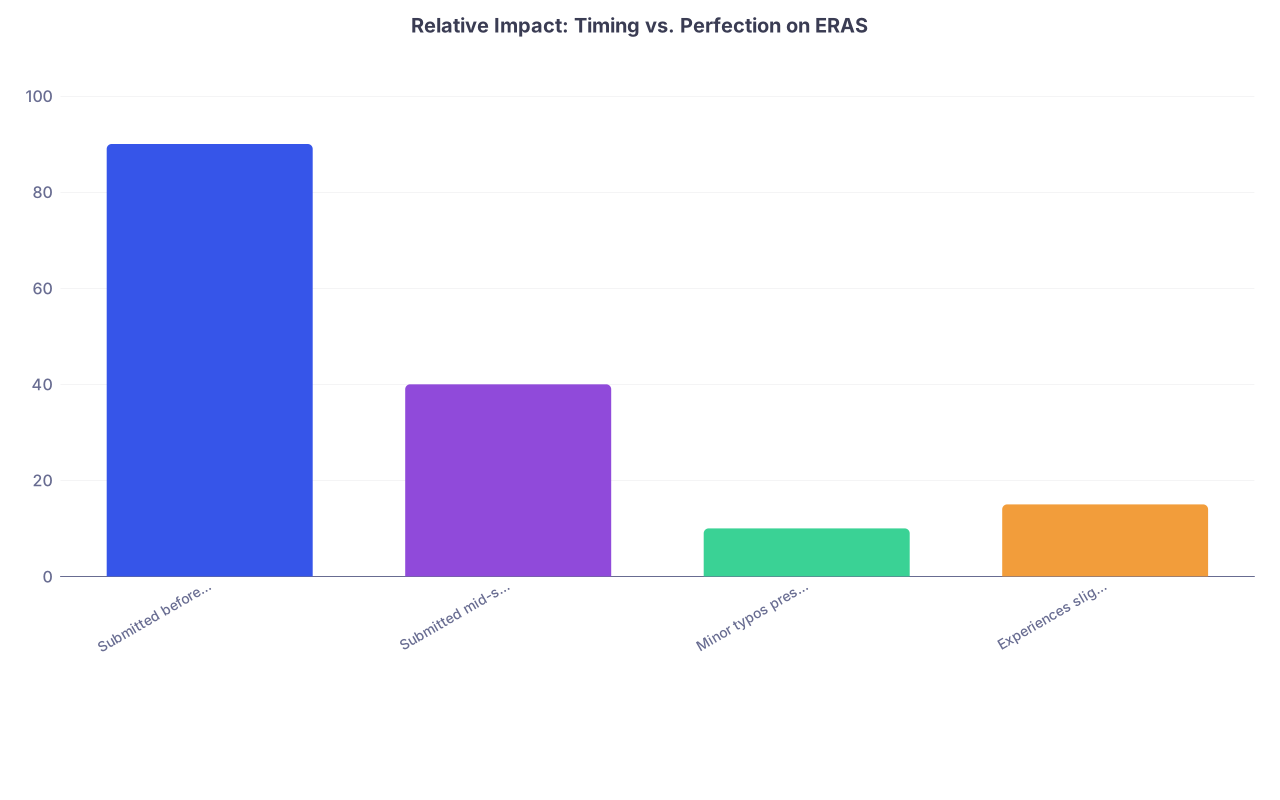
| Category | Value |
|---|---|
| Submitted before reviews start | 90 |
| Submitted mid-season | 40 |
| Minor typos present | 10 |
| Experiences slightly under-polished | 15 |
That chart isn’t exact science, but you get the idea: being generally on time matters a lot more than minor imperfections.
The nightmare scenario isn’t “I submitted with two typos.”
It’s “I waited three extra weeks to edit out those typos, and by then half the interview slots were gone.”
What You Can Fix After Submission (And What You’re Stuck With)
This is the other thing ramping your anxiety: the idea that hitting submit is permanent, irreversible doom. Once you certify, you can’t edit most of the core application content.
But there are things that update over time:
- New letters of recommendation can still be uploaded and assigned later.
- New exam scores (Step 2, COMLEX Level 2) can be released later.
- Some programs review in waves, and you’ll be seen when they get to you, not necessarily on day one only.
What you can’t do after certifying:
- Rewrite your personal statement in ERAS and have it magically replace the old one already sent
- Fix the awkward phrasing in your research description
- Change your volunteer hours from 150 to 200 because you kept going after submission
So yes, you do need your application to be “final enough” that you can live with it. But not “I’ll never think of a better sentence in my life.”
Because you will think of better sentences later. That’s how the brain works. And you can’t keep your entire future on hold waiting for a level of perfection you’ll never hit.
When Delaying Actually Hurts You
There’s a line where “I want it to be good” turns into “I’m self-sabotaging because I’m scared.”
Delaying to:
- Fix huge inconsistencies?
- Add an important away rotation you just finished?
- Wait for a crucial transcript correction?
Reasonable.
Delaying because:
- You’re afraid of one comma being in the wrong place
- You keep asking 5 more people to “take one last look”
- You’re rewriting your personal statement from scratch for the 9th time
That’s not strategy. That’s anxiety in a lab coat.
The brutal truth: some programs send out a bunch of their interview invites relatively early in the cycle. If your application shows up weeks after release because you were tweaking adjectives, you might actually miss out. Not because of your quality, but because of your timing.
So the real question is not:
“How perfect does it need to be on day one?”
It’s:
“At what point am I sacrificing real opportunities for the illusion of control?”
A Practical “Am I Ready to Hit Submit?” Checklist
You want a sanity check? Here’s one.
If you can honestly say “yes” to these, you’re ready—even if you’re still scared:
- My demographic, clinical, and exam information is accurate.
- My personal statement clearly explains why I want this specialty and who I am—even if it’s not poetic.
- My experiences are honest, reasonably organized, and free of glaring typos.
- I’ve checked my program list at least twice for accuracy (categorical vs prelim, correct specialty).
- Someone I trust has looked over the application once for big red flags.
- My fear about hitting submit is mostly “what if they don’t like me?” not “I know there are huge mistakes I haven’t fixed.”
If those are true, your application is “ERAS-ready.” Not mythical perfect. But real-world good enough.
And that’s all you need.

| Step | Description |
|---|---|
| Step 1 | Working on ERAS |
| Step 2 | Fix demographics/exams |
| Step 3 | Revise for clarity, not perfection |
| Step 4 | Edit for basics, not flair |
| Step 5 | Submit now. Perfection can wait. |
| Step 6 | Polish briefly, then submit |
| Step 7 | Hit Certify & Submit |
| Step 8 | Core info accurate? |
| Step 9 | Personal statement clear? |
| Step 10 | Experiences honest & readable? |
| Step 11 | Delay = weeks or days? |
A Quick Reality Check on Your Worst Fears
Let’s match your catastrophizing to what actually happens:
Fear: “If there’s a typo, they’ll think I’m careless and reject me.”
Reality: If you have 1–2 minor typos in a 10+ page application, no one cares. A pattern of sloppiness everywhere? Different story. Tiny mistakes? Human.
Fear: “If my personal statement isn’t profound, I won’t get interviews.”
Reality: Most people’s statements are… fine. Programs will reject people with perfect statements and interview people with average ones. Your scores, letters, clinical narrative, and fit with the specialty matter more.
Fear: “If I don’t submit on day one, I’m automatically late.”
Reality: Submitting within a reasonable window around the release date is early enough. Truly late is weeks or months into interview season, not hours or a couple of days.
Fear: “Everyone else is confident and done. I’m the only disaster.”
Reality: Everyone is panicking. People who look chill on the outside are rewriting bullets the night before, too.

Summary: What You Need to Remember Before You Hit Submit
I’m not going to pretend this isn’t high stakes. It is. That’s why you’re scared.
But here’s the truth you need to walk away with:
- ERAS doesn’t have to be perfect on day one. It has to be accurate, coherent, and on time.
- Submitting reasonably early with a “B+” application is better than submitting late with an “A+” you over-edited into oblivion.
- Your anxiety is louder than the reality. A couple of typos or an unpoetic sentence will not end your match chances.
You’re allowed to be terrified. Hit submit anyway.
FAQ (Exactly 4 Questions)
1. If I find a mistake after I submit ERAS, am I screwed?
No. Unless it’s something huge like misreporting exam scores or visa status, it’s usually fine. You can’t edit most sections after certifying, but programs understand this is a huge, complex application. Minor errors happen. Don’t email programs about tiny typos; you’ll just draw attention to them. Fix what you can on your end (like future communications or interviews) and move on.
2. How late is “too late” to submit ERAS?
“Too late” isn’t one exact date, but if you’re submitting weeks after program applications are released, you start to hurt yourself—especially in competitive specialties. Submitting within a few days of program release? Still totally fine. Submitting 3–4 weeks after? Risky. Submitting months into interview season? Very bad idea unless there’s a serious reason (illness, major life event) and you’ve discussed it with mentors.
3. Do programs actually notice if I submit a few days after the release date?
Not in the way you think. They don’t sit there checking timestamps like, “Oh, this person submitted at 3:12 PM the next day—reject.” What can matter is whether your application is in the pool when they start serious review and inviting. As long as you’re in that first wave of applications they’re actively reviewing, a day or two difference won’t matter.
4. Should I wait to submit until I have my Step 2 / COMLEX Level 2 score?
If your Step 1 / Level 1 is weak and Step 2 / Level 2 is stronger, it can help to have it in by the time programs are reviewing. But that doesn’t always mean wait to submit. Often, you submit with what you have, then release the new score once it arrives. Talk to a mentor in your specialty—this is one of the few timing questions where individual strategy really matters.