
Programs are not sitting there at 9:00 AM on ERAS opening day judging you for not clicking “submit.”
They’re barely even looking at complete files yet.
Let me say the quiet part out loud: a ton of the panic around “you MUST submit ERAS the second it opens” is premed/med school forum mythology, not reality.
You and I both know what’s going on in your head, though:
“If I don’t submit on day one, they’ll think I procrastinate. If I don’t send it at 9:01 AM, they’ll assume I’m not serious. What if they fill their interview spots before they even see my app?”
So let’s actually walk through what really happens on the program side, what “late” actually means for ERAS, and how far you can push things before it does start to hurt you.
How Programs Actually See Your ERAS (vs. the Horror Movie in Your Head)
Picture what you’re imagining:
An attending and PD with multiple monitors, coffee in hand, refreshing ERAS at 8:59 AM like it’s Ticketmaster for Taylor Swift. Your name doesn’t show up, and they immediately put a mental black mark next to you: “Not motivated. Pass.”
Now picture what’s actually going on in most programs:
- They don’t even download applications the exact second they become available.
- A coordinator batch-downloads a massive pile of apps after the ERAS release date.
- Faculty review happens in waves, often days to weeks later.
- They literally cannot tell which day you physically clicked submit as long as it’s before the big data release.
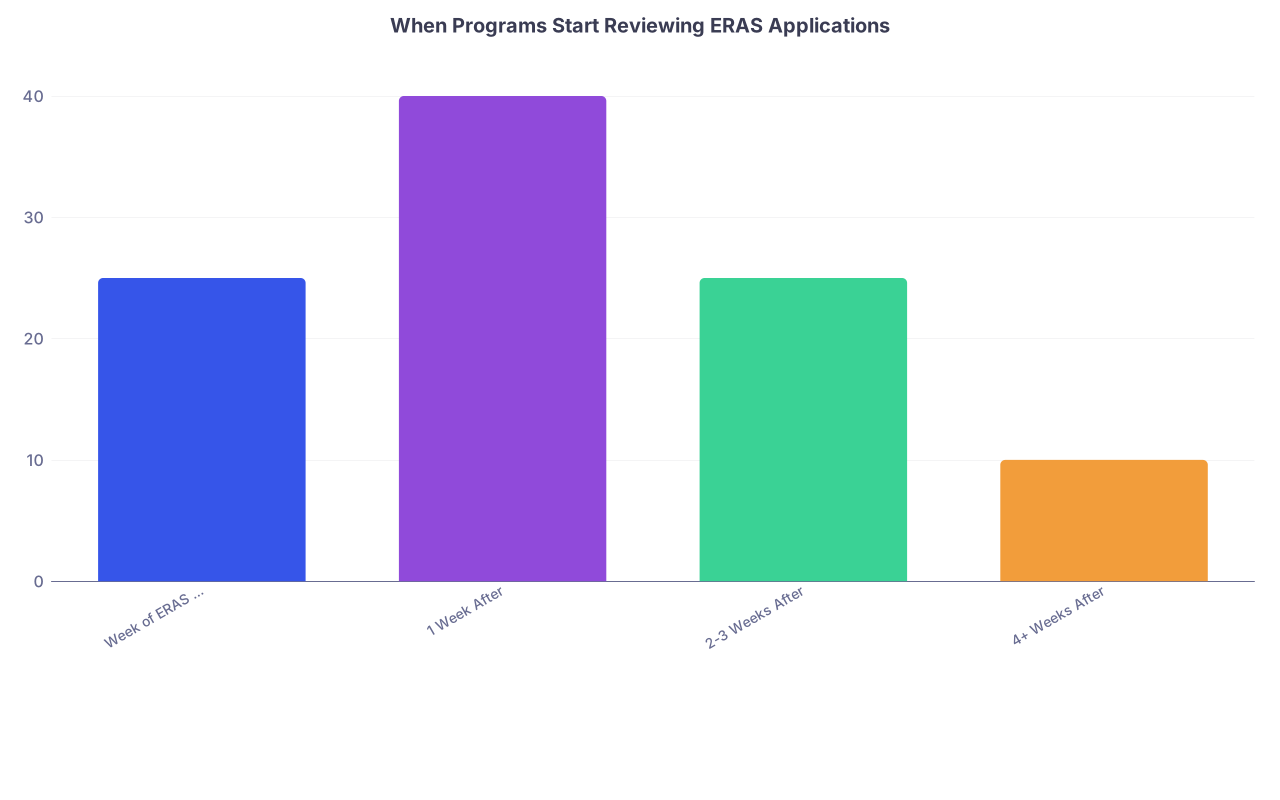
| Category | Value |
|---|---|
| Week of ERAS Release | 25 |
| 1 Week After | 40 |
| 2-3 Weeks After | 25 |
| 4+ Weeks After | 10 |
Is this exact data for every single program? No. But this is the pattern I’ve heard over and over from PDs and coordinators:
- “We don’t start seriously reviewing until the weekend after ERAS opens.”
- “Faculty don’t get their first review lists until the second week.”
- “We set an internal review deadline, not a ‘must have application on opening minute’ cut-off.”
They care about complete vs incomplete. Strong vs weak. Consistent vs inconsistent.
Not “9:00 AM vs 2:00 PM on day one.”
If your app is there when they pull their first big batch to review, you’re early enough.
What Actually Counts as “Early,” “On Time,” and “Late”?
The anxiety trap is thinking there are only two buckets:
- Early = opening minute
- Late = anything after that
That’s just not how this works.
Here’s a more realistic breakdown of timing during application season.
| Timing (Relative to ERAS Opening/Release) | How Programs Usually See It | Actual Risk Level |
|---|---|---|
| Submitted before ERAS release to programs | Early / Ideal | Very low |
| Submitted within 1 week after release | On time / Normal | Very low–low |
| Submitted 2–3 weeks after release | Slightly late but fine | Low–moderate |
| Submitted 4–5+ weeks after release | Late | Moderate–high |
| Submitted near/in November | Very late | High |
Key nuance you can stop losing sleep over:
Early vs On-Time
Programs do not treat “submitted on opening day” vs “submitted within the same first week” as dramatically different. They see all of that as early/normal. There’s no checkbox they click that says “this person was 4 days slower to submit.”The real danger zone
The panic should not be: “I clicked submit on day 5 instead of day 1.”
The panic might be: “It’s mid-October, and my app still isn’t in because I’m rewriting my personal statement again.”
If you’re within that first 1–2 weeks of the release date, they are not labeling you lazy. You’re just another normal applicant in a giant spreadsheet.
“But Won’t They Think I Procrastinate or Don’t Care?”
This is the core fear, right? Not just missing out. Being judged.
Here’s the blunt truth: programs don’t psychoanalyze your submission timestamp. They psychoanalyze:
- Your Step/COMLEX and transcript: Are you consistent or all over the place?
- Your clinical evaluations: Does your story line up across letters and MSPE?
- Your personal statement and activities: Do they read like a real person or generic fluff?
- Your red flags or unexplained gaps: Are you honest and coherent about them?
They are not sitting there saying:
“This candidate took 4 extra days to submit ERAS. Clearly doesn’t want it enough.”
I’ve watched PDs skim 50 applications in a row. They look at name, school, scores, experiences, letters, personal statement, sometimes research. They do not scroll up and say, “Hmm, what day did this user log in and click finalize?”
The only time timing feels like a character judgment is when it’s patterned:
- Your ERAS was super late.
- Your Step 2 CK wasn’t taken anywhere near when advised.
- Your letters trickled in at the last second.
- Your dean’s office had to chase you to finish mandatory stuff.
Then maybe someone quietly wonders if you’re disorganized. But that’s about the whole behavior pattern, not “submitted on opening vs day four.”
If all you’re “guilty” of is not being one of the hyper-anxious people who sprinted to submit at 9:00 AM sharp? That’s not laziness. That’s… normal.
The Real Trade-Off: Perfect vs Early Enough
Here’s where it actually gets tricky. You’re scared of being late. But you’re also scared of sending something that’s not perfect.
So you end up stuck in this awful loop:
- “I should submit now so I’m early…”
- “…but this sentence in my personal statement sounds weird…”
- “…and this activity description could be stronger…”
- “…but if I wait, I’ll be late and never match…”
Here’s my honest take: being “late” by a few days because you improved your application meaningfully is not a problem. Being “late” by weeks because you’re tweaking tiny things out of panic is.
Let’s draw a line.
Delaying a few days is reasonable if:
- You’re waiting on a major core letter (like from a critical sub-I).
- Your personal statement is still a mess, not just missing a nicer adjective.
- There’s a significant red flag you’re not addressing coherently yet.
- You’re finalizing your school list and haven’t actually done the research.
Delaying becomes self-sabotage if:
- You’re obsessively rearranging sentences that were already fine.
- You’ve had 5 people read it and they’re all saying “submit, it’s good.”
- You keep pretending you’re “editing” when really you’re just avoiding the anxiety of being done.
- The only thing keeping you from submitting is the fear that you could always make it “a little better.”
At some point, “I’m just being thorough” turns into “I’m slowly making myself late for no real gain.”
You don’t need perfect. You need:
- Coherent
- Honest
- Proofread
- Submitted close to the ERAS release date
That’s enough.
How Long Is Too Long to Wait?
Let’s talk numbers because the vague “don’t be late” is useless when your anxiety brain is screaming.
Assuming a typical ERAS cycle where programs can first see apps on a specific release day:
If you:
Submit before the release date
You’re in the “no one will ever question your timing” zone.Submit within 7 days after the release date
You are still solid. Zero reasonable program is calling that lazy.Submit 2–3 weeks after release
You’re not “blacklisted,” but you might miss out on a few early invites at the most competitive places. Still very matchable, especially in non-ultra-competitive fields and with a solid app.Submit 4–5+ weeks after release
Now you’re tangibly late. Some programs will have done their first wave of invites. You’re making your life harder, especially in competitive specialties or locations.Submit in November
This is where people burn themselves. At that point, yeah, some programs will assume something went wrong (Step scores, professionalism issues, or serious disorganization), unless there’s a clear explanation.
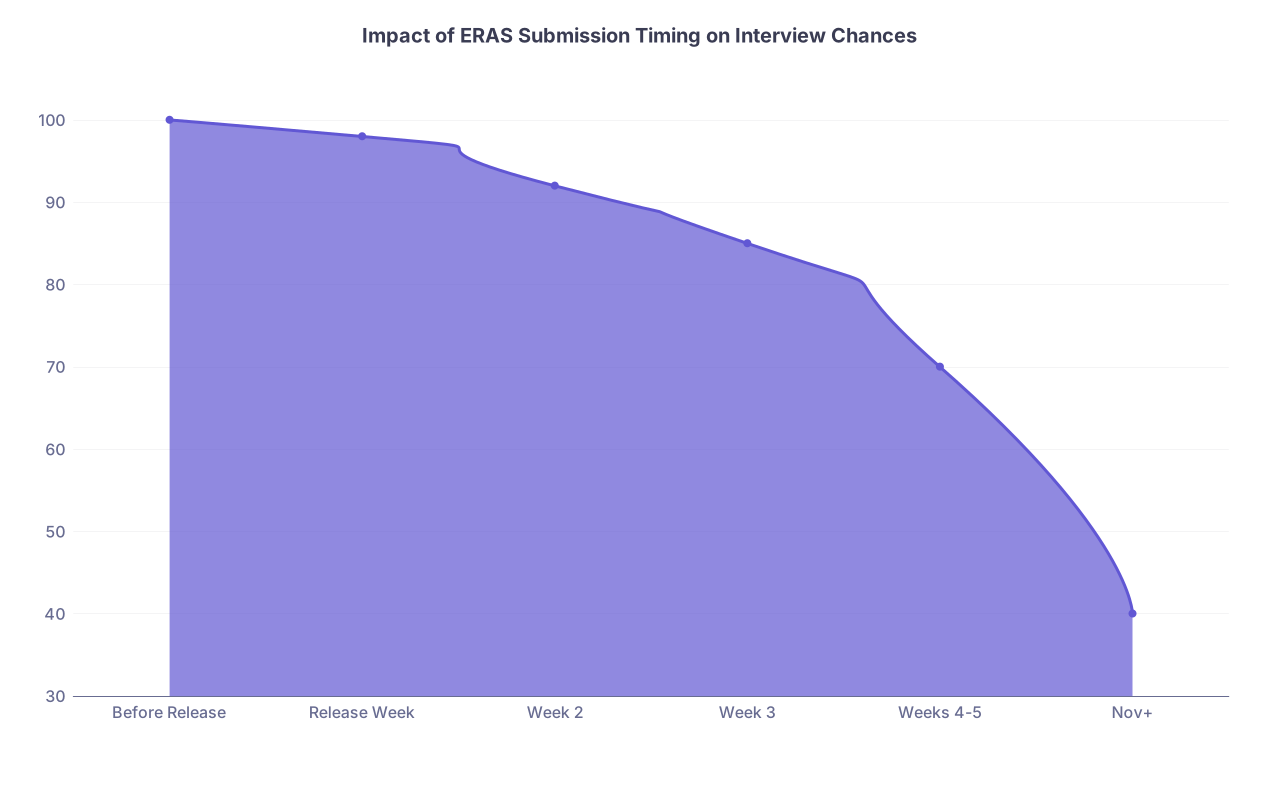
| Category | Value |
|---|---|
| Before Release | 100 |
| Release Week | 98 |
| Week 2 | 92 |
| Week 3 | 85 |
| Weeks 4-5 | 70 |
| Nov+ | 40 |
Is this exact? No. But the trend is real. Early-ish is good. Slightly later is still okay. Very late hurts.
Again: a few days ≠ failure. Weeks late with no good reason? That’s when you start actually losing opportunities.
What If My Letters or Step 2 Aren’t Ready Yet?
This is the part nobody explains well and it freaks people out.
You might be thinking:
- “I shouldn’t submit until all my letters are in.”
- “I should wait to see my Step 2 score first.”
- “If my app is ‘incomplete’ they’ll think I’m sloppy.”
Reality check:
- You can submit ERAS before all LORs arrive. They’ll be attached as they come in.
- Programs know letters trickle in. They don’t assume you’re lazy because your ortho letter came a week late.
- Step 2 timing is more nuanced—some PDs almost expect it a bit later, especially if you took it mid-late summer.
What does look bad is:
- You waiting an extra 2–3 weeks to submit just to see your Step 2 score…
- …and then if the score doesn’t go how you want, you’re now late and stressed.
If Step 2 is a likely strength, sure, coordinate as best you can. But don’t freeze your entire app for weeks over something that might not even be a deal-breaker.
Many people submit with “Step 2 pending” and it’s fine. Programs update their info as your score comes in.
If You’re Already “Late-ish,” What Can You Do?
If you’re reading this and you’re past that “safe zone” already, your brain is probably spiraling:
- “I ruined my chances.”
- “Everyone else is weeks ahead.”
- “Programs must think I’m not serious.”
Take a breath. This is salvageable more often than people admit.
Here’s how you minimize damage:
Submit the strongest version you can ASAP
Stop rewriting for perfection. Clean it, correct it, own your story, submit.Apply a bit more broadly
If you’re late, compensate with a slightly wider net of programs to account for fewer early interview chances.Use your personal statement or experiences section smartly
If your lateness is due to something serious (illness, family emergency, major life event), you can address it briefly and calmly, either in secondary communications or if asked. Don’t write a “sorry I was late” essay in ERAS, but you can give context when appropriate.Do not compound “late app” with “late email responses”
Once interviews come, respond quickly. Show you’re engaged and responsible now.
You can’t rewind time, but you can absolutely stop the damage from spreading.
FAQs – Fast Answers for Your Overthinking Brain
1. If I don’t submit on opening day, will programs think I’m lazy?
No. As long as you’re in that first general wave (roughly by the end of the first week after apps are released to programs), you’re just another normal applicant. They are not tracking your timestamp and assigning moral character points to it.
2. Is submitting 3–5 days after ERAS opens “late”?
No. Not in any meaningful way. Forums might make it sound like that, but from a program standpoint, they’re still orienting themselves, setting up filters, and organizing reviews. You’re still early enough to be fully in the mix.
3. Should I wait to submit until all my letters of recommendation are uploaded?
Usually, no. Submit when the rest of your app is ready. LORs can attach later and programs understand that letters arrive in waves. Don’t delay your entire file unnecessarily just because one letter is a little behind.
4. What’s worse: submitting a few days later or submitting with a mediocre personal statement?
Submitting weeks late is worse. But waiting an extra 3–4 days to turn a truly weak, confusing personal statement into a coherent, honest one? That’s worth it. Just don’t let “editing” drag into weeks of avoidance.
5. Will submitting 2–3 weeks after ERAS opens kill my chances?
Not automatically, no. You’re at a disadvantage compared to people who were ready on time, especially at the most competitive programs, but it’s not a death sentence. You may just need to apply more broadly and accept that you might get fewer early invites.
6. Do competitive specialties care more about early submission?
Yes, somewhat. In highly competitive fields (derm, ortho, plastics, ENT, etc.), being early/early-ish matters more because they’re drowning in strong applications and start filtering quickly. Still, “early” means by the first 1–2 weeks after release, not “minute one or you’re done.”
Bottom line, so you can maybe sleep tonight:
- Programs are not judging your work ethic off the precise day you click submit as long as you’re roughly on time.
- A few days to make your application meaningfully better is fine; weeks of perfectionism that push you into October/November are not.
- Focus less on the timestamp and more on having a coherent, honest, proofread, and reasonably early application in the system. That’s what actually moves the needle.