
When ‘Just One More Publication’ Makes Your ERAS Fatally Late
What if the paper you are waiting to get accepted is the exact reason your application never gets seriously reviewed?
Let me be blunt: chasing “just one more publication” is how strong applicants quietly sabotage their own ERAS. I have watched objectively competitive students turn themselves into easy auto-screens because they delayed submission for a line on their CV that no one cared about, and programs never even saw.
You are juggling two clocks during ERAS season:
- The research clock (submissions, revisions, “with the editor,” “accepted pending minor changes”).
- The program clock (filters, interview invites, and a rapidly shrinking number of open spots).
Most students overestimate the first clock and ignore the second. That is the mistake I am trying to pull you away from.
How ERAS Timing Actually Hurts You (Not How You Wish It Worked)
You think: “If I wait two more weeks and add one more PubMed paper, I will look so much stronger.”
Programs think: “Our filter already screened you out before anyone saw you were alive.”
Here is what you are really up against.
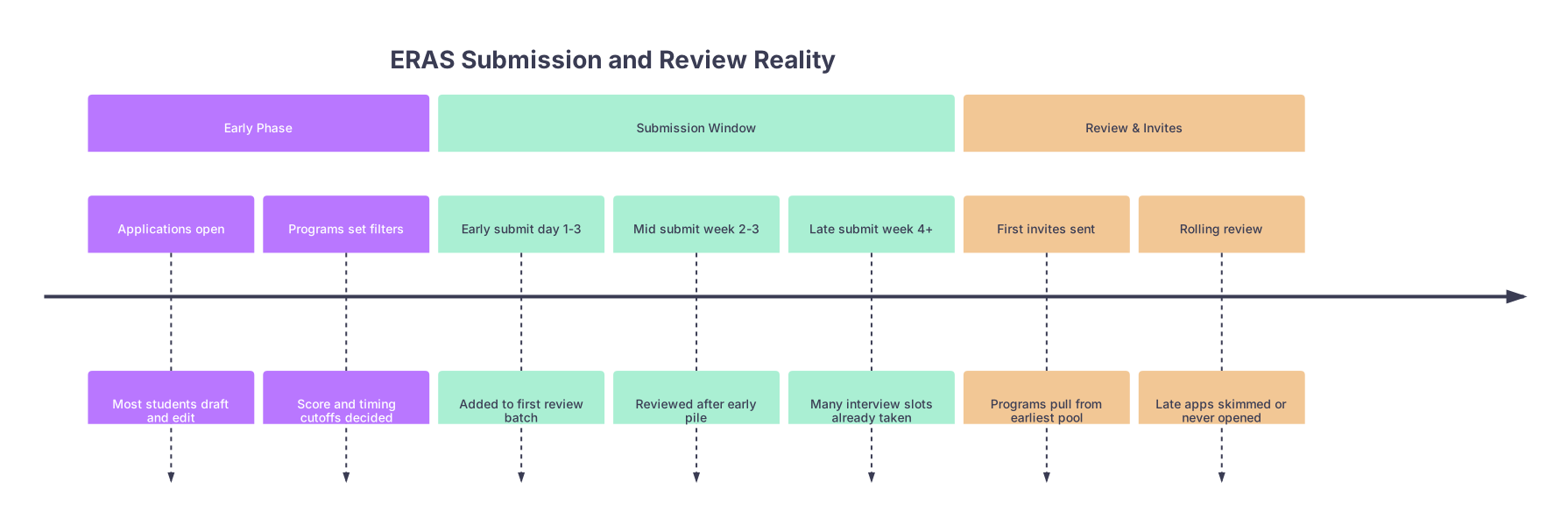
| Period | Event |
|---|---|
| Early Phase - Applications open | Most students draft and edit |
| Early Phase - Programs set filters | Score and timing cutoffs decided |
| Submission Window - Early submit day 1-3 | Added to first review batch |
| Submission Window - Mid submit week 2-3 | Reviewed after early pile |
| Submission Window - Late submit week 4+ | Many interview slots already taken |
| Review & Invites - First invites sent | Programs pull from earliest pool |
| Review & Invites - Rolling review | Late apps skimmed or never opened |
Most programs do not sit and wait until every single ERAS application is in before they start reading. They:
- Set filters.
- Generate lists.
- Start sending invites.
And they tend to do this early.
The common fantasy: “It is all holistic; they will wait until the deadline; my complete application will shine.”
Reality: A significant portion of programs will never meaningfully review applications submitted well after their internal review start. Your file is technically “received.” Functionally, it is invisible.
Now combine that with you delaying for a maybe-accept in Journal of Regional Subspecialty Stuff That No One Has Time To Read. That is how “just one more publication” becomes a fatal timing error.
The Research Illusion: Why That Extra Paper Matters Less Than You Think
You have been trained for years to worship research output. Posters, abstracts, manuscripts, middle authorships. I know the internal monologue:
“If I can bump from 3 to 4 publications, that might be the thing that pushes me into the interview pile for competitive programs.”
Sometimes that is true. Usually, it is not.
Programs care about research signal, not micro-increments in total count—unless you are applying in extremely research-heavy specialties (Derm, Plastics, some Rad Onc, some academic IM tracks). Even there, timing still matters.
Here is how programs roughly see your research:
| Research Profile | How Programs Commonly Read It |
|---|---|
| 0–1 pubs, minimal posters | Unfocused on research |
| 2–3 pubs, some posters | Has done meaningful research |
| 4–7 pubs, consistent involvement | Strong research experience |
| 8+ pubs, first-author, big journals | Research-heavy / academic trajectory |
| 15+ pubs, all low-tier / case reps | Possible “CV padding,” not automatically better |
If you are already in the “strong research experience” bucket for your specialty, one more low–medium impact paper does not move you into a new category. But submitting ERAS two weeks late absolutely does move you into a worse category: “late applicant with lower interview probability.”
That trade is usually terrible.
The only time “waiting for one more publication” might be rational:
- You are applying to very research-intensive specialties or research tracks; and
- The publication is high-impact, first-author, clearly relevant; and
- You can still submit in the first wave (not “whenever it gets accepted”).
If you cannot check all three boxes, your instinct to wait is likely wrong.
The Real Cost of a Late ERAS: Not Theoretical, Very Concrete
You do not “sort of” pay for late submission. You pay in interview invites you never receive.
Here is what a lot of students do not appreciate: programs often pre-build lists and filters before they even get far into holistic review. Once you are not in that early data pull, it is hard to get on their radar.
Look at it this way:
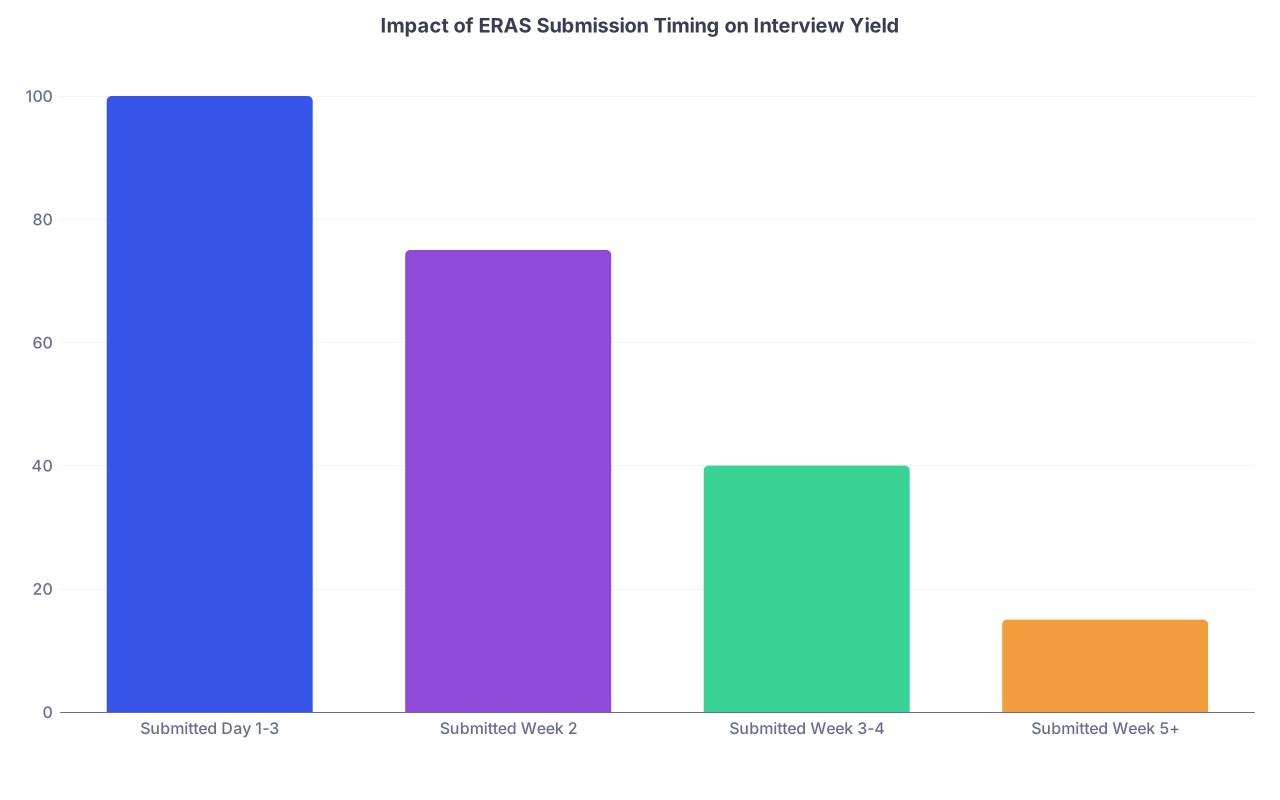
| Category | Value |
|---|---|
| Submitted Day 1-3 | 100 |
| Submitted Week 2 | 75 |
| Submitted Week 3-4 | 40 |
| Submitted Week 5+ | 15 |
These are illustrative numbers, but they match what I have seen from advising data and student reports over multiple cycles.
Relative interview yield plummets as you move away from the early submission window. A late but “slightly more impressive” application frequently underperforms an earlier, slightly less polished one.
So when you say, “I will submit after this paper is accepted”—what you are really saying is:
“I am willing to trade a large percentage of my interview chances for a small bump in perceived research output that might not even be noticed.”
That is not ambition. That is bad risk management.
The Three Most Dangerous “Just One More” Traps
1. “Just one more publication” before I certify
The classic.
You are mostly done with ERAS. Personal statement is in decent shape. LoRs pending but promised. You have 3–4 publications, a couple of posters. You hear from your PI:
“The manuscript looks good. I think the journal will accept with minor revisions.”
You tell yourself: “I will just wait until it is officially accepted. Then I can list it as ‘Published’ instead of ‘Submitted.’ Programs will like that more.”
Here is the problem:
- You do not control when the editor replies.
- “Minor revisions” can still drag on for weeks.
- Acceptance can easily roll into “decision pending,” “waiting on co-author,” or silence.
While you wait, programs are not waiting.
Worse: ERAS already allows you to list submitted and provisionally accepted work. You can update status during the season if it fully publishes. Delaying initial submission just to upgrade the label from “submitted” to “accepted” is a vanity move that costs you time you never get back.
2. “Just one more abstract” right before ERAS opens
Another favorite mistake.
You see a conference deadline in June. You think: “If I rush this retrospective chart review and submit an abstract, I can put another line under presentations before ERAS opens in September.”
So you:
- Burn your study schedule and your sanity in June and July.
- Waste time chasing data, IRB amendments, emails to statisticians.
- End up with a half-baked abstract in a minor meeting.
By the time ERAS opens, you are:
- Behind on rotations.
- Behind on personal statements, experiences descriptions, and LoR requests.
- Editing your application in a panic instead of calmly submitting early.
All for what? A poster that sits in the “also has posters” pile, indistinguishable from the 5,000 others. While your application timing, coherence, and letters—all much higher-yield—suffer.
3. “Just one more line on my CV” in September
This is the late-stage version.
The portal opens. You realize your CV is not as thick as some of your classmates. You panic. You start emailing:
“Hey, Dr. X, do you have any quick case reports or small projects I can help with before ERAS is due?”
This is magical thinking.
No meaningful research project that helps you will:
- Start,
- Be done properly,
- Be written,
- Be submitted,
in time to matter for this ERAS cycle.
What does happen is:
- You distract yourself from finishing ERAS.
- You turn what could have been an early submission into a mid- or late-cycle one.
- You get a basically worthless “in progress” line that screams rushed padding.
If you are going to do “one more thing” in September, make it revising your personal statement or tightening experiences descriptions—not launching a last-minute project you can barely explain in an interview.
Anchor Yourself To The Right Deadline (Not Your PI’s Timeline)
Your deadline is program-facing, not research-facing.
That means you do not plan backward from:
- “When will this paper get accepted?”
- “When will the conference send decisions?”
- “When will this dataset be ready?”
You plan backward from:
- “When do I need to submit ERAS to be in the first wave of applications programs actually review?”
For most specialties and cycles, that means:
- Being ready to hit submit as early as ERAS allows “sending to programs.”
- Considering anything later than the first major wave (often day 1–3) as a conscious disadvantage, not neutral.
If your PI is pushing you:
“Let us just get this paper out before you submit so you can look stronger on ERAS.”
Your firm internal translation needs to be:
“I am not delaying submission for this. I will list it as in progress or submitted. My timing comes first.”
Your PI is thinking about their PubMed profile and the project. You need to think about your match odds.
What You Should Actually Do With “Almost Done” Research
Here is the part everyone seems to miss: ERAS is perfectly capable of showing that you are actively engaged in research without waiting for everything to be fully accepted.
Use the categories intelligently:
- “Submitted”
- “Provisionally accepted”
- “Accepted”
- “In preparation” (sparingly; do not list every half-idea as a project)
You are not lying by listing submitted work. You are describing the truth at the time of submission.
The smart move:
- Complete ERAS early with honest, accurate research statuses.
- Hit submit early in the cycle.
- If something major changes (a big paper gets accepted), update programs later or discuss it in interviews or emails when appropriate.
Programs care more that:
- You submitted on time.
- Your story is coherent.
- Your letters are strong.
- Your evaluations match the version of you they see on paper.
One more acceptance line is the least important part of this equation.
Competitive Specialties: The One Possible Exception (And Its Limits)
If you are applying to Derm, Plastics, ENT, integrated Vascular, or certain academic-heavy IM or Neuro programs, you might think:
“This does not apply to me. Research is everything in my field.”
Yes, research is heavily weighted. No, timing suddenly stops mattering.
The nuance:
- In hyper-competitive specialties, you often need a critical mass of research before the application season even starts—months to years earlier.
- If you are still trying to “make up ground” with one more paper in August or September, you are already late from a strategic standpoint.
What you cannot do is:
- Transform a borderline application into a competitive one with a single paper obtained at the last second.
- Fix a multi-year pipeline deficiency in 2–4 weeks by delaying ERAS.
If your mentor tells you, “This KOL in the field will be first author, and you will be prominent on a paper going to NEJM or JAMA Derm, and acceptance is imminent”—fine, that is the rare real exception. But notice how specific that scenario is. And even then, I would still be asking:
“Can I submit ERAS now and update the program later when this is officially accepted?”
Most of the time, the honest answer is yes.
The Psychological Trap: Perfectionism Masquerading As Strategy
I see the same pattern over and over.
Students will say they are being “strategic” and “maximizing their competitiveness.” What they are actually doing is:
- Avoiding the discomfort of hitting submit.
- Clinging to something concrete (a publication) because they cannot control the rest of the process.
- Convincing themselves that more lines on the CV equal more safety.
This is perfectionism dressed up as productivity.
Submitting ERAS early feels final. Vulnerable. Once you submit, you cannot hide behind “I am still working on my application.” So you unconsciously look for reasons to delay:
- One more edit.
- One more mentor review.
- One more research entry.
At some point, “one more” stops helping and starts hurting.
Ask yourself, honestly:
“If I could not add a single new publication from today forward, would my ERAS still be basically representative of what I have done?”
If yes, your focus needs to shift from acquiring new to presenting well and submitting on time.
If no, and you truly are that early in your trajectory, the real conversation might be whether you should delay your application cycle altogether rather than patching holes with frantic September research.
Those are two very different problems.
How To Avoid This Exact Mistake: A Simple Rule
Use this rule. Do not rationalize your way around it.
If waiting for “just one more publication” pushes your ERAS submission out of the first major submission wave, you do not wait.
You:
- List the work as submitted / in progress.
- Submit ERAS in that early window.
- Accept that your application will never be perfect—and that is fine.
One more chart to tattoo onto your brain:
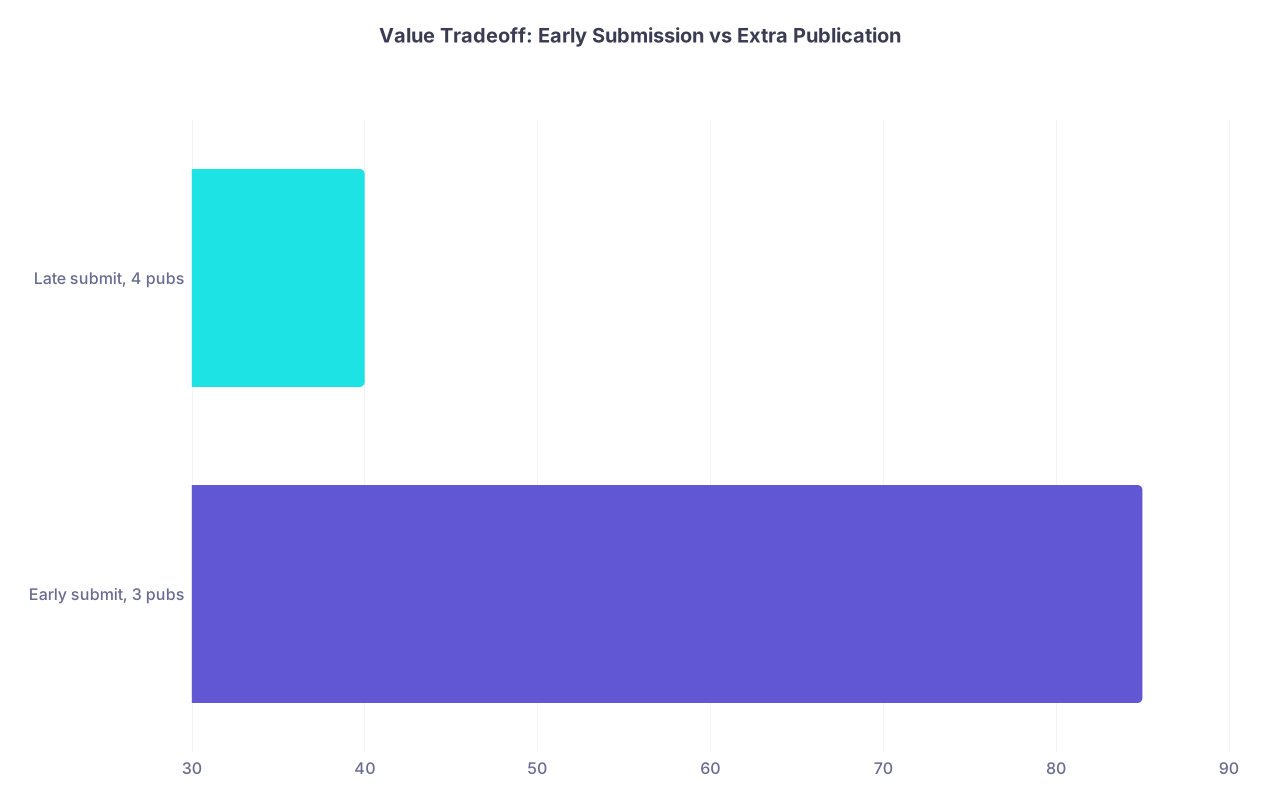
| Category | Value |
|---|---|
| Early submit, 3 pubs | 85 |
| Late submit, 4 pubs | 40 |
Think of “value” as likelihood your application is actually reviewed and granted a fair shot at an interview. The extra publication does not compensate for the loss in review probability.
You are trading a high-yield factor (timing) for a low-yield vanity boost (incremental research volume). It does not make sense.
Final Warnings: Red Flags You Are About To Make This Mistake
You are on track to harm your application if:
- You are checking your manuscript status daily instead of finalizing ERAS.
- You are telling friends, “I will submit once this paper is accepted.”
- You keep saying “I just need one more thing” after ERAS opens.
- Your PI’s timeline, not ERAS’s, is dictating your decisions.
- You are more stressed about how your CV compares to classmates than about whether programs will actually see it early.
Catch yourself there. Stop. Submit.
Let me close this very simply.
Key point 1: Being early and complete beats being late and slightly shinier almost every time.
Key point 2: Programs cannot be impressed by research they never see because your application hit their desk after they had already filled interviews.
Do not let “just one more publication” be the reason you turned a strong candidacy into a quiet, avoidable disappointment.