
Submitting ERAS late because you are a reapplicant is how people quietly sabotage a second chance.
Let me be blunt. Programs do not care that you are reapplying. They care when your file is complete in their inbox. If you are reusing old documents and still miss the front of the review queue, you are handing away one of the few controllable advantages you actually have.
You asked a very specific question: When should you submit ERAS if you are reapplying and reusing old documents?
The honest answer is not “whenever it is ready.” The honest answer is: as early as the system allows, with a ruthless plan for what you are reusing, what you are updating, and what you are fixing.
Let me break this down precisely.
1. The Non‑Negotiable Timeline: What “On Time” Really Means for a Reapplicant
First, anchor the actual ERAS calendar. I will generalize the dates a bit because they shift slightly each year, but the pattern is stable.
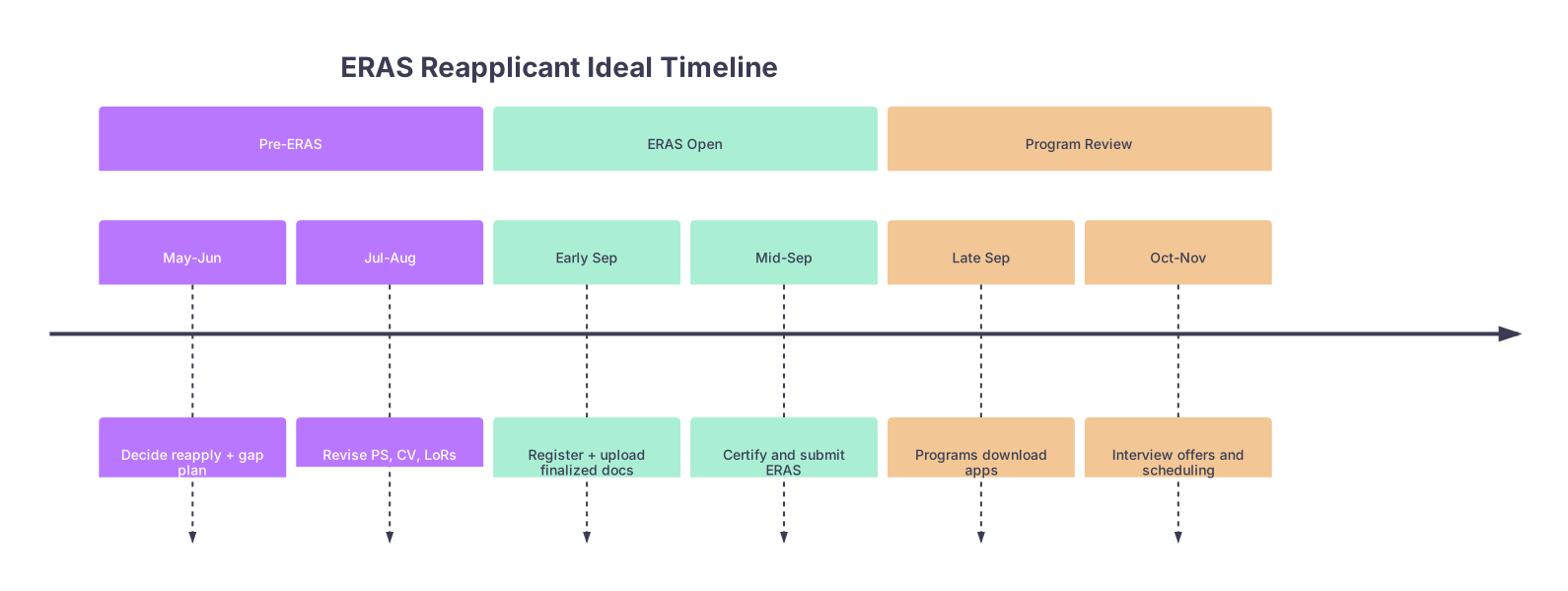
| Period | Event |
|---|---|
| Pre-ERAS - May-Jun | Decide reapply + gap plan |
| Pre-ERAS - Jul-Aug | Revise PS, CV, LoRs |
| ERAS Open - Early Sep | Register + upload finalized docs |
| ERAS Open - Mid-Sep | Certify and submit ERAS |
| Program Review - Late Sep | Programs download apps |
| Program Review - Oct-Nov | Interview offers and scheduling |
Here is the key reality: programs do their heaviest screening in the first 1–2 weeks after they start receiving applications. That early wave dominates who gets interviewed.
For a typical cycle:
- ERAS opens for applicants: early September
- Applicants can start submitting to programs: mid–September
- Programs can start downloading applications: about a week later
For a reapplicant, “on time” is not “sometime in September.” “On time” is:
- Submit (certify) ERAS on day 1 or day 2 of submission opening.
- Letters, transcripts, and USMLE/COMLEX scores should be in or very close behind.
If you are submitting after that first week, you are not “late” in a literal sense. But you are behind the early screen. Which is where many programs fill most of their interview slots for average or slightly below‑average applicants.
Now tie this to your situation: reapplying and reusing old documents. Your theoretical advantage is that much of your content already exists. So there is zero justification for you to miss the earliest submission window, unless:
- You are waiting for a crucial new Letter of Recommendation from a recent rotation
- You are updating Step/COMLEX scores or CK
- You made a major strategic shift (e.g., changing specialties) and are rewriting key components
Even then, you typically still certify on day 1 and let late pieces (like one letter) trickle in.
2. What You Can Safely Reuse vs What Must Change
Reusing old documents is not inherently wrong. Blindly recycling them is.
Programs do flag reapplicants. Some ERAS views show “previous application year(s)” directly. If they remember you, or if they check your prior file, and your application looks like last year’s with a new date slapped on it, that is a problem.
Let’s go piece by piece.
2.1 Components You Can Usually Reuse With Minimal Changes
These are the relatively “static” elements:
- Demographics & basic personal info – same.
- Medical school details, degrees, institutions – same.
- Older, completed experiences (preclinical jobs, undergrad research, volunteer work) – same content, but confirm descriptions are clean, consistent, and not riddled with old grammar mistakes.
You do not need to reinvent your entire ERAS CV. You do need to update timeframes, roles, and responsibilities if anything has evolved.
2.2 Components You Absolutely Should Update
This is where reapplicants silently lose ground.
Personal Statement
Reusing last year’s PS verbatim signals one of two things:- You did not learn anything from last cycle.
- You did not invest the effort to reframe your story.
Both are red flags.
You can reuse the same core narrative, but you should:
- Add a short, honest sentence or two reflecting what you did in the interim year (research, observerships, prelim year, improved exams, language courses, etc.)
- Tighten sections that were unfocused or generic.
- Remove lines that read like clichés (“I have always been passionate about…”) and demonstrate concrete growth instead.
Experience Entries for the Gap / Reapplication Year
This is non‑negotiable. The most common question PDs ask about reapplicants: What did they do with the time?If your new year is blank or padded with fluff, your application dies early.
Examples that matter:
- Full‑time or part‑time clinical work (scribe, hospitalist assistant, outpatient clinic assistant)
- Research with credible output (abstracts, posters, manuscripts in progress)
- A prelim or transitional year with strong performance
- Structured observerships (especially for IMGs) with clear clinical relevance
These new entries must be in the ERAS experiences section, not buried in your personal statement.
Letters of Recommendation (LoRs)
Here is where reusing is tricky.- A strong letter from a respected attending that is only one year old can be reused once.
- A generic letter (“hardworking, punctual, pleasant to work with”) is not worth reusing even if it is brand-new.
As a rule:
- Reapply with at least one new letter that reflects your growth since last cycle.
- Do not carry over all the same letters. That just screams “nothing changed.”
USMLE/COMLEX and Exam Narrative
- If you added Step 2 CK / COMLEX 2 CE or improved scores, highlight that implicitly via the transcript and (if needed) explicitly in a short sentence in your PS or a program‑specific communication.
- If you failed an exam last year and passed on reattempt, the narrative must shift from “here is my excuse” to “here is the pattern of improvement and how I addressed weaknesses.”
3. The Real Question: Exactly When Should You Hit “Certify and Submit”?
Now to the heart of what you asked.
You are reapplying. You have old documents. You are wondering if you should wait to perfect updates or just submit early.
Here is the specific breakdown, scenario by scenario.
3.1 Best‑Case Reapplicant: Minor Updates Only
Scenario:
- Same specialty as last year
- No major red flags added this year
- You have at least one new letter and some new meaningful experiences
- You are comfortable with last year’s PS structure, just adjusting it
Your target timeline:
By late August
- Finalize revised personal statement (new content about the interim year).
- Update ERAS experiences with new entries and accurate dates.
- Confirm your LoRs are requested, with clear deadlines to your writers.
On the day ERAS opens for applicants (early September)
- You already have your entire ERAS application filled out and saved as draft.
- Upload your updated personal statement and assign letters you expect to arrive.
On the first day ERAS allows submission to programs (mid‑September)
- You certify and submit. Day 1. Not day 10. Not “after I double‑proofread it again for the 5th time.”
- You let letters that are not yet uploaded catch up over the next 1–2 weeks.
Why submit even if 1–2 letters are still pending? Because:
- Programs start downloading applications from day 1.
- Many will re‑pull or automatically update letters as they arrive.
- Waiting for that last letter while the review wave is happening is a bad trade.
3.2 Moderate‑Change Reapplicant: New Specialty or Major Narrative Shift
Scenario:
- You switched from, say, General Surgery to Internal Medicine, or from EM to Family Medicine.
- Or you had a serious event (leave of absence, remediation, new failure, or conversely, huge new strength) requiring real narrative rework.
For you, a bit more care is justified, but not at the cost of being late.
Your target timeline looks like:
July–early August
- Decide specialty definitively. No “hedging” with two different main specialties unless you know exactly what you are doing.
- Draft a brand‑new personal statement for the new specialty. Reusing the old one with minor edits is lazy and transparent.
- Identify at least one letter writer relevant to the new specialty.
By late August
- Final PS complete.
- ERAS experiences fully updated, especially any experiences that support your new direction (IM sub‑I, outpatient medicine, etc.).
- Requests for new LoRs sent, deadlines clearly communicated.
Submission day
- Same rule: submit on day 1 of ERAS submission opening.
- Do not push your submission into October waiting for the “perfect” letter or endlessly rewording your personal statement.
The rebrand to a new specialty is visible to programs. You want to signal decisiveness and preparation, not last‑minute scrambling.
3.3 High‑Risk Reapplicant: Significant Red Flags or Massive Gaps
Scenario:
- Multiple exam failures
- Big time gap since graduation (e.g., 5+ years)
- Previously unmatched after multiple attempts
- Very weak prior interview season (almost no invites)
Here, your strategy matters more than the question of a few days’ difference in submission. But early submission still helps you.
You may choose to delay 2–3 days after opening only if:
- You are concretely waiting for a transformative document (e.g., a powerful new letter from a PD after a full‑time year with them).
- Or you have a Step 2 CK / COMLEX 2 CE score releasing within days that meaningfully changes your competitiveness.
However, even in these cases, we are debating days, not weeks.
If your choice is:
- Submit day 1 without that one letter vs
- Submit October 5 “once everything is perfect”
You submit day 1. Every time.
4. How Programs Actually View Reapplicants Who Reuse Documents
Let me be clear about the psychology on the other side.
Program directors and faculty reviewers think in quick mental shortcuts. They are triaging hundreds (or thousands) of applications.
Here is what I hear in actual committee rooms:
- “This person applied to us last year. Did anything change?”
- “Same PS, same letters, one observership. Pass.”
- “Reapplied, but Step 2 went up 20 points and has a PD letter from XYZ. Let’s look again.”
Reusing old documents is fine if:
- The core facts of your career have not changed dramatically, and
- You have made visible, specific improvements and updates.
Reusing old documents is damaging if:
- It implies lack of insight into why you did not match.
- It suggests you did almost nothing productive in the gap.
- It reads like you just hit “resend” on last year out of desperation.
Think through each component with that lens:
- Does this PS read like I have grown and learned, or like I copy‑pasted last year?
- Do my letters speak to my current self or my M3 self from 2.5 years ago?
- Does my ERAS timeline make sense, or does it show a blank 12–18 months?
You are not trying to impress them with verbosity. You are trying to answer the unspoken question: “Why should this cycle be different?”
5. Practical Submission Strategy: Day‑By‑Day Plan
Let me give you a very concrete playbook for timing if you are reapplying and reusing some content.
5.1 6–8 Weeks Before ERAS Opens to Applicants
Decide exactly what you are reusing:
- PS: same skeleton, updated interim year + improved focus
- Experience entries: mostly reusing, adding new entries
- Letters: 1–2 old, 1–2 new (ideally more weighted toward new if last cycle was weak)
Build a simple checklist:
- PS revised and proofread by at least one person who knows the specialty
- CV/experiences updated with accurate end dates and descriptions
- LoR requests sent; writers given specific deadlines (e.g., “Please upload by Sept 5”)
- USMLE/COMLEX scores released or with clear release dates
5.2 The Week ERAS Opens for Applicants
- Log in day 1.
- Fill out every section meticulously:
- Experiences
- Publications
- Awards
- Licenses / ECFMG (if applicable)
- Paste in your updated PS, then read it in the ERAS viewer (formatting issues show here).
- Assign the correct PS to each specialty. Do not mix a surgery PS with a medicine application. Sounds obvious. I have watched people screw this up.
5.3 The Day ERAS Allows Submission to Programs
Before you click “Certify and Submit”:
- Run a last‑pass check of:
- Exam scores
- Program list (no wildly inappropriate choices that signal you have no idea about competitiveness)
- PS assignments
- Confirm at least some of your LoRs are already uploaded or clearly coming.
- Run a last‑pass check of:
Then: Submit that day.
You gain nothing by stewing over wording. You lose priority in the review queue.
5.4 The 1–2 Weeks After Submission
- Monitor LoR arrival.
- Send polite, concise reminders to any missing letter writers.
- If a critical letter does not arrive, adjust: some programs will still review you with 2–3 strong letters instead of 4 mediocre ones.
6. Common Reapplicant Timing Mistakes (And How to Avoid Them)
Let me call out the mistakes I see every single year.

Mistake 1: Waiting for “All Letters” Before Submitting
Reality: Many programs will accept and later see additional letters after initial download. If waiting for your fourth letter costs you two weeks of timing, that is a bad trade.
Fix: Submit with 2–3 solid letters in place. Let the stragglers follow.
Mistake 2: Hiding a Weak Year by Doing Nothing and Reusing Everything
Programs are not stupid. They see graduation year and they see lack of new experiences.
Fix: If your year was unproductive, be honest with yourself and build something tangible before applying again. Even a late start in a clinic or research lab is better than a black hole.
Mistake 3: Overvaluing Micro‑Edits, Undervaluing Early Submission
I have seen applicants delay submission 10 days because they were stuck choosing between two synonyms in their PS conclusion. Meanwhile, their application sat unseen while thousands of others got downloaded and sorted.
Fix: Get your documents to “very good,” not “perfect,” well before submission week. Then protect your place in line.
Mistake 4: Submitting Late Because “I Already Applied Once; It Does Not Matter”
It matters more. As a reapplicant, you are already slightly disadvantaged at many programs. Being late compounds that.
Fix: Treat timing as one of the few knobs you can actually control. Early, clean, and updated beats late, polished, and invisible.
7. How Early vs Late Actually Impacts Interview Chances
To ground this in data‑style thinking, here is a rough conceptual comparison. This is not from one specific published study, but it reflects what PDs and advisors see over and over.
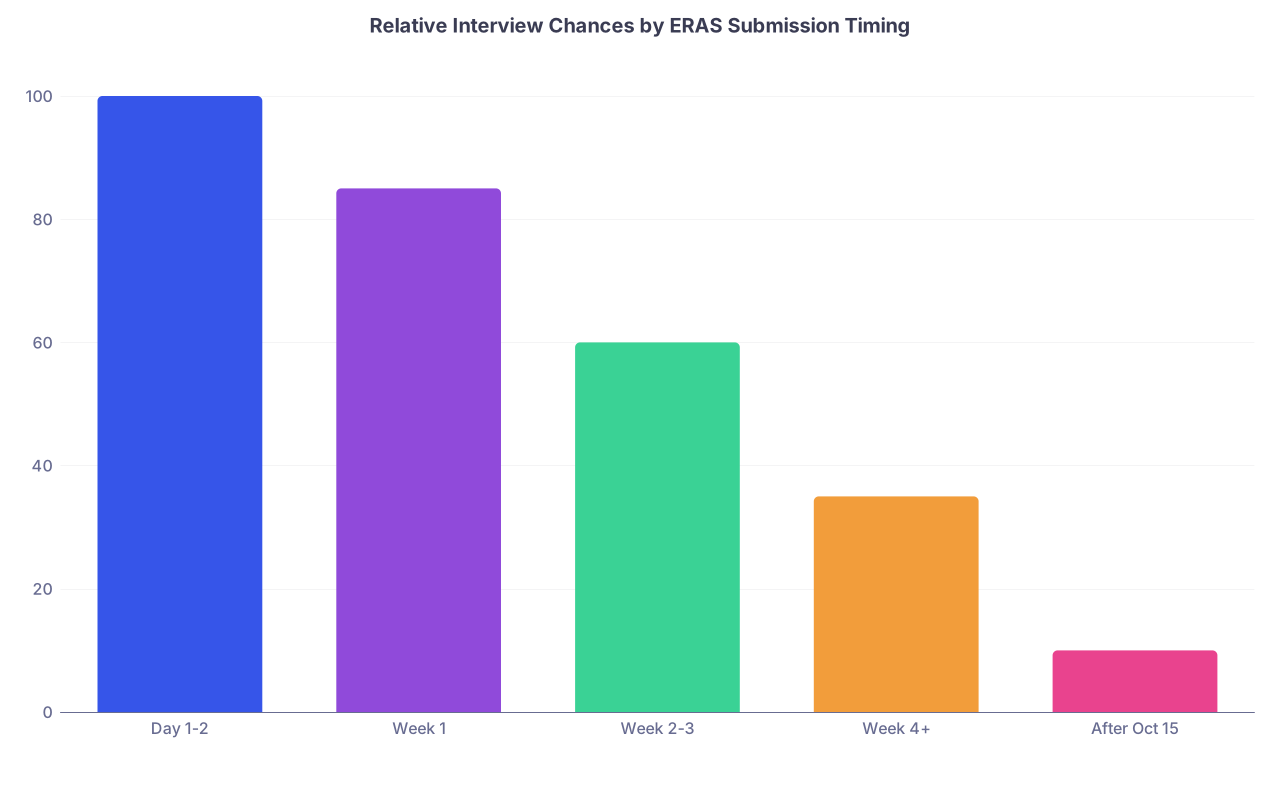
| Category | Value |
|---|---|
| Day 1-2 | 100 |
| Week 1 | 85 |
| Week 2-3 | 60 |
| Week 4+ | 35 |
| After Oct 15 | 10 |
Think of “100” as your baseline chance of an interview if your application is appropriate for the program’s competitiveness. Not a guarantee; just a relative benchmark.
- Submit day 1–2: You are in the first wave.
- Submit week 1: Slight erosion, still mostly fine.
- Submit weeks 2–3: You are now fighting for leftovers at many medium‑competitive places.
- Submit after week 4: Many programs have already sent their initial interview invites.
- Submit after mid‑October: This is essentially a Hail Mary.
As a reapplicant, you do not have the luxury of eroding your odds further.
8. Quick Decision Table: Should I Wait or Submit?
Here is your simple decision framework.
| Situation | Best Move |
|---|---|
| All core docs ready, 1 letter pending | Submit day 1 |
| New Step score releasing within 2–3 days | Wait up to 3 days max |
| Critical PD letter will be 2+ weeks late | Submit now, add when available |
| Switching specialties with unfinished new PS | Finish PS *before* submission day |
| No meaningful new experiences in past year | Consider delaying cycle entirely |
If you are in that last row—no new experiences, same weak metrics—your problem is not when to submit. It is whether to submit this cycle at all.
9. How to Talk About Being a Reapplicant Without Shooting Yourself in the Foot
Last piece: timing is mechanical; narrative is human. Programs will sometimes see or infer that you reapplied.
You address it indirectly by:
- Showing concrete productivity in your new experiences.
- Demonstrating a clear specialty commitment (no scattershot specialty mix).
- Letting your improved letters and scores speak for themselves.
If you mention reapplication in your PS, keep it brutally short:
“After not matching last cycle, I spent the past year working as a clinical research coordinator in a busy academic internal medicine clinic, where I [specific responsibilities]. This experience deepened my interest in [X] and reinforced my commitment to a residency in internal medicine.”
No long excuses. No melodrama. One or two sentences, then back to why you are a better candidate now.

10. The Bottom Line: Your Exact Answer
You wanted a clear, direct answer. Here it is.
If you are reapplying and reusing some documents, you should:
- Have all reusable content fully updated before ERAS opens for applicants.
- Certify and submit your ERAS application on the first or second day that program submission opens.
- Never delay submission more than a few days just to wait for non‑critical letters or to tweak non‑essential phrasing.
- Only consider pushing submission beyond the first week if a truly game‑changing exam score or PD‑level letter is arriving within days—and even then, we are talking days, not weeks.
Reusing documents is acceptable. Reusing last year’s strategy and timing mistakes is not.

FAQ (Exactly 4 Questions)
1. If I am reusing my personal statement, how much do I need to change for a reapplication?
At minimum, you update two things: first, any vague or generic sections that did not add real value last year, and second, a brief but concrete description of what you did in the interim year and how it strengthened your fit for the specialty. You do not need a completely different story, but you should not send a word‑for‑word replica. If a PD compares versions and sees no evolution, that signals stagnation.
2. Can I reuse all the same Letters of Recommendation from last year?
You can, but you should not. One excellent letter from last year can be safely reused once. Beyond that, you need fresh voices that speak to your current skills and growth. A strong reapplicant profile usually has at least one–two new letters (often more) and does not rely solely on the same three from two application cycles ago. New clinical work or research should generate new letters.
3. Is it better to submit ERAS early with 2–3 letters or wait until I have all 4?
Submit early with 2–3 good letters. The marginal benefit of a fourth letter is much smaller than the advantage of being in the first wave of applications programs review. Additional letters can and do populate after submission, and many programs will see them. You gain nothing by being “complete” on day 20 if you could have been “good enough” on day 1.
4. I did not add many new experiences this year. Should I still apply and just submit early?
If your application is essentially unchanged—no new experiences, no new scores, no stronger letters—submitting early just gets the same weak file seen sooner. In that situation, the honest move is to step back and ask whether you should skip a cycle, build meaningful experience (clinical or research), and apply when you have something genuinely different to show. Early submission helps, but it does not rescue an unchanged reapplication.