

What happens to your evaluation when the attending hits you with a question, your brain turns into static, and you just… stare?
Because that’s what this feels like, right?
Not “I missed a question.”
More like: “I exposed myself as a fraud in front of the whole team and now my eval is wrecked and my future specialty is gone.”
Let’s pull that apart before your brain does another 3 a.m. replay of the moment.
What Pimping Actually Measures (vs What You Think It Measures)
Here’s the thing nobody tells you clearly: attendings say pimping is “teaching,” but they’re also using it to take your temperature.
Not your Step score. Not your raw knowledge.
Your:
- Baseline preparation
- Clinical reasoning
- How you react under stress
- Whether you’re safe with patients
- Whether they’d trust you as a future colleague
You think it’s: “If I miss questions = I’m dumb = below expectations.”
They think it’s more like: “Does this student show up prepared, curious, and not crumble or get defensive when they don’t know?”
You freezing on one question – even a whole set of questions on one topic – does not automatically mean “below expectations.” I’ve seen “Outstanding” evals on students who missed half the questions on a tough rounds session.
You know who actually gets bad evals?
- The student who keeps guessing wildly when they clearly have no idea
- The one who argues with evidence-based answers
- The one who visibly checks out when they’re not the one being asked
- The one who’s unprepared consistently (day after day)
Missing specific content once? Embarrassing, yes. Damning, no.
The Difference Between “I Froze” and “I Don’t Care”
Let me be blunt: attendings can smell anxiety.
They can also smell apathy. They hate apathy way more than anxiety.
When you froze, what happened next? That part matters more than the silence.
Scenario A (the nightmare replay):
Attending: “What’s the empiric treatment for suspected meningitis in a 65-year-old?”
You: ……………………………….
Brain: White noise.
You (finally): “Uh. I’m blanking, I’m sorry.”
Attending gives answer. You nod, but you’re already spiraling.
That’s not fatal. That’s normal.
Scenario B (what kills evals over time):
Attending: “What’s the empiric treatment for suspected meningitis in a 65-year-old?”
You: “I… don’t know.” Shrug. No follow-up. No “I’ll look it up.”
Later that day you’re scrolling your phone instead of checking the guidelines.
That? That starts to look like you don’t care. And that does show up in evals.
If you froze, looked mortified, and clearly cared? That actually tells them you give a damn. People don’t look wrecked by something they don’t care about.
One Bad Pimping Session vs Your Whole Rotation
Your anxiety is telling you: “They’re going to write my eval based on that one moment.”
Reality: Most attendings don’t even finish your eval until the rotation is over, and they think in patterns, not single events.
Here’s what they mentally average:
- Your pre-round notes and presentations
- How you show up on time (or not)
- Whether you read and improve over the month
- Your attitude when you’re wrong
- Whether you’re at least safe clinically
Pimping is one slice. And even within that slice, they remember trends.
Let’s be specific.
If over 4 weeks:
- Week 1: You freeze a couple times, say “I’m blanking,” look upset, then come back the next day with one-liners like, “Yesterday you asked about meningitis — for >50, ceftriaxone + vancomycin + ampicillin to cover Listeria.”
- Week 2: You start getting some questions right, miss others, still look engaged.
- Week 3–4: You’re able to reason it out: “I’m not 100% sure, but I’d start with X because of Y…”
That reads as strong growth. That’s actually what “above expectations” looks like for a lot of services.
The disaster pattern they worry about is:
- Day 2: Freeze.
- Day 5: Same topic, still no idea.
- Week 3: Same style of freezing, no change, no initiative.
Your brain is zoomed into a single bad scene. They’re watching the entire movie.
How Attendings Actually Fill Out Your Evaluation
Let me demystify this, because the black box makes everything scarier.
Most schools use some variation of:
| Category | What They’re Actually Thinking About |
|---|---|
| Medical Knowledge | Are you reading? Can you explain basics, even if imperfect? |
| Clinical Reasoning | Do your plans make sense? Can you justify them? |
| Work Ethic | On time, reliable, follows through? |
| Communication | With patients, team, nurses – are you appropriate? |
| Professionalism | Attitude, respect, integrity |
When they click “Meets expectations” or “Above expectations” for Medical Knowledge, they do not mean “You aced board-style pimping.” They mean:
- You improved
- You read
- You didn’t repeatedly make the same unsafe mistake
- You eventually grasped core concepts
I’ve watched attendings fill these out. I’ve literally heard stuff like:
- “She froze a bunch at the beginning, but she worked at it and by the end she was solid. I’m giving her above expectations for effort and growth.”
- “He didn’t know a lot on rounds, but he cared, asked good questions, and clearly read at night. Meets expectations.”
No one has said:
“He missed the empiric therapy for CAP once. Below expectations.”
They don’t have that kind of memory for specific moments the way you do.
Okay, But I Totally Choked: What Do I Do Now?
You can’t erase the moment. But you can absolutely shape the story that moment becomes in their head.
1. Same Day: Quick Recovery Move
If it’s still the same day (or next day), try this:
Find the attending or resident when there’s a pause and say something like:
“Yesterday during rounds when you asked about [topic], I completely froze. I looked it up afterward — the answer is [X], and I realized [brief insight]. I’m going to keep working on not blanking when I know something.”
That does three things:
- Shows you care
- Proves you followed through
- Frames the freeze as anxiety, not laziness

| Step | Description |
|---|---|
| Step 1 | Froze on question |
| Step 2 | Look it up thoroughly |
| Step 3 | Write down key points |
| Step 4 | Bring it up next day briefly |
| Step 5 | Watch for similar questions |
If that terrifies you, do it once with a resident you trust. Word spreads in a good way when you do this.
2. That Night: Turn the Shame into Data
You already know you’re going to obsess over it at 1 a.m. Fine. Weaponize it.
Write down:
- The exact question (or as close as you can get)
- What you wish you’d said
- The actual correct answer
- A 1–2 line summary in your own words
Put it in a “Pimping Mistakes” note on your phone or a small notebook. I’ve seen people score major points months later because they could pull from that log during a different rotation.
You can’t stop the replay in your head. But you can turn it into spaced repetition instead of just self-torture.
How Much Does One Freeze Actually Matter for Your Career?
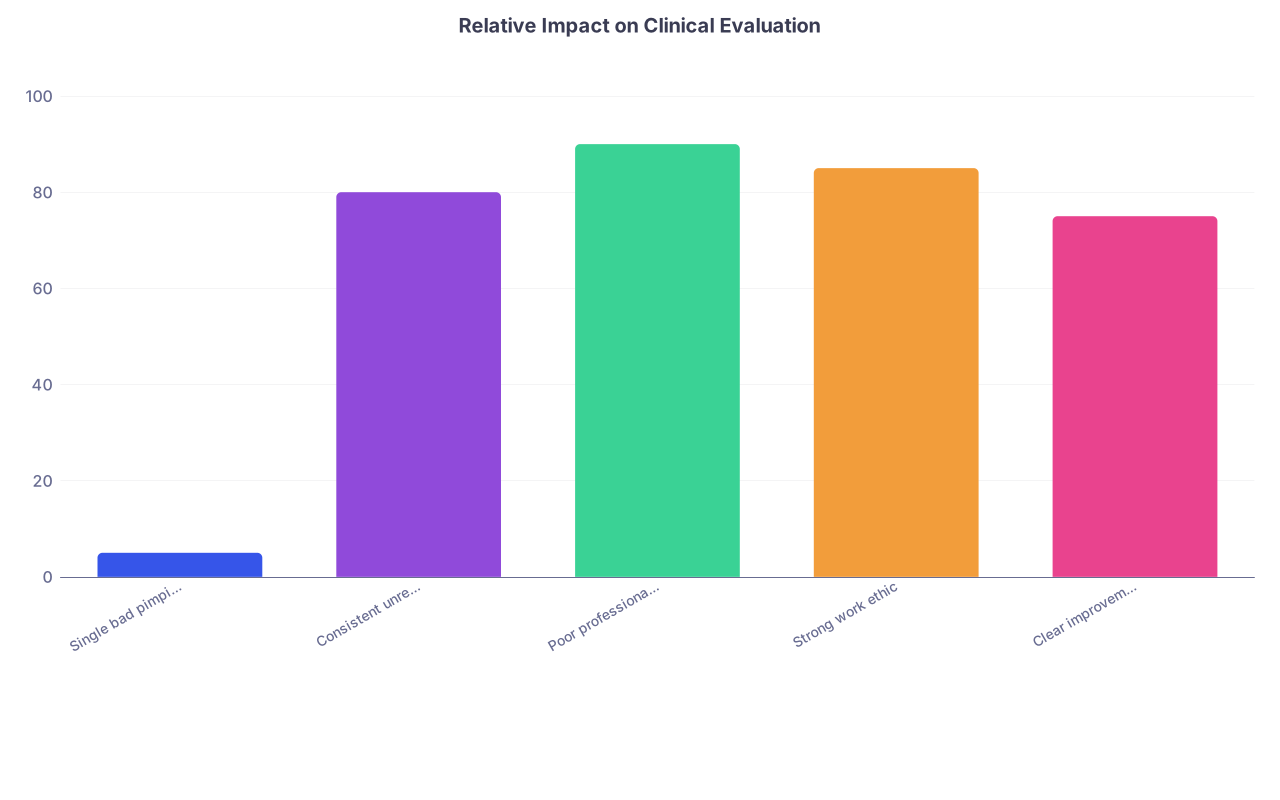
Let’s be brutally honest about what does move the needle:
| Category | Value |
|---|---|
| Single bad pimping moment | 5 |
| Consistent unreadiness | 80 |
| Poor professionalism | 90 |
| Strong work ethic | 85 |
| Clear improvement over time | 75 |
- One bad moment: maybe 5/100 impact
- Repeatedly not knowing core stuff: that starts to hurt
- Being unprofessional or disengaged: that’s what tanks evals hard
- Showing effort and growth: that rescues a rough start
Residency PDs are looking at:
- Your overall clinical grades
- Narrative comments like “hard-working, teachable, pleasant to work with”
- Maybe a shelf score
They are not saying:
“Hm, I suspect this applicant froze on a UTI question on IM rounds.”
That’s your personal horror movie, not their selection criteria.
How to Handle It Next Time So You Don’t Spiral
You can’t control when your brain randomly decides to hit the “fog” button. You can control your script for how you respond.
Next time you get pimped and your mind goes blank:
Take 2–3 seconds. Breathe once. Still blank?
Use something like:
- “I’m blanking on the exact answer, but here’s how I’d think about it…”
- “I’m not sure, but I know [related concept], so I’d guess…”
- “I don’t know the specific guideline, but what I do know is…”
Then, out loud: “I’ll look that up after rounds.”
That’s it. That’s the move.
| Category | Value |
|---|---|
| Total silence | 10 |
| Wild guessing | 20 |
| Honest + reasoning | 35 |
| Honest + follow-up plan | 35 |
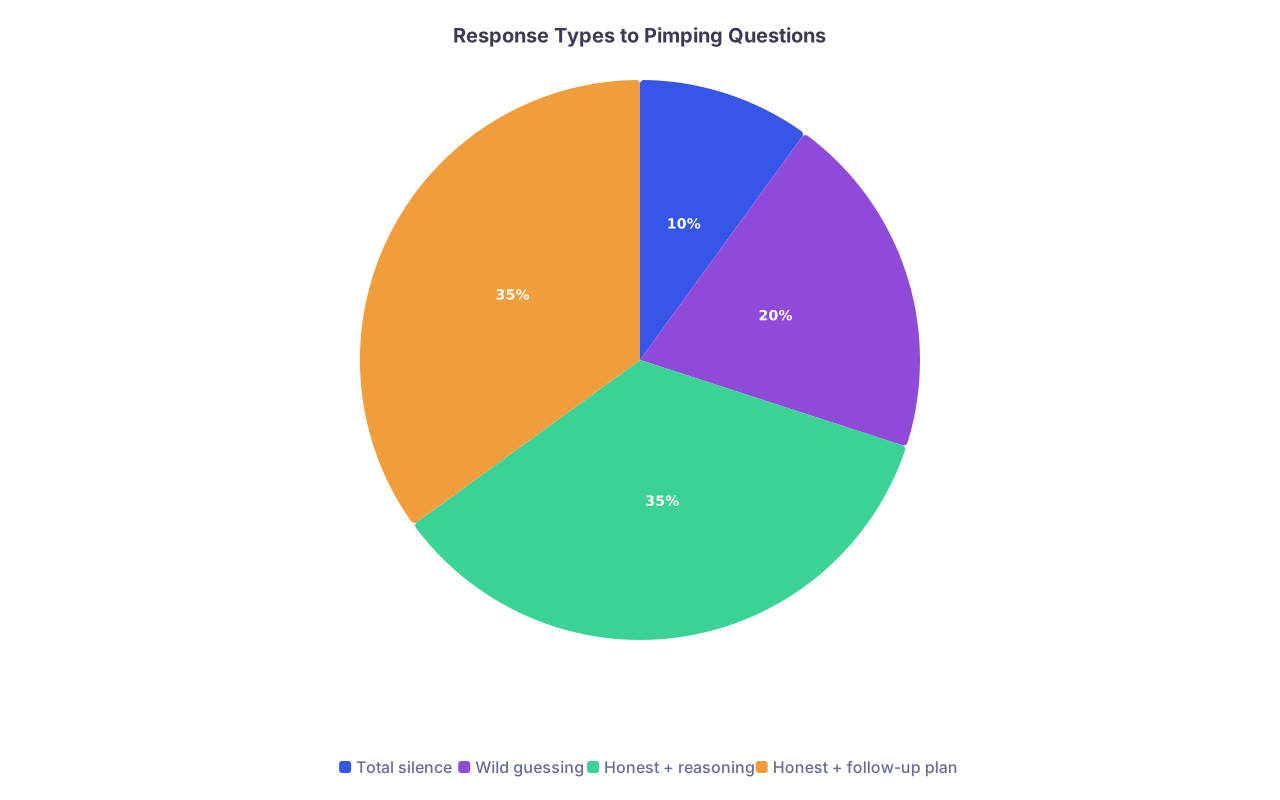
Attendings love when you try to reason, even if you’re wrong. It shows you have a mental framework, not just Anki cards rattling around.
The one thing you want to avoid is long, rambling guesses that sound confident but are medically unsafe. That freaks people out way more than “I don’t know.”
What If I Already Got a Mediocre Evaluation From This?
If the eval is already in and you think you got dinged for this (or something like it), you still have options.
Look at the pattern across rotations. PDs do. One average eval among several good ones is noise, not destiny.
On a later rotation with the same department, you can very clearly show you’ve grown. People completely change their minds about students over time. I’ve watched it.
If you get asked in an MSPE meeting or advising session about a weaker eval, you can literally say:
“At the start of that rotation, I froze badly when questioned and let it shake my confidence. Since then I’ve worked on speaking up even when I’m unsure and turning missed questions into focused reading. My recent evaluations reflect that growth.”
That’s not spin. That’s actually what happened.
| Period | Event |
|---|---|
| Early Rotations - Freeze on pimping | Confidence low |
| Middle Rotations - Start reading from missed questions | Confidence improving |
| Later Rotations - Answer with reasoning, accept not knowing | Performs strongly |
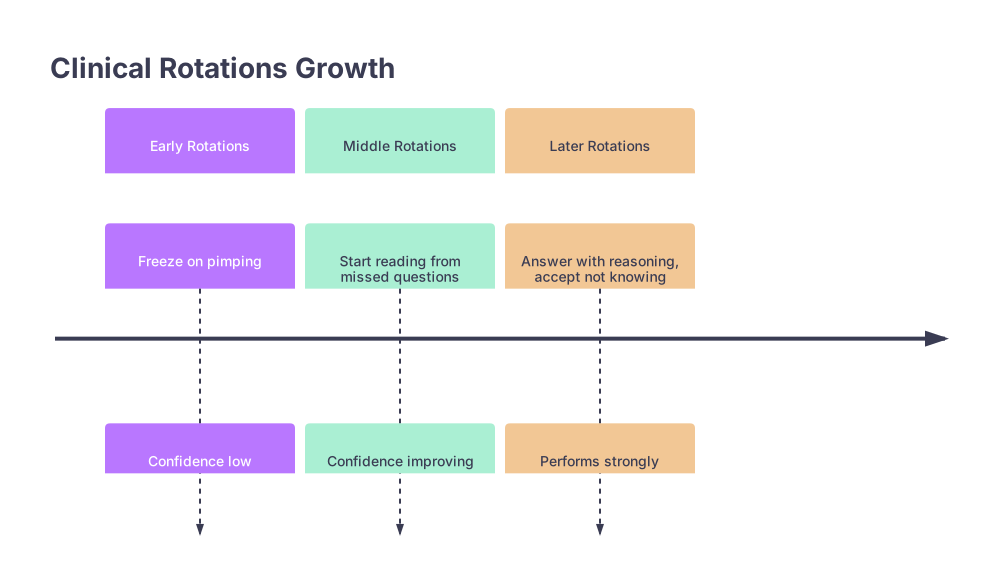
No one expects you to be fully formed from day one. They expect you to learn.
How to Stop the 3 a.m. Replays (Or At Least Soften Them)
I’m not going to give you some fake “just don’t worry!” line. You’re going to worry. But you can at least keep it from spiraling into “I’ll never match.”
A few things that actually help:
- Anchor in data, not vibes. Remind yourself: “One pimping freeze is maybe 5% of my eval at most.”
- Ask a resident you trust, straight up: “I totally froze on rounds yesterday, and it’s getting in my head. Does that kind of thing actually tank evals?”
They will almost certainly say no. They’ve been there too. - Give yourself one “processing window” for the cringe — like 10 minutes after you get home — then write it down, turn it into a learning point, and force yourself to close the mental tab. You’re not weak for needing structure around your anxiety.
You’re not the first student to think, “I ruined everything.”
You are absolutely not the first student to be wrong about that.
FAQ (Exactly 6 Questions)
1. I literally said “I don’t know” three times in a row on rounds. Is that worse than guessing?
It’s better than confidently guessing something unsafe. If they sense you’re just stonewalling and not even trying, that’s a problem. But “I don’t know, here’s what I do know, and I’ll look it up” is actually the ideal answer when you’re stuck. Repeat “I don’t know” with zero effort or follow-up, day after day? That’s what hurts. Not a single bad morning.
2. The attending looked annoyed when I froze. Am I doomed?
They looked annoyed because rounds are stressful and they’re juggling a million things, not necessarily because they hate you. People’s “thinking/pressured face” is often read as anger by anxious students. I’ve seen attendings look irritated and still give glowing evals. Their face in the moment is not a direct printout of your grade.
3. How many missed pimping questions is “too many” before it affects my evaluation?
There’s no magic number. If you’re consistently unprepared on core topics that have already come up multiple times, yes, they’ll notice. If you miss a bunch of obscure questions but show you’re reading and improving, they’ll usually shrug it off. Think patterns: unread + unchanged over time = problem. Missed questions + visible growth = fine.
4. Should I email the attending to apologize or explain after a bad day?
No long dramatic apology emails. That can actually make things weirder. A short, in-person comment the next day like, “I felt off yesterday and froze on your questions. I read up on X and learned Y,” is much more effective and appropriate. You’re a learner, not someone who committed a crime.
5. Can I bring this up in my dean’s letter or personal statement as “growth”?
Only if it truly turned into a larger pattern of growth, not just one awkward moment. Residency readers don’t need a blow-by-blow of every embarrassment. But if you had a real arc from anxious and silent to engaged and reasoning out loud, that can be woven into a broader story about learning to handle uncertainty and feedback.
6. Be honest: Did I ruin my evaluation by freezing once?
No. One freeze, even a really awkward one, doesn’t ruin an evaluation. At worst, it’s a tiny negative data point in a much larger picture. If you respond to it by reading, following up, and slowly getting better at answering (or at least reasoning), it actually becomes evidence in your favor: you get knocked down, you adjust, you improve. That’s what they want to see.
Key points to hang onto:
- One awful pimping moment doesn’t define your evaluation; patterns over weeks do.
- How you respond afterward (following up, reading, improving) matters way more than what happened in that 10-second freeze.
- Anxiety is normal; apathy is what hurts you. Care, show growth, and this becomes a footnote, not your headline.


