

The unspoken grading system on rotations isn’t “Pass / Fail.” It’s “Star / Invisible.”
And you already know which one you’re terrified of being.
You walk onto the ward, and there’s that person. The one who somehow always has the perfect answer, knows every patient’s sodium from memory, laughs easily with residents, and is already “basically an intern.” The attending says their name ten times a day. You’re pretty sure they’ll write a glowing letter, nominate them for some award, and maybe name a wing of the hospital after them.
And then there’s you. Standing there clutching your folded progress notes, trying to remember if this patient had COPD or CHF, and wondering if everyone can see how much your hands are shaking.
Let me say this bluntly: the fear that you’ll be quietly judged and downgraded just for standing next to a “star” student is real. I’ve seen it warp people’s entire clerkship year. I’m not going to gaslight you and pretend hierarchy and comparison don’t exist. They do.
But I’m also going to tell you some hard things that might actually help you breathe.
The Hidden Truth About “Star” Students (That You Never Hear On Rounds)
There’s a myth that attendings and residents are objectively ranking you against each other like some Step 1 scoreboard.
That’s not exactly how it works.
Yes, they compare you. They’re human. But it’s not one monolithic ranking; it’s more like a messy set of impressions: “reliable,” “tries hard,” “pain to work with,” “teachable,” “checked out,” “weirdly competitive,” “quiet but solid.”
And here’s the part that people don’t say out loud: the “star” student standing next to you can hurt you a little, but not nearly as much as your brain is telling you.
I’ve watched a sub-I with 260+ scores, insane research, and golden-child energy work next to a quieter, slower, more anxious student. The “star” got comments like: “Excellent knowledge base, functions at intern level.” The quieter one? “Thoughtful, clearly cares about patients, improving steadily." Both got Honors.
Programs and clerkship directors know there will always be a range of personalities on a team. They know not everyone is the loudest, quickest, or most polished. What usually kills evaluations isn’t “wasn’t as good as the star student.” It’s:
- Unreliable (late, disappears, doesn’t follow up)
- Defensive or resistant to feedback
- Clearly doesn’t care about patients or the team
- Actively competitive in a gross way
If you’re anxious and quieter and slower to answer questions but you show up, follow through, and don’t make people’s lives harder? You’re not doomed.
Is there bias? Yes. Do some attendings fall in love with the shiny extrovert and overlook the rest of the team? Yes. You might get unlucky. That’s the part that keeps me up at night too.
But your job is not to out-sparkle them. It’s to give people absolutely no reason to dislike working with you.
How Comparison Eats You Alive On Rotations
Let’s be honest about what this really does to your brain.
You’re on medicine. Your classmate presents their patient in a flawless, organized H&P with pertinent positives and negatives flying out of their mouth like they wrote Harrison’s themselves. The attending smiles, nods, says “Great job.”
Then it’s your turn. Your voice wobbles on the first sentence. You forget the order of the physical exam. You definitely ramble. You sit down feeling like you should just go home and withdraw from the year.
Here’s what your mind does immediately after:
- “They probably think I’m not trying.”
- “The resident will never pick me for procedures now.”
- “I’ll get Pass while she gets Honors and I’ll never match.”
- “Everyone can tell I don’t belong.”
You go quiet for the rest of the day because you’re trying not to “mess up again.” By the end of the week, you’re the student who “doesn’t speak up much.”
You know what that looks like on evals? “Quiet, needs to participate more.” Not because you lack knowledge, but because you got so freaked out by the star student that you stopped letting anyone see you.
The comparison doesn’t just hurt your confidence; it changes your behavior. And that’s the part that actually shows up on your evaluation.
So coping with this isn’t some fluffy “love yourself” nonsense. It’s literally damage control. You’re protecting your performance from your own panic.
What Attendings Actually Remember (It’s Not What You Think)
You think they’re remembering your worst answer. The time you said “beta blocker” when it was clearly contraindicated. The day you forgot to check a post-op hemoglobin.
Half the time, they don’t even remember who said what by the end of the week.
They remember patterns. Vibes. Who made their day easier, who made it harder, who faded into the background.
Let me break down what tends to stick in their heads:
| Category | What They Remember |
|---|---|
| Reliability | On time, follows up, organized |
| Attitude | Curious vs. checked-out |
| Teamwork | Helps others vs. self-focused |
| Trajectory | Clearly improving vs. stagnant |
| Red Flags | Dishonesty, laziness, arrogance |
Notice what’s missing? “Always the smartest person on the team.”
They like smart, obviously. But they hate arrogant, unreliable, or bitter. A mid-knowledge, high-effort student is often more loved — and better evaluated — than a brilliant jerk.
There’s also this other piece people ignore: attendings see way more “average” students than “stars.” They know the normal range. The bar in their heads isn’t “are you as good as the single best student this year?” It’s “are you someone I’d trust as an intern with some backup?”
You don’t have to be the best. You have to be safe, teachable, and not miserable to be around.
The whole “but I’m not the top student” fear comes from this false belief that there’s one Honors slot and everyone else gets destroyed. Yes, some schools curve Honors. Yes, sometimes someone else’s brilliance highlights your weaknesses. But more often than not, the person who tanks your evaluation is… you, when you shut down.
Concrete Ways to Cope When You’re Rotating With a Star
You don’t need a motivational poster. You need tactics you can actually use tomorrow when you’re standing next to Ms. Perfect Sub-I and feeling like an impostor in human form.
1. Redefine what “doing well” means for you on that rotation
If your internal metric is “be better than the star student,” you’ve already lost.
Change the question from “Am I as good as them?” to “Would they feel okay leaving me alone with their patient for 10 minutes?”
That mental shift matters. You don’t need to be the walking UpToDate of the team; you just need to be competent and improving.
Set 2–3 behavioral goals per week. Stuff like:
- “I’m going to volunteer to present one new patient.”
- “I’ll follow up on every lab I ordered and report it without being asked.”
- “I’ll ask one content question and one management question each day.”
Those are things under your control, not dependent on how bright someone else shines.
2. Make the star your resource, not your rival
This sounds nauseatingly mature, but it works.
Instead of stewing, try: “Hey, you’re really solid on presentations — any tips? I get tangled halfway through.”
Yes, it’s uncomfortable. But you know what that does?
It turns them from a threat into a low-key coach. It also makes you look collaborative rather than resentful, which attendings subconsciously like.
You can even study how they operate. Not to copy their personality, but to steal techniques. How do they structure “one-liner, overnight events, subjective, objective, assessment, plan”? How do they phrase “I don’t know” without collapsing?
Use them as a real-life template, not a weapon against yourself.
3. Verbally label your learning curve
You’re terrified they’ll think you’re dumb. Fine. Name the elephant before it steps on you.
Say something like, “I’m still getting comfortable with organizing my presentations, but I’m working on tightening them up. If you have any feedback, I’d really appreciate it.”
Does that feel vulnerable? Yes. Does it also:
- Show insight
- Signal that you’re improving
- Lower expectations from “perfect” to “learning”?
Also yes.
Residents love “on the upswing” students. Even if you start below the star, showing visible improvement can leave a stronger impression than someone who was great on day one and then just… stayed great.
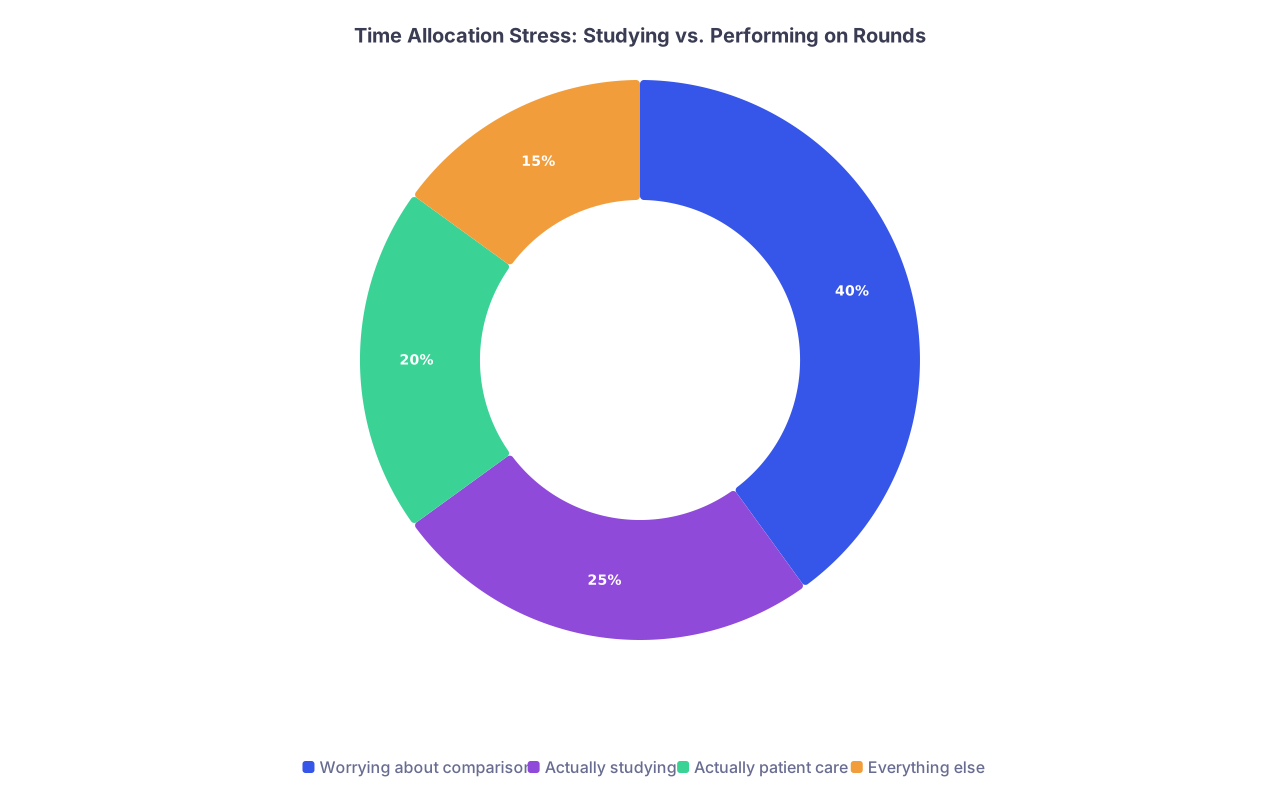
| Category | Value |
|---|---|
| Worrying about comparison | 40 |
| Actually studying | 25 |
| Actually patient care | 20 |
| Everything else | 15 |
4. Protect your mind outside the hospital or you’ll implode
You cannot spend all day feeling inferior on rounds and then all night doom-scrolling Reddit threads about people with 270s, 20 pubs, and 19 Honors asking “Is my app okay?”
That’s how you fry your nervous system.
You need boundaries. Not the Pinterest type. The practical kind:
- Do not ask your co-students what grades they’re aiming for or what they got on last rotation. That never calms you.
- Limit Reddit/Discord/SDN during evaluation weeks. Your brain is already in threat mode; it will latch onto every worst-case post it finds.
- Pick one or two humans you trust — friend, upperclassman, resident — and when your thoughts spiral to “I’m going to fail and never match,” say it out loud to them. Humiliation drops fear power.
Also, sleep. I know, cliché. But I’ve watched exhausted students become paranoid about everything — expressions, tone, side comments — and then their evals read like “overly sensitive, anxious.” You don’t want that.
The Quiet Student Problem: Are You Doomed If You’re Not Loud?
Here’s a nasty thought that lives rent-free in my head: “If I’m not constantly talking, asking questions, showing off my reading, they’ll assume I’m lazy or dumb.”
I wish I could tell you that’s 100% false. It’s not. Some attendings equate loud with engaged. It’s stupid, but real.
So if you’re quieter, you have to be a bit more deliberate about being visible — without pretending to be someone you’re not.
You can:
- Ask one well-thought-out question instead of ten random ones.
- Volunteer for concrete tasks: “I can call the family and update them,” “I’ll track the post-op labs,” “I can get the outside records.”
- Give small, clear updates during rounds: “Mr. X’s pain improved after the dose increase; no side effects so far.”
You don’t need to be the constant voice. You do need some trail of evidence that your brain is turned on.
Also, say things like: “I tend to be quieter but I’m really engaged — please let me know if it ever looks like I’m not pulling my weight.” That one sentence can reframe you in a resident’s mind from “maybe checked-out?” to “quiet but invested.”

| Step | Description |
|---|---|
| Step 1 | Rotate with star student |
| Step 2 | Compare yourself constantly |
| Step 3 | Feel inadequate & anxious |
| Step 4 | Speak up less, avoid questions |
| Step 5 | Look disengaged to team |
| Step 6 | Worse evals or vague feedback |
| Step 7 | More anxiety on next rotation |
The Worst-Case Scenario You’re Afraid Of (And What Actually Happens)
Let’s walk through the nightmare version in your head.
You’re on IM with a super-star. They crush everything. You bumble around, improve some, but never reach their level. They get Honors, you get High Pass or Pass. You spiral: “This one rotation ruined my chances. Every program will see I’m worse. I’m done.”
Reality is less dramatic and more annoying. Your transcript becomes:
- A mix of Honors, HPs, maybe a Pass or two
- A dean’s letter that says something like “hardworking, well-liked, improving clinically”
- No one on the residency side knows or cares who you were compared to on that single team
What can hurt is patterns. Honors in easy rotations, Pass in the harder ones. Repeated comments about being disengaged or not improving. Red flags in professionalism.
One star student on one team does not create a pattern. Even two don’t.
You’re scared that every attending is secretly saying, “Well, they were fine, but not as good as [Star].” Some might. But residency committees aren’t cross-checking all your clerkships to see if you were the #1 student every time. They’re asking: Does this applicant clear the bar? What trajectory are they on? Does anything smell off?
You could match into solid programs with a transcript full of “good, works hard, nice to patients” and zero “best student I ever worked with” comments. Happens constantly.
Quick Reality Check: You’re Not Seeing Their Whole Story
Last thing, because your brain is probably doing that lovely thing where it turns the star into a flawless demigod.
You don’t see:
- The days they go home and sob because they missed a pimp question too
- Their Step score anxiety, their own “I’ll never be as good as that other person” loop
- The rotation where they were the slow one
- The bad evaluation they quietly got before this clerkship
Everyone compares. Everyone is terrified of being exposed as not enough. The only difference is some people are better at hiding it behind confident body language and rapid-fire answers.
You’re not broken because your fear is louder. You’re just more honest with yourself.
FAQs
1. What if I’m always the “second-best” student — does that ruin my chances at competitive specialties?
Annoyingly, no one is tracking this as cleanly as your brain assumes. There isn’t a secret log: “Always overshadowed by a star; reject.” Residency programs see your grades, narratives, Step scores, letters. If your overall package is strong — solid clinical comments, good letters, no disastrous rotations — no one knows or cares how many times you stood next to a golden child. Being “second-best” on good teams usually means you’re actually quite strong.
2. How do I handle it in the moment when the attending keeps praising the star and ignoring me?
It stings. You’re human. Internally: let yourself feel the punch in the gut, but don’t shut down. Externally: keep doing your job. If it becomes a pattern over days, grab the resident you trust and say, “I’m trying to grow on this rotation — any feedback for me? Anything I should focus on?” That gently reminds them you exist and signals you care, without whining about someone else’s praise.
3. Should I tell an attending I feel overshadowed by another student?
Usually, no. Saying “I feel overshadowed” directly can sound like you’re asking them to compare you more. Instead, frame it around your growth: “I’d really appreciate any specific feedback on how I can improve my presentations/clinical reasoning — I want to make sure I’m meeting your expectations for this level.” That gets you what you actually want: guidance and maybe some positive reinforcement.
4. What if my anxiety about comparison is so bad it’s affecting my performance?
Then it’s not a personality quirk; it’s a performance-limiting problem and deserves real help. Talk to student wellness, a therapist, or a trusted dean. Sometimes a few sessions of CBT-style work around performance anxiety, or even short-term meds for severe anxiety, can make a huge difference in how you function on the wards. This isn’t a character flaw. It’s treatable.
5. How much do clinical evaluations really matter compared to Step and research?
For some specialties, Step + research dominate. For others (like primary care, psychiatry, some IM programs), your letters and clinical comments carry a ton of weight. But no one is choosing purely based on “was this student the brightest on their team?” They care more about: Will you show up? Will you learn? Will you be safe? One rotation where you felt overshadowed — even two — won’t tank your whole app if the overall picture is solid.
6. Is it ever okay to be openly competitive with other students?
If by “openly competitive” you mean gunning — taking procedures away, correcting peers in front of attendings to look smart, hoarding information — no. That stuff follows you. Residents and attendings talk. You can be ambitious and driven without making colleagues collateral damage. The best “competitors” I’ve seen were the ones who lifted others up, shared resources, and still quietly worked their asses off. Ironically, that’s who people end up calling “star” later.
Key points: You don’t have to outshine the star; you just have to be reliable, teachable, and visibly engaged. The comparison in your head is almost always harsher than what’s actually happening on your evaluations. And the biggest threat to your performance isn’t the brilliant student next to you — it’s what your anxiety does to you if you let it run the show.


