

Programs are not judging your worth as a future physician by how many IVs you placed as a third-year.
They’re just not.
I know that feels impossible to believe when your classmates are bragging about their 10th LP and you’re over here proud of… removing a Foley. Once. With supervision. On a mannequin two weeks ago.
Let’s talk about it before you spiral all the way into “I’ll never match.”
The ugly truth about procedures in med school
There’s a dirty little secret no one says out loud: procedure exposure in med school is wildly inconsistent and mostly random.
You can be:
- On surgery and never touch a scalpel because you got assigned to the attending who treats students like moving coat racks.
- On OB with an intern who lets you catch five babies in a day.
- On EM nights in July with eager seniors who throw lines at you.
- Or on EM days in March with burned-out residents who would rather do it themselves in 30 seconds.
You know that. But your brain still says: “If I don’t have a big list of procedures in my evals, programs will assume I’m incompetent, slow, or lazy.”
They won’t. Here’s why.
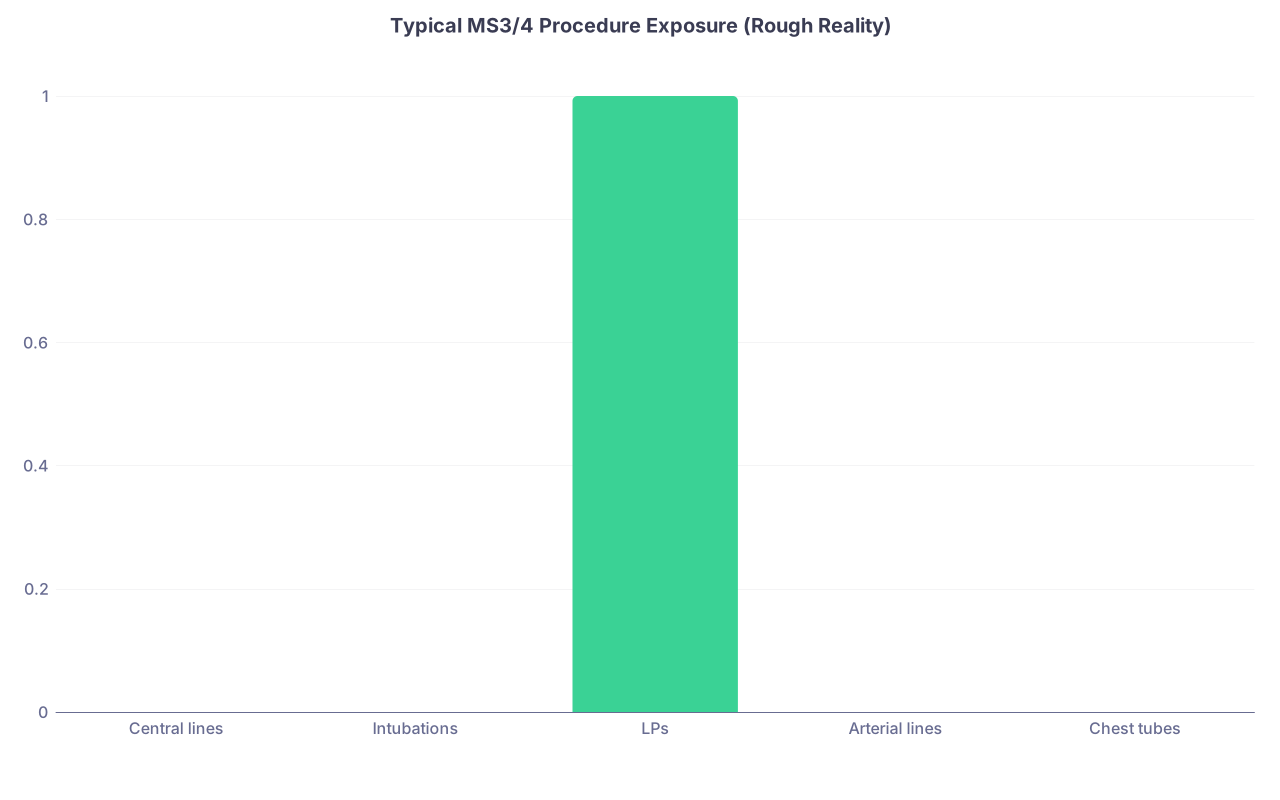
| Category | Value |
|---|---|
| Central lines | 0 |
| Intubations | 0 |
| LPs | 1 |
| Arterial lines | 0 |
| Chest tubes | 0 |
That bar chart? That’s closer to what most students actually get, not the fantasy version people flex about on Reddit.
Most med students graduate having:
- Never placed a central line
- Never done an intubation on a real patient
- Maybe done one LP, if that
- A few I&Ds, sutures, or punch biopsies if they got lucky
- A handful of vaginal deliveries if their OB rotation was generous
And here’s the kicker: residency programs know this. They train interns starting from that baseline every single year.
What programs actually care about (and what they don’t)
Let me be direct: No one is sitting in a conference room saying, “Hmm, this applicant didn’t do enough paracenteses as a student, reject.”
They’re looking for:
- Work ethic
- Reliability
- Ability to learn
- Attitude under stress
- How you function on a team
- Clinical reasoning and ownership
Procedural skill in med school is nice-to-have seasoning. Not the main dish.
Honestly, if you show up as an intern already thinking you’re amazing at lines and intubations, that’s more of a red flag. Programs worry more about the overconfident “I’ve got this” intern than the “I’m eager but careful” intern.
I’ve seen evals torpedoed by one phrase: “Does not accept feedback; overestimates skill level.” The student had done a bunch of procedures. Didn’t matter. The attitude killed them.
Meanwhile, the anxious ones who say, “I haven’t done many, but I’m really trying to learn and I read up before every case” do just fine.
Why it feels so bad even if it’s normal
You’re not crazy for panicking. The environment basically sets you up to feel behind.
You hear things like:
- “When I was a med student, I did 50 vaginal deliveries.” (Were you in 1987? At a county hospital? Different world.)
- “My cousin in another med school got to intubate on his first EM shift.”
- “Our school expects you to be comfortable with [insert 10 procedures] by graduation.”
Then you go on your rotation and it’s:
- “We’ll let you know if there’s a good one for you.”
- “This one’s too sick, I’ll just do it.”
- “We’re running behind, I’ll do it quickly.”
- Or worst: nobody even tells you the procedure is happening.
So you internalize: If I were better — more proactive, more impressive — they’d let me do things.
That’s not how this works. A lot of it is:
- Timing
- Patient acuity
- Resident/attending personality
- How busy the service is
- How medicolegal-paranoid the attending is feeling that day
Which has almost nothing to do with your actual competence.
What programs expect you to know by the end of med school
Here’s a more honest benchmark: they expect you to understand procedures conceptually, be safe around them, and maybe have assisted or done a few simple ones. That’s it.
Think in three buckets:
Know about it
You understand indications, contraindications, complications, basic steps, and post-procedure care. You could talk through a paracentesis even if you’ve never held the needle.Assist / observe
You’ve held the ultrasound probe, set up the tray, positioned the patient, or retracted. For intubation, maybe you’ve seen it dozens of times and know the sequence.Actually perform
You’ve done the “simple” ones under close supervision: suturing, basic I&D, maybe an LP or arthrocentesis if your site is generous.
Residency is where bucket 3 gets filled. For real.

How to talk about weak procedure exposure without sounding incompetent
You’re probably terrified that if you mention lack of procedures, it’ll make you look weak. It won’t, if you frame it right.
Don’t say:
“I never got to do procedures, so I’m really behind.”
Do say things like:
- “Our site had limited opportunities for invasive procedures, so I focused heavily on understanding indications, complications, and post-procedure management. I’m really eager to get hands-on in residency.”
- “While I haven’t had many chances to perform procedures myself, I’ve assisted frequently and made a point of pre-reading technique and anatomy beforehand.”
- “I know my procedural numbers aren’t high. I’ve tried to compensate with strong clinical reasoning and being meticulous about sterile technique when I do get the chance.”
That signals self-awareness, not incompetence.
What worries programs is the opposite: someone with inflated numbers clearly stretching the truth, or zero understanding of what procedures entail but insisting they “love procedures.”
Concrete things you can still do now (without magically generating more LPs)
You can’t force your hospital to hand you procedures, but you’re not powerless.
Here’s what you can realistically do:
Learn the “why” and “how” cold
Before every shift: pick one procedure you might see and know:- Indications / relative & absolute contraindications
- Necessary equipment (be able to help grab it)
- Major complications and how you’d respond
- Rough step-by-step
Make it stupid-easy for people to teach you
Stuff like:- “If any suturing or bedside procedures come up, I’d really love to help if the situation allows.”
- Stand near the action: the student across the ward never gets pulled in.
- Have consent forms, sterile gloves, and a pen ready before anyone even asks.
Do simulation if you can
Skills lab, sim center, or even a half-decent online course plus a kit. Yes, it’s not the same. But it shows initiative and builds muscle memory.Document what you actually do
Keep a simple log. It doesn’t have to be impressive; it just keeps you honest and helps when your brain says, “You’ve done nothing.” Often, you’ve done more than you remember.
| Procedure | Typical Student Exposure | Comfortable by Residency Start? |
|---|---|---|
| Simple suturing | 1–10 attempts | Helpful but not required |
| I&D abscess | 0–3 assists/attempts | Nice, not mandatory |
| LP | 0–2 attempts | Totally fine if zero |
| Paracentesis | 0–1 assists | Expected to learn as intern |
| Central line | 0 | 100% okay to start at zero |
That last column is the part your anxiety keeps ignoring.
How this actually plays out once you’re an intern
Picture this: It’s July 5th. You’re an intern on nights. Senior says, “We’ve got a possible LP. You done one before?”
You answer honestly: “I’ve seen a few, but I haven’t successfully done one myself yet. I’ve read up on technique and feel comfortable with the steps but will definitely need close supervision.”
That’s not a red flag. That’s textbook.
Your senior is expecting:
- To walk you through positioning
- To help you find landmarks
- To scrub in right next to you
- To be there if you miss
- To do the rest of the shift exactly the same whether you got it or not
What they don’t want is:
“I’ve done tons of these” — and then you break sterile field twice, don’t know what tubes to use, and have no plan for post-LP headache.
They can work with anxious-but-prepared. They cannot work with confident-but-clueless.

| Step | Description |
|---|---|
| Step 1 | Observe procedure |
| Step 2 | Assist with setup |
| Step 3 | Perform under direct supervision |
| Step 4 | Perform with minimal prompts |
| Step 5 | Perform independently as senior |
Notice where “medical student” usually lives? A → B, occasionally C. That’s it.
What actually signals incompetence (and it’s not low numbers)
If you want to know what scares programs, it’s not “this student never did a chest tube.” It’s patterns like:
- Chronic lateness, disappearing on the unit, unreachable when needed
- Not reading about patients or showing zero curiosity
- Unsafe behavior: ignoring vitals, not asking for help when unsure
- Blaming others, never taking responsibility
- Lying or “rounding up” about experience
None of those are about procedures. They’re about character and judgment.
I’ve seen students with almost no procedures get glowing comments like:
- “Teachable, hardworking, will be an asset to any program.”
- “Strong clinical foundation, will pick up procedures quickly.”
Programs read that and think: “We can teach them the hands-on stuff.”
How to stop the mental comparison game (or at least turn the volume down)
The comparison is killing you more than the actual lack of procedures.
You see:
- The surgery keener posting their suture videos
- The EM-bound student tweeting “First intubation!!”
- The one classmate whose uncle is an anesthesiologist who “lets” them intubate when they visit
You translate that into: “Everyone but me is competent.”
Try a mental reframe that’s actually accurate:
- “They got lucky with opportunities.”
- “Their situation is different; mine isn’t worse, just different.”
- “Residency is designed to start people from varying baselines.”
- “My job now is to show I’m safe, teachable, and motivated.”
You don’t need to be the most procedurally experienced intern on July 1. You just need to not be the one who refuses to learn or scares everyone with overconfidence.
Quick reality checks before you panic again
If you’re still thinking, “Yeah, but my lack of procedures is uniquely terrible,” let me snap you out of it with some blunt truths:
- You can match into IM, peds, FM, psych, OB, EM, or even surgery without ever having done a central line in med school. People do it every year.
- Most program directors have zero idea how many procedures their interns did as students. They barely trust the “numbers” they see from some schools anyway.
- They know procedure access is more about school, hospital, and preceptor style than about student initiative.
- The fastest learners in residency are not the ones with the most pre-existing experience; they’re the ones who ask good questions, prepare, and don’t shut down when they mess up.

FAQs
1. Should I lie or exaggerate my procedural experience on applications or in interviews?
No. Flat no. People can tell. If you say, “I’ve done lots of LPs,” someone might say, “Walk me through your technique step-by-step,” and now you’re stuck. It’s much safer to say, “I’ve had limited hands-on experience but solid exposure and understanding, and I’m eager to build skill.” Programs would rather train an honest novice than deal with a dishonest “expert.”
2. Will my low procedure numbers hurt me if I’m applying to a procedural specialty like EM, anesthesiology, or surgery?
Not by themselves. Those fields care more about your overall application: Step scores (if applicable), letters, rotation performance, work ethic, and genuine interest. If you’ve done few procedures, balance it by demonstrating you understand and enjoy the field in other ways: good EM/anesthesia/surgery evals, electives, strong letters, maybe some relevant research or case reports. They fully expect to train you from a basic starting point.
3. Is it too late in MS4 to improve my procedural skills?
It’s not too late to improve your readiness even if you can’t get tons more hands-on practice. On sub-Is or acting internships, tell residents from day one that you’re eager for any appropriate procedures. Use sim centers, practice knot tying, review ultrasound basics, and read step-by-step guides. You may not rack up huge numbers, but you can absolutely show up to residency more prepared and less scared.
4. Programs in my country/hospital expect graduates to be more “procedurally ready.” Am I doomed if my school is light on procedures?
You’re not doomed, but you will need to be intentional. Start now: maximize any procedures you can get, even if they’re basic. Talk to mentors about realistic expectations locally. Use skills labs, workshops, and assistant roles to build foundation. In your application and interviews, frame your experience honestly but emphasize your proactive efforts: what you’ve studied, courses you’ve taken, simulations you’ve done, and your commitment to catching up quickly.
Bottom line:
- Lack of procedures in med school does not equal incompetence; it usually equals bad luck and system issues.
- Programs care far more about your attitude, work ethic, and teachability than your LP count.
- Your job now isn’t to magically create more procedures; it’s to be prepared, honest, and ready to learn fast once you’re finally given the chance.


