

You’re sitting there staring at your rotation schedule for the year, and your stomach just drops.
Everyone else seems to have done this perfectly. Surgery before EM. IM before Sub-I. Their chosen specialty early enough to impress people and get letters. And you… somehow put your specialty late. Or after some random rotation. Or you burned one of your audition spots on a specialty you’re no longer even sure you want.
And now your brain is going:
“I screwed this up.”
“I’m behind.”
“Everyone else planned this better.”
“Did I just ruin my chances at my dream specialty because I clicked the wrong order on a Google form six months ago?”
Let’s walk through this. Because I’ve seen people match competitive specialties with what looked like an absolute chaos rotation order. And I’ve also seen people with “perfect” schedules still crash and burn for totally different reasons.
You’re not the first person to feel like you broke your year before it even started.
The Fear: “I Put My Specialty Too Late… Did I Just Screw Myself?”
This is the big one, right? You’re interested in, say, internal medicine or EM or ortho, and your core or sub-I in that specialty isn’t until… way later. Maybe even after ERAS opens. Horrible.
Here’s the ugly feeling:
“I won’t have strong letters in time.”
“I won’t know if I even like this specialty until it’s too late.”
“I’ll look unprepared on that rotation because I didn’t do XYZ first.”
Some reality:
For most core clerkships, the order matters a lot less than your anxiety is telling you.
Programs care about:
- Your clinical performance (shelf + evals)
- Your letters
- Your narrative: do your choices make sense by the time you apply?
They do not open ERAS and say, “Oh wow, this person did IM in March instead of July, reject.”
Where timing does start to matter more is:
- Sub-internships / audition rotations
- Having at least 1–2 letters in your chosen field ready by mid to late summer
So the question isn’t “Did I pick the wrong order and ruin everything?” It’s “Given my current order, how do I still get what I need?”
You have more wiggle room than you think.
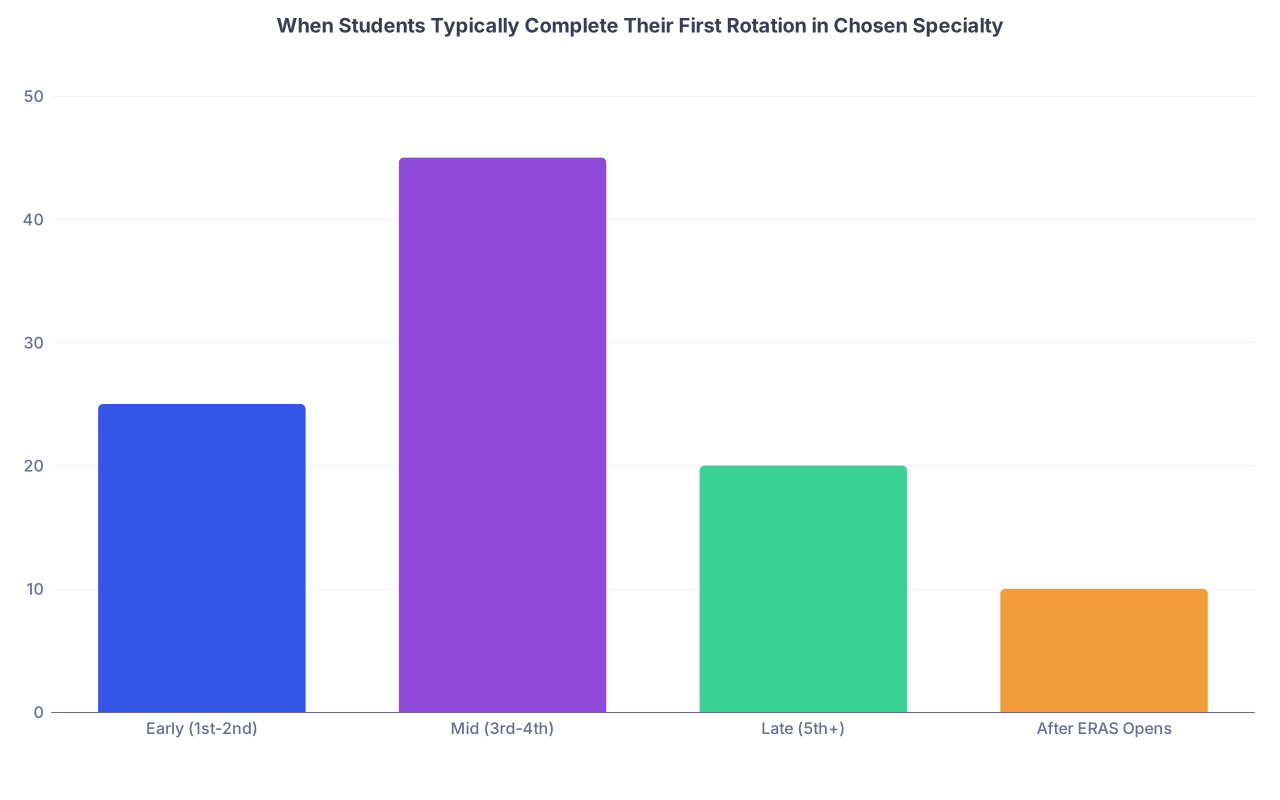
| Category | Value |
|---|---|
| Early (1st-2nd) | 25 |
| Mid (3rd-4th) | 45 |
| Late (5th+) | 20 |
| After ERAS Opens | 10 |
Worst-Case Thinking vs Actual Risk
Let me be blunt: your brain is catastrophizing the schedule way more than program directors are.
The catastrophic stories going through your head probably sound like:
- “If I don’t do IM first, I’ll be terrible on IM and get a bad letter.”
- “If I do surgery late, they’ll expect me to be good already and I’ll look dumb.”
- “If my EM rotation is in September, I won’t even have an SLOE in time.”
- “If I change my mind late, I’ll have no shot at switching specialties.”
Here’s what I’ve actually seen happen:
- People who did IM as their first rotation and still got stellar letters because they showed up early, were teachable, and asked for feedback constantly.
- People who did their “dream” specialty crazy late and still got great letters that were used for that cycle.
- People who were sure they wanted one specialty, changed their minds in August, and still matched into the new specialty with a combination of late rotations, non-core letters, and a very clear story in their personal statement.
The real risks with “weird” rotation order are narrower:
- You might feel less confident early on.
- You might have to scramble a bit to get letters by deadlines.
- You might need to be more intentional explaining your path in your application.
Annoying? Yes. Fatal? Usually no.
Specific Scenarios You’re Probably Spiraling About
Let’s go through some of the common “I ruined everything” situations and what’s actually salvageable.
1. “My chosen specialty rotation is after ERAS opens.”
This one feels like a punch in the gut.
Say you want IM and your IM sub-I isn’t until September. ERAS opens in early September. Programs start downloading applications later that month. You’re panicking because your Big Letter isn’t even started.
Options:
- Use earlier letters that are still strong, even if they’re not in the specialty. EM letter for IM? Surgery letter for FM? Totally happens. Programs care a lot more that someone is vouching that you’re a good clinician than that every letter is hyper-specialty-specific.
- Ask your later preceptor if they’re willing to write a letter quickly. Some attendings are used to this timing crunch. I’ve seen letters turned around in a week when students asked early in the rotation and reminded them near the end. You can even tell them, “My ERAS is already in, but programs will see updated letters.”
- Schedule an earlier, shorter experience if your school allows it: an elective week, a half-day clinic, a shadowing block with someone in your chosen field, then ask them for a letter based on that plus your past work. Not ideal, but real.
Does it feel good to hit “submit” without a letter in your final specialty? No. Is it a guaranteed death sentence? Also no.
Programs add letters to your file as they come in. A strong late letter is still valuable.

2. “I put super hard rotations first and I’m going to bomb them.”
Maybe you’ve got surgery as your first rotation. Or OB. Or some notoriously malignant site. And you’re thinking, “Perfect, I’m going to be the least competent person there and they’re going to destroy my confidence for the rest of the year.”
Reality check:
Everyone is mediocre on their first rotation.
You don’t lose points for not knowing where the dressing supplies are. Or being slow with EPIC. Or not knowing all the steps of a cholecystectomy. What does get you in trouble is:
- Looking disinterested
- Being late
- Having a bad attitude when you’re corrected
- Disappearing when work needs to be done
Your knowledge curve is honestly not the biggest variable here. They know you’re starting out.
Weirdly, some people actually benefit by having a brutal first rotation because everything afterward feels manageable, and they build this “I can survive anything” mindset.
Could your grade be slightly lower than if you’d done that rotation later? Maybe. But one “High Pass” instead of “Honors” is not going to kill your application.
3. “I realized too late I want a different specialty, and my schedule doesn’t match that at all.”
This is the nightmare: you built your schedule around, say, surgery, and now you want anesthesia or PM&R or psych. And your rotations reflect your old life.
Programs don’t hate that.
If anything, it often creates a more interesting narrative. “I thought I wanted X, then during Y rotation I realized I actually cared more about [XYZ aspects], which led me to this specialty.” That’s fine. That’s human.
Main things you need:
- At least 1–2 people in the new field who can write you letters.
- A believable explanation of the switch that doesn’t sound flaky or impulsive.
- Evidence that you actually know what you’re getting into (electives, shadowing, mentors).
You can still pivot even with a schedule that looks “wrong.” You’ll just have to hustle a bit more to line up letters and experiences in the new specialty, even if they’re late.
How Different Specialties Actually Look at Rotation Order
Some fields care more about specifics than others. It’s not totally uniform, but let me generalize a bit.
| Specialty | How Much Rotation Order Matters |
|---|---|
| Internal Medicine | Low–Moderate |
| Family Medicine | Low |
| Psychiatry | Low |
| Pediatrics | Low–Moderate |
| Emergency Medicine | Moderate–High (for SLOEs) |
| General Surgery | Moderate |
| Ortho / ENT / Urology | Moderate–High (auditions) |
| Anesthesiology | Moderate |
For most primary care–leaning fields (IM, FM, psych, peds), the content of your application matters more than the choreographed order of your rotations.
Where it starts to matter more is:
- EM: Because of SLOEs and needing at least 1–2 by the time programs review apps. If your EM rotation is after apps open, you’ll feel behind. People still match that way, but it’s trickier. You might want to do an early away or home EM if possible.
- Surgical subspecialties: They love audition rotations. If your auditions are all super late, your letters may cut it close.
But even here, I’ve watched students match EM with SLOEs coming in October and November. They weren’t thrilled about the timing, but they still got interviews.
So no, there isn’t some master spreadsheet where PDs rank you down because “This student did peds after IM instead of before.” That’s not how this goes.
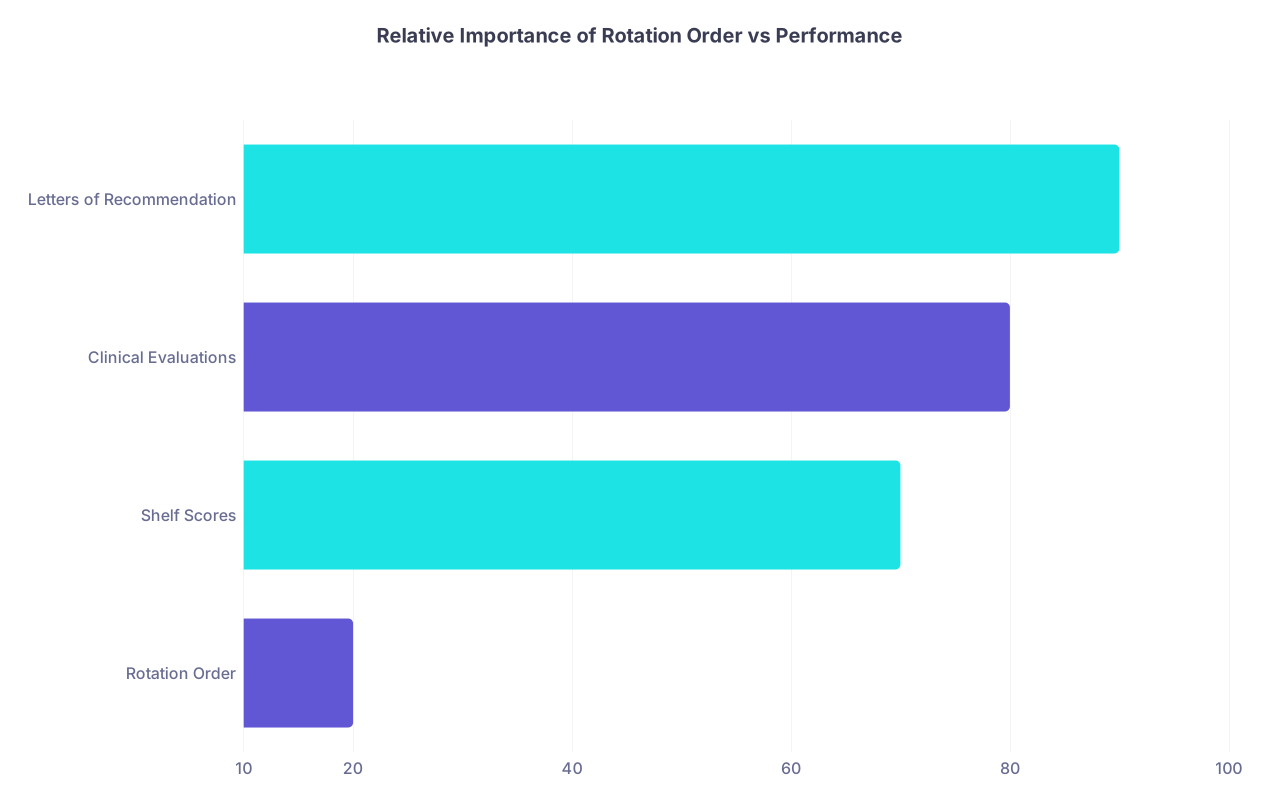
| Category | Value |
|---|---|
| Rotation Order | 20 |
| Shelf Scores | 70 |
| Clinical Evaluations | 80 |
| Letters of Recommendation | 90 |
What You Can Control Now (Instead of Rewriting the Past)
You can’t un-click the schedule choices. You can’t magically move that IM sub-I to July if the spots are gone. So what’s left are the levers you actually still have.
A few you might not have thought about:
You can often adjust where you do a rotation, even if you can’t change when. Site matters. Some sites are known for great teaching and reasonable expectations; others are notorious. If you’re stuck with, say, surgery first, maybe you can at least pick a site with a more education-focused culture.
You can front-load studying. If your chosen specialty isn’t until later, that doesn’t mean you have to show up cold. If you know you want IM but it’s month 5, you can start slowly reviewing IM content during earlier rotations, especially the overlapping stuff. That way you hit the ground running.
You can communicate with your dean’s office. This is underrated. Go to your advising dean or clerkship director and say, “I’m worried about getting letters in time because my [specialty] rotation is late. Are there any ways to:
– add a brief elective early?
– shift one block?
– get paired with someone now who could know me well enough for a letter?”
Sometimes they say no. But sometimes there’s flex you don’t see from the student side.
You can be strategic about letters from other rotations. A glowing letter from OB saying, “This student was the best on our service this year, incredible work ethic” still helps you for IM, EM, anesthesia—all of it. Don’t treat non-specialty rotations as throwaways just because they don’t “match” your field.
You can build relationships outside of formal rotations. Shadow days. Clinic half-days. Research mentors who also work clinically. These are all real letter sources.

| Step | Description |
|---|---|
| Step 1 | Realize schedule isnt ideal |
| Step 2 | Identify potential early letter writers |
| Step 3 | Focus on strong performance |
| Step 4 | Ask for feedback early and often |
| Step 5 | Request letters near end of rotation |
| Step 6 | Arrange brief elective or shadowing |
| Step 7 | Prepare targeted for that rotation |
| Step 8 | Ask elective mentor for letter |
| Step 9 | Explain timeline in application if needed |
| Step 10 | Need earlier letters? |
| Step 11 | Specialty rotation late? |
The Part Nobody Says Out Loud
A lot of the anxiety around “rotation order” is actually about something else:
You’re terrified of being behind.
Of being the least competent person in the room.
Of having your “dream specialty” depend on decisions you made before you knew what you were doing.
And some of that is just… medicine. It’s built on this constant feeling that if you missed the “right” step at the “right” time, you’re doomed. It keeps people anxious and compliant.
Rotation order can make your life easier or harder in the short term. I won’t pretend it’s irrelevant. Having your chosen specialty in the first half of the year, with enough time to get letters and maybe an extra elective? Yeah, that’s convenient.
But the people who end up matching well aren’t the ones who had flawless schedules. They’re the ones who:
- Performed consistently wherever they were thrown
- Recovered from less-than-ideal situations without spiraling into paralysis
- Asked for help and letters proactively
- Could tell a coherent story by the time ERAS went in
I’ve seen someone with their first EM rotation in August still match EM because they absolutely crushed that block, got a fast SLOE, and had other strong general letters.
I’ve also seen someone with the perfect early-EM, early-sub-I schedule still struggle because they were passive on rotations and no one strongly advocated for them.
Your schedule isn’t your destiny. It’s just the map. You’re still the one walking it.
A Concrete Next Step (Today, Not Theoretical)
Do this right now. Not later, not “after I feel less anxious.”
Open whatever you use to track your rotations—your school portal, your spreadsheet, your calendar.
On a piece of paper (actual paper), write three things:
- Your likely target specialty (even if you’re 70% sure, just write the frontrunner).
- Which rotations you’ll complete before ERAS opens that could realistically generate letters.
- The name of one attending, resident, or mentor you could reach out to this week to talk about letters or timing.
Then send one email today. Something like:
“Hi Dr. X, I’m a rising [M3/M4] and I’m starting to think about going into [specialty]. My rotation schedule’s a little odd this year and I’m worried about getting letters in time. Could I meet with you briefly to get your advice on how to approach this and whether there might be opportunities to work with you or colleagues earlier in the year?”
That’s it. One email. One concrete move away from the spiraling “What if I chose the wrong rotation order?” and toward “Okay, this is my schedule—how do I still win with it?”
The schedule you already picked isn’t perfect. Fine. Almost nobody’s is.
But it’s not a death sentence. It’s just the starting position.


