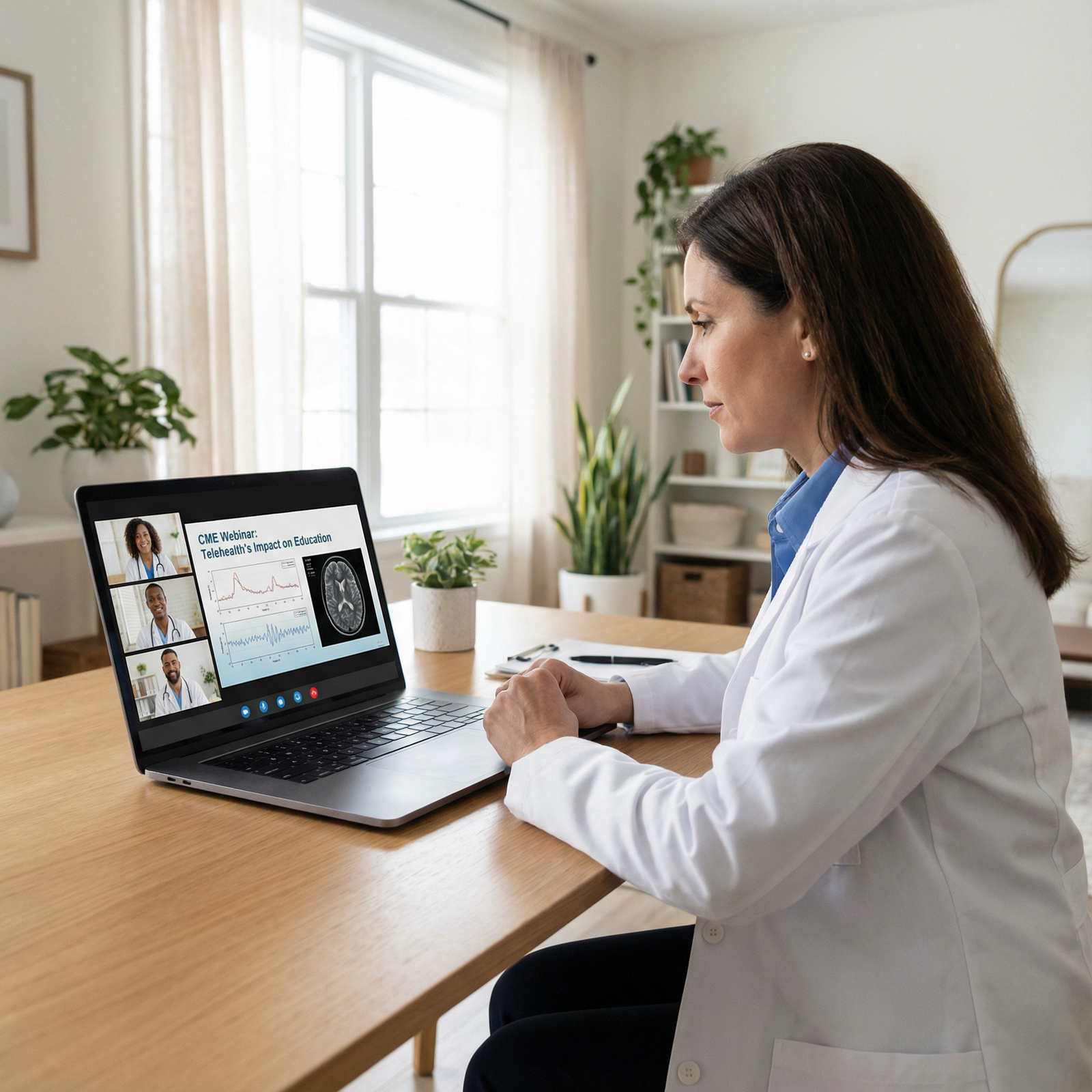
Continuing Medical Education (CME) is no longer confined to lecture halls and conference centers. Telehealth and digital platforms have reshaped how physicians, residents, and other clinicians learn, practice, and maintain competence. For residency applicants and early-career clinicians, understanding how telehealth intersects with CME and broader healthcare training is now essential for both licensure and long-term professional development.
This enhanced guide explores how telehealth is bridging critical gaps in Continuing Medical Education, what benefits and challenges it brings, and how you can leverage these tools strategically throughout your medical education and career.
The Essential Role of Continuing Medical Education in Modern Practice
Continuing Medical Education is the backbone of safe, high-quality, evidence-based care. Regardless of specialty, geography, or practice setting, ongoing learning is an ethical and regulatory requirement.
What Is Continuing Medical Education (CME)?
CME refers to formally structured educational activities that help healthcare professionals:
- Maintain current clinical knowledge and skills
- Acquire new competencies or subspecialty expertise
- Improve professional performance and patient outcomes
For most physicians and advanced practice providers, CME lies at the intersection of medical education and continuing professional development. It connects residency training to lifelong learning and is tightly linked with licensure, credentialing, and board certification.
Key Drivers Behind CME Requirements
1. Regulatory and Licensure Requirements
- State medical boards: Many require 20–50 CME credits every 1–2 years to maintain licensure, often with specific content requirements (e.g., opioid prescribing, ethics, implicit bias, Telehealth regulations).
- Specialty boards: Maintenance of Certification (MOC) often includes CME credit thresholds plus periodic assessments.
- Hospital privileges and payers: Hospitals, health systems, and insurers may require proof of CME activity for credentialing, privileging, or participation in certain networks.
Because rules vary by state, specialty, and institution, clinicians must actively track:
- Total CME hours/credits required
- Deadlines and reporting periods
- Required topic areas (e.g., patient safety, quality improvement, Telehealth law)
- Accepted activity formats (live, enduring, performance-improvement, simulation)
2. Quality of Care and Patient Safety
CME is directly tied to improving:
- Diagnostic accuracy
- Adherence to updated clinical guidelines
- Patient communication and shared decision-making
- Use of new therapeutics, devices, and digital health tools
For example, rapid changes in COVID-19 management, anticoagulation practice, or biologic therapies for autoimmune disease show how critical CME is for delivering safe, up-to-date care.
3. Career Development and Professional Identity
Beyond minimum requirements, CME is a key tool for:
- Pivoting into new subspecialties or clinical niches (e.g., pain management, addiction medicine, telepsychiatry)
- Developing leadership, quality improvement, or teaching skills
- Preparing for new roles (e.g., medical director, telehealth program lead)
- Staying competitive in an evolving healthcare workforce
Yet traditional in-person CME has long been limited by travel costs, rigid schedules, and geographic access—especially for clinicians in rural or underserved settings. That’s where telehealth and online medical education enter the picture.
The Rise of Telehealth and Its Impact on Medical Education
Telehealth, once a niche innovation, is now integral to clinical care and healthcare training. Understanding telehealth is no longer optional CME content—it is part of core clinical competence.
What Is Telehealth in the Modern Healthcare System?
Telehealth broadly includes:
- Synchronous video visits (live video consultations)
- Asynchronous (store-and-forward) care (e-consults, secure messaging, image review)
- Remote patient monitoring (RPM) using connected devices and wearables
- Tele-triage and virtual urgent care
- Digital therapeutics and app-based interventions
During the COVID-19 pandemic, telehealth became a front-line modality for many specialties—psychiatry, primary care, endocrinology, dermatology, and more. This rapid shift required clinicians to develop new skills in:
- Virtual physical exam techniques
- Webside manner and communication
- Remote diagnostic reasoning
- Risk management and documentation in virtual settings
- Familiarity with telehealth regulations, billing, and privacy rules
As telehealth became central to care delivery, Continuing Medical Education quickly adapted—both in format (how CME is delivered) and content (what clinicians are learning).
How Telehealth Has Transformed CME Delivery
Telehealth technologies and online platforms now extend across the spectrum of medical education and professional development:
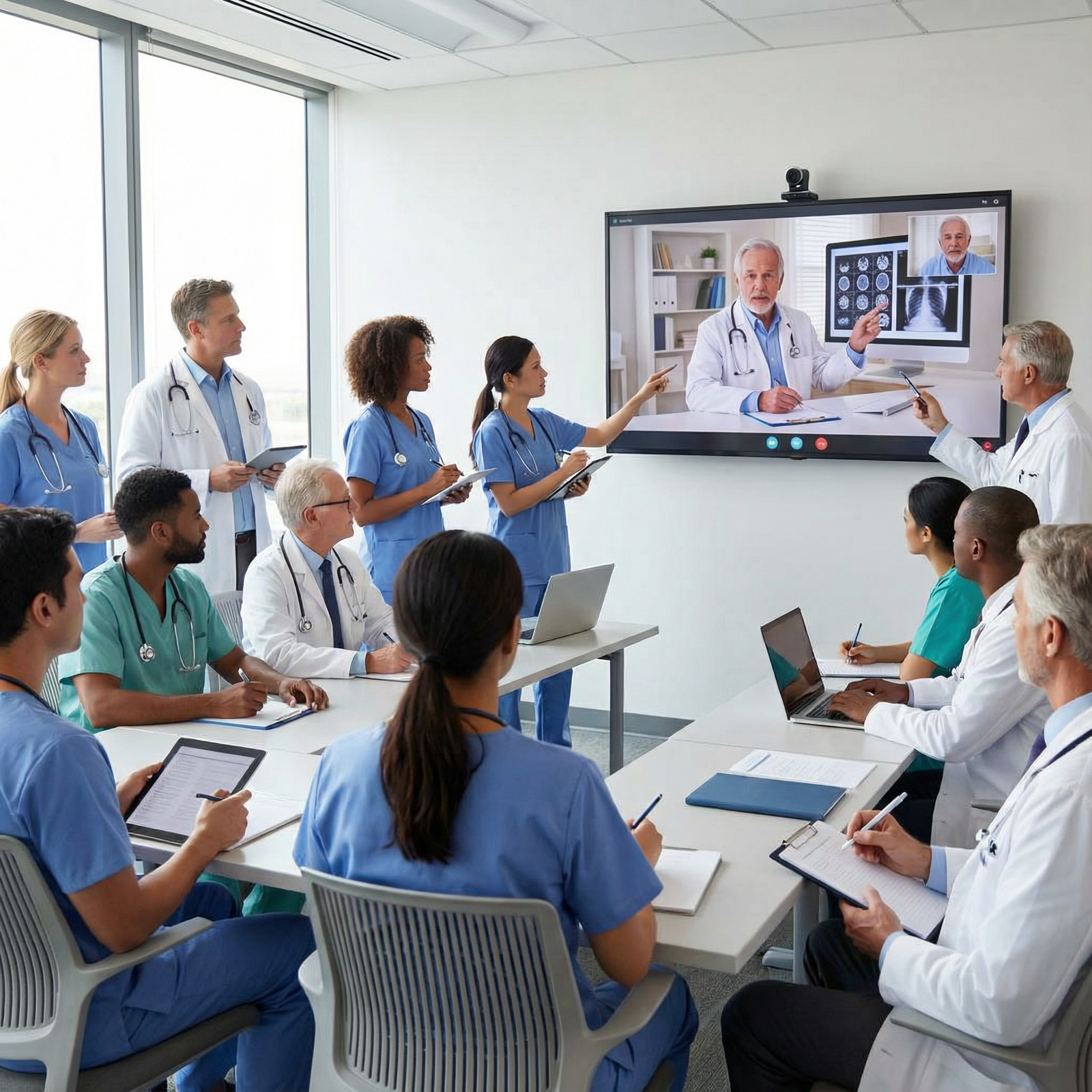
- Live, interactive webinars replacing or supplementing conference lectures
- Virtual grand rounds and case conferences across institutions
- Online, on-demand enduring materials for self-paced learning
- Tele-simulation and virtual standardized patient encounters
- Multi-site, interprofessional workshops delivered entirely online
These modalities have helped bridge persistent gaps in CME: time, cost, and access. For residents transitioning into practice, they also provide a continuity of learning that fits into demanding schedules and diverse practice environments.
Key Benefits of Telehealth-Enabled CME for Clinicians
Telehealth and digital platforms offer multiple advantages that extend beyond simple convenience. For those planning a career in clinical practice, academia, or leadership, understanding these benefits can help you optimize your learning strategy.
1. Expanded Accessibility and Equity in Medical Education
Telehealth-based CME lowers multiple barriers:
- Geographic barriers: Rural physicians, community hospital staff, and international practitioners can access high-quality CME offerings from academic centers worldwide.
- Scheduling flexibility: Recordings and on-demand modules allow participation across time zones and shift schedules.
- Institutional reach: Smaller hospitals or clinics can join multi-institutional CME programs and case conferences.
This has significant implications for health equity. Clinicians who serve underserved communities can more easily access cutting-edge knowledge, reducing gaps between resource-rich and resource-limited settings.
Example:
A family physician in a frontier rural clinic can now regularly attend virtual subspecialty case conferences (e.g., ECHO-style models) on complex chronic pain or hepatitis C management, enhancing local care without requiring costly travel.
2. Cost-Effectiveness for Individuals and Institutions
Traditional in-person CME often involves:
- Registration fees
- Airfare and ground transportation
- Hotel and meal costs
- Lost clinical productivity while traveling
Telehealth-based CME dramatically reduces or eliminates many of these costs. For residents, early-career physicians, and healthcare systems with constrained budgets, this is a major advantage.
Institutions also benefit by:
- Offering internal, system-wide online CME at scale
- Reducing logistical costs for events and guest speakers
- Leveraging recorded content for ongoing education
3. Personalized and Data-Driven Learning Paths
Modern CME platforms often incorporate:
- Adaptive learning systems that adjust content difficulty based on performance
- Pre- and post-tests that identify knowledge gaps
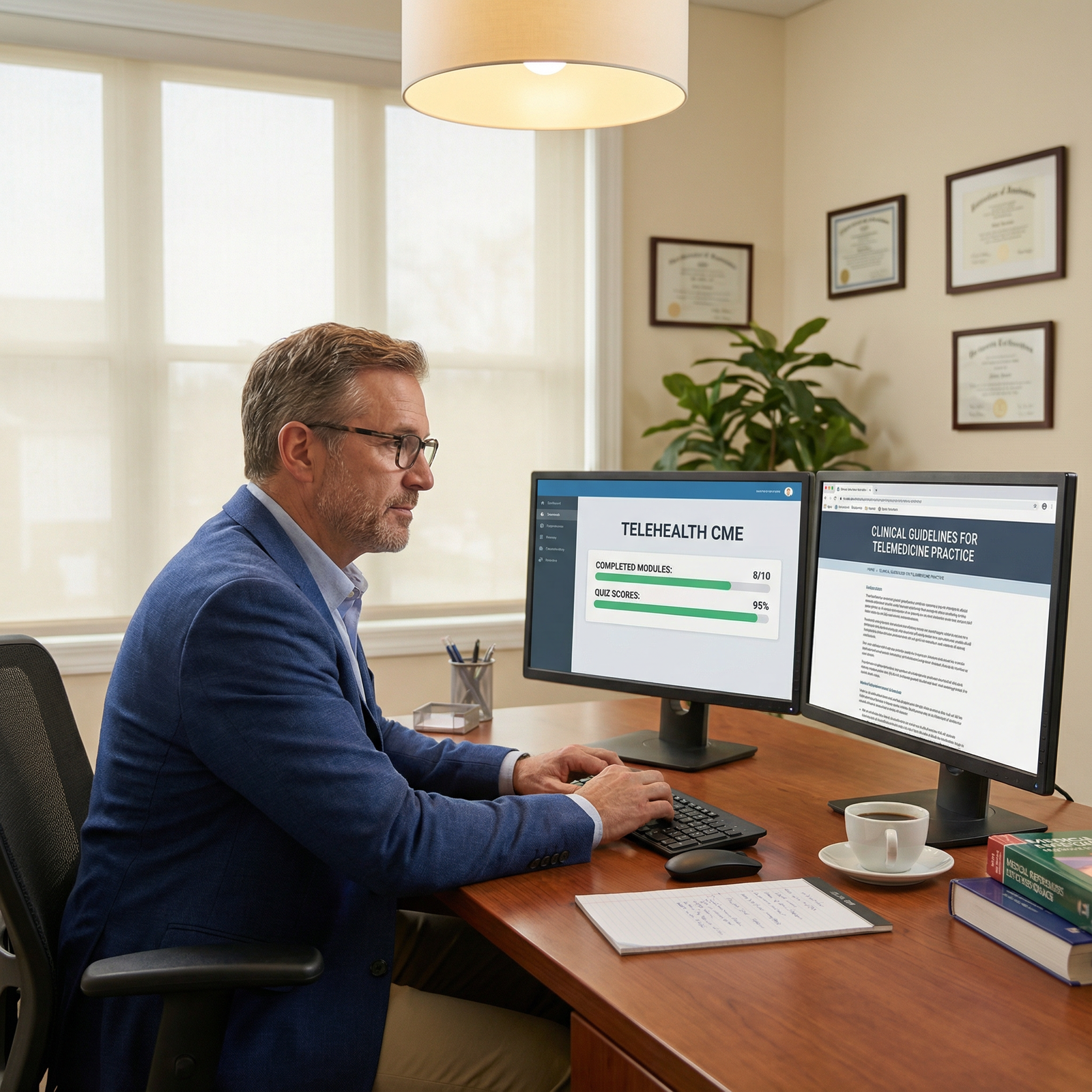
- Dashboards that track progress against individual CME and MOC requirements
For clinicians, this means:
- Focusing CME time on high-yield knowledge gaps
- Selecting courses tailored to practice setting (e.g., telepsychiatry for outpatient psychiatry, remote monitoring for cardiology)
- Documenting competencies with quantitative data that can be used in performance reviews or credentialing discussions
This personalization turns CME into a strategic tool for professional development, not just a checkbox exercise.
4. Diverse, Engaging Educational Formats
Telehealth has expanded the range of CME formats:
- Live webinars with audience response systems and breakout rooms
- Virtual journal clubs with screen-shared articles and annotated guidelines
- Interactive decision-making modules and virtual patient scenarios
- Podcasts and microlearning modules accessed on mobile devices
- Tele-simulation and role-play scenarios for communication skills
These varied formats:
- Support different learning styles (visual, auditory, interactive)
- Improve retention compared to passive lecture-based learning
- Facilitate active learning and real-time feedback
For example, tele-simulation can teach a resident how to manage a suicidal patient in a virtual visit—combining content, communication, and systems-based practice in one scenario.
5. Direct and Immediate Clinical Application
Telehealth CME is often embedded in or closely aligned with real-world clinical practice:
- Training on telehealth triage protocols can be used in the next clinic session
- CME on remote monitoring platforms can be integrated into chronic disease management workflows
- Legal and billing CME sessions help clinicians immediately adjust documentation and coding practices
This direct applicability reinforces learning and shortens the time between knowledge acquisition and practice change—one of the core aims of modern healthcare training.
Challenges and Limitations of Telehealth-Based CME
Despite its advantages, integrating telehealth into CME is not without obstacles. Understanding these challenges can help you choose high-quality programs and advocate for better designs in your institution.
1. Technology Access and Digital Literacy
Not all clinicians have equal access to:
- High-speed, stable internet connections
- Updated hardware (computers, cameras, microphones)
- IT support for troubleshooting live sessions
In addition, digital literacy varies. Some clinicians may be:
- Unfamiliar with video conferencing tools
- Uncomfortable with interactive features (polling, breakout rooms, chats)
- Hesitant to navigate new online CME platforms
For residency applicants and younger clinicians, this is often an area of relative strength—an opportunity to lead or mentor others in your future practice environment.
2. Regulatory and Accreditation Complexity
Telehealth introduces new layers of regulatory and accreditation questions for CME:
- Credit eligibility: Not all online activities qualify for CME credit. Programs must be accredited by recognized bodies (e.g., ACCME in the U.S.).
- Cross-state and international practice: CME content may involve multi-state telehealth laws, licensure compacts, and payer rules that differ across jurisdictions.
- Documentation and verification: Online attendance and engagement must be tracked reliably (e.g., login duration, post-tests).
Clinicians must verify:
- Whether a telehealth CME course is accredited and by whom
- How credits are reported (self-report vs. direct reporting to boards)
- Whether the content aligns with their state board and specialty board requirements
3. Ensuring Educational Quality and Rigor
As the volume of online content increases, quality assurance becomes crucial. Potential pitfalls include:
- Superficial or outdated content
- Commercial bias or inadequate disclosure of conflicts of interest
- Limited opportunities to ask questions or clarify complex concepts
- Minimal assessment of learning outcomes
When evaluating telehealth CME offerings, look for:
- Clear learning objectives tied to evidence-based content
- Faculty with relevant clinical and educational expertise
- Opportunities for interaction (Q&A, poll questions, case discussions)
- Robust evaluations and post-activity assessments
4. Engagement, Interaction, and Professional Community
One of the most commonly cited downsides of virtual CME is reduced:
- Networking: Fewer incidental conversations and professional connections compared to in-person conferences
- Collaboration: Less organic development of research or quality improvement partnerships
- Social support: Fewer informal peer interactions that combat isolation and burnout
However, thoughtful design can partially mitigate this:
- Small-group breakout rooms during webinars
- Longitudinal online communities around specific topics (e.g., telehealth in rural OB/GYN)
- Chat-based networking and follow-up discussion forums
For trainees and early-career physicians, combining select in-person conferences with ongoing virtual engagement can provide both depth and breadth of professional connection.
The Future of CME and Telehealth: Trends, Innovations, and Opportunities
The convergence of telehealth, digital health, and Continuing Medical Education is accelerating. Over the next decade, clinicians can expect more integrated, intelligent, and practice-embedded learning opportunities.
Emerging Models and Hybrid Approaches
1. Hybrid CME Experiences
Blended models offer the best of both worlds:
- In-person workshops or simulation labs for hands-on skills (e.g., procedures, physical exam maneuvers)
- Virtual follow-up sessions for updates, case reviews, and Q&A
- Asynchronous modules to reinforce learning and track outcomes
For telehealth-specific skills—like conducting neurologic or musculoskeletal exams via video—hybrid training can include:
- In-person demonstrations and practice
- Recorded exemplars and tele-simulation scenarios
- Virtual coaching and feedback on real patient encounters
2. Interprofessional and Team-Based Telehealth Training
Telehealth naturally involves care teams: physicians, NPs, PAs, nurses, pharmacists, social workers, and behavioral health providers. Future CME will increasingly:
- Bring teams together in joint telehealth training sessions
- Focus on workflows, role clarity, and communication during virtual visits
- Use case-based learning to improve coordination of care in virtual and hybrid models
For learners in residency or fellowship, participating in interprofessional telehealth CME can be a powerful way to develop systems-based practice skills.
Data-Driven and Competency-Based CME
Advances in data analytics and learning technologies will reshape CME from time-based credit accumulation to competency-based progression:
- Learning analytics: Platforms will track not just attendance, but performance on quizzes, case decisions, and simulations.
- Practice integration: Quality metrics (e.g., HbA1c control, readmission rates, telehealth no-show rates) could be linked to CME participation.
- Personalized recommendations: Systems will suggest targeted CME activities based on real practice data and performance gaps.
This aligns CME with broader professional development and healthcare system goals—value-based care, patient safety, and improved outcomes.
Regulatory Evolution and Policy Changes
As telehealth becomes standard practice, expect:
- Updated state and federal regulations around telehealth training and competence
- More explicit CME requirements related to telehealth (e.g., privacy laws, cross-state practice, digital prescribing)
- Institutional expectations that clinicians demonstrate telehealth competencies as part of credentialing and performance evaluation
Staying informed through your specialty societies, state medical board communications, and institutional education offices will be essential.
Practical Strategies: How to Make the Most of Telehealth CME
For medical students, residents, and practicing clinicians, telehealth CME can be a powerful resource if approached strategically.
1. Align CME With Your Stage of Training and Career Goals
- Students and residents: Focus on foundational telehealth skills—communication, workflow, basic documentation, and familiarity with regulations. Look for sessions attached to your institution or specialty society.
- Early-career clinicians: Seek specialized telehealth CME in your chosen discipline (e.g., telecardiology, teledermatology). Incorporate sessions on billing, risk management, and quality improvement.
- Mid-career and senior clinicians: Consider leadership-focused CME—telehealth program design, supervision of trainees in virtual care, and integration of remote monitoring.
2. Choose High-Impact, Accredited Programs
When evaluating telehealth CME:
- Confirm accreditation (e.g., ACCME for physicians in the U.S.).
- Review learning objectives and how closely they match your practice needs.
- Check for interactive elements and case-based teaching.
- Look at faculty qualifications and any disclosed conflicts of interest.
Specialty societies, academic medical centers, and large health systems often provide reliable, evidence-based CME options.
3. Optimize Your Learning Environment
To get maximum value from telehealth CME sessions:
- Use a stable internet connection and a device with a good display and audio.
- Minimize distractions: silence notifications, close unrelated tabs, and protect the time as you would for an in-person lecture.
- Engage actively: ask questions in chat, participate in polls, and take concise notes with key clinical takeaways.
4. Translate Learning Into Practice Quickly
After completing a telehealth CME activity:
- Identify 1–3 concrete practice changes you can implement immediately (e.g., new virtual exam maneuvers, updated documentation phrases, new patient education strategies).
- Share key insights with your team via brief huddles, emails, or local teaching sessions.
- Where possible, integrate changes into EMR templates, clinic workflows, or checklists to sustain practice improvement.
5. Track and Document Your Professional Development
For ongoing professional development and compliance:
- Maintain a digital portfolio of completed CME activities, certificates, and transcripts.
- Use CME tracking tools from your specialty board or institution.
- Periodically map your CME activities against your stated career goals and performance reviews—adjust your learning plan accordingly.
Frequently Asked Questions (FAQ) About CME and Telehealth
1. How many CME credits do physicians typically need, and can telehealth CME fulfill these?
Most U.S. state medical boards require 20–50 CME credits every 1–2 years, but this varies by state and specialty. Many or all of these credits can now be earned through telehealth-based or online CME, as long as:
- The activity is accredited by a recognized body (e.g., ACCME).
- The format (live or enduring) is accepted by your specific board.
- The content aligns with any mandated topics (e.g., opioid prescribing, ethics, Telehealth regulations).
Always confirm details with your state medical board and specialty board.
2. Is telehealth CME considered equivalent in quality to in-person CME?
Well-designed telehealth CME can be equal or superior to traditional in-person activities in terms of:
- Content quality
- Interactivity
- Learning outcomes
However, quality varies across providers. Look for:
- Accredited programs
- Clear learning objectives and evidence-based content
- Opportunities for interaction and Q&A
- Strong evaluations and post-tests
In some areas (e.g., procedural skills), a hybrid model that includes in-person components may still be preferred.
3. Can I earn CME credit for learning how to conduct telehealth visits or using digital health tools?
Yes. Many accredited CME activities now focus specifically on:
- Telehealth etiquette and communication skills
- Virtual physical examination techniques
- Telehealth documentation, coding, and billing
- Legal and regulatory issues (licensure, consent, privacy)
- Remote patient monitoring and digital therapeutics
These activities often provide the same category of CME credit as more traditional clinical topics and can be particularly valuable as telehealth becomes standard in many practice settings.
4. What are best practices to stay engaged and avoid “Zoom fatigue” during telehealth CME?
To maintain engagement and reduce fatigue:
- Prioritize shorter, high-yield sessions or break up longer events.
- Actively participate—ask questions, respond to polls, and contribute in chat.
- Alternate between listening, note-taking, and brief movement or stretching breaks during longer events.
- Choose sessions closely aligned with your current patients or practice problems to increase relevance and motivation.
If possible, combine occasional in-person conferences with more frequent, focused online CME to balance interaction and convenience.
5. How can I stay informed about new telehealth CME and regulatory updates?
To stay current:
- Subscribe to email updates from your specialty societies, state medical board, and institutional CME office.
- Follow reputable organizations (e.g., AMA, AAMC, major specialty colleges) and academic medical centers that frequently publish telehealth-related CME.
- Use CME search platforms and filters specifically for “Telehealth,” “Digital Health,” or “Virtual Care.”
- Participate in institutional committees or working groups focused on telehealth; they often sponsor or highlight relevant CME.
Telehealth is transforming not only how we deliver care, but also how we learn to deliver it. For medical students, residents, and practicing clinicians, integrating telehealth-based CME into your ongoing medical education and professional development strategy is now essential. By selecting high-quality programs, engaging actively, and rapidly translating knowledge into practice, you can leverage telehealth to stay current, meet regulatory requirements, and ultimately deliver safer, more effective, and more equitable patient care.