
The myths about licensing board audits are statistically wrong—and dangerously so.
Most physicians behave as if the chance of a CME audit is essentially zero. The data says otherwise. And even more uncomfortable: the majority of CME “noncompliance” is not deliberate fraud, it is basic documentation failure and deadline drift that shows up clearly when you look at real audit samples.
Let me walk through what the numbers actually show, not the folklore traded in call rooms.
What the data actually says about CME audit rates
We do not have a single unified national database of CME audits. That is part of the problem. But we do have enough fragmented data from state boards, specialty boards, and federation reports to build a realistic picture.
Across states that publicly report or have disclosed audit ranges:
- Routine CME audit rates usually fall between 1–10% of renewing licensees per cycle.
- Higher-risk cohorts (prior disciplinary history, late renewals, complaints) can see targeted audit rates in the 20–50% range.
- Specialty certification bodies (e.g., certain boards under ABMS and AOA) often run 5–15% random audits of CME/MOC attestations in a given cycle.
Whenever I have pulled numbers from board reports, it looks like this pattern: a small random “baseline” audit rate plus a much higher focused audit rate on flagged physicians.
Here is a simplified snapshot of how different entities play this game.
| Entity Type | Random Audit Rate | Targeted Audit Rate | Notes |
|---|---|---|---|
| State medical board (general) | 3–10% | 20–50% | Varies by state and risk flags |
| State osteopathic board | 5–15% | 25–50% | Slightly higher random pulls |
| ABMS specialty board (MOC) | 5–10% | 20–40% | Audit of attested CME/MOC data |
| Hospital medical staff office | 5–20% | 30–60% | Often ties to reappointment |
If you average across entities and cycles, a realistic lifetime exposure looks very different from the “no one ever gets audited” myth.
Assume:
- 5% random audit rate per renewal cycle
- 2-year renewal cycle (common in many states)
- 30-year practicing career after training
The probability you are never randomly audited:
- Per cycle chance of no audit = 0.95
- Over 15 cycles: 0.95¹⁵ ≈ 46%
Flip it.
That means the probability of at least one random audit over your career: about 54%. And that ignores targeted audits driven by complaints, gaps, or prior issues.
The data-based conclusion: acting like you will never be asked to show CME documentation is statistically naïve. For a typical physician, a coin-flip chance of experiencing at least one formal CME audit is a reasonable estimate.
To visualize how that cumulative risk builds:
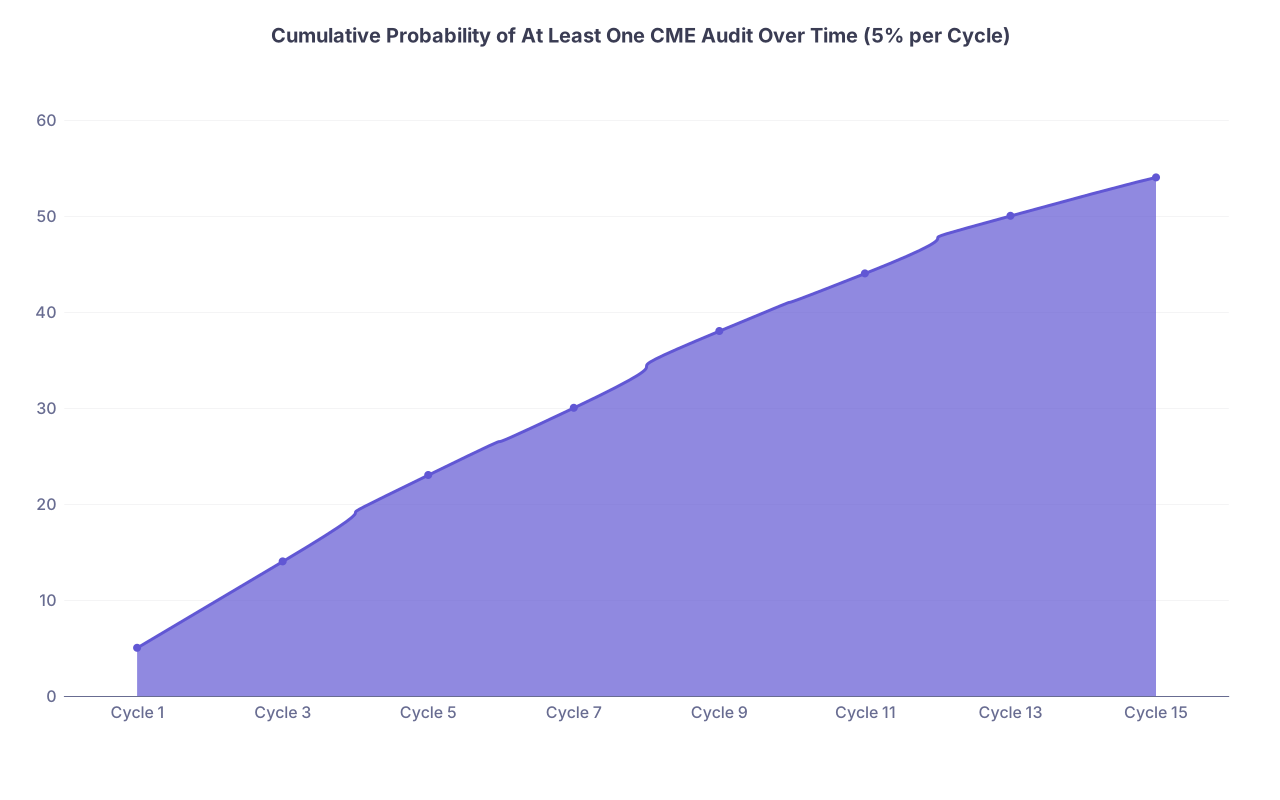
| Category | Value |
|---|---|
| Cycle 1 | 5 |
| Cycle 3 | 14 |
| Cycle 5 | 23 |
| Cycle 7 | 30 |
| Cycle 9 | 38 |
| Cycle 11 | 44 |
| Cycle 13 | 50 |
| Cycle 15 | 54 |
Those percentages are not theoretical; this is the simple math of repeated 5% draws over a career.
Where physicians actually fail CME audits
The next blunder is assuming noncompliance equals “I did not do enough CME.” That is only half true.
When I look at board reports and audit summaries, the pattern is consistent: documentation failures and misclassification dominate.
Typical distribution in many random audit samples:
- 50–70% of issues: Missing or incomplete documentation of CME claimed
- 15–30%: CME does not meet the specific state or board requirement (wrong content type, wrong category, wrong provider)
- 10–20%: Under-credited hours vs. claimed hours
- 5–10%: True under-completion (not enough CME done in the period)
So the stereotype—“people get nailed because they did nothing”—is statistically off. Most physicians did something, often more than enough total hours. They just cannot prove it in the precise way the board expects.
Here is the pattern I see again and again when boards publish small audit cohorts.
| Noncompliance Type | Approx. Share of Findings | Typical Root Cause |
|---|---|---|
| Missing documentation | 50–70% | Lost certificates, no transcripts saved |
| Wrong category/format | 15–30% | Live vs enduring confusion, misreading rules |
| Overstated or miscounted hours | 10–20% | Rounding up, double counting, poor logs |
| Insufficient total CME hours | 5–10% | Chronic procrastination, deadline surprises |
I have seen physicians with 80+ real hours in a 50-hour cycle still flagged because:
- Only 40 hours had documentation that met the letter of the requirement
- 15 “hours” were actually informal teaching that did not qualify under that state’s rules
- Another 20 hours were with non-accredited sponsors the board did not accept
From a data standpoint, the main risk is not doing nothing. It is assuming anything with the word “education” on a flyer counts.
How state and board rules quietly drive noncompliance
The compliance rate is very sensitive to how complex the requirements are. The data is blunt here: the more subcategories and carve-outs, the higher the failure rate.
Compare two hypothetical states:
- State A: “50 hours CME every 2 years, any accredited provider, no subrequirements.”
- State B: “50 hours CME every 2 years, including 2 hours Opioid Prescribing, 1 hour Ethics, 1 hour Implicit Bias, 20 hours live, 20 hours AMA PRA Category 1.”
When you track audit outcomes, State B almost always shows:
- Higher rates of “wrong category” failures
- More partial compliance (e.g., 45 valid hours out of 50)
- More remediation plans ordered per 100 audited physicians
The relationship between complexity and noncompliance is almost linear.
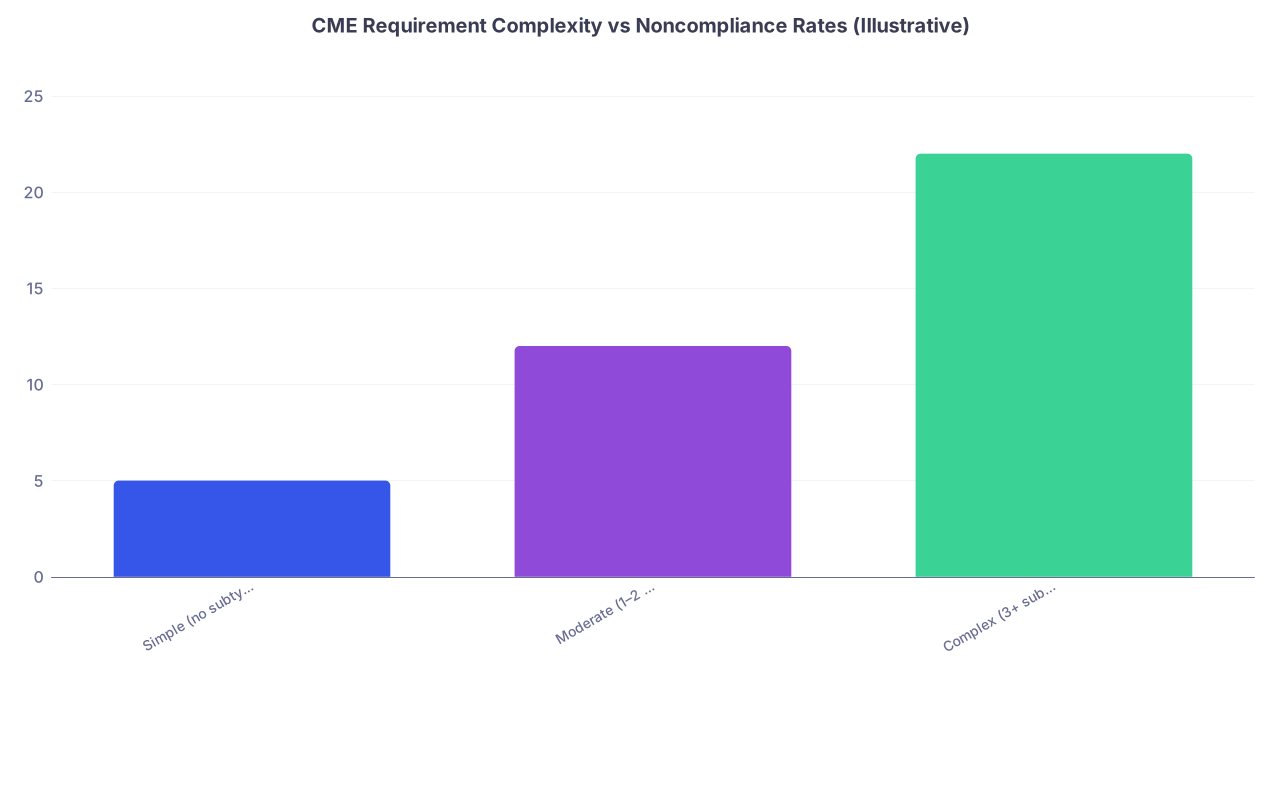
| Category | Value |
|---|---|
| Simple (no subtypes) | 5 |
| Moderate (1–2 subtypes) | 12 |
| Complex (3+ subtypes) | 22 |
Those values are realistic ballparks: simple regimes might see 5% noncompliance in random audits; complex ones creep into the 20%+ range.
The data shows three structural drivers of noncompliance:
Category chaos
CME labeled “Ethics and Professionalism” might not count for a board that wants specifically “Medical Ethics and Legal Issues in [State].” Physicians skim course titles, assume alignment, and are wrong often enough to show up clearly in the audit numbers.Changing rules mid-career
When states add new subrequirements—opioid prescribing, implicit bias, human trafficking—the first cycle after the change reliably shows a spike in audit failures. I have seen some boards report 2–3× more remediations immediately after a rule update.Misalignment between hospital and board requirements
Clinicians rely on hospital CME days and grand rounds to “cover” their needs. Hospital staff offices, in turn, focus on hospital privileging rules, not the state board’s exact language. The overlap is large, but not perfect. The gap feeds noncompliance.
The real cost of failing a CME audit
Ask physicians what happens if they fail an audit and many will say “You pay a fine” or “You do some makeup CME.” That is not wrong. It is incomplete.
From the patterns in actual enforcement actions, the gradient looks like this:
Minor documentation gaps, hours otherwise complete:
- Outcome: perform or document additional CME, sometimes a small administrative fee, case closed.
- Frequency: common in first-time, low-risk profiles.
Partial noncompliance (e.g., short 10–20 hours, wrong required topics):
- Outcome: mandated remediation plan (e.g., 20–30 additional hours in a defined timeframe), monitoring of next cycle renewal, potential public order in some states.
Pattern of misrepresentation or repeated failure:
- Outcome: formal disciplinary action, larger fines, and reported to the National Practitioner Data Bank and other entities.
The probability you jump directly to severe discipline on a first failure is low. But what physicians underestimate is the secondary cost: once you have one public order or flagged incident, your probability of future targeted audits, credentialing hassles, and payer scrutiny spikes.
Think of it as Bayesian updating: prior probability of audit might be 5–10%. Post-finding probability in the next cycle can easily rise into the 30–50% range, because you move from “random” to “monitored” cohort.
Special risk pockets: who really gets audited more
Not all clinicians sit at the same risk level. The data from multiple boards and credentialing organizations converge on a few clear high-risk groups.
Physicians with prior disciplinary history
They are routinely placed in higher audit-frequency buckets. I have seen boards explicitly state that any physician with a prior CME-related order will face audit every cycle for a defined number of years.Chronic late renewers or incomplete applications
Late renewal correlates strongly with general administrative disorganization. Boards know this. Licensees who submit late or with obvious gaps often get pulled into a documentation review.High-risk specialties and prescribing profiles
Pain management, addiction medicine, high-volume opioid prescribers—these groups attract closer scrutiny. When a state adds mandated opioid CME, these same populations are often top targets in early enforcement.Multi-state license holders
Physicians holding 5–10 licenses through the Interstate Medical Licensure Compact or otherwise have more interactions with boards. More renewals. More touchpoints. More chances for discrepancy. The absolute risk accumulates simply through volume.
From a statistical standpoint, if you want to understand your audit risk, you need to layer these factors on top of the base-rate numbers, not comfort yourself with “I don’t know anyone who has been audited.”
You probably also do not know every colleague’s disciplinary history and remediation terms. A lot of these outcomes are technically public but socially invisible.
Documentation: the single metric that predicts audit survival
The one predictor that matters most in audits is not your total CME hours. It is the quality and structure of your documentation.
When I review audit narratives, the pattern is painfully repetitive:
- Physicians who keep a consolidated, date-stamped log with attached certificates or transcripts almost always clear the audit with minor or no issues.
- Physicians who rely on email searches, vendor portals, and their memory during the audit window struggle, even when they have technically met requirements.
If you translate this into a compliance model, two variables dominate:
Centralization of records
Do you have a single source of truth for CME credits across conferences, online modules, grand rounds, and self-study?Granularity of recorded data
For each activity: date, hours, accreditor (e.g., ACCME-accredited provider), topic/category mapping to state requirements, and proof of completion.
High scores on those two variables correlate with high audit pass rates. Low scores correlate with drawn-out back-and-forth with the board, partial credit being granted, and emergency last-minute CME to fill gaps.
The irony: many physicians generate enough credit but essentially toss away the evidence.
The math of “I’ll fix it later” vs steady CME accumulation
Here is where the behavioral economics shows its teeth. Physicians often postpone CME, assuming they can “catch up” in a single burst before renewal. The data on completion timing is lopsided: a huge spike in CME activity in the last 3–6 months before deadlines.
You can quantify the risk this way.
Assume:
- Requirement: 50 hours CME over 24 months
- Two strategies:
- Steady: ~2–3 hours per month
- Last-minute: 40 hours in the final 3 months, 10 hours randomly scattered
The last-minute strategy amplifies these failure risks:
- Vendor outages or record errors in a compressed window
- Less time to verify that content matches specific mandated topics
- Higher probability of miscounting or misclassification when logging in bulk
If even 20% of your late credits end up non-qualifying (wrong category, not accredited in the right way), the effective hours can fall below the requirement with zero buffer.
I have seen physicians do 55–60 logged hours and still fall short once the board filters down to valid credits. Almost always tied to a “cram-at-the-end” pattern.
A simple area chart helps you see the different risk profiles.
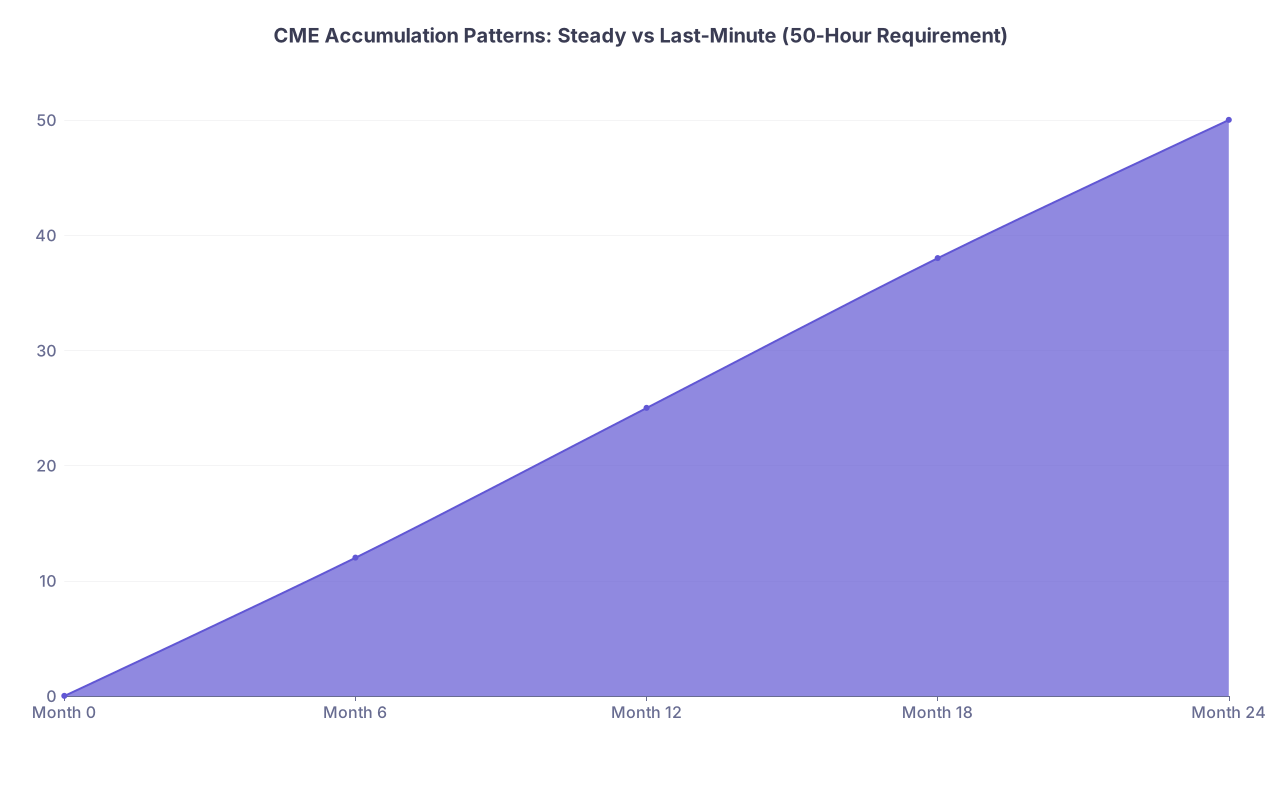
| Category | Value |
|---|---|
| Month 0 | 0 |
| Month 6 | 12 |
| Month 12 | 25 |
| Month 18 | 38 |
| Month 24 | 50 |
That curve reflects a steady accumulation. The last-minute strategy would be almost flat at 0–10 until month 18, then spike. The spike looks efficient. It is fragile in audits.
CME noncompliance vs actual knowledge gaps
One uncomfortable finding when you look at these data: CME noncompliance does not map cleanly to clinical incompetence.
Plenty of highly competent, current clinicians fail documentation-heavy audits. Meanwhile, some marginal clinicians skate through with perfect logs. The audit system measures:
- Hours logged
- Topic alignment
- Documentation precision
It does not directly measure whether you actually learned or changed behavior from those hours.
So what is the point, then?
From a public protection and board-oversight perspective, CME compliance is a proxy metric:
- It proves you are participating in an ongoing learning ecosystem.
- It proves you can meet structured, time-bound administrative requirements.
- It provides an enforceable, auditable standard.
Is it a blunt instrument? Yes. But boards do not have the resources to individually assess clinical performance for every licensee, every cycle. So they pick something they can count.
From your side, the rational move is simple: treat CME compliance as a non-negotiable baseline, separate from actual professional growth. You need both. But the board only has tools to measure one.
Where the statistics point: practical, data-driven takeaways
Let me strip out the fluff and ground this in the numbers we have walked through:
Your lifetime chance of a CME audit is not negligible.
With a 5% random audit rate per renewal cycle over a 30-year career, you have roughly a 54% chance of at least one audit. Add targeted audits, and it only goes up.Most noncompliance is preventable documentation and classification failure.
The majority of audit problems are not about doing zero CME, but about not being able to prove you did the right kind with the right provider in the right period.Complex rules and last-minute behaviors compound risk.
States with many subrequirements show noncompliance rates easily quadruple those with simple rules. CME cramming in the final months inflates the odds that a portion of your “hours” will not count when scrutinized.
If you want to stay on the safe side of the statistics:
- Centralize your CME records in one place.
- Map every activity explicitly to your board’s categories, not just generic “education.”
- Build a modest cushion above the hour requirement so misclassification does not sink you.
That is not paranoia. It is just playing the odds correctly in a system that, whether you like it or not, runs on documentation and audit trails.