
The way most clinicians handle CME deadlines is broken—and it is hurting careers, licenses, and sometimes patients.
You are not “busy.” You are making the same three predictable CME procrastination mistakes as everyone else. And the system punishes those mistakes brutally.
Let me walk you through the patterns I keep seeing that backfire, hard, on otherwise competent physicians and advanced practice clinicians.
The Hidden Math That Traps You
The first mistake is simple: you misjudge the math.
You tell yourself, “I need 50 credits every 2 years. That is only 25 a year. I can do that.” Then you do not. For 18 months.
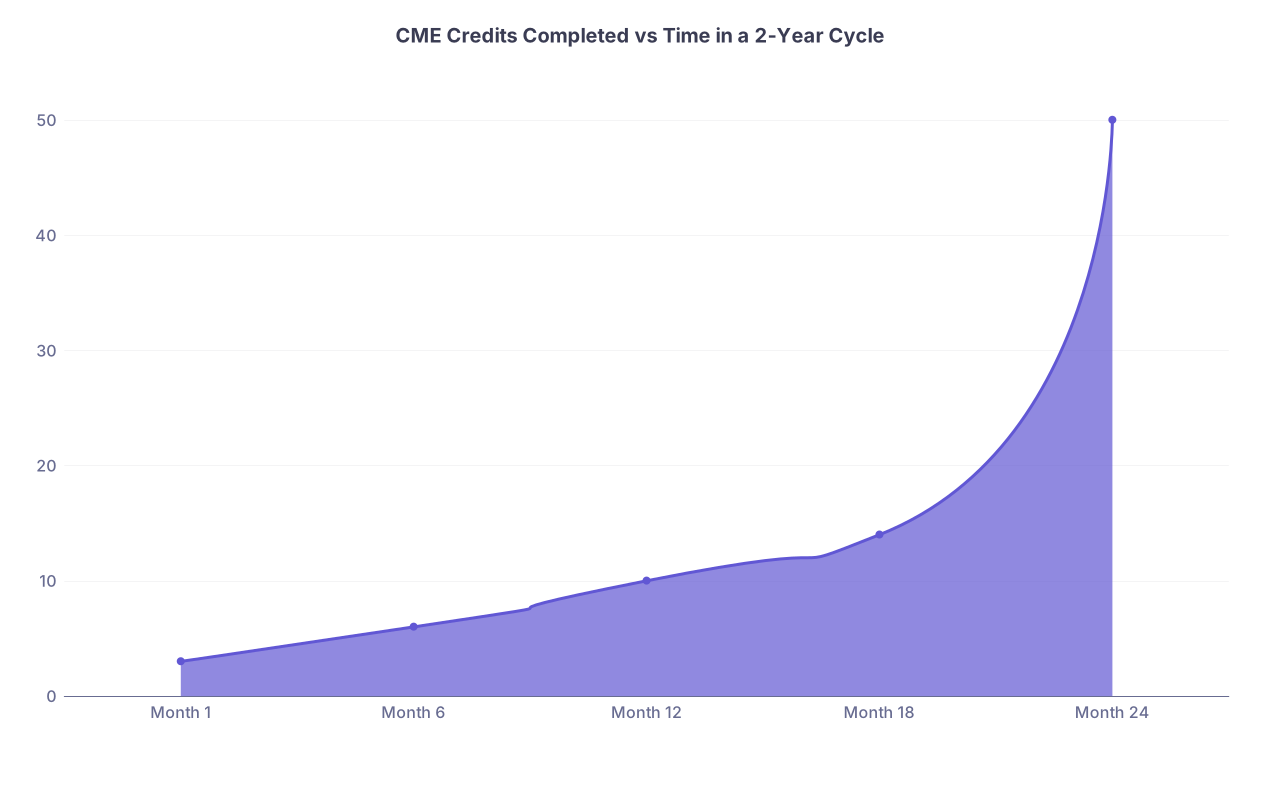
| Category | Value |
|---|---|
| Month 1 | 3 |
| Month 6 | 6 |
| Month 12 | 10 |
| Month 18 | 14 |
| Month 24 | 50 |
I see the same pattern:
- First 12 months: scattered credits from a conference and a few online modules
- Months 13–18: mild awareness, no action
- Months 19–24: blind panic
This is how you end up binge-watching 36 AMA PRA Category 1 Credits™ worth of barely relevant CME in the last 6 weeks of your cycle. You do not retain much. You resent the process. And you are one EMR login issue away from a compliance disaster.
The dangerous assumption is, “I can always catch up later.” That is fantasy. Here is why:
- Clinical chaos never hits when you are ahead. It hits right when you are trying to cram: new EMR go-live, COVID surge, partner on maternity leave, Joint Commission visit. I have watched this movie too many times.
- Vendor issues and verification delays are real. Portals go down. Attendance records are wrong. Certificates do not auto-transfer. If you plan to finish on the last weekend, you leave zero margin for any of this.
- Your board and your state license do not accept “I was busy.” They accept on-time documentation. Or they suspend.
The math that actually works? Assume you will lose 20–25 percent of your available time to unpredictable events. If your cycle is 24 months, behave like you have 18–19. If your requirement is 50 credits, behave like it is 60.
Anything else is wishful thinking dressed up as productivity.
The “Single Deadline” Myth That Gets People Suspended
A big, unforced error: treating CME like it has one deadline.
You think: “My state license renews in November. That is the only date that matters.”
Wrong. You are usually juggling three or more clocks.

For many clinicians, there are at least four separate timelines:
| Requirement Type | Typical Cycle | Who Enforces It |
|---|---|---|
| State license CME | 1–3 years | State medical board |
| Board MOC / recert | 2–10 years | Specialty board |
| DEA / opioid training | 1–3 years | DEA / state regulators |
| Hospital privileges CME | 1–2 years | Hospital / credentialing |
The mistake is simple but brutal: you optimize for one and ignore the others.
For example:
- You carefully hit 100 Category 1 CME in your 10-year ABIM cycle.
- You ignore that your state now requires 2–3 hours of opioid/pain management CME every renewal.
- Or your hospital demands X credits in risk management or patient safety during the last 24 months.
I have watched physicians get their hospital privileges frozen because they were short on a tiny, specific requirement: “2 hours of risk management CME in the last 2 years.” They had 150 total credits. But not the right 2.
Here is the pattern that backfires:
- You focus only on total credit count (50, 100, etc.).
- You ignore required topics (opioids, ethics, implicit bias, risk management).
- You ignore timing within the cycle (e.g., “X hours must be completed in the most recent 24 months”).
- At renewal, credentialing or the board says, “You are short exactly on the one thing you did not track.”
You do not want to discover this after your license auto-lapses at midnight.
Action checkpoint: if you cannot, in under 5 minutes, say exactly:
- Your state CME total requirement
- Needed special-topic hours (opioids, cultural competency, etc.)
- Your specialty board’s current MOC/continuous certification structure
- Any hospital-specific CME (quality, safety, etc.)
…then you are flying blind. And blind is how people lose practice privileges.
The “I’ll Upload It Later” Fantasy
The next trap is not about taking the CME. It is about proving you took it.
The common lie: “I will upload the certificates this weekend.” That weekend never comes.

| Step | Description |
|---|---|
| Step 1 | Complete CME Activity |
| Step 2 | Receive Certificate Email |
| Step 3 | Leave in Inbox |
| Step 4 | Inbox Overflows |
| Step 5 | Cannot Find Certificate |
| Step 6 | Deadline Approaches |
| Step 7 | Panic Search and Recreate |
| Step 8 | Risk Audit or Noncompliance |
| Step 9 | Central CME Log Updated |
| Step 10 | Easy Renewal and Audit |
| Step 11 | Save or Upload Now |
The dangerous behavior pattern:
- Certificates sit in your email.
- Conference badges keep the QR code “for later.”
- You rely on third-party CME providers to maintain flawless records forever.
- You assume everything will be simple to pull when your board audits you.
Then:
- That portal you used 3 years ago merges with another company and your login does not work.
- The hospital CME office changed software and archives are “not easily retrievable.”
- The email with your certificates was auto-deleted after 365 days.
I have seen clinicians try to reconstruct 2–3 years of CME within a 10-day audit response window. It is ugly. They beg CME offices, dig through trash folders, argue with vendors. The board does not care; they just want proof.
The mistake here is pushing documentation downstream and assuming “future me” will care more and have more time. Future you will not. Future you will have a full clinic and a family crisis and a QI project due.
The safe pattern is unglamorous:
- Every time you complete CME, you document it that week, not “someday.”
- You keep your own master log, independent of any vendor or institution.
- You store certificates in one controlled location with a simple naming rule, like “2026-03-14_ACP_InternalMedUpdate_8credits.pdf.”
Not doing this is like doing your entire residency and then throwing away your case logs.
The “Random CME Is Fine” Miscalculation
Another costly pattern: you treat CME as generic points instead of targeted requirements.
You think any AMA PRA Category 1 Credit™ activity is good enough. Then you get burned by the fine print:
- Your board requires self-assessment or performance improvement modules, not just passive lectures
- Your state demands live CME or enduring material in certain proportions
- Opioid prescribing hours must be from approved sources or specific curricula

I watched one physician accumulate more than 100 credits in his board cycle. The problem? Almost all of it came from conferences and online lectures. His board required a certain number of “Part II” and “Part IV” MOC activities, including QI projects and assessment modules. He had very few of those.
End result: he was technically “out of compliance” and had to scramble through multiple board-specific modules in a compressed window just to remain certified.
The underlying mistake is ignoring the category of CME:
- AMA PRA Category 1 vs 2
- Live vs enduring vs journal-based
- Board MOC Part II vs Part IV vs “just CME”
- DEA/state-specific opioid training vs general addiction lectures
This is where people get blindsided. They feel virtuous for accumulating hours. Then they discover that 20 of those hours “do not count” for the very requirement they actually needed.
If you do not know which categories your board and state track, you are probably wasting effort in the wrong buckets.
The Emotional Procrastination Nobody Talks About
Let us be honest. You are often not avoiding CME because of time. You are avoiding it because of emotion.
Typical internal stories I hear:
- “Most CME is garbage. I do not learn anything.”
- “Every module feels like more bureaucracy.”
- “My board keeps moving the goalposts. Why bother engaging seriously?”
So you delay. You disengage. You treat it like a box-checking chore. Then you end up bingeing modules at midnight, half-listening, clicking “next,” getting nothing out of it and feeling resentful.
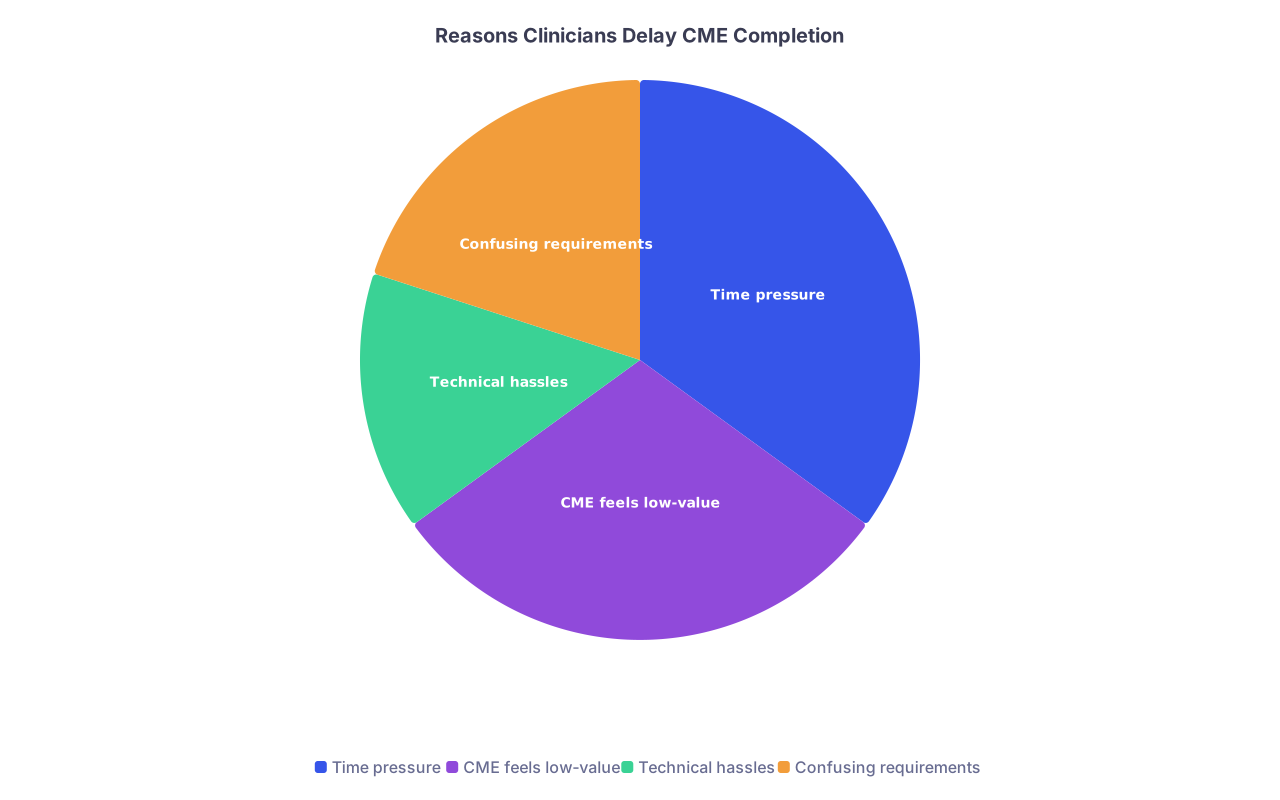
| Category | Value |
|---|---|
| Time pressure | 35 |
| CME feels low-value | 30 |
| Technical hassles | 15 |
| Confusing requirements | 20 |
Here is the problem: emotional procrastination adds a nasty multiplier to every other issue:
- You avoid reading the rules because they irritate you. So you miss changes.
- You avoid engaging early with your board or CME office because you are annoyed. So minor clarifications turn into last-minute crises.
- You start believing CME is “fake learning,” so you never choose higher-value options that might actually help your practice and make the time feel useful.
Then, at audit time or renewal time, you suddenly care very much. But now you are in a rush, and rushed people do sloppy documentation, choose the wrong modules, and make avoidable errors.
You do not have to love CME. But you do need to stop letting your irritation run your calendar.
Risk Scenarios That Actually Happen (Not Theoretical)
Let me spell out how this backfires in the real world. These are not hypotheticals; versions of these play out every year.
Privilege Freeze at a Hospital Credentialing Meeting
Physician submits reappointment packet. CME log is incomplete and missing 2 hours of mandated risk management. Committee approves “with conditions” and temporarily restricts elective procedures until proof is submitted. Surgeon loses OR time and income for weeks over a 2-hour deficiency.State Board Audit After a Complaint
A patient complaint triggers a broader review. Board asks for proof of CME from the last license period. Physician has “probably more than enough” but poor records. Scramble ensues. Inadequate documentation leads to a formal reprimand “for failure to maintain required CME documentation,” now permanently on the public profile.Board Certification Lapse That No One Catches Immediately
Internist assumes their board will “remind me if anything is missing.” They ignore multiple emails. MOC requirements not met. Board certification lapses for several months. Employer contract and insurance panels require “active board certification.” Cleanup is bureaucratic hell.
The common thread? None of these clinicians were lazy or incompetent. They were reactive. They assumed things would “somehow” work out.
You cannot outsource this to hope.
Build a CME System That Does Not Rely on Willpower
You do not fix CME procrastination with more motivation. You fix it with systems that make procrastination expensive in the short term, not years later.

You want a boring, almost mechanical structure:
A Single Source of Truth
One document or app that tracks:- Credits earned
- Type/category of credit
- Related requirement (state, board, hospital)
- Date and provider
If you are piecing together transcripts from 6 platforms every cycle, you will eventually miss something.
A Default Monthly CME Slot
Same day, same time: for example, first Tuesday evening, 1–1.5 hours. Non-negotiable unless you are on a plane or in the OR. You do not “find time”; you reserve it.Immediate Documentation Rule
If you complete CME, you log it within 7 days. No exceptions. That is the cost of doing the activity. Otherwise you are half done, and half done does not count.Front-Loaded Special Requirements
Opioid training, implicit bias modules, risk management, QI/MOC Part IV—do them in the first half of your cycle, not the last. Get the finicky stuff off your plate early. The last 6–12 months should be for topping off general credits, not chasing obscure mandates.At Least One Mid-Cycle Check with Each Regulator
Halfway through your cycle, you or your administrator should review:- State board website for any CME rule changes
- Specialty board portal for updated MOC requirements
- Hospital medical staff office guidance for upcoming changes
Assumption that “nothing changed” is how people get trapped by new laws (opioid rules are notorious for this).
CME Deadline Creep: The Subtle Slide You Do Not Notice
The scariest part is not one big missed deadline. It is CME deadline creep.
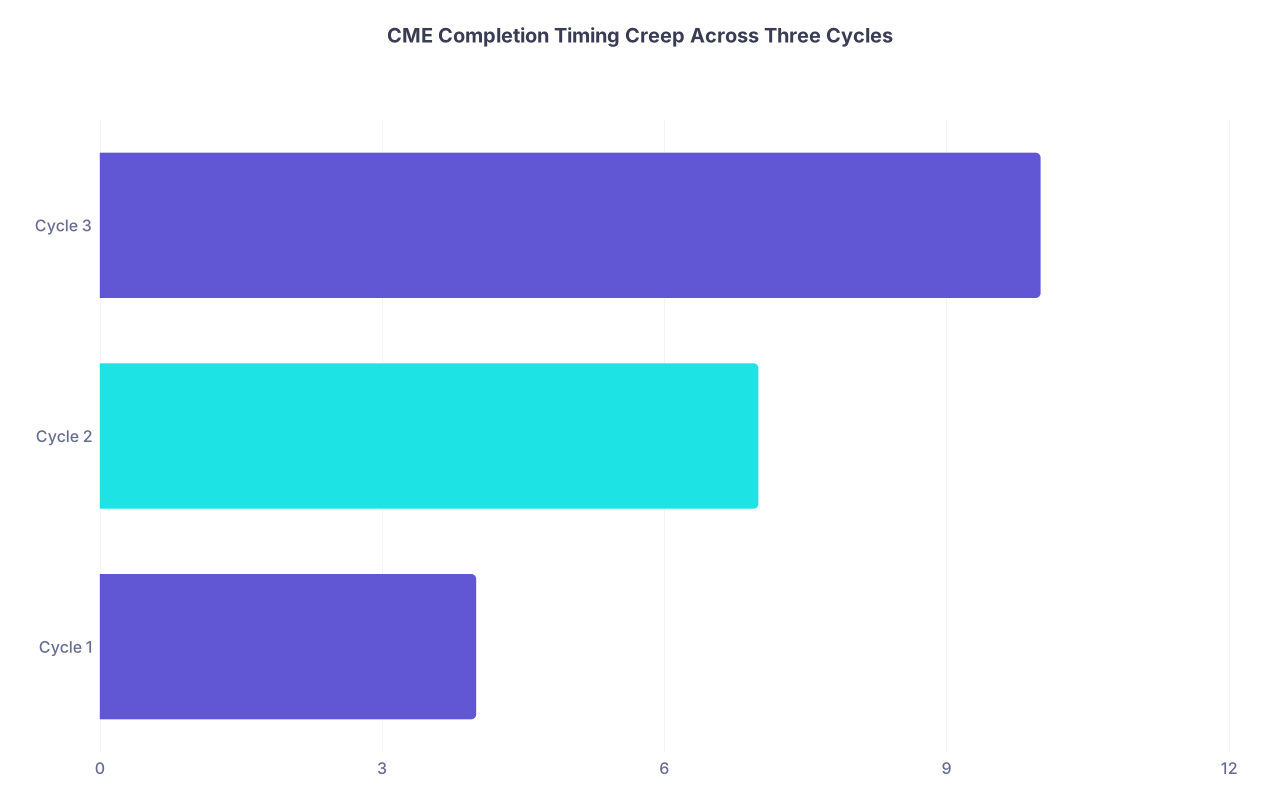
| Category | Value |
|---|---|
| Cycle 1 | 4 |
| Cycle 2 | 7 |
| Cycle 3 | 10 |
I keep noticing this pattern across multiple licensing cycles:
- First cycle: you complete everything with 4 months to spare
- Second cycle: 2 months to spare
- Third cycle: days to spare, then hours
Every cycle, you push “acceptable urgency” a little closer to the edge:
- You become comfortable with last-minute behavior because “it worked last time”
- You normalize the feeling of low-grade panic around renewal seasons
- Your staff starts assuming they will be cleaning up your paperwork every cycle
Eventually, the system catches you on the one cycle where life actually does go sideways—illness, parental care, leadership role, new job, whatever.
The smart move is to reverse the creep early:
- If your last cycle ended with 1 month to spare, deliberately aim for 3 months this time
- Set a personal soft deadline that is well ahead of the official one, and treat it as real
- Refuse to let “I barely made it” become your standard operating model
FAQs
1. How many months before my state license renewal should I aim to have all CME done?
Stop targeting the state’s date. Set your own. I recommend finishing all state-required CME at least 90 days before your renewal date, and finishing specialty board-related CME at least 6 months before any major recertification deadline. That 3–6 month buffer is what protects you from vendor errors, miscounted credits, or discovering you misunderstood a requirement.
2. Is it really necessary to track CME myself if my board and CME vendors keep transcripts?
Yes. That is one of the biggest mistakes I see: blind trust in external records. Vendors change platforms. Hospital CME offices change software. Boards mis-import credits. Your own log is your first line of defense. Think of vendor and board transcripts as backups, not the primary system. If there is a discrepancy, having your own organized records puts you in the stronger position.
3. What is the minimum tracking system I can get away with that is still safe?
You need three things: a simple spreadsheet or note with columns for date, provider, activity title, credits, and type; a single digital folder (with subfolders by year or cycle) for certificates; and a repeating calendar reminder once a month to log and file anything new. That is the bare minimum. Anything less and you are relying on memory, which will fail you during a multi-year cycle.
4. What should I do if I realize I am dangerously behind on CME this cycle?
Do not panic-click random free webinars. First, map the gap: how many total credits are you missing, and in which categories (opioid, risk management, MOC Part IV, etc.)? Second, contact your board or CME office before the deadline and ask about options: grace periods, late fees, remediation. Boards are far more reasonable when you are proactive rather than hoping they will not notice. Then create a tightly focused plan to meet the exact shortfalls, not just pad “any CME.”
5. How do I evaluate whether a CME opportunity is actually worth my time, beyond just credits?
Ask three questions: Does it satisfy a specific requirement I need (board, state, hospital)? Will it improve something concrete in my practice within the next 6–12 months (diagnostic skill, workflow, billing accuracy, patient counseling)? And is the format realistic for my schedule (on-demand modules I can pause vs multiday conference)? If the answer is “no” to all three, you are probably doing it just for points—which is exactly how resentment and procrastination start.
Open your latest CME transcript and your state license / board portals right now. Identify the earliest upcoming deadline and set a personal soft deadline at least 90 days before it. Put that date on your calendar today and treat everything later than that as a failure point, not a target.