
The way most physicians “handle” CME is broken—and that is exactly why you keep ending up behind on credits.
You are not lazy. You are not disorganized. You are running a full clinical load with inbox messages at midnight, kids’ soccer on weekends, and a health system that treats your time like a free resource. Of course CME falls to the bottom.
So let us fix this like we would fix any clinical problem: with a clear diagnosis, a 30‑day treatment plan, and a prevention strategy.
Step 0: Know Your Exact Target (1–2 Hours, Day 1)
Before you do anything, you need sharp numbers, not vibes.
1. Pull your actual CME requirements
You cannot “catch up” on something you have not defined. Spend one focused session (set a 30–45 minute timer) and gather:
Licensing board requirements
- Total CME hours per cycle
- Category breakdown (Category 1 / AMA PRA, state-specific, ethics, opioid, risk management, etc.)
- Cycle dates (start and end)
- Any “live” or “interactive” requirements
Hospital / credentialing requirements
- Do they mirror your board, or are there extra items (e.g., infection control, ACLS, sedation)?
- Deadlines may differ from board dates
Specialty board MOC requirements (if applicable)
- CME hours per year or cycle
- Any specific modules (e.g., ABIM MOC, Part II points, patient safety modules)
If you are not sure, call or email:
- State medical board CME office
- Your hospital’s medical staff office
- Your specialty board’s member services
Do this once. Save screenshots and PDFs in a folder called “CME 20XX–20XX.”
2. Calculate the gap
Now you need to know the deficit like a lab value.
Example:
- Required this cycle: 100 hours
- Already completed: 58 hours (from AMA profile, CME tracker accounts, and certificates)
- Gap: 42 hours
- Days until deadline: 30 days
So your required pace is:
42 hours ÷ 30 days ≈ 1.4 hours per day
That might look terrifying on first pass. Hold that thought. We are going to redistribute.
3. Identify type-specific gaps
Not all hours are equal. Build a simple list:
- Total CME hours needed: ___
- Category 1 hours needed: ___
- State-specific (e.g., opioid prescribing, pain management): ___
- Ethics / professionalism / risk management: ___
- “Live” activity requirement (if any): ___
Now you know exactly what you are solving for.
Step 1: Design a 30-Day CME Sprint (Not a Death March)
You are not going to “find” extra time. You are going to carve it out ruthlessly and protect it.
1. Decide your weekly CME dose
You can do this two ways:
-
- 45–60 minutes CME on weekdays
- 2–3 hours total on the weekend
- Works best if your schedule is steady and you can stack CME onto existing habits (post‑call, after kids’ bedtime)
Chunked sessions
- 2–3 evenings per week with 90‑120 minutes each
- 1 larger weekend block (2–3 hours)
- Works better for shift workers or hospitalists
Do the math backward. For a 42‑hour gap:
Option A (Daily):
- Weekdays: 1 hour × 5 = 5 hours/week
- Weekends: 3 hours = 3 hours/week
- Total: 8 hours/week
- 30 days ≈ 4 weeks → 32 hours. Too low.
- So you bump weekdays to 1.25 hours or weekends to 4–5 hours.
Option B (Chunked):
- 3 evenings × 1.5 hours = 4.5 hours/week
- Weekend = 4.5 hours
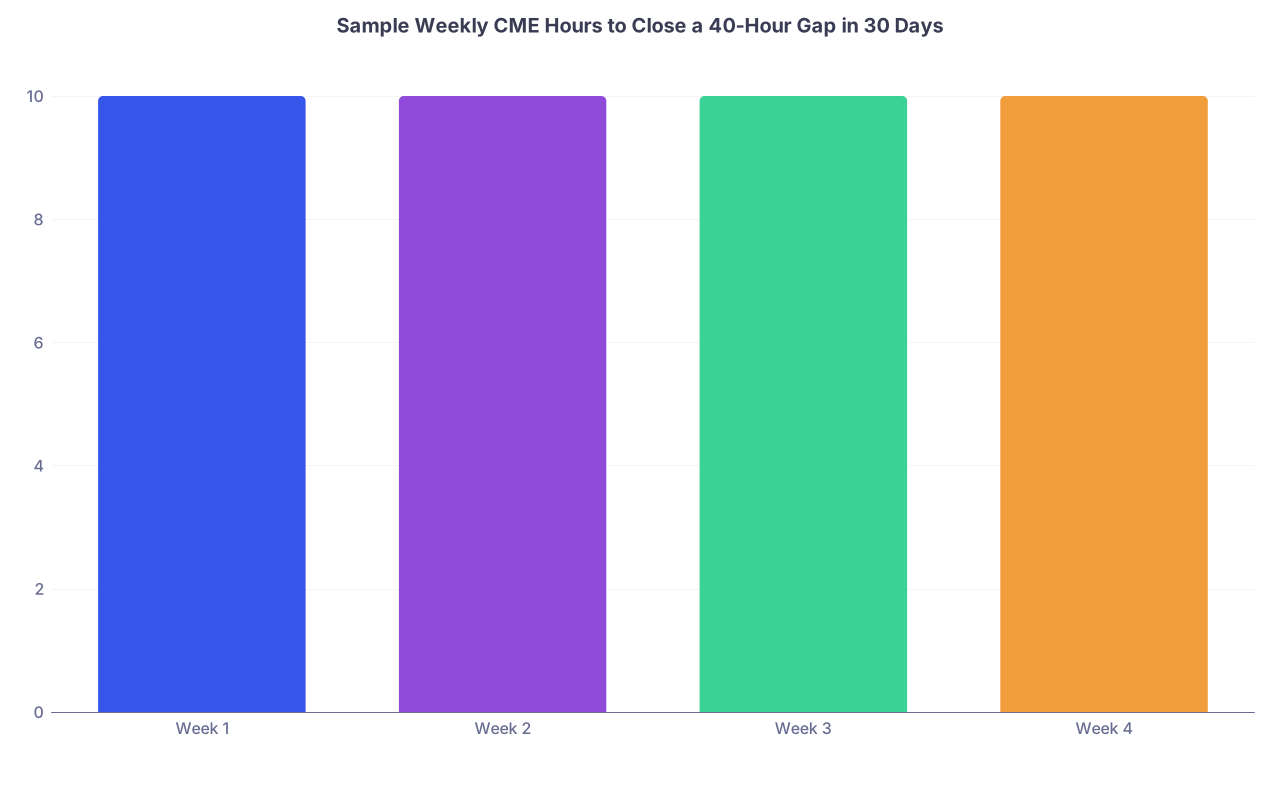
- Total: 9 hours/week
- 4 weeks = 36 hours. Still short. Add one more 1‑hour block each week → 40 hours. Then sprinkle a bit of catch‑up.
You want your plan to show slight overage (10–20%) in case of emergencies.
| Category | Value |
|---|---|
| Week 1 | 10 |
| Week 2 | 10 |
| Week 3 | 10 |
| Week 4 | 10 |
2. Put CME blocks on a real calendar
Do not keep this in your head.
Open your actual call schedule / clinic template
Look for:
- Post‑clinic windows (e.g., 5:30–6:30 pm)
- Early morning (6–7 am before the world wakes up)
- Predictable light days
- Post‑call afternoons (light, low‑brain-power modules)
Now name the blocks:
- “CME – 2 modules pain management”
- “CME – 1.5 hr cardiology board review”
- “CME – ABIM MOC points + ethics”
If you share a calendar with a spouse or team, mark these as “busy.” You do not need permission. You need boundaries.
Step 2: Use Only High-Yield CME Sources (No Random Webinars)
If you are 6 months ahead of schedule, you can wander into random one‑hour webinars and boutique conferences. You are not that person right now.
You need:
- High credit/hour density
- Trusted content
- Efficient formats (no fluff intros, no 20‑minute sponsor pitches)
Here is how the options stack up.
| Option Type | Pros | Cons |
|---|---|---|
| CME podcasts / audio | Commute friendly, flexible | Lower concentration, tracking |
| On-demand video libraries | High yield per hour, trackable | Screen time, some cost |
| Board review question banks | Strong learning, point dense | Higher cognitive effort |
| State-mandated modules | Required content, clear credits | Usually boring, rigid format |
| Live virtual webinars | Satisfy 'live' requirement | Fixed times, less flexible |
1. Prioritize platforms that track and store certificates
Stop hunting for PDFs in your inbox 3 years from now.
Look for:
- Integrated tracking (AMA Ed Hub, specialty society portals)
- Automatic transcript generation
- Direct reporting to boards where available
If you do not already have a reliable primary platform, pick one now and stick with it for this 30‑day sprint.
2. Match formats to your day
Do not try to watch dense video modules when you are post‑call and half-conscious. Match intensity:
Low-energy times
- Audio CME and podcasts during commute
- Easy state-required modules that are mostly reading and quizzes
- Quick risk management or professionalism lectures
High-energy times
- Board-style QBank CME (e.g., NEJM Knowledge+, specialty board reviews)
- Deep-dive video courses in your subspecialty
- Interactive case conferences or virtual live CME
3. Stop wasting “commute hours”
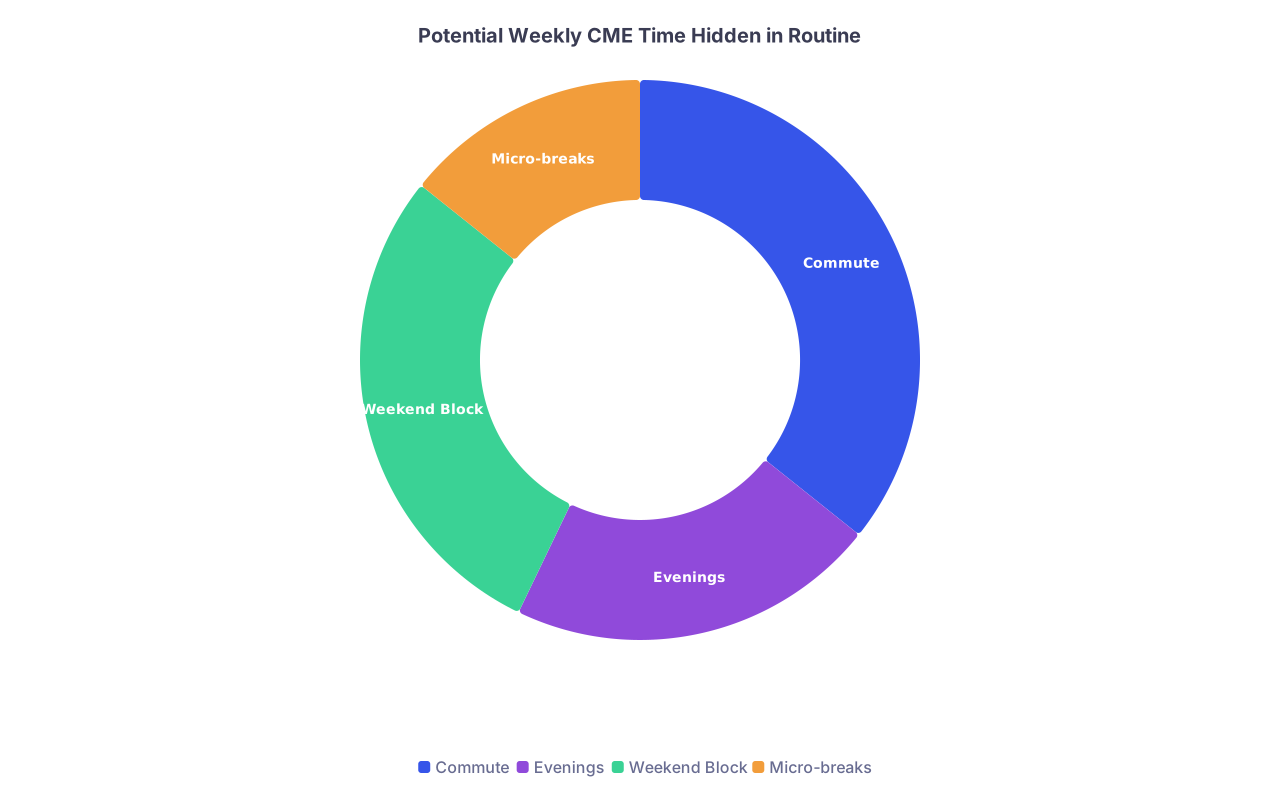
You probably have 3–7 hours a week of commuting, walking between buildings, or doing mundane tasks.
Turn that into CME:
- CME podcast series (primary care updates, specialty‑specific shows)
- Audio-capable CME apps with offline download
- Call in to virtual grand rounds while commuting (if allowed and safe—hands free only)
If you convert even 5 hours/week of commute or walking time into CME, your 30‑day problem becomes trivial.
| Category | Value |
|---|---|
| Commute | 5 |
| Evenings | 3 |
| Weekend Block | 4 |
| Micro-breaks | 2 |
Step 3: The 30-Day Recovery Plan (Day-by-Day Structure)
You do not need a military-level schedule for each day, but you do need a structure you can rinse and repeat.
Week 1: Stabilize and Build Momentum
Goal: 25–30% of your total CME gap.
Day 1:
- Confirm exact CME gap and categories
- Select platforms and logins
- Schedule 30 days of CME blocks on your calendar
- Do one easy 30–60 minute module just to start
Days 2–7:
- Weekdays: 60–90 minutes per day
- 30–45 minutes commute audio CME
- 30–45 minutes evening video or QBank
- Weekend: 2–3 hour focused block (break into 45‑minute chunks with short breaks)
- Weekdays: 60–90 minutes per day
Focus this week on:
- Any expiring or time‑sensitive modules
- State-mandated topics (opioids, pain, infection control)
- A mix of your specialty and general updates
You want one thing at the end of Week 1: proof that this is doable.
Week 2: Hit the Middle 40%
Goal: Reach 60–70% of your CME gap by end of Week 2.
This is where most people fall apart. The novelty is gone. You are not close enough to feel “almost done.” So you automate it.
Tactics for Week 2
Create standard “CME recipes”:
- Recipe A (60 minutes): 1 podcast episode + 1 short online module
- Recipe B (90 minutes): 20 QBank questions + 1 video lecture
- Recipe C (2 hours): 3 short lectures + 1 quiz-based module
Use a visible tracking method:
- Paper calendar on your desk with CME hours written per day
- A simple spreadsheet: date, activity, hours, category
- You want to see progress, not guess.

Try this weekly structure:
- 2 days: board-style QBank CME (tough but efficient)
- 2 days: specialty video series
- 1 day: general medical updates / journal-based CME
- Weekend: mop-up of state-mandated and “required topic” modules
If your board or state requires an ethics or risk management module, get it done by end of Week 2. Do not leave all the painful stuff for the very end.
Week 3: Clean Up Category Gaps
Goal: Finish most of the remaining hours and resolve category-specific requirements.
By now:
- Your total hours should be >70% complete
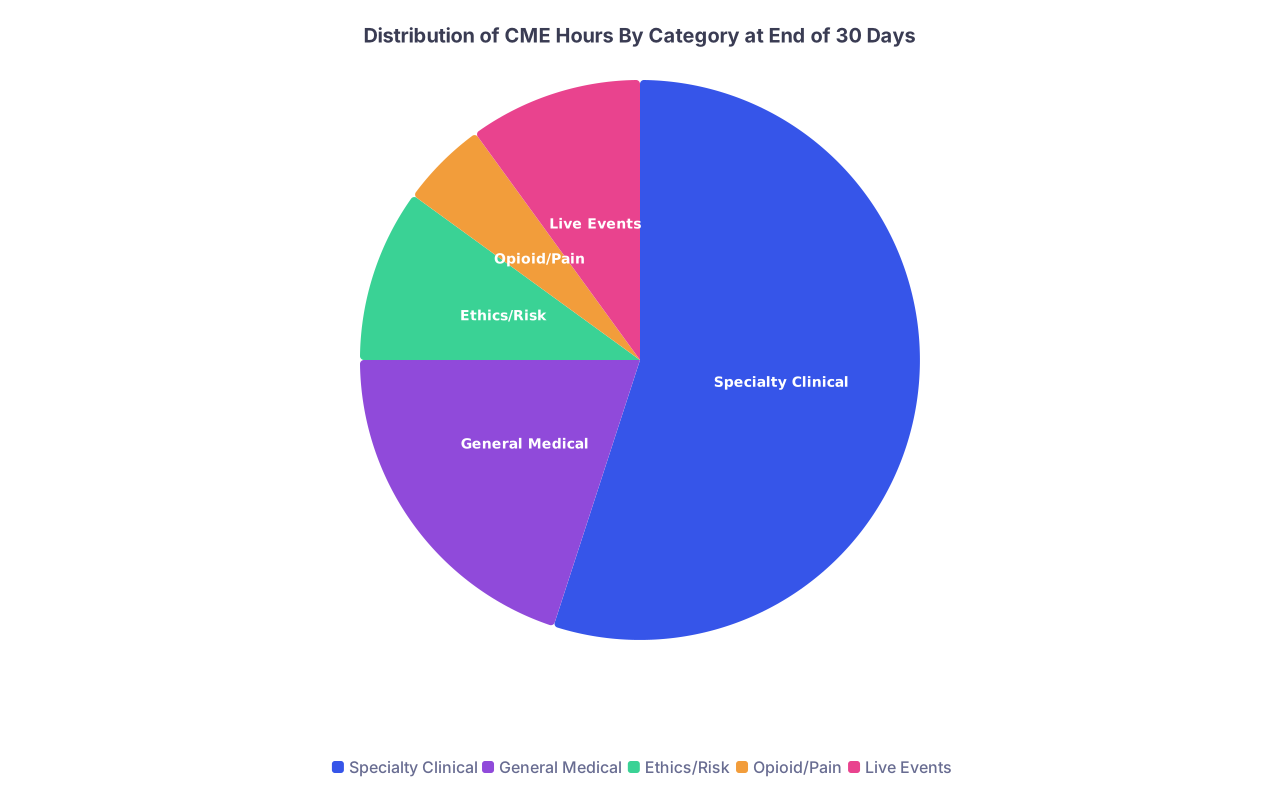
- You should know exactly what is left by category:
- Example:
- General CME remaining: 10 hours
- Ethics: 2 hours
- Opioid prescribing: 1 hour
- “Live” activities: 3 hours
- Example:
Week 3 is for targeted strikes.
1. Run a gap analysis
Sit down for 15 minutes and write:
- Hours completed by category
- Hours remaining by category
Then match CME modules precisely to those gaps.
| Category | Required | Completed | Remaining |
|---|---|---|---|
| Total CME | 100 | 72 | 28 |
| Category 1 | 80 | 60 | 20 |
| Ethics / Risk Mgmt | 4 | 1 | 3 |
| Opioid / Pain | 3 | 2 | 1 |
| Live / Interactive | 10 | 7 | 3 |
2. Schedule category-specific sessions
- Ethics and risk management: usually 1–3 hour bundled modules—knock them out in 1–2 sessions.
- Opioid/pain: your state typically lists approved courses. Do exactly what they recommend and print the certificate.
- “Live” CME:
- Virtual grand rounds
- Live webinars with Q&A
- Local society meetings
You may need to adjust your calendar to attend specific times. Protect those like you would an OR block.
Week 4: Buffer, Verify, and Lock It In
If you do Weeks 1–3 properly, Week 4 is not panic. It is insurance.
Goal: Finish remaining hours + build 10–20% over minimum.
Why over-minimum? Because:
- Systems lose documentation
- You misclassify a few hours
- Audits are real, and arguing about 1.5 questionable hours is not worth your time
1. Build a verification checklist
Spend a focused 30–45 minutes on documentation:
Download or save:
- All certificates (PDF)
- Email confirmations for live webinars
- Transcripts from main CME platforms
- Copies of completion screens if certificates are not immediately available
Store in:
- One cloud folder:
CME / [CycleYears] - Subfolders by year or category if you want to get fancy
- One cloud folder:
Check your progress against:
- State board CME log (if they provide one)
- Specialty board dashboard (ABIM, ABFM, etc.)
- Hospital credentialing portal
| Category | Value |
|---|---|
| Specialty Clinical | 55 |
| General Medical | 20 |
| Ethics/Risk | 10 |
| Opioid/Pain | 5 |
| Live Events | 10 |
2. Do a test “audit packet”
Assume your name gets picked for a CME audit next year. Could you respond in one evening?
Make sure you have:
Master spreadsheet or summary of:
- Course name
- Provider
- Date
- Hours
- Category
Folder with all supporting documents clearly named:
2025-03-15_Cardiology-Update_2h_Category1.pdf2025-03-22_Opioid-Prescribing-StateReq_3h.pdf
If it would take more than 2–3 hours to prepare that packet now, fix it while everything is fresh.
Step 4: Build a No-Drama CME System for the Next Cycle
You do not want to repeat this 30‑day scramble every cycle. Catching up once is fine. Doing it every time is a systems failure.
1. Convert your sprint into a permanent baseline
Once this 30‑day crisis ends, drop to a maintenance dose of CME.
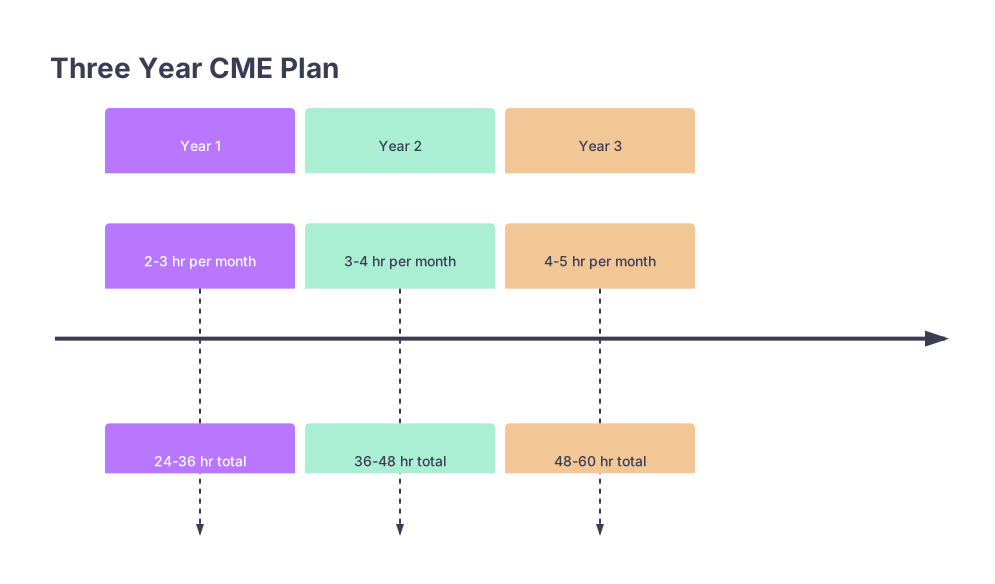
Example:
- Aim for 2–3 hours per month during non-renewal months
- Aim for 4–5 hours per month in the final year of the cycle
That is roughly:
- 24–36 hours/year early in the cycle
- 48–60 hours/year in the final year
For a 3‑year, 100‑hour requirement, this keeps you well above water.
| Period | Event |
|---|---|
| Year 1 - 2-3 hr per month | 24-36 hr total |
| Year 2 - 3-4 hr per month | 36-48 hr total |
| Year 3 - 4-5 hr per month | 48-60 hr total |
2. Standardize your CME workflows
Pick defaults:
- Default commute: CME podcast instead of random talk radio 2–3 times per week
- Default slow clinic afternoon: 1 short online module
- Default end-of-month ritual: log CME in your tracker and download new certificates
Set up:
- Recurring 30‑minute monthly calendar event: “CME log + documentation”
- One password manager entry with all CME platform logins
- One main CME platform as “home base” (even if you occasionally use others)
3. Stop saying “I will remember that”
You will not. You see hundreds of patients, dozens of labs, and have 5–10 new logins a week for various portals.
Use a simple rule:
- Every time you finish a CME activity:
- Log hours immediately into your spreadsheet or platform
- Download or screenshot the certificate page
- Drop it into your CME folder
Total time: 2–3 minutes.
Future you will be very grateful.
Step 5: Handle Common Constraints Without Derailing
Real life will not politely step aside for your 30‑day CME plan. Expect friction and plan around it.
1. On call / hospitalist blocks
During heavy inpatient weeks:
- Lean into audio CME for commutes and walks
- Aim for shorter modules (15–30 minutes) you can complete between tasks
- Save cognitively demanding QBank CME for lighter weeks
Give yourself permission to redistribute hours:
- Less CME during call week
- More CME the following week
As long as your 30‑day total holds, you are fine.
2. Family responsibilities
Do not promise yourself “I will do CME every night after the kids go down” if that has never been true in your life.
More realistic:
- 2 weekday evenings per week are non‑negotiable CME nights (communicate this to your partner)
- Swap childcare on weekends: you get 2 hours Saturday morning; your partner gets equivalent time Sunday
3. Cost and access issues
If your institution does not subsidize CME, you still have options:
Free CME:
- Major journals’ CME articles (JAMA, NEJM, etc.)
- Free modules from specialty societies and state programs
- Industry-sponsored (if you are comfortable and within your institution’s policies)
Low-cost bundles:
- Annual CME subscriptions with unlimited credits
- Conference recordings instead of in‑person attendance
If money is tight, do a quick budget:
- How much would an audit problem or missed renewal cost you?
- Now compare that to $200–$400 for a year of solid, trackable CME.
The answer is obvious.
Quick Example: A Realistic 30-Day Schedule for a 40-Hour Gap
Here is what a practical plan looks like for a full-time clinician:
Weekly structure:
- Mon: 45 min commute audio + 30 min evening module (1.25 h)
- Tue: 45 min audio + 45 min QBank (1.5 h)
- Wed: 60 min specialty video (1 h)
- Thu: off (or optional 30 min)
- Fri: 45 min audio + 30 min easy module (1.25 h)
- Sat: 2 × 60 min focused blocks (2 h)
- Sun: 2 × 60 min focused blocks (2 h)
Total ≈ 10 hours/week × 4 weeks = 40 hours.
You can slide days around, but keep the weekly total non‑negotiable.

What To Do Today (Not Tomorrow)
If you are still reading and your deadline is close, here is your 3‑step “start now” protocol:
Clarify the gap (60–90 minutes)
- Confirm requirements
- Total your current hours
- Calculate your deficit and daily / weekly pace
Choose your tools (45–60 minutes)
- Pick 1–2 main CME platforms
- Identify 3–5 audio sources for commutes
- Log in, bookmark, and test at least one module
Schedule and complete your first 2–3 hours
- Put at least three 60‑minute CME blocks on your calendar over the next 7 days
- Complete one module today—even a 30‑minute one—to prove momentum
Once you see that a couple of hours are actually doable, the panic dial drops. Then it is just execution.
FAQ (Exactly 4 Questions)
1. What happens if I still cannot finish all my CME before the deadline?
Call your state medical board and your hospital medical staff office early, not after the deadline. Many boards have processes for conditional renewal, grace periods, or remediation plans if you are close and can document good‑faith effort. Showing up with a concrete plan (“I have completed 80 of 100 required hours and have X, Y, Z scheduled this month”) is far better than silently missing the mark and hoping nobody notices.
2. Can I count the same CME activity for my state license, hospital credentialing, and board MOC?
Usually yes, as long as the activity meets each entity’s requirements and is correctly categorized (Category 1, ethics, opioid, etc.). The same 3‑hour opioid course can often satisfy both a state requirement and general CME totals. You still need to log and submit it in each system as required. Always verify specific rules with your board and institution, but double‑counting across systems is normal and expected.
3. Are free CME activities enough, or do I need to pay for a subscription or conference?
You can absolutely meet most CME requirements using free sources if you are organized and willing to hunt a bit. That said, paid subscriptions or conference packages often give you higher yield, better tracking, and more focused content. When you are behind and under time pressure, a $200–$300 high-quality, unlimited-credit platform can easily be worth it compared with the cost of lost time chasing dozens of small, poorly documented free modules.
4. How much documentation do I really need to keep in case of an audit?
Assume you will need to show: activity name, provider, date, number of hours, and proof of completion. That typically means a certificate PDF or transcript from the CME provider. Screenshots of completion pages are acceptable backups. Keep everything for at least one full renewal cycle beyond your current one (often 5–6 years total). One master tracking sheet plus a single organized folder of certificates is enough. Anything less, and an audit will turn into a multi-day scavenger hunt.