
The way most physicians handle CME is backward: they react to looming deadlines instead of building a strategic, multi‑year plan. That is how you end up rage‑clicking through low‑yield online modules at 11:45 p.m. on December 31.
You can do better. Starting PGY‑3.
This is a year‑by‑year roadmap from PGY‑3 through your early attending years that shows you exactly what to do, when to do it, and how to avoid the usual CME chaos.
Step 0: Know the Numbers Before You Start
At this point, before you even talk about PGY‑3 versus PGY‑4, you need a rough sense of what the rules actually are. Not vague “I’ll need like 50 hours or something.” Specific.
| Requirement Type | Common Range |
|---|---|
| State license CME | 25–100 credits / 1–2 yr |
| Specialty board (MOC) | 25–50 credits / year |
| DEA opioid training | 8 hours (one‑time) |
| Hospital privileges | 25–50 credits / 2 years |
You will tailor this later, but keep these anchor points in mind. They dictate your pacing once you are an attending.
PGY‑3: Lay the Foundation Before It Counts
PGY‑3 is not about racking up formal CME hours. It is about building the habits and infrastructure so that once the clock starts (as an attending), you are not scrambling.
At this point you should:
Inventory your future obligations (1–2 afternoons)
Do this once, properly.- Look up your state board CME requirements (for the state you realistically plan to practice in).
- Total hours per cycle
- Cycle length (1 vs 2 years)
- Required topics (opioids, ethics, implicit bias, child abuse, etc.)
- Check your specialty board (ABIM, ABEM, ABFM, ABS, etc.):
- Annual or cycle‑based CME / MOC hours
- Any “self‑assessment” or “Part II/IV” requirements
- If you already have an idea of your job:
- Ask for the medical staff bylaws for CME. Hospitals often add their own requirements.
Create a one‑page breakdown. Not a paragraph in an email. A single clear reference you can glance at.
- Look up your state board CME requirements (for the state you realistically plan to practice in).
Set up a CME tracking system (1 evening)
Waiting until you are an attending to “figure it out later” is how credits get lost.At this point you should:
- Decide where you will track:
- A simple spreadsheet, or
- A password‑protected note, or
- A CME tracker within a board portal or employer system
- Create basic columns:
- Date
- Activity name
- Provider (ACCME, board, hospital, etc.)
- Credits (Type 1, Category 1, MOC points, etc.)
- Topic (opioid, ethics, general)
- Proof (PDF, email, screenshot location)
- Create a “CME Certificates” folder in your cloud drive, with subfolders by year.
- Decide where you will track:
Treat resident education like practice CME (ongoing, PGY‑3)
Your noon conferences and grand rounds may not count as official CME yet, but behave as if they did.- For every conference, write a 1‑sentence learning point in your tracker or a notes app.
- Label by topic: quality, safety, guideline update, procedure.
- You are building the muscle of reflective, trackable learning.
Use electives and courses as dry runs (by mid‑PGY‑3)
If your program lets you attend a specialty board review course or national conference as a resident:- Go through registration as if you needed CME credit:
- Opt in for CME documentation
- Download certificates, store them in your new system
- Even if the hours do not “count” toward later cycles, you are rehearsing the workflow.
- Go through registration as if you needed CME credit:
End of PGY‑3 checklist
By the time you graduate residency you should already have:
- A documented summary of:
- State CME requirements
- Board / MOC expectations
- A functional CME spreadsheet or tracker
- A cloud folder structure for certificates
- At least one real CME certificate stored correctly (even if just for practice)
- A documented summary of:
If you leave PGY‑3 without these, you are voluntarily signing up for future pain.
First Year Out (Early Attending, Year 1): Build Your Baseline CME Rhythm
This is where the clock really starts. Licensure cycles, hospital bylaws, MOC cycles. The whole thing goes live.
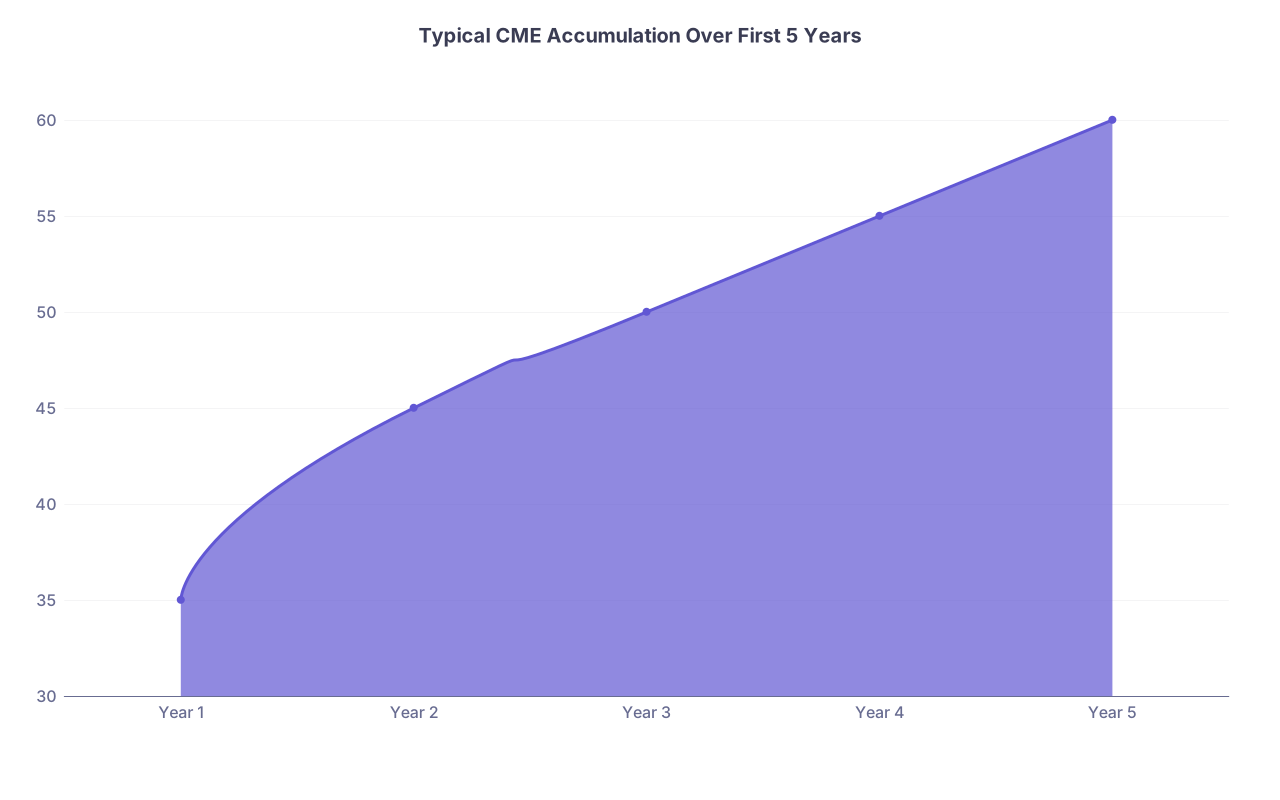
| Category | Value |
|---|---|
| Year 1 | 35 |
| Year 2 | 45 |
| Year 3 | 50 |
| Year 4 | 55 |
| Year 5 | 60 |
Month 0–1: Onboarding and Reality Check
At this point you should:
- During onboarding, explicitly ask:
- “What are the CME requirements for medical staff reappointment here?”
- “Does the organization provide CME funds and protected time? How much?”
- Get exact numbers:
- Dollar amount per year (e.g., $2,500 CME fund)
- Paid days for conferences or courses (e.g., 3–5 days / year)
- Any preferred vendors or subscriptions they cover (UpToDate, specialty packages)
Then:
- Update your CME summary document:
- Add employer/hospital CME rules to your existing state + board overview
- Set your minimum annual target:
- Add up the strictest combination and divide appropriately.
For example, if your state requires 50 credits every 2 years (25/year), your board wants 25/year, and your hospital wants 30 every 2 years (15/year) → your working target is 40–45 credits per year so you always have a cushion.
Month 1–2: Build a Year‑1 CME Plan
Design Year 1 instead of letting it happen to you.
At this point you should:
- Select 1–2 major CME anchors for the year:
- One national meeting (10–25 credits)
- One board review or intensive online course (15–30 credits)
- Map them on a calendar:
- Avoid the heaviest clinical blocks
- Coordinate with colleagues to cover call / shifts
- Pre‑allocate your CME budget:
- Conference registration
- Travel and lodging
- One core resource (e.g., UpToDate or specialty Q‑bank with CME credits)
Now translate this into a simple annual schedule:
| Quarter | Primary Activity | Estimated Credits |
|---|---|---|
| Q1 | Online modules (night) | 10 |
| Q2 | National conference | 20 |
| Q3 | Board review course | 15 |
| Q4 | Ethics/required topics | 5–10 |
Month 3–12: Weekly and Quarterly Habits
Week‑to‑week, your life is busy. You need friction‑free patterns.
At this point you should:
Weekly (15–30 minutes):
- Log any CME completed that week. Same day if possible.
- Attach certificates or take screenshots immediately.
- Tag topics: opioid, ethics, QI, etc.
Monthly (30–60 minutes):
- Check your CME total vs your target pace:
- If you want ~40 credits / year → ~3–4 credits / month
- If you are short, schedule:
- One evening of online modules
- One weekend half‑day for a focused course
Quarterly (1–2 hours):
- Review your board portal and state board (if they track CME electronically)
- Make sure required topic boxes are getting filled:
- If your state wants 2 hours ethics every 2 years → aim for 1 hour/year
- Scan your practice:
- New medication classes?
- New technologies or procedural techniques?
- Choose 1 targeted CME activity to close that gap.
By the end of Year 1 you should not be wondering where you stand. You should know, within 5 credits, how much you have, how much is banked in each category, and what your next 6 months look like.
Year 2: Align CME with Career Direction
By Year 2, you are slightly less panicked clinically and starting to think about who you want to be as an attending. Your CME should follow.

Start of Year 2: Re‑baseline and Correct Course
At this point you should:
- Pull up your tracker and count:
- Total credits last cycle
- How many in each required category (opioids, ethics, etc.)
- How many count toward MOC vs generic CME
- Compare with:
- State license cycle deadlines
- Board MOC milestones
- Hospital recredentialing timeline
If you discover a gap—like you ignored opioid education entirely last year—plan to overcorrect early this year.
Mid‑PGY‑like Transition: Subspecialty and Role‑Focused CME
Year 2 is a good time to stop doing random CME.
At this point you should:
- Decide your near‑term focus:
- Becoming the “go‑to” for sepsis management in your ED
- Building a niche in geriatrics within your IM group
- Taking on a quality or safety leadership role
- Select 1–2 theme areas for CME this year:
- Clinical depth (subspecialty content)
- Systems and leadership (QI, patient safety, teaching, informatics)
Then build around those themes:
- Choose:
- One major conference in that niche
- One longitudinal online course (e.g., QI methods with CME)
- One project‑linked CME (QI project that gives MOC points)
Year 2: Quarter‑by‑Quarter Pattern
Q1: Tighten compliance
- Make sure:
- Required topics are on track (opioid, ethics, etc.)
- At least one MOC‑eligible activity is in progress.
Q2: Deep clinical update
- Heavy clinical CME:
- New guidelines, high‑risk conditions, procedures
- Aim for 10–15 credits focused on your planned niche.
Q3: Systems and leadership
- Pick nonclinical CME:
- Quality improvement
- Teaching and education
- Billing and coding (yes, annoying, but high‑yield financially)
- Integrate with your job:
- CME tied to an actual improvement project or committee work.
Q4: Clean‑up and strategic catch‑up
- Identify:
- Categories that are light (ethics, cultural competency, etc.)
- Board requirements that reset next year
- Knock out low‑interest but mandatory topics now, not 1 week before your license renewal date.
By the end of Year 2, the goal is simple: your CME should be obviously supporting your clinical strengths and your chosen direction, not just checking boxes.
Year 3–4: Move from Passive Consumer to Active Participant
This is the phase where you stop just attending and start contributing.
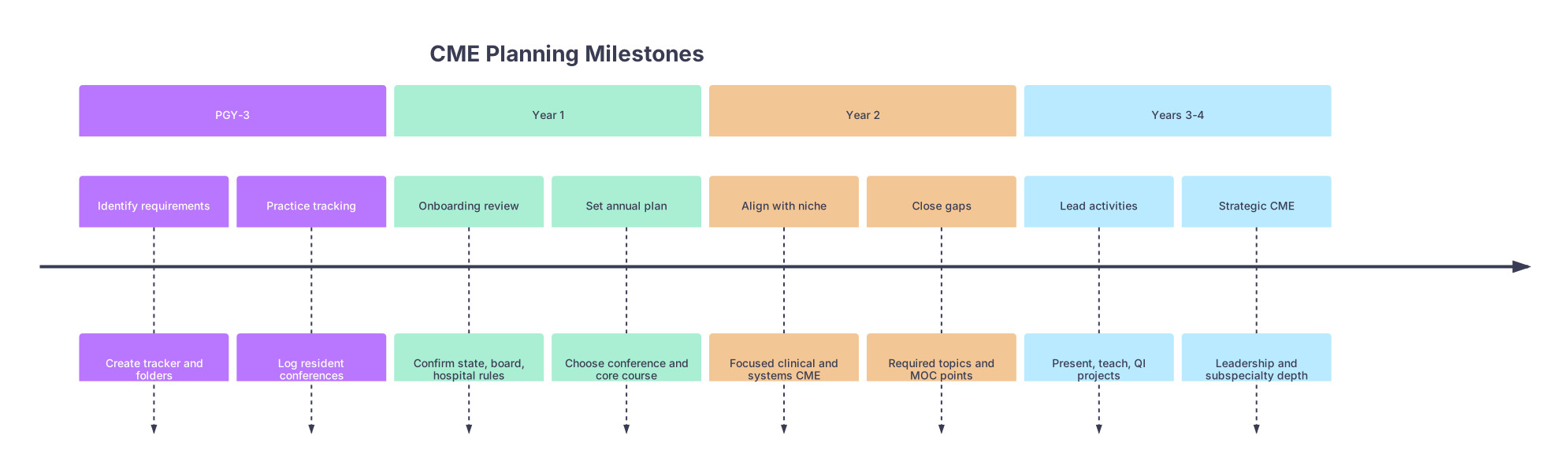
| Period | Event |
|---|---|
| PGY-3 - Identify requirements | Create tracker and folders |
| PGY-3 - Practice tracking | Log resident conferences |
| Year 1 - Onboarding review | Confirm state, board, hospital rules |
| Year 1 - Set annual plan | Choose conference and core course |
| Year 2 - Align with niche | Focused clinical and systems CME |
| Year 2 - Close gaps | Required topics and MOC points |
| Years 3-4 - Lead activities | Present, teach, QI projects |
| Years 3-4 - Strategic CME | Leadership and subspecialty depth |
Start of Year 3: Audit and Elevate
At this point you should:
- Do a full 2–3 year audit:
- What proportion of your CME is:
- Clinical direct care
- Systems/QI
- Teaching/education
- Required regulatory topics
- How many hours are just low‑yield online modules at 1 a.m.?
- What proportion of your CME is:
- Decide what you want more of:
- If your goal is fellowship or subspecialty practice → more advanced clinical CME.
- If your goal is leadership → more management, QI, informatics, or education CME.
Then adjust your annual target mix. Keep your total credits steady but flip the ratio toward what actually advances your career.
Years 3–4: Turn CME into CV Lines
You can convert passive learning into things that actually show up on a promotion packet.
At this point you should aim to:
- Present at least once:
- Grand rounds
- Regional conference
- Quality or safety meeting (with CME attached for attendees)
- Lead or co‑lead a CME activity:
- Journal club counted for CME
- Case conferences with formal objectives and evaluation
- QI project that earns MOC Part IV credit
You are not just a consumer now. You are part of the educational environment. That matters when you apply for leadership positions or academic appointments.
Early Attending Years 5+: Systematize and Future‑Proof
By Year 5, CME should not be a constant background worry. If it is, your system is broken.
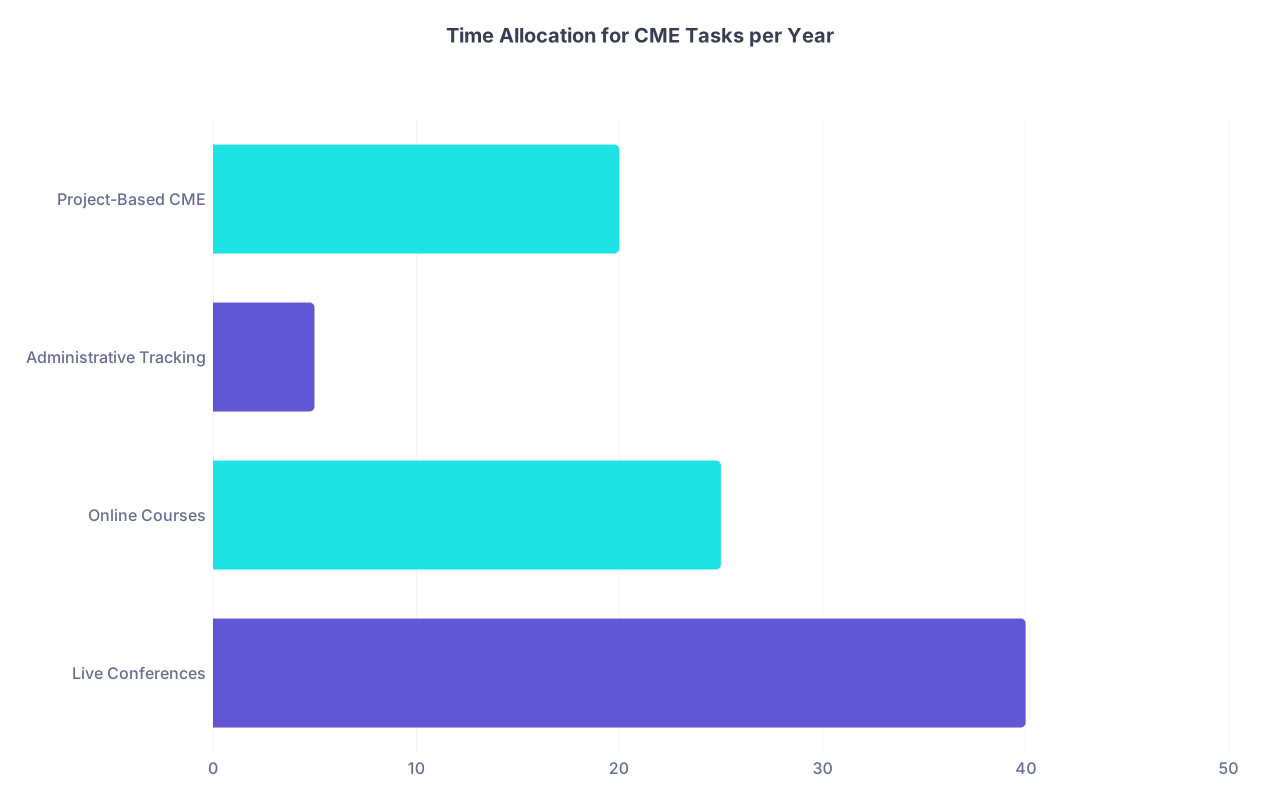
| Category | Value |
|---|---|
| Live Conferences | 40 |
| Online Courses | 25 |
| Administrative Tracking | 5 |
| Project-Based CME | 20 |
Year 5: Build a 5‑Year CME Cycle View
At this point you should step back and map 5 years at a time.
- Lay out:
- State license renewal dates
- Board MOC reporting cycles
- Hospital reappointment cycles
- For each year, assign a dominant theme:
- Year A: Board recertification heavy year (board review course + exam‑focused CME)
- Year B: Leadership and management CME (if you are moving into admin roles)
- Year C: Deep subspecialty or procedural update
- Year D: Teaching and education (if you are on faculty)
- Year E: Balanced year; clean up any regulatory or category gaps
This 5‑year view keeps you from bunching all the painful stuff into one cycle.
Annual Maintenance from Year 5 On
At this point you should:
- Standardize a CME closing ritual every December or at the end of your fiscal year:
- Export CME transcripts from:
- Board portals
- Major CME platforms
- Hospital systems
- Cross‑check totals against your tracker
- Store consolidated PDFs in your CME folder by cycle (e.g., “State License 2024–2026”)
- Export CME transcripts from:
- Maintain a minimum floor of:
- X credits per year even in “light” years (for most physicians, 30–40 is safe)
- At least some MOC‑linked CME each year so you never face a massive deficit
At this point, surprises should be rare. If a state board letter or hospital recredentialing packet catches you off guard, it is a system failure, not a requirement problem.
Quick Reality Check: Common Mistakes and How This Timeline Prevents Them
You are trying to avoid being the person who:
- Realizes 6 weeks before license renewal that they are 20 opioid credits short.
- Has done 80 hours of CME but has no documentation.
- Needs MOC Part IV points and discovers the only available option is a bloated, irrelevant project.
This roadmap prevents that by forcing specific actions at specific times:
- PGY‑3: You build the infrastructure (tracker, folders, requirement list).
- Year 1: You establish a baseline rhythm and learn your systems.
- Year 2: You align CME with your career path and fix early gaps.
- Years 3–4: You shift from consumer to contributor, earning CME in ways that help your CV.
- Year 5+: You zoom out to 5‑year cycles and embed CME into your professional identity, not just your compliance checklist.
Final Takeaways
- Treat PGY‑3 as your CME rehearsal year: build the tracking and habits before the credits really matter.
- In your first 2–3 attending years, design CME around both compliance and career direction—stop doing random hours.
- By Year 5, operate on multi‑year cycles so CME becomes predictable, strategic, and boring—in the best possible way.