

Missing one CME cycle does not “ruin” your record. The panic around this is wildly out of proportion to the actual consequences in most jurisdictions.
Let me be blunt: regulators, hospitals, and boards care about patterns, not one-off human mistakes. But they do care if you pretend it did not happen or you let it snowball.
You want the reality? It’s this: missing one CME cycle is usually fixable, sometimes annoying, occasionally expensive, and only career-threatening if you ignore it or lie about it.
The Myth: “If I Miss One CME Cycle, I’m Basically Done”
You’ve heard some version of this in the hallway:
“If you don’t have every credit by the deadline, you’re in big trouble. The board will have a record on you forever.”
That’s the myth. And it’s wrong in three different ways:
- It assumes every jurisdiction treats CME the same. They do not. At all.
- It assumes every lapse goes straight into some permanent, publicly shaming record. Often it does not.
- It assumes there is no remediation window or plan. In reality, most systems are built around remediation.
Let’s anchor this in actual structure, not gossip.
| Body | First-Time Lapse Response |
|---|---|
| State Medical Boards | Grace period + late renewal fees |
| Specialty Boards (MOC) | Remediation, extra CME, fees |
| Hospitals/Privileges | Provisional or time-limited renewal |
| Insurers/Payors | Documentation requests, rarely immediate action |
There are outliers, and some boards are stricter than others. But the default is “fix this” not “you’re finished.”
Reality Check #1: CME Is a Compliance System, Not a Moral Scorecard
Most clinicians talk about CME as if it’s a moral referendum on your professionalism. That’s not what the system is actually designed to do.
CME is a regulatory checkbox and risk-management tool. It exists so that:
- Boards can say they have a mechanism to ensure “ongoing competence.”
- Hospitals can say their medical staff meets “current standards.”
- Insurers and accreditors can say they contract with clinicians doing continuing education.
That means the system is built around:
- Documentation
- Deficiency notices
- Remediation windows
- Fees
Notice what’s missing? Instant, catastrophic punishment for one late cycle.
How Boards Often Actually Handle a Missed Cycle
In many states and with many boards, the sequence looks more like this:
- You hit the renewal deadline short on CME.
- You get a notice: you are “deficient” and must complete X hours by a new date.
- You often can still practice under a “lapsed,” “expired,” or “inactive” status for a short period, or you move to that status until corrected.
- You complete the CME, pay a late fee, submit documentation.
- Status returns to active.
Public discipline for a first-time CME shortfall is relatively uncommon unless:
- You ignore repeated notices.
- You attest falsely (“Yes, I completed everything”) and that gets discovered.
- You already have a history of other issues.
Boards care way more about dishonesty than about being busy and late.
Reality Check #2: Data Shows Patterns, Not Doom
We do not have perfect national data on CME lapses (because not every board publishes the details), but we do see consistent patterns in disciplinary reports and policy language.
The vast majority of formal disciplinary actions you can actually read—those listed on state medical board websites—are for things like:
- Substance misuse
- Criminal behavior
- Gross negligence / patient harm
- Fraud (billing, prescribing, documentation)
- Repeated non-compliance across multiple areas
CME-only discipline is almost always:
- Repeated non-compliance across cycles, or
- Non-compliance plus misrepresentation, or
- Bundled with other problems you’d actually lose sleep over.
The scary hallway story you heard—“My colleague’s license was flagged for missing CME one year”—usually leaves out that they also ignored letters for 18 months or were already on probation.
Where the Record Actually Matters
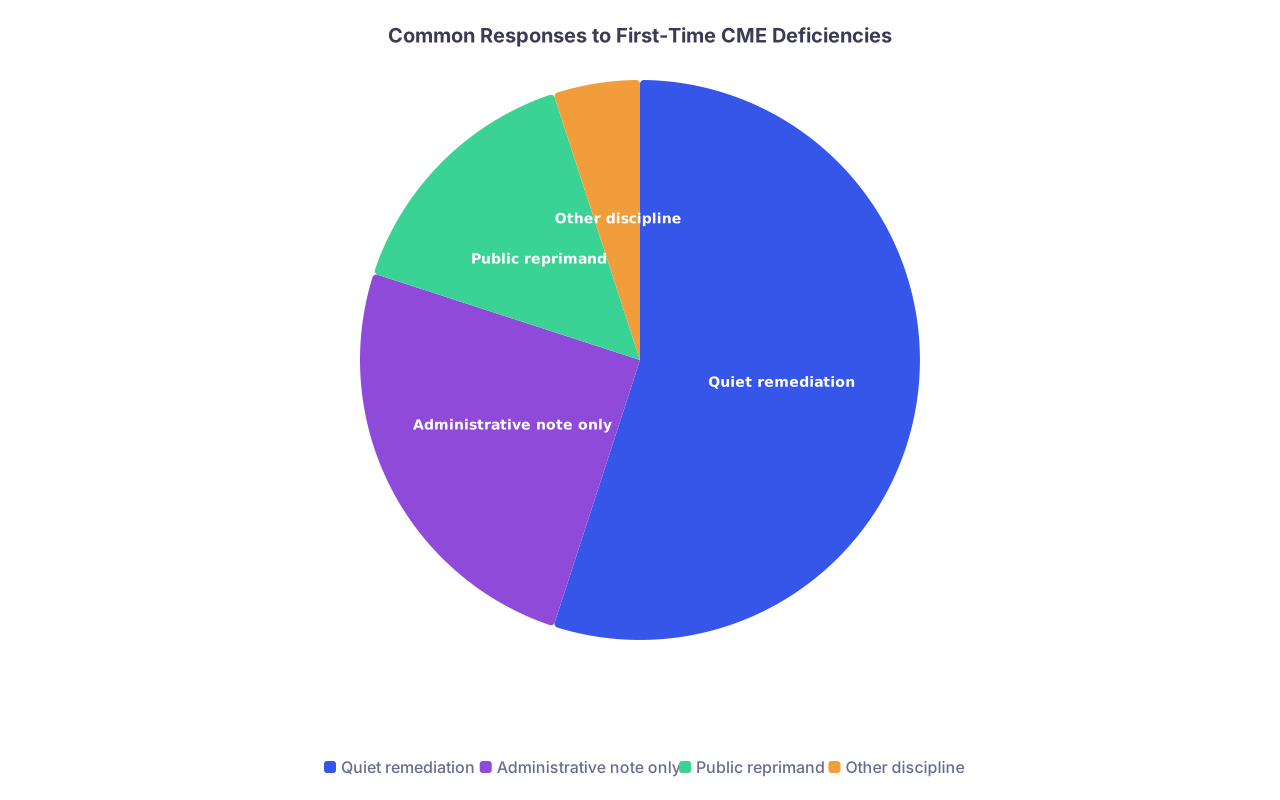
There is a record. But it’s not always a scarlet letter.
| Category | Value |
|---|---|
| Quiet remediation | 55 |
| Administrative note only | 25 |
| Public reprimand | 15 |
| Other discipline | 5 |
This rough breakdown reflects what many state board minutes and policy summaries show when you look at cases: most are remediated quietly or with low-level administrative handling. Only a minority become public reprimands, and very few go beyond that—almost always when other problems exist.
So no, one missed cycle, fixed promptly and honestly, does not usually “ruin your record.”
Reality Check #3: The Real Risks Are Practical, Not Eternal
Here’s where people get burned—not by some permanent black mark, but by immediate, practical consequences.
Think about it as three risk buckets: licensure, credentialing, and certification.
1. Licensure (State Medical Boards)
If you miss CME and don’t fix it, you risk:
- Inability to renew on time, which can mean a period where you legally should not practice.
- Late fees or administrative penalties.
- Possible “administrative discipline” if you let it drag out.
Most boards have a catch-up process. Some will allow you to attest you’ll complete missing CME within a short time window; others require it before renewal goes through. Many offer a defined remediation pathway in their rules.
The real danger: you keep practicing after your license goes inactive/expired because you did not read the notices. That becomes a bigger problem than the CME itself.
2. Credentialing (Hospitals, ASCs, Groups)
Hospitals are more blunt: no license or missing CME = headaches.
They might:
- Grant only provisional or time-limited privileges while you catch up.
- Delay your reappointment, which can disrupt scheduling and income.
- Require extra CME in a specific area if your deficiency looks substantive or related to performance issues.
But again, as someone who’s seen medical staff offices handle this: they are annoyed far more than they are horrified.
What they actually fear is a pattern of sloppiness or dishonesty. If you say, “Yep, I missed this, here’s my catch-up plan and completed CME,” most credentialing committees move on.
3. Board Certification / MOC
Specialty boards are some of the worst offenders in the fear-industrial complex.
Their letters sound terrifying: “Risk of losing certification,” “not meeting your MOC requirements,” and so on. But they too have remediation pathways.
Common options include:
- Extra CME credits in a short window
- Assessment-based CME
- Late fees or re-enrollment fees
- For chronic noncompliance, a gap in “continuous certification” status that can later be restored
Do some hospitals and payors care about continuous board certification? Yes. But they usually care more that you are currently board certified, and many accept reinstatement after a lapse as long as it’s explained and documented.
Missing one CME or MOC cycle, then completing remediation, is annoying. Not fatal.
Reality Check #4: The Only Thing That Does Ruin Your Record: Lying
The fastest way to turn a minor compliance issue into a serious mark on your record is to lie about it.
Boards, hospitals, and insurers have one shared non-negotiable: truthful attestation.
If you:
- Attest that you completed all CME when you did not
- Provide falsified or altered CME certificates
- Double-count CME or “invent” activities
- Ignore repeated requests for accurate documentation
…then you’ve moved from simple noncompliance to unprofessional conduct or fraud. That’s when you start seeing:
- Public reprimands
- Probation
- Reports to the National Practitioner Data Bank
- Questions on every future credentialing form
Again, the CME number itself is usually less important than what your behavior signals about your judgment and honesty.
So if you’re short, say you’re short. Fix it. It is absolutely not worth “smoothing the edges” on an attestation.
Reality Check #5: Catch-Up Is Common and Normal, Not Shameful
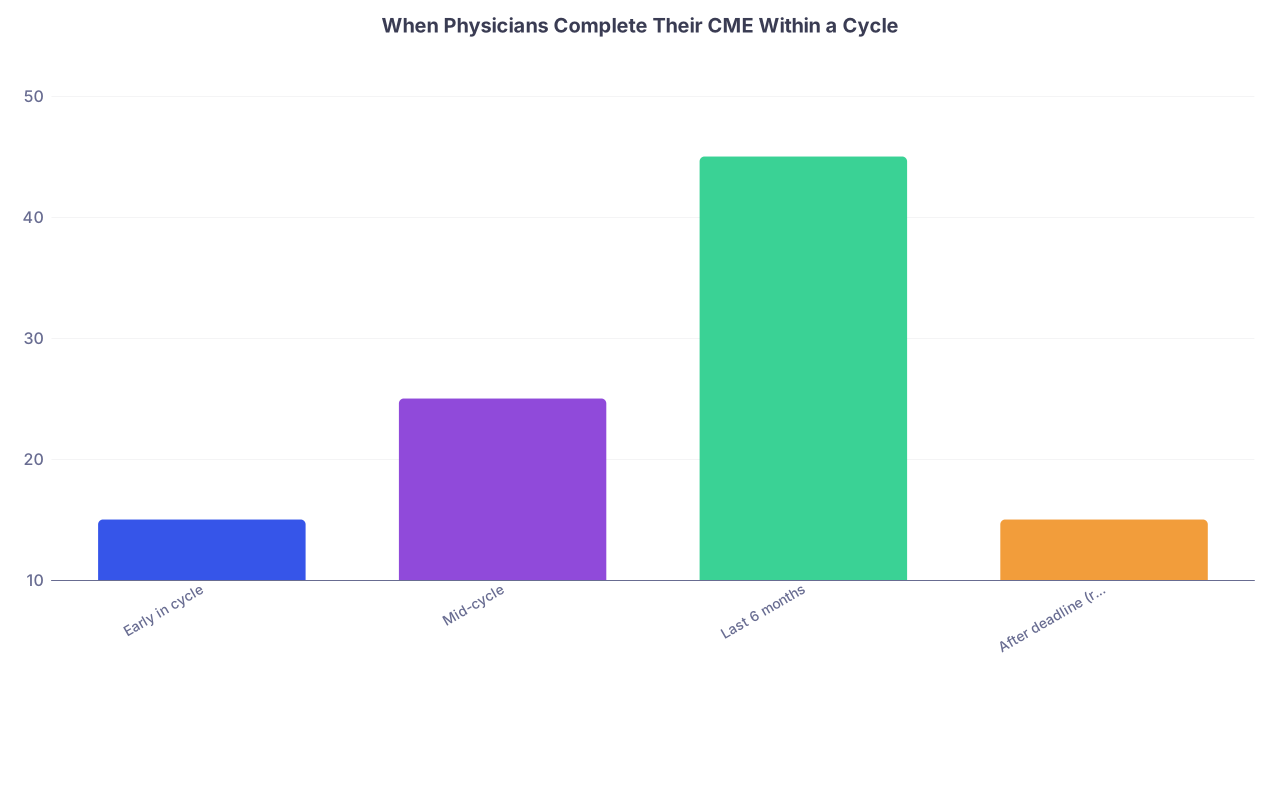
Everyone pretends they’re on top of CME all year. In reality, a huge number of clinicians cram CME in the last 3–6 months of a cycle, and a not-small minority end up using extension and remediation windows.
| Category | Value |
|---|---|
| Early in cycle | 15 |
| Mid-cycle | 25 |
| Last 6 months | 45 |
| After deadline (remediation) | 15 |
This is not an argument for procrastination. It’s pointing out that being behind does not make you an outlier; it makes you normal.
The systems around you are designed with that reality in mind. That’s why:
- Many CME providers submit credits directly to boards or ABMS boards.
- Boards publish FAQs that literally say, “What if I am short CME?”
- There are dense CME bundle offerings every time a renewal or MOC deadline looms.
You are not the first physician to scramble. The infrastructure exists because lots of you scramble.
What Actually Matters Long-Term
If you want to protect your record in a way that actually means something, focus on these things rather than obsessing over one missed cycle.
1. Keep Your Paper Trail Boring and Complete
Boring is good. Boring means:
- Your CME statements match what you attest.
- Your renewal and reappointment packets go through without “please explain” letters.
- When someone audits your CME, they lose interest quickly because everything matches.
This is far more protective than trying to be perfect but cutting corners on documentation.
2. Watch for Patterns of Noncompliance
One missed cycle that you remediate? Almost no one cares.
Three cycles in a row where you barely scrape by after repeated notices? That looks like a professionalism issue.
Patterns boards worry about:
- Repeated late renewals
- Repeated missing documentation
- Repeated “I forgot” explanations across different domains (CME, medical records, chart signatures, etc.)
They start seeing a clinician who does not respect the administrative side of patient safety.
3. Know Your Actual Rules, Not the Rumors
The biggest problem I see is people operating off vague fear instead of reading the exact language.
Your homework—once, not obsessively:
- Read your state board’s CME rules and FAQ.
- Read your specialty board’s MOC/CME policy and what happens for a missed year or cycle.
- Glance at your hospital’s medical staff bylaws about CME at reappointment.
You’ll see the same pattern: deadlines, deficiency notices, remediation, and then much later—if you keep ignoring—discipline.

| Step | Description |
|---|---|
| Step 1 | Cycle Ends |
| Step 2 | Renew/Attest |
| Step 3 | Deficiency Notice |
| Step 4 | Submit Proof and Renew |
| Step 5 | License or Privilege Risk |
| Step 6 | Discipline Possible |
| Step 7 | CME Complete |
| Step 8 | Respond and Catch Up |
| Step 9 | Continued Nonresponse |
The system is not “one strike and you’re out.” It’s “multiple warnings and then we escalate.”
Sorting Myth from Reality, Practically
Let me put it in plain language, because that’s what you actually need when you’re staring at a renewal form at 11:30 p.m.
- If you missed a cycle and there’s a remediation path: use it, document everything, move on.
- If you’re not sure whether you’re actually deficient: check your CME transcript, board portal, and state requirements. Don’t guess.
- If someone told you “your record is ruined”: ask them to show you the exact policy that says that. They won’t be able to, because it does not exist in that absolute form.
Is it ideal to miss a cycle? No. But it’s a fixable compliance issue, not a moral failure or career-ending event.
Years from now, you’ll remember specific patients, not how many hours of CME you were short one December. Your professional record is built on patterns of behavior and honesty over time, not one imperfect cycle.


