
The fastest way to delay your medical license renewal is to treat CME like an afterthought.
You already know you need continuing medical education. That’s not the problem. The problem is how smart, competent physicians keep tripping over the same avoidable CME mistakes—and then watching their license renewal stall, sometimes right when they’re about to sign a big contract or credential at a new hospital.
Let me walk you through the 7 big traps that cause the most headaches, panic emails to medical boards, and “I thought I was fine” moments. If you avoid these, your renewal will be boring. Which is exactly what you want.
1. Assuming “Any CME Is Good CME”
This is the classic one. “I did 60 hours of CME, I’m good.” Maybe. Maybe not.
Medical boards rarely care about your total hours in the abstract. They care if you met the right types of CME, from the right sources, within the right time frame.
Here’s where people screw this up:
- Counting non-accredited activities as CME
- Loading up on Category 2 when their state wants Category 1 (or equivalent)
- Doing lots of “interesting” courses that don’t meet state-specific topic mandates (opioid prescribing, pain management, cultural competency, implicit bias, etc.)
- Using CME from outside the license period and assuming it will count
You can absolutely have “too much” of the wrong kind of CME and still be non-compliant.
| Activity Type | Common Wrong Assumption |
|---|---|
| Journal reading without quiz | “I’ll just log this as Category 1” |
| Unaccredited industry dinner talk | “They gave me a certificate, so it counts” |
| Pre-licensure CME from last cycle | “Hours roll over to the next renewal” |
| Non-patient safety webinar | “Any CME covers safety requirements” |
| Grand rounds with no documentation | “Everyone knows I attend, that’s enough” |
Mistake to avoid: Treating “CME hours” as one bucket.
Do this instead:
- Look up your state board’s exact breakdown: total hours, Category 1 vs 2, mandated topics, and any special rules for controlled substances.
- Then plan CME that explicitly satisfies those categories.
- Before you register for something, check if:
- The provider is accredited (ACCME, AOA, AAFP, specialty society, etc.)
- The course states clearly what credit type and amount you’ll receive
- It aligns with a state-mandated topic you actually need
If the activity can’t tell you what category, hours, and accreditation you’re getting, don’t count on it.
2. Ignoring State‑Specific and License‑Type Requirements
You’d think “I’m board-certified and doing solid CME” would be enough. Boards don’t care. They care about their rules.
This is how you get burned:
- You move states and assume your old state’s requirements still apply.
- You renew a DEA registration and completely miss the state’s opioid/pain CME requirement.
- You’re in a special category (telehealth-only, non-clinical, volunteer, retired-active) and assume the standard rules fit you.
I’ve seen physicians delayed because they missed a 2-hour opioid prescribing course that could have been done in one evening… but they discovered it a week before renewal.
Some states are quietly strict. They require:
- State-specific CME topics (e.g., elder abuse reporting, human trafficking, domestic violence, HIV/AIDS, ethics, cultural competency)
- First-time prescriber CME vs ongoing prescriber CME
- Different CME totals based on full vs limited license, or active vs inactive
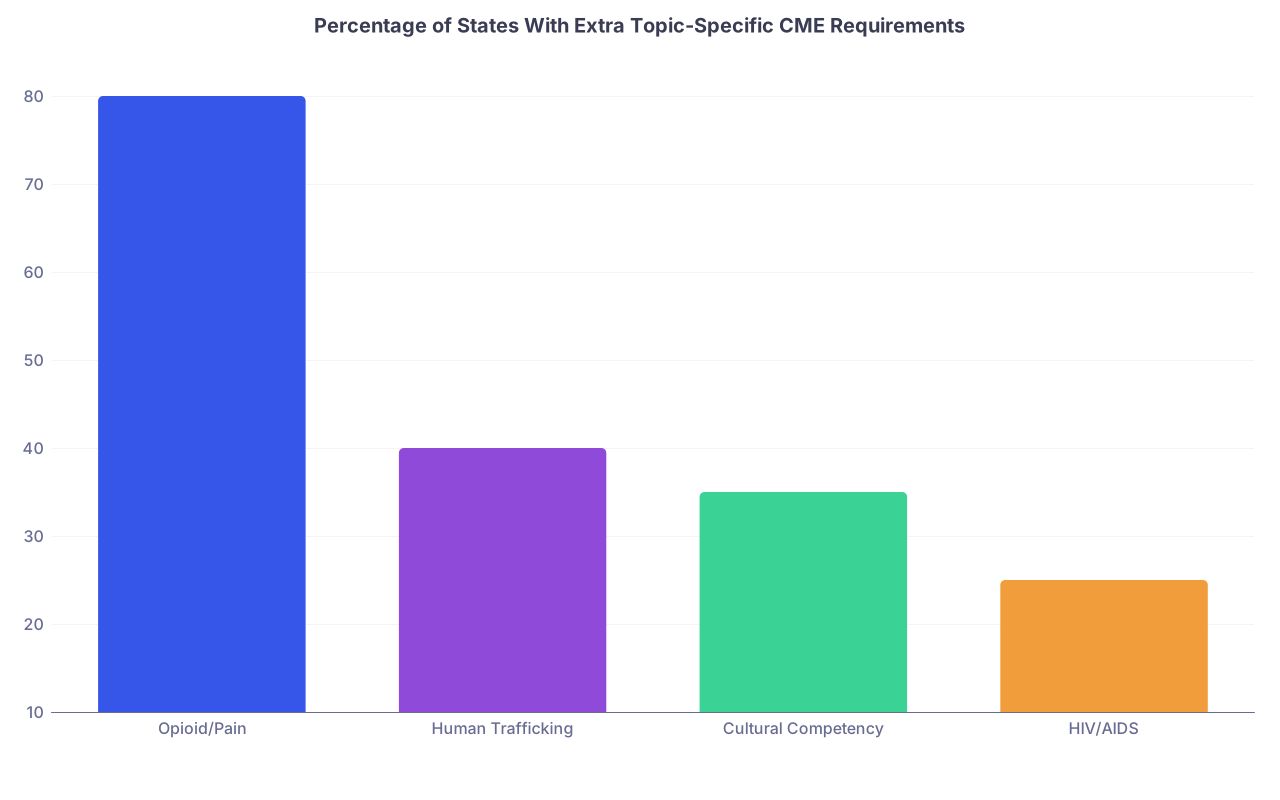
| Category | Value |
|---|---|
| Opioid/Pain | 80 |
| Human Trafficking | 40 |
| Cultural Competency | 35 |
| HIV/AIDS | 25 |
Mistake to avoid: Assuming board certification or hospital credentialing CME automatically equals licensing CME.
Do this instead:
- Go to your state medical board website, not a third‑party blog summary.
- Print or save the current renewal CME policy and literally highlight:
- Required total hours
- Required types (Category 1 vs 2, live vs online, etc.)
- Required topics and minimum hours per topic
- Any “first renewal only” or “every other cycle” rules
- If you hold multiple state licenses, build a single plan that satisfies the strictest state and confirm where overlap is allowed.
Never rely solely on what a colleague in the lounge told you. Half of them are behind on their own CME.
3. Letting CME Pile Up Until the End of the Cycle
This is the one that creates genuine panic.
You tell yourself you’ll “knock it out later.” Then:
- You’re 6 weeks from your license expiration.
- You’re short 8–15 hours, including a mandatory topic you can’t find a quick course for.
- The board wants proof of completion before approving renewal.
Now you’re trying to:
- Find immediately available online CME that meets your state’s strange sub-requirements.
- Complete dozens of hours after work or on call weekends.
- Track down certificates and transcripts from years ago.
And here comes the worst part: You do finish it all… but the provider takes a week to issue the certificates, or your board randomly audits you. License renewal stalls. HR starts emailing. Credentialing pauses. You lose clinic days.
Mistake to avoid: Treating CME like your taxes—something to cram before a deadline.
Do this instead:
- At the start of every cycle, break your CME into quarterly targets:
- Example: Need 50 hours over 2 years? Aim for 6–7 hours per quarter, plus buffer.
- Knock out mandatory topics early in the cycle so you’re not hostage to them at the end.
- Set a calendar reminder every 3–6 months: check total hours, categories, and gaps.
- Build CME into existing commitments: conferences, grand rounds, M&M conferences, hospital-required modules that actually issue accredited credit.
If you’re within 3 months of renewal and still chasing double digits of CME, you’re already in the danger zone.
4. Failing to Track and Document CME Properly
You’d be shocked how many physicians “have all their CME” but can’t put their hands on:
- Actual certificates of completion
- Official transcripts from major CME providers
- Documentation of topic content for state‑specific requirements
Boards don’t care if you remember attending the course. They care if you can prove you completed it.
Common documentation mistakes:
- Relying solely on email confirmations (“You’re registered”) instead of completion certificates.
- Losing usernames/passwords for CME portals with your history locked inside.
- Not realizing that some providers purge old records after a few years.
- Not saving PDFs of certificates the day you complete the activity.
- Assuming the board can “just look it up” from the provider. (Often, they can’t or won’t.)

Mistake to avoid: Having your CME scattered across inboxes, portals, and random paper piles with no central record.
Do this instead:
- Create a single CME master folder:
- Digital: one folder on your computer or cloud drive
- Physical: one labeled binder if you like paper
- Every time you complete CME:
- Download the certificate as a PDF
- Rename it with date_provider_topic_hours (e.g.,
2025-03-10_ACCME_Opioid_2hrs.pdf) - Drop it in that folder
- Maintain a simple CME log spreadsheet with:
- Date, provider, course title
- Credit hours and category (Cat 1/2, AMA/AAFP/AOA, etc.)
- Special tags: “opioid,” “ethics,” “cultural competency,” etc.
- File location for the certificate
If your board audits you, you should be able to assemble your documentation in under 30 minutes. If that sounds impossible today, you’re at risk.
5. Misunderstanding License Periods and CME Timing
This one is subtle and surprisingly brutal.
Many physicians assume:
- CME from any time in the last 2 years before renewal counts.
- CME they did immediately after last renewal can be applied backward.
- CME right after expiration can magically “fix” the just-ended cycle.
Boards often have very specific rules:
- CME must be completed within the exact license period (e.g., 01/01/24–12/31/25).
- CME cannot be carried forward to the next cycle (some boards allow limited carryover—but not many).
- Late renewal or reinstatement might require extra CME on top of the base requirement.
- Some boards require all CME to be done before you submit the renewal application, not after.
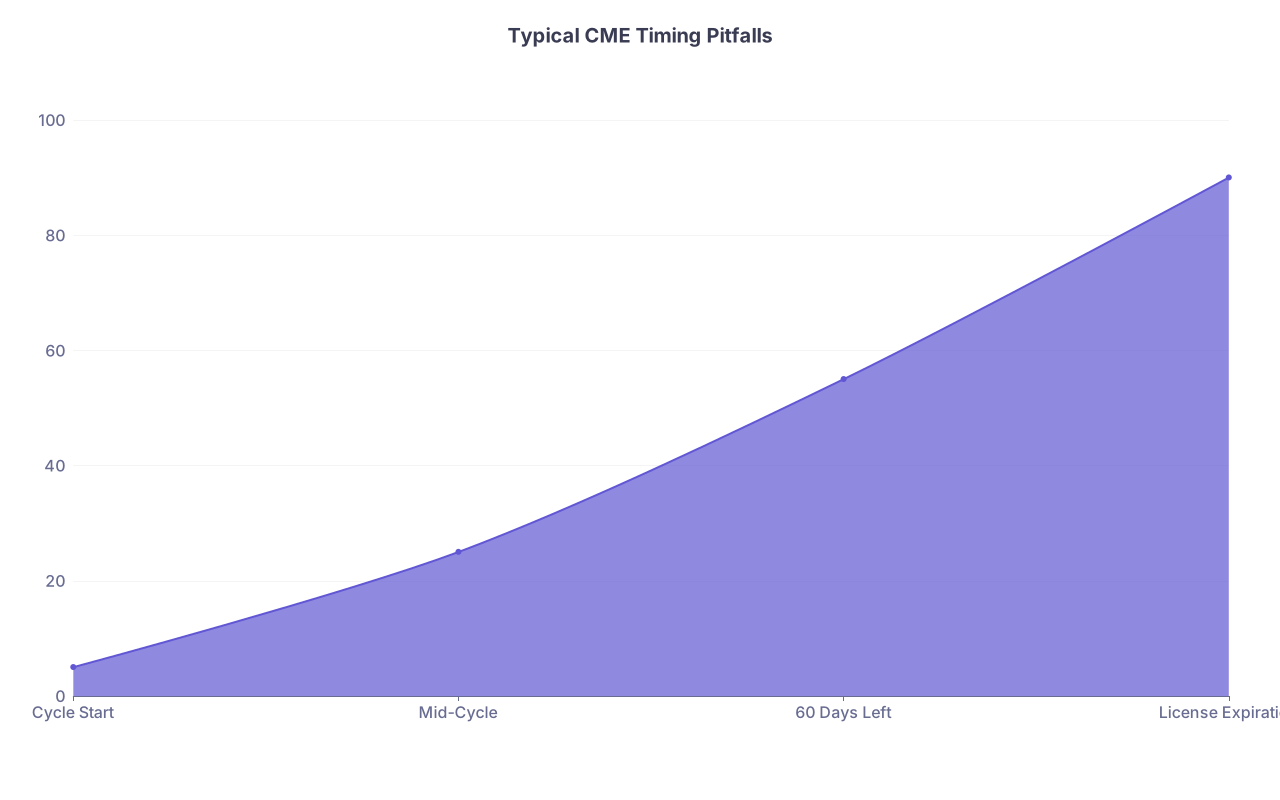
| Category | Value |
|---|---|
| Cycle Start | 5 |
| Mid-Cycle | 25 |
| 60 Days Left | 55 |
| License Expiration | 90 |
(Think of that chart as the percent of physicians who think they’re compliant vs the ones who actually are—confidence rises, then reality hits near expiration.)
Mistake to avoid: Assuming “two years of CME around my renewal” is close enough.
Do this instead:
- Confirm these specifics on your board site:
- Exact start and end dates for the CME reporting period
- Whether carryover from the last cycle is allowed
- Whether extra CME is required if you renew late or reinstate
- On your personal CME log, add a column: “License cycle.”
Don’t mix cycles. Keep each period clearly separated. - Don’t count on last‑minute CME done after your expiration to fix gaps unless the board explicitly allows it for reinstatement—and even then, expect extra conditions.
If you’re relying on fuzzy timing to make your numbers work, you’re gambling with your license.
6. Over‑Relying on Employers, Hospitals, or Boards to “Tell You”
“I thought the hospital would let me know.”
No. They might remind you of your license expiration, but they’re not your compliance babysitter.
Here’s how this goes wrong in the real world:
- You think hospital-required modules (HIPAA, fire safety, EMR training) are accredited CME. Many aren’t.
- Your group practice says, “We have a CME day,” and you assume it checks all your state-specific boxes. It probably doesn’t.
- You expect the state board to email you if your CME is off. Many only check if you’re audited or if your renewal triggers a deeper review.
The harsh truth: You are responsible. Not your employer. Not your medical group. Not your specialty board.
| Entity | Actual Role |
|---|---|
| You | 100% responsible for meeting board requirements |
| Employer | May provide CME funds/activities, not oversight |
| Hospital | Care about credentialing, not full CME details |
| Medical Board | Enforces rules, not proactive coaching |
| CME Providers | Provide credit, not state-specific guidance |
Mistake to avoid: Believing that if something is required for your job, it automatically helps your license.
Do this instead:
- Any time you complete an employer or hospital module:
- Ask explicitly: “Is this accredited CME? If so, what type and how many hours?”
- Request formal documentation, not just a screenshot of “module complete.”
- Treat employer CME as bonus, not the foundation of your compliance plan.
- Never assume your state board will correct you in real time. Their “correction” may be a denied renewal, not a friendly warning.
If you end up short, “my hospital never told me” will not move the board.
7. Treating Renewal as a One‑Step, Last‑Minute Click
Too many physicians think renewal is: log in → pay fee → done.
Here’s what really causes delays:
- Address or practice details outdated, triggering extra verification.
- Missing or incomplete CME attestation or documentation upload where required.
- Not realizing the board needs processing time—sometimes weeks.
- Being randomly selected for CME audit, and you’re not ready.
- Answering “yes” to new disclosure questions (discipline, malpractice, health) without documentation ready, which slows processing.
Now combine that with CME gaps and bad documentation and you’ve just walked yourself into a perfect storm.
Mistake to avoid: Starting your renewal the week of expiration and assuming instant approval.
Do this instead:
- Start the renewal at least 30–60 days before your license expiration.
- Before you even log in:
- Confirm you’ve met all CME totals and categories.
- Ensure your CME documentation folder is complete and organized.
- Have your CME summary/log ready to reference.
- Expect that your renewal might:
- Ask specific yes/no questions about CME compliance.
- Trigger an audit request (random, not personal).
- Require upload of CME certificates or a consolidated transcript.
If renewal is tonight’s emergency project, you’re already exposing yourself to unnecessary risk.
A Quick Reality Check: Are You Quietly Headed for Trouble?
Do a blunt self-audit right now. If any of these are true, your license renewal is more fragile than it looks:
- You couldn’t, in under an hour, produce organized documentation of all CME from this cycle.
- You’re not entirely sure what state-specific CME topics your board mandates.
- You’ve been counting non-accredited or poorly documented activities as CME.
- You’re within 6 months of renewal and haven’t confirmed your total hours by category.
- You’re licensed in multiple states but only planned CME around one set of rules.
If you checked even one box, fix it now—when you still have time to be methodical instead of desperate.
The 3 Things You Actually Need To Do
Strip away the noise and the CME industry marketing, and avoiding license‑renewal delays really comes down to three disciplined habits:
Know your exact rules.
State board. License type. Required totals and topics. No guessing. No “I heard.”Track as you go.
One folder. One log. Every certificate saved immediately. If you can’t find it in 5 minutes, for compliance purposes it doesn’t exist.Stay ahead of the clock.
Quarterly progress checks. Mandatory topics done early. Renewal started at least a month before expiration.
You do not want your license renewal to be exciting. You want it to be dull, predictable paperwork backed by airtight CME records. Avoid these seven mistakes and that’s exactly what it will be.