
The biggest mistake doctors make with CME is assuming every credit counts twice automatically. It does not.
If you want to reuse CME credits for both state medical licensure and board Maintenance of Certification (MOC), you need to understand three things: the source of the CME, the type of credit, and the rules of your specific state and board. Once you get those right, you absolutely can “double dip” a large portion of your CME—legitimately.
Let me walk you through how this actually works in real life.
Short answer: Yes, but only if the CME meets both sets of rules
Here’s the clean, direct answer:
You can usually use the same CME activities to satisfy both:
- Your state medical license CME requirements, and
- Your specialty board’s MOC CME requirements
…as long as:
- The activity is accredited appropriately (ACCME, AOA, etc.).
- Your state accepts that type of credit.
- Your board counts that activity or credit type toward its MOC (and you’ve claimed/reported it correctly).
Where people get burned is assuming “CME is CME.” It isn’t.
Some CME is:
- Fine for state licensure but useless for MOC.
- Great for MOC but does not satisfy specific state topics (opioids, ethics, pain, implicit bias, etc.).
- Not recognized at all because it lacked proper accreditation.
So the right mindset is: one activity, two uses—but only if it’s compatible with both systems.
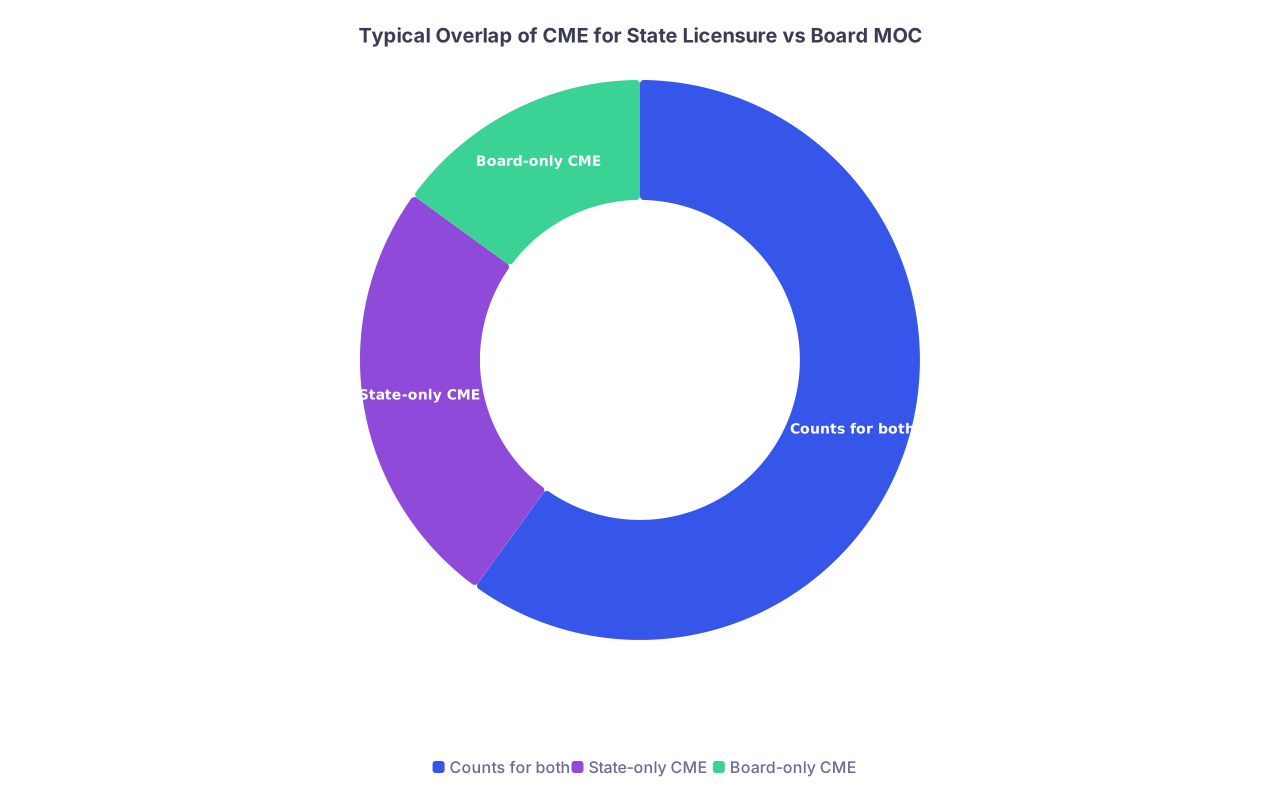
| Category | Value |
|---|---|
| Counts for both | 60 |
| State-only CME | 25 |
| Board-only CME | 15 |
How reuse actually works in practice
Think of CME credits as a currency with different “acceptance rules.”
You do an online course or live meeting. That generates some form of CME credit.
Then your:
- State medical board looks at: total hours, renewal period, required topics, accepted accreditation.
- Specialty board looks at: is it ACCME/AMA PRA Category 1 Credit™? Does it have MOC “points” attached? Does it meet a specific part of the MOC program?
If that one activity meets both sets of rules, you can absolutely apply it toward both requirements in the same cycle. No ethical issue. No regulatory issue. That’s exactly how many physicians stay sane.
Where it breaks:
- Your state needs, for example, 3 hours of opioid prescribing from state-approved courses only.
- Your board just needs general Category 1 CME in your specialty.
If you take a generic pain management CME that isn’t on the state’s approved opioid list, your board will likely accept it, but your state may not.
A simple example
You’re an internist in Texas, board-certified by ABIM.
You take:
- A 2-hour ACCME-accredited online course on diabetes updates with ABIM MOC points attached.
Result:
- State of Texas: Likely counts as AMA PRA Category 1 Credit™ toward your general CME requirement.
- ABIM: Counts as both CME and ABIM MOC Medical Knowledge points (assuming the activity is registered for that).
Same 2 hours. Two uses. Completely legitimate.
Now compare that to:
- A 2-hour unaccredited dinner talk sponsored by industry with no ACCME accreditation.
Result:
- State: probably does not count.
- ABIM: definitely does not count.
So yes, you can reuse—but only if you choose the right CME.

Key rules: state licensure vs board MOC
Let’s separate the two systems so you see how they overlap.
State medical license CME
States care about:
- Total hours (e.g., 50 hours every 2 years, 100 every 3 years, etc.).
- Period covered (license renewal cycle).
- Content/mandated topics (opioid prescribing, pain management, human trafficking, implicit bias, cultural competency, ethics/jurisprudence, child abuse, etc.).
- Accreditation source (ACCME, AOA, AAFP, state medical society, etc.).
- Documentation (certificates, transcripts, attestation, random audits).
Each state is different, and some are picky:
- Some require specific courses from state-approved lists.
- Some require a portion of CME to be “live” or interactive.
- A few states accept board certification/MOC in lieu of some or all CME, but not all.
Board MOC CME
Boards (ABIM, ABFM, ABS, ABP, ABOG, etc.) care about:
- Credit type: typically AMA PRA Category 1 Credit™ or equivalent.
- Whether it’s registered for “MOC points” (for many ABMS boards).
- Activity format: CME only vs performance improvement (PI), quality improvement, or assessment activities.
- Time frame aligned with your MOC cycle.
Different boards, different quirks:
- ABIM: Many CME activities offer ABIM MOC Medical Knowledge points. PI activities count toward separate requirements.
- ABFM: Wants both knowledge activities and performance improvement.
- Surgical boards: Often require specific operative or practice-related activities in addition to general CME.
Bottom line: general educational CME with ACCME accreditation often works for both—but specialty boards and states layer additional criteria on top.
| CME Type | State License Likely? | Board MOC Likely? |
|---|---|---|
| ACCME CME with no MOC points | Often yes | Sometimes |
| ACCME CME with ABMS MOC points | Often yes | Yes (for that board) |
| State-specific opioid course | Yes (if required) | Maybe/rare |
| Non-accredited industry talk | Usually no | No |
When you can reuse CME (and when you can’t)
Common situations where reuse works well
These are the sweet-spot scenarios where you absolutely should double-count:
ACCME-accredited online CME with ABMS MOC points
- Example: A cardiology update course labeled “20 AMA PRA Category 1 Credits™; offers ABIM MOC points.”
- Use it for: your state’s general CME requirement + your ABIM MOC points.
Conferences or society meetings with proper accreditation
- ACC, ACR, AAN, ACOG, CHEST, ASCO, etc.
- Most big meetings are ACCME-accredited and many are registered for multiple boards’ MOC.
- Those hours can usually go straight into both your license renewal log and your MOC portfolio.
Hospital or health system CME that’s ACCME-accredited
- Many larger systems are accredited CME providers.
- If they attach board MOC to grand rounds or QI projects, that’s easy double use.
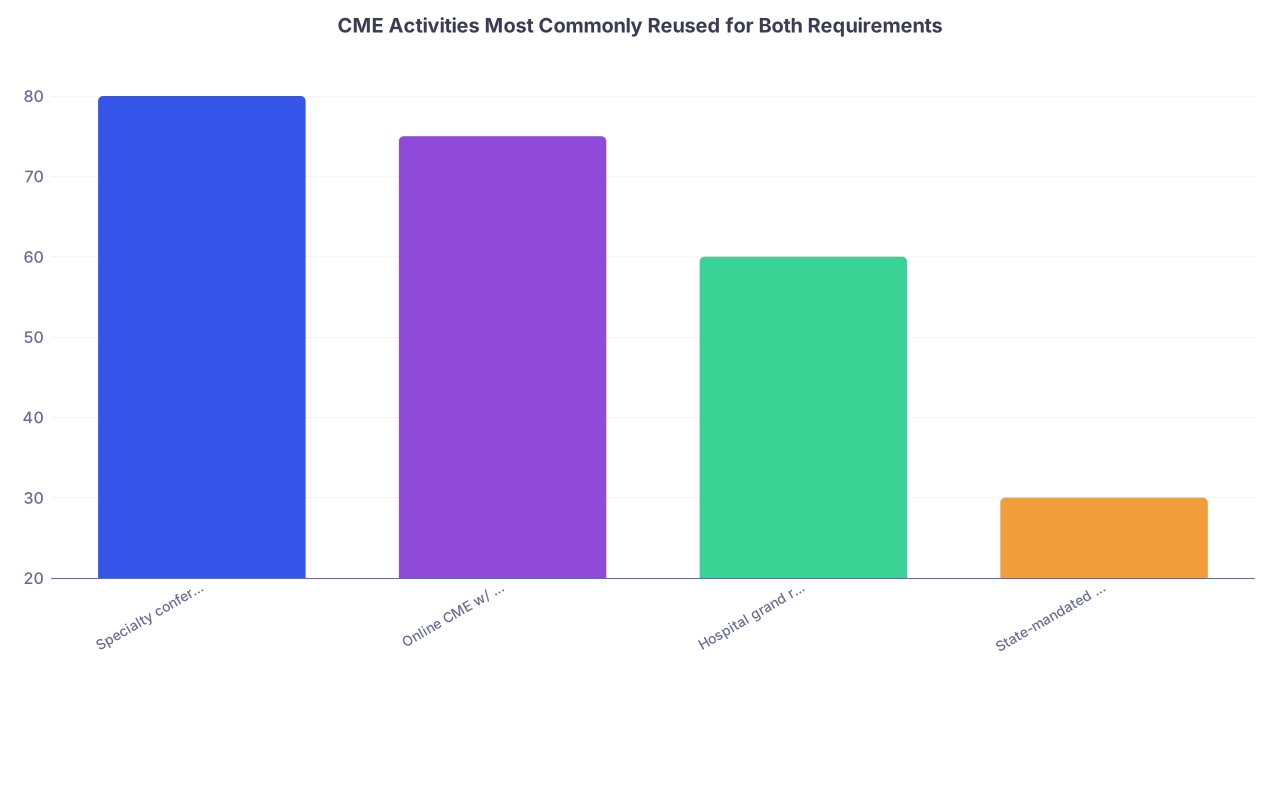
| Category | Value |
|---|---|
| Specialty conferences | 80 |
| Online CME w/ MOC | 75 |
| Hospital grand rounds | 60 |
| State-mandated topics | 30 |
Situations where reuse is limited or fails
State-mandated, narrow-topic courses
- Example: “3 hours opioid prescribing from a state-approved list.”
- Your board might accept it as generic CME, but rarely as a specific MOC activity.
- It still “counts twice” in total hours, but it doesn’t usually move specific MOC requirement needles (like PI, self-assessment, etc.).
Board-specific QI/PI projects
- Example: ABFM or ABIM performance improvement modules tied directly to your practice metrics.
- States often do not care about PI versus regular CME. Many states treat it simply as general CME, and some do not formally distinguish it at all.
- It can count as hours but may not satisfy any special state-topic requirement.
Non-accredited learning
- Reading UpToDate, guidelines, journal articles informally.
- Unless you’re claiming CME through a system that grants official credit (e.g., UpToDate CME), it usually doesn’t count anywhere.
How to set yourself up to reuse credits effectively
If you plan ahead, you can make a huge portion of your CME pull double duty.
Step 1: Know your numbers and requirements
You should be able to answer, for your current cycle:
State license:
- How many total hours?
- Over what time frame?
- Any specific content requirements (opioid, ethics, etc.)?
- Any requirement for “live” or “interactive”?
Board MOC:
- How many CME or MOC points this cycle?
- Any required breakdown (knowledge, practice assessment, QI)?
- Any high-stakes assessment or longitudinal exam tied to CME?
Write this down once. Keep it in your notes app. It saves you from guessing later.

| Step | Description |
|---|---|
| Step 1 | Identify State Requirements |
| Step 2 | Identify Board MOC Requirements |
| Step 3 | Choose CME Activities |
| Step 4 | Track for Both State and Board |
| Step 5 | Use for Single Requirement Only |
| Step 6 | Save Certificates and Logs |
| Step 7 | ACCME and MOC eligible? |
Step 2: Choose CME that clearly supports both
Look for CME that says things like:
- “ACCME-accredited; AMA PRA Category 1 Credit™”
- “This activity offers MOC points for ABIM/ABFM/ABP/etc.”
If you see:
- “Enduring material, non-accredited” or
- “For educational purposes only, no credit offered”
…skip it unless you’re doing it purely for your own learning.
Step 3: Track credits in a way that separates hours from requirements
Here’s what I’ve seen work best:
- Maintain a simple spreadsheet or use a CME tracker.
- For each activity, record:
- Date
- Provider/Platform
- Number of credits
- Type (Category 1, PI, ABIM MOC, opioid, ethics, etc.)
- Where you used it (state, board, both)
Then, when it’s time to renew:
- For your state: pull total hours + any specific topic credits.
- For your board: log into their portal and make sure those same activities (if MOC-eligible) are showing up.
If you ever get audited by the state, you’re not frantically digging through email.

Common traps and misconceptions
Let me cut through some bad assumptions I hear all the time.
“If it has MOC points, my state must accept it.”
Wrong.
States do not care about “MOC points.” They care about:
- Is it CME?
- Is it accredited?
- Does it meet our topic requirements?
MOC is a board system, not a state system. Overlap exists, but it’s not guaranteed.
“If my board accepts it, I’m safe everywhere.”
Also wrong.
Boards and states are separate authorities. You can be in good standing with your board and still be out of compliance with a state’s opioid training rule or ethics requirement.
“My state accepts board certification instead of CME, so I’m done.”
Sometimes true, often dangerous.
A few states say: if you maintain ABMS board certification, we treat that as meeting CME. But:
- That can change with legislation or rule updates.
- Some states accept board certification only partially or only for certain categories.
- You still might need state-specific content (e.g., opioid prescribing law course).
Always read the current wording on your state medical board site. Do not rely on hallway hearsay.
“I can use the same activity across multiple cycles.”
Usually no.
CME has to fall within the specific date window for the cycle:
- State renewal period (e.g., 2024–2026).
- Board MOC cycle (e.g., 10-year or continuous 5-year segments).
You generally cannot reuse the same 2022 course for your 2028 renewal, even if it was great.

How to check if a specific CME can be reused
If you have a particular activity in mind and want to know if it can count for both:
Look at the accreditation statement on the activity page or certificate.
- You want to see ACCME accreditation or equivalent and AMA PRA Category 1 Credit™ (or AOA Category 1-A for DOs, etc.).
Look for any explicit mention of MOC.
- “This activity is approved for ABIM MOC points” or similar language.
- If not listed, it may still count as plain CME for your board, but not automatically as MOC points.
Compare the activity to your state’s specific rules.
- If the activity is a general clinical update, it probably works as general CME.
- If you need a specific state-mandated topic, confirm the activity matches that requirement (and in some states, must appear on an approved list).
When in doubt, email either:
- The CME provider (ask: is this ACCME-accredited and does it offer MOC points?), or
- Your state board / specialty board (brief, specific question with link to the activity).
FAQ: Reusing CME for State Licensure and Board MOC
1. Can I use the same CME hours for both my state license renewal and my ABMS board MOC?
Yes, in many cases you can. If the activity is properly accredited (e.g., ACCME, AMA PRA Category 1 Credit™) and your state accepts it as CME, those same hours can usually be applied toward your board’s MOC requirements—especially if the activity is registered for MOC points. Just make sure the credits fall within both required time windows.
2. Do state medical boards recognize “MOC points” directly?
No. States recognize CME, not “MOC points.” When an activity offers MOC points, that’s a board-side feature layered on top of regular CME. Your state only cares that the CME is accredited and meets any required topics or hour counts. MOC status does not automatically give it special recognition with the state.
3. If my state requires opioid or pain management CME, can those hours also count toward my board MOC?
Sometimes. If the opioid or pain management course is ACCME-accredited and offers AMA PRA Category 1 Credit™, your board will often accept it as regular CME, and some activities also grant MOC points. But state-specific opioid courses chosen only from a state-approved list might not be registered with your board for MOC. In that case: yes for state, maybe for MOC.
4. Do boards ever accept non-accredited CME for MOC?
Generally no. ABMS boards and AOA boards expect accredited CME from recognized providers (ACCME, AOA, etc.). Informal learning—like reading articles without claiming CME, unaccredited industry talks, or random online content—does not count toward formal MOC requirements. If there’s no certificate or transcript from an accredited provider, assume it will not count.
5. If my state says board certification satisfies CME, do I still need to track individual CME activities?
You should. Even if your state temporarily accepts active ABMS/AOA board certification as proof of ongoing education, rules can change, and some states still require specific topic-based CME (opioids, ethics, implicit bias) regardless of board status. Your board may also audit or require documentation of certain MOC activities. Keeping a basic log and certificates protects you on both fronts.
6. How can I maximize reuse of CME for both requirements without overcomplicating things?
Three steps: pick ACCME-accredited activities that explicitly offer MOC points when possible; keep a simple running list of what you’ve completed (date, credits, type, where used); and check your state and board requirements once a year so you’re targeting any special topics early. If you do this, most of your CME will pull double duty for license renewal and MOC with no last-minute scramble.
Key points:
- Yes, you can reuse many CME activities for both state licensure and board MOC—if they’re properly accredited and align with both sets of rules.
- States care about CME hours, topics, and accreditation; boards care about accredited CME and whether the activity is linked to their MOC system. Plan ahead so your CME hits both targets at once.