

The way most physicians handle CME when they move into administration is backwards.
They keep collecting clinical credits they barely use, while the skills they actually need—finance, quality, leadership, strategy—get treated as optional “extras.” That mismatch will hurt you. In your credibility, in your effectiveness, and eventually in your career options.
If you’re shifting out of day‑to‑day clinical work and into administration, you need to treat your CME plan like a complete rebuild, not a tweak.
Here’s how to do it—step by step, and without blowing up your license or your sanity.
Step 1: Get Clear on Your New Reality (Before You Touch CME)
Do this before you sign up for a single course.
You’re not just “a doctor who goes to more meetings” now. Your risk profile, your visibility, and your mistake tolerance just changed.
You’re moving from:
- Individual patient risk → Organizational risk
- Single decision impact → System-level impact
- Personal time management → Other people’s time, budgets, and careers
You probably recognize this scenario:
You’re now the Associate CMO, Program Director, Service Line Director, or “Medical Director of Something Vague but Important.” You still see some patients, but now you’re:
- In budgeting meetings where people throw around “EBITDA,” “RVU targets,” and “payer mix” like everyone was born knowing them
- Getting asked to “own” quality metrics you did not design
- Expected to lead clinicians who are skeptical, burned out, or both
- On email threads with legal, compliance, risk, and C‑suite people you’ve never met
That’s the real job. Your CME needs to match that job, not the job you had five years ago.
So first, answer these three questions bluntly:
- How much clinical work will you realistically be doing in 12–24 months?
- What are you actually accountable for now (by your job description and by unspoken expectation)?
- Who’s in the room where decisions are made—and what do they know that you do not?
Write down the answers. They’re going to drive your CME decisions.
Step 2: Separate “License Maintenance” CME From “Career Building” CME
Most physicians blur these, which is why they end up with piles of low‑yield credits.
You need two separate tracks:
- Minimum clinical CME to stay licensed and board‑certified
- Strategic CME to make you competent and credible in administration
For the first track, this is a box-checking exercise. For the second, it’s career-defining.
Know Your Numbers (Rough Benchmarks)
Every jurisdiction and board is different—yes, check your specific requirements—but here’s the general pattern I see:
| Type | Typical Requirement |
|---|---|
| State license CME | 20–50 credits every 1–2 years |
| Specialty board MOC | 25–50 CME/yr + exams/activities |
| DEA/substance-specific | 8–12 hours per renewal cycle (varies) |
| Risk/ethics modules | 1–4 credits per cycle (state-dependent) |
You need to know:
- Your state CME requirements (number of hours, mandated topics like opioids, pain, implicit bias, etc.)
- Your board CME and MOC requirements (and whether they care about content being specialty‑specific)
- Any institutional requirements (e.g., mandatory corporate compliance or risk modules that also count as CME)
Once you know the floor for clinical CME, you protect that floor with low-friction options: on‑demand modules, cheaper virtual conferences, and existing hospital offerings.
Then you free your remaining time and money for the second track: leadership and administrative CME.
Step 3: Redefine What “Counts” as Valuable CME For You Now
If you’re staying in administration for more than a year, the highest-yield “CME” for you is not another update on sepsis guidelines. It’s:
- Reading a P&L and actually knowing what you’re looking at
- Understanding payer contracts and why your surgeons are yelling about case mix
- Knowing what your quality dashboard really measures—and what it hides
- Leading an angry group of clinicians through change without burning the place down
Plenty of programs that cover those topics now offer AMA PRA Category 1 Credits. Historically they didn’t, which is why many physicians still think “leadership” or “business” courses don’t count as CME. That’s outdated.
You want educational activities that hit at least one of these buckets:
Leadership and Organizational Behavior
- Leading change
- Difficult conversations
- Running effective meetings
- Coaching and feedback
- Conflict management with high‑autonomy professionals
Quality, Safety, and Process Improvement
- Lean/Six Sigma basics (but translated into clinical language, not factory jargon)
- Root cause analysis, safety event review
- Measurement, dashboards, run charts
- Reliability, standard work, clinical pathways
Health Care Finance and Strategy
- RVUs, contribution margin, overhead
- Service line development
- Value-based care basics
- Payer mix, contracts, and denial patterns
Legal, Regulatory, and Risk
- EMTALA, Stark, Anti‑Kickback basics
- Documentation and coding risk
- Peer review structures
- Credentialing and privileging
Those are the CME areas that will actually save your neck in meetings and keep you from nodding along while having no idea what’s going on.
Step 4: Build a 2–3 Year CME Plan That Matches Your Transition
You’re not just answering “what conference should I go to this year?” You’re managing a transition arc.
Let’s take three common situations and I’ll show you how I’d structure CME differently for each.
Scenario A: 80% Clinical → 20% Admin (Early in Transition)
You’re still mostly clinical, picking up your first admin role (medical director of a unit, small committee chair, assistant PD).
CME priorities:
- Keep clinical CME strong—your clinical reputation still drives your credibility
- Add one serious leadership or quality course rather than a dozen short fluff webinars
Example mix for a year:
- 20–30 credits: Your usual specialty conference + journal-based CME
- 10–15 credits: A foundational leadership/quality program (many are 10–20 CME credits across modules)
- Required: Any state opioid/ethics modules, hospital compliance, etc.
Scenario B: 50% Clinical → 50% Admin (Middle of the Shift)
You’re now formally splitting your time. You’re in more system meetings, maybe supervising people, maybe overseeing a project or service line.
CME priorities:
- Maintain minimum viable clinical currency, not peak specialty mastery
- Go heavy into quality, operations, and people leadership
- Pick one major in‑depth program instead of three shallow ones
Example mix:
- 15–20 credits: Targeted clinical updates + required board/state content
- 20–30 credits: Leadership/management/quality courses—ideally longitudinal, with coaching, not just lectures
- Optional: Intro health care finance course if you’re touching budgets
Scenario C: 10–20% Clinical → 80–90% Admin (You’re Basically an Administrator Now)
You might still hold clinic or do call to keep your hand in, but your calendar is meetings, strategy, and oversight.
CME priorities:
- Satisfy license and board requirements with lowest time-cost methods
- Treat yourself like an executive who happens to need CME, not the other way around
- Go deep on finance, strategy, system redesign, and high-level leadership
Example mix:
- 10–15 credits: Efficient clinical CME (journal CME, on-demand specialty modules, short virtual updates)
- 25–35 credits:
- A certificate or mini‑MBA‑style program in health care management, or
- An advanced quality improvement/Lean leadership academy, or
- A formal physician leadership institute
Step 5: Use the Right Formats (Stop Defaulting to Conferences)
Admin work changes the kind of learning that actually sticks.
Traditional conferences are:
- Expensive
- Travel-heavy
- Mostly passive listening
- Biased toward clinical content
You need more:
- Longitudinal programs with projects
- Small‑group leadership training
- Case‑based workshops on real administrative scenarios
Here’s how I’d split formats:
Annual or biennial in‑person event:
- One leadership or quality program with workshops and networking (e.g., a physician leadership institute, ACHE Congress, quality and safety conference with project work)
Quarterly online modules or short courses:
- Finance, HR basics, communication skills, process improvement mini‑courses
Ongoing project-based learning:
- Many organizations will give CME for leading or participating in QI projects, especially if there’s a formal curriculum attached
You want learning that forces you to apply new skills in your actual workplace. Not just sit and collect slides you’ll never open again.
Step 6: Negotiate Support and Alignment With Your Organization
Here’s where a lot of people screw this up. They quietly pay for admin-focused CME out of pocket, while their institution happily funds purely clinical conferences that don’t help the organization one bit.
If your role is at least 30–40% administrative, your admin‑relevant CME is part of your job. Treat it that way.
Have a grown‑up conversation with whoever controls your budget—CMO, department chair, service line VP. Use language they care about:
- “To be effective in this role and hit the metrics we’re accountable for, I need formal training in X.”
- “This program specifically covers [quality/finance/leadership] and includes a project I can tie directly to our [readmissions, length of stay, throughput] goals.”
- “Here’s a side‑by‑side of a $3,000 clinical conference vs. a $3,000 leadership/quality program, and which organizational problems each addresses.”
You can even literally compare options:
| Feature | Specialty Clinical Conference | Physician Leadership Program |
|---|---|---|
| CME Type | Mostly clinical | Leadership/quality/finance |
| Organizational Impact | Low to moderate | Moderate to high |
| Project Component | Rare | Common |
| Cost (approx.) | $2,000–$3,500 | $2,500–$4,000 |
| Travel Required | Often | Often optional/virtual |
You’re not begging for a perk. You’re asking for training to do the job they gave you without winging it.
Step 7: Protect Your Clinical Legitimacy—But Stop Overdoing It
The fear is real: “If I stop going to the big specialty meeting, everyone will think I’m not a real doctor anymore.”
Here’s the reality I’ve seen in multiple hospitals:
- Your clinical colleagues care more that you’re present, fair, and not clueless than whether you attended the latest massive conference in Vegas.
- You do not lose all credibility the moment you shift half your CME into leadership and quality.
- You do lose credibility if you’re making decisions about length of stay, on‑call structure, or clinic flow and you clearly have no idea how the work actually happens.
So:
- Keep some clinical CME that keeps you conversant in your field. One solid update conference every 2–3 years plus steady journal CME is often enough if you’re still practicing part‑time.
- Be transparent: “I’ve shifted my CME toward leadership and quality so I can better support you all in X, Y, Z.” Most reasonable clinicians will respect that.
You’re not abandoning medicine. You’re moving up a level in the system that supports it.
Step 8: Track and Bundle Smartly So You’re Not Scrambling at Renewal Time
Admin jobs are overloaded with email and meetings. CME tracking becomes an afterthought until you’re staring at a renewal deadline.
Do it differently:
Pick one tracking system and stick to it
- A spreadsheet
- Your specialty board’s portal (many let you upload “other” CME)
- A commercial CME tracker
Create two simple tags for every activity you log:
- “Clinical” vs “Admin/Leadership”
- “State-required topic” if applicable (opioid, ethics, cultural competence, etc.)
Once a quarter, spend 15 minutes:
- Log credits
- See if you’re off balance (too clinical, not enough leadership CME, or vice versa)
- Adjust your next quarter accordingly
You should also deliberately stack:
- State-required modules combined with leadership content (e.g., CME on opioid prescribing that also touches system-level protocols and quality)
- MOC activities that count for both your board and your state license
- QI work that counts as CME, MOC Part IV, and organizational project time
If it is not serving at least two purposes (license, board, job performance, promotion, internal credibility), think twice before doing it.
Step 9: Build a Personal “Admin Curriculum” Instead of Random Credits
You’ll advance faster if you think of your CME as a curriculum, not an annual scavenger hunt.
Example 3‑Year Arc for a Physician Moving Into Administration:
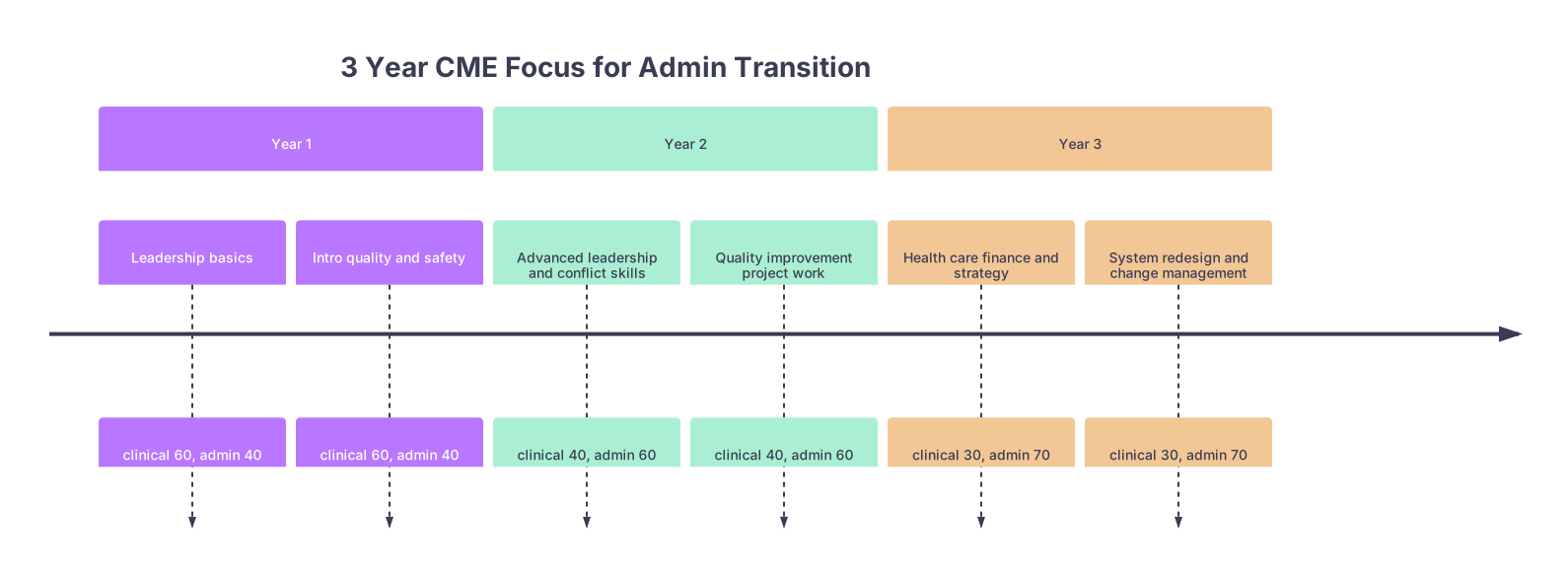
| Period | Event |
|---|---|
| Year 1 - Leadership basics | clinical 60, admin 40 |
| Year 1 - Intro quality and safety | clinical 60, admin 40 |
| Year 2 - Advanced leadership and conflict skills | clinical 40, admin 60 |
| Year 2 - Quality improvement project work | clinical 40, admin 60 |
| Year 3 - Health care finance and strategy | clinical 30, admin 70 |
| Year 3 - System redesign and change management | clinical 30, admin 70 |
You want to come out of those three years being able to say confidently:
- “I understand how our hospital actually gets paid.”
- “I can lead a multidisciplinary project from idea to implemented change.”
- “I know the basics of quality measurement and can tell a good metric from garbage.”
- “I can sit in a room with finance, operations, and clinicians and not feel like the least prepared person there.”
That is what shifting your CME priorities buys you.
Step 10: Avoid the Common Traps
Let me be blunt about the mistakes I see over and over.
The “Ghost Clinician” Trap
You’re 80% admin but still spending 80% of CME on niche clinical topics. You’re essentially training for a job you no longer have. Fix: align CME with your actual calendar and performance goals.The “All Leadership Is Equal” Delusion
Many leadership CME offerings are fluff: inspirational talks, zero practice, no feedback. If you’re not uncomfortable or applying it to real work, you’re probably not growing. Fix: look for programs with coaching, projects, or small-group practice.The “I’ll Just Learn It On the Job” Fantasy
That’s how you end up making amateur mistakes in finance, HR, or quality that haunt you for years. You would never accept “I’ll learn it on the job” as a plan for inserting central lines. Don’t do it with multi-million-dollar system decisions.The “I Don’t Want to Ask for Money” Problem
You quietly fund your own admin CME while the organization benefits from your improved skills. Fix: tie your CME plans explicitly to institutional metrics and negotiate it like part of your job description.
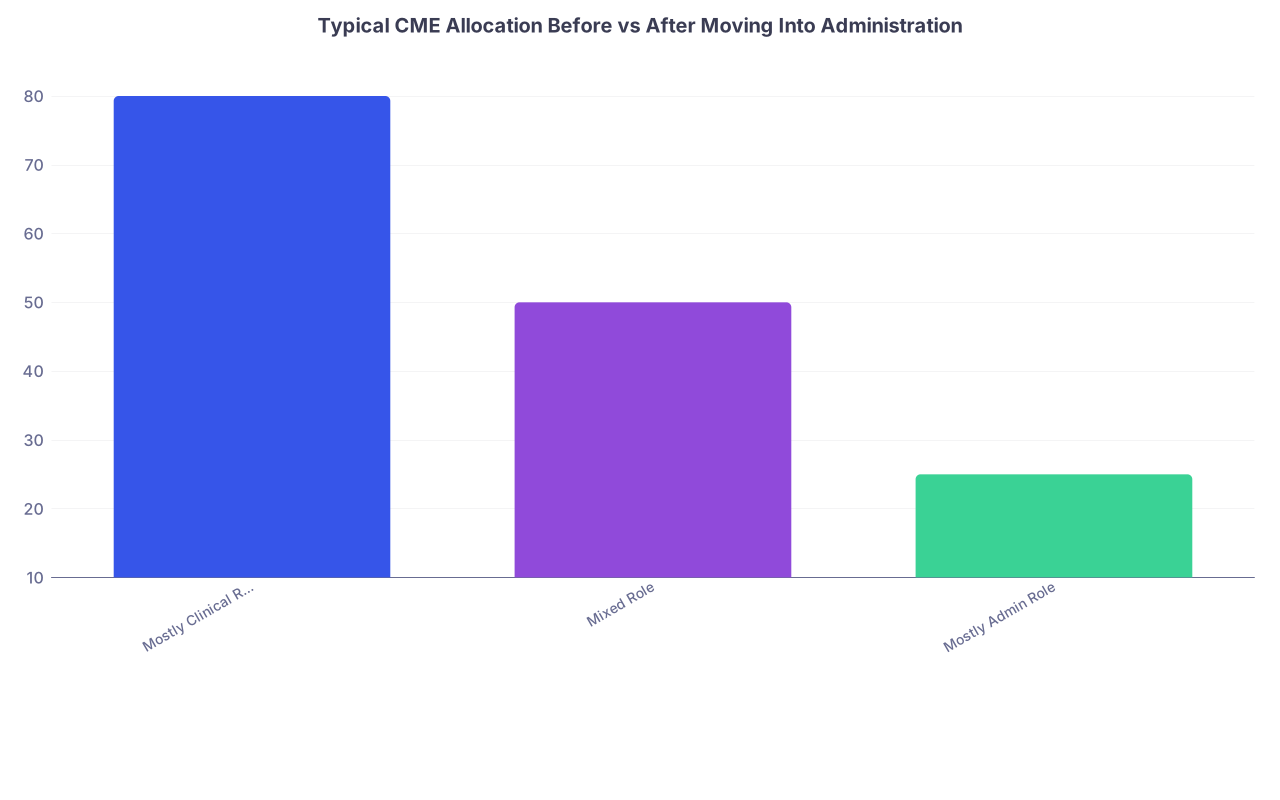
| Category | Value |
|---|---|
| Mostly Clinical Role | 80 |
| Mixed Role | 50 |
| Mostly Admin Role | 25 |
(Interpretation: as administrative responsibilities increase, the proportion of CME that’s purely clinical should drop, with the remainder shifting to leadership, quality, and management content.)
The Bottom Line
If you’re moving into administration, you cannot just re‑up your old CME habits and hope it works out.
Three things to remember:
- Protect the floor: Know your exact license and board requirements, meet them efficiently, and stop over‑investing in clinical CME that doesn’t match your actual role.
- Invest in the new job: Shift a growing share of your CME into leadership, quality, finance, and system-level skills. Treat it as a serious curriculum, not “extra.”
- Make your organization pay attention: Align your CME with their metrics and your formal role. Then negotiate support—because this isn’t a perk. It is you learning how not to fail in the job they just gave you.


