
The biggest misconception about opioid CME is that it is “one thing.” It is not. It is fifty-plus different regulatory experiments that all happen to use the word “opioid.”
Let me break this down specifically, because this is where physicians get burned: you do not have an “opioid CME requirement.” You have a Florida opioid CME requirement. Or a Pennsylvania opioid CME requirement. Or a multi‑state, overlapping, slightly insane opioid CME situation if you hold several licenses.
Why states care about opioid CME at all
States did not wake up one day and decide “everyone needs 2 hours of pain CME.” They moved after three things converged:
- Escalating opioid overdose deaths and diversion.
- Federal pressure (CDC guidelines, DOJ attention).
- High‑profile cases in their own backyard—pill mills, mega‑prescriber prosecutions, Board horror stories.
So legislatures and medical boards did the one thing they reliably know how to do: pass training mandates.
The ethics angle is not cosmetic. Almost every state rule explicitly or implicitly tries to push you toward:
- Better risk–benefit analysis.
- Tighter documentation.
- Prescribing as a last resort for chronic non‑cancer pain.
- More emphasis on consent, monitoring, and tapering.
But they implement that with wildly different knobs: hours, frequency, topics, first‑time vs renewal, and which professions are included.
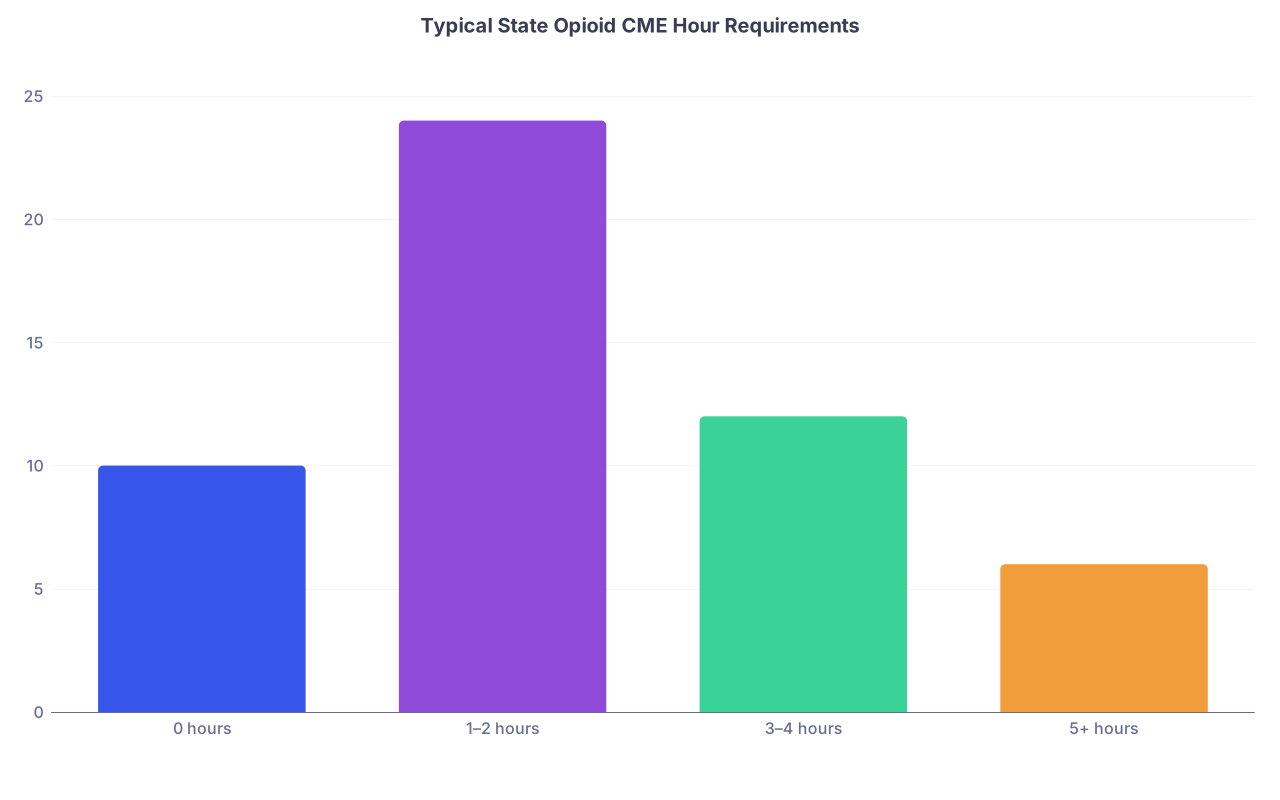
| Category | Value |
|---|---|
| 0 hours | 10 |
| 1–2 hours | 24 |
| 3–4 hours | 12 |
| 5+ hours | 6 |
The basic building blocks of opioid CME rules
Before we get into states, you need the taxonomy. Almost every state prescription‑opioid rule is some combination of:
- Who: MD, DO, NP, PA, dentists, podiatrists. Some rules are physician‑only; others hit any prescriber with a DEA registration.
- When: one‑time (e.g., at first renewal) vs recurring (every cycle) vs initial license only.
- How much: from 1 hour to 8+ hours per cycle.
- What content:
- Safe opioid prescribing.
- Pain management fundamentals.
- Substance use disorder recognition/treatment.
- PDMP use.
- Ethics/professional boundaries.
- Sometimes very specific (e.g., Florida’s “controlled substance prescribing” course).
- How delivered:
- “Board‑approved” vs any accredited CME.
- Live vs enduring materials (most now allow online).
- How documented:
- Self‑attested at renewal.
- Named course ID (Florida, for example).
- Random audits with certificate production.
If you are smart, you pick CME that kills multiple birds: meets multiple state requirements and satisfies general risk management or DEA‑related expectations.
Five archetypes of state opioid CME rules
Most states fall into one of these patterns. Knowing which archetype you live in saves you time.

1. The “license plus DEA” states
These states tie opioid CME to prescribing authority (DEA registration, controlled substance license, or Schedule II authority). Examples include:
- Some New England states.
- A few Midwestern boards that say: if you prescribe opioids, you must complete X hours.
Typical structure:
- 2–3 hours per renewal cycle.
- Must cover:
- Safe opioid prescribing (acute vs chronic).
- CDC guideline concepts: lowest effective dose, shortest duration.
- Risk assessment tools (ORT, SOAPP, etc.).
- Treatment of opioid use disorder (OUD)—MAT basics.
- Often apply to MD/DO, NPs, PAs, and dentists.
Ethically, these states are pushing you toward gatekeeping with documentation. If you are still casually renewing 90‑day oxycodone prescriptions without PDMP checks and clear functional goals, you are out of sync with what these rules assume.
2. The “one‑time hit” states
A lot of physicians are surprised by this pattern. Several states require a substantial opioid/pain course once, usually tied to:
- Initial licensure.
- First renewal after a specific date.
- First time you register for a state controlled substance license.
These can be 3–8 hours. They typically include:
- Comprehensive pain management theory.
- Opioid pharmacology and risk.
- Non‑opioid alternatives and multimodal strategies.
- Regulatory environment and documentation ethics.
On the ground, what I have seen is this: physicians cramming in a 6‑hour opioid course on a weekend, passing the post‑test, then mentally shelving it. Legally fine. Ethically weaker. The one‑time format does not support habit formation.
Still, if you are in one of these states, you must know exactly when that one‑time requirement triggers. Miss it, and you risk:
- Renewal delays.
- Fines or consent orders requiring even more education.
- Temporary practice restrictions.
3. The “every cycle, small dose” states
This is the most reasonable pattern—and often the least well tracked by busy physicians. These states say:
- Every renewal cycle (often 2 years):
- 1–2 hours of opioid, pain, or SUD CME.
- Can be:
- Part of your total CME (e.g., 2 of your 40 hours).
- Or in addition to your base hours.
Typical content requirements:
- Opioid prescribing for chronic pain.
- Acute pain management and post‑op prescribing.
- PDMP use and documentation.
- Screening for misuse, OUD recognition.
- Naloxone co‑prescribing and overdose prevention.
- Ethics: boundaries, diversion, “doctor shopping.”
Done right, this small recurring hit keeps you from drifting into outdated habits. Done poorly, it becomes another checkbox webinar you run at 1.5x speed in December.
4. The “opioid plus ethics” hybrid states
Some boards have paired opioid CME with explicit ethics/professionalism requirements. Structure looks like:
- X hours of controlled substance/opioid prescribing.
- Y hours of ethics/boundaries/law.
- Combined or separate courses allowed, but both boxes must be checked.
This is actually where the conversation gets more interesting, because now you are not just being taught how to prescribe safely, but when not to:
- Refusing inappropriate requests without abandoning the patient.
- Responding to diversion suspicions.
- Handling impaired colleagues.
- Managing conflict when tapering or discontinuing opioids.
From a practical standpoint, your life is easier if you choose integrated courses—opioid prescribing that includes ethical case discussions, consent, and boundary issues—so you satisfy multiple mandates at once.
5. The “silent but watching” states
Do not confuse the absence of an opioid CME mandate with regulatory indifference. Several states:
- Have no specific opioid CME hours.
- Still discipline aggressively for:
- Departures from CDC‑style standards.
- Failure to use PDMP.
- Inadequate documentation.
- Overly high MME without justification.
Ethically, you are still held to the national standard of care, even if your board never says “2 hours of opioid CME.” If you practice in one of these states and prescribe a significant volume of opioids, skipping opioid‑focused CME is reckless.
Concrete state‑by‑state nuances: how they differ in practice
I will not pretend to list every state here; rules change too often. Instead, I will show you the types of differences that matter, with some illustrative contrasts.
| State Type | Hours Required | Frequency | Tied To |
|---|---|---|---|
| State A | 2 | Every renewal | Any prescriber |
| State B | 3 | One-time | Initial license |
| State C | 4 | Every renewal | DEA registrants |
| State D | 8 | One-time | Controlled sub |
| State E | 0 | N/A | No specific rule |
Now, the real nuance.
1. Initial vs renewal license traps
Several states do this:
- New license: must complete X hours of opioid/pain CME before or within first renewal.
- Existing license at time of law change: must complete X hours by a specific date.
This creates a very specific trap: people who move into the state mid‑cycle and assume they can “pick it up next year.” Boards do not always think that way.
Ethically, boards expect that anyone entering their jurisdiction gets up to speed on:
- Local PDMP rules (access, frequency).
- State‑specific pain treatment statutes (e.g., written agreements, pill limits).
- Required documentation elements.
You want your first few months of prescribing in a new state to already meet those expectations, not play catch‑up after a complaint.
2. PDMP‑focused vs pain‑management‑focused states
Look closely at the language. Some states barely mention “opioid” but hammer PDMP:
- “CME must include training on the state prescription drug monitoring program.”
- “Prescribers shall complete education on accessing and interpreting PDMP data.”
Others are more concerned with:
- Multimodal pain care.
- Non‑opioid therapies.
- SUD treatment integration.
Practically, this changes what is ethically central in your chart:
In PDMP‑heavy states:
- You better have a visible PDMP check pattern documented, especially for:
- New opioid starts.
- Dose escalations.
- Early refill requests.
- If you do not routinely document PDMP checks, you are inviting trouble.
- You better have a visible PDMP check pattern documented, especially for:
In pain‑heavy states:
- They are going to scrutinize:
- Presence of a pain diagnosis with clear workup.
- Functional goals.
- Trials of non‑opioid options.
- Periodic reassessment and taper attempts.
- They are going to scrutinize:
3. Opioid CME that explicitly covers OUD treatment
Some states have moved beyond “do not overprescribe” and into “you must also know how to treat addiction.” Expect requirements like:
- Basics of buprenorphine, methadone, and naltrexone.
- Screening and brief intervention (SBIRT).
- Referral pathways for higher‑level addiction care.
- Legal protections and barriers for OUD treatment.
This is ethically significant. It says: you are not only responsible for preventing misuse but also for recognizing and responding when it happens.
If you still respond to obvious OUD by simply cutting off opioids and discharging the patient, you are behind this curve.
4. Dentistry, podiatry, and the “non‑physician” prescribers
Do not assume these are physician‑only rules:
- Dentists are targeted in states with high young‑adult opioid exposure from wisdom‑tooth extractions.
- Podiatrists in post‑op orthopedics communities.
- NPs and PAs in primary care and pain clinics.
And the expectations are not lower. Boards expect the same fundamental ethical behaviors:
- Lowest effective dose.
- Shortest duration.
- PDMP checks.
- Patient education on risks and disposal.
If you supervise NPs or PAs in a collaborative practice state, you should view opioid CME as a team requirement even if the law names individual licenses.
How to pick opioid CME that actually holds up under scrutiny
You can satisfy your board with the bare minimum, but you will not satisfy a plaintiff’s attorney with it. Let me be blunt: I have watched attorneys in deposition walk right through flimsy CME.
“You took a 1‑hour on‑demand course four years ago. Is that the basis of your pain management expertise?”
That is not where you want to be.
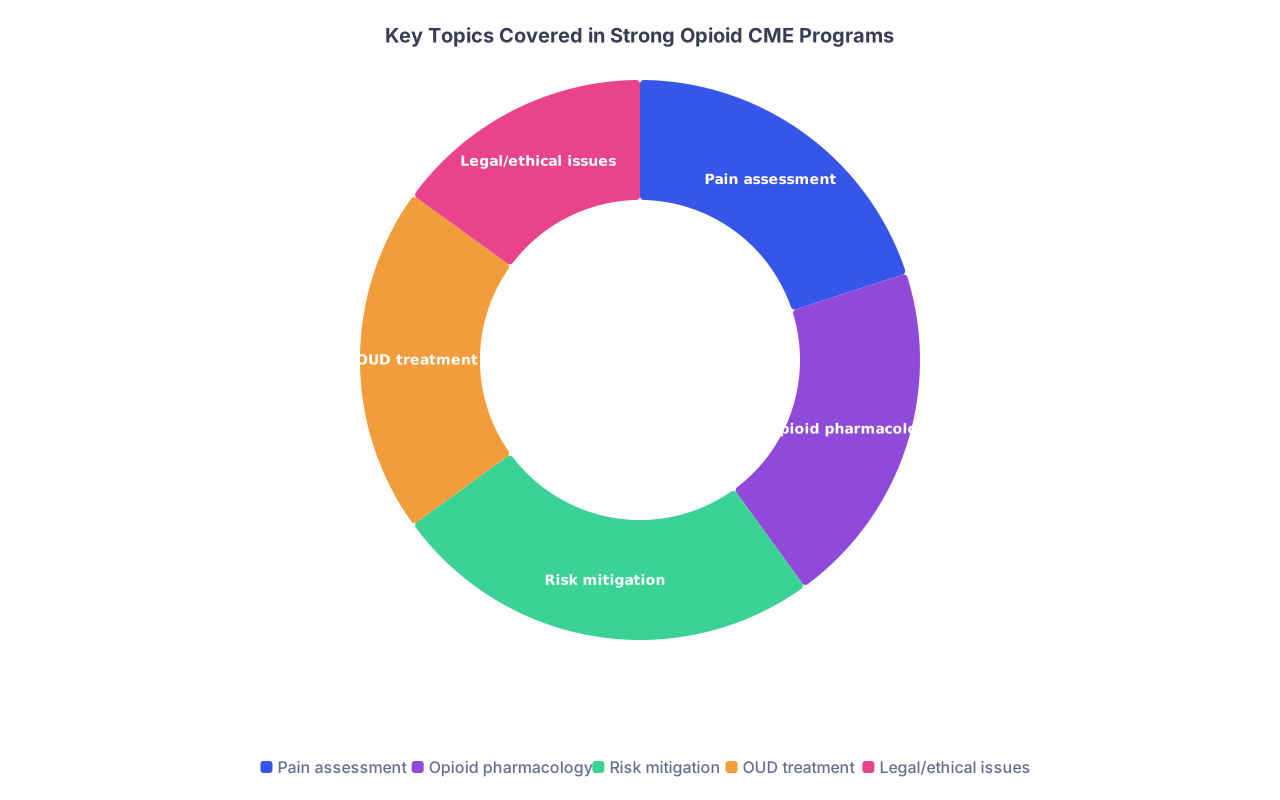
| Category | Value |
|---|---|
| Pain assessment | 20 |
| Opioid pharmacology | 20 |
| Risk mitigation | 25 |
| OUD treatment | 20 |
| Legal/ethical issues | 15 |
Look for programs that:
Explicitly reference state or federal guidelines
- CDC opioid prescribing guideline.
- State medical board policies.
- PDMP rules.
This gives you something to cite in your notes and, if needed, in testimony.
Use case‑based teaching
High‑yield if they cover:- Chronic low back pain on long‑term opioids seeking dose escalation.
- Post‑operative patient pushing for refills beyond 7–10 days.
- Patient with clear signs of misuse or diversion.
- Complex comorbidity (COPD, OSA, benzodiazepines).
Include documentation examples
You want to walk away knowing how to phrase:- Risk–benefit analysis.
- Informed consent about opioid risks.
- Functional goals.
- Reasoning for tapering or discontinuation.
Integrate ethics, not bolt it on
Good courses will cover:- Managing patient anger and conflict when you say “no.”
- Avoiding abandonment while setting boundaries.
- Handling pressure from family members to prescribe.
- Responding ethically to suspected diversion.
Generate a solid paper trail
Always keep:- Certificate with your name, date, hours, and matching description to board requirement.
- Course description saved as PDF or screenshot (so when the website updates, you still have proof of content).
If your state requires “Board‑approved” courses, verify that list on the board site. Do not trust a CME vendor’s marketing line alone. I have seen physicians complete 3 hours of “opioid CME” that the board later refused to count because it was not on the approved roster.
The actual ethics: beyond the checkboxes
Let me get past the bureaucracy for a minute. Ethically, what do opioid CME requirements want from you?
At minimum:
- Stop reflexively using opioids as first‑line treatment for most chronic non‑cancer pain.
- Treat opioids as one tool among many, with clearer thresholds for starting and stopping.
- Treat addiction as a disease, not a moral failure.
- Document your reasoning like you expect a stranger to read it later.

Some concrete ethical pivots opioid CME pushes you toward:
From “pain as fifth vital sign” to “function and safety as priorities”
Old mindset: pain score drives treatment intensity.
New mindset: functional improvement and safety trump numeric pain scores.From “patient satisfaction” to “patient safety”
There is a long, ugly history of Press‑Ganey scores and opioid prescribing. Modern CME is blunt: you do not sacrifice safety for satisfaction.From “automatic continuation” to “structured re‑evaluation”
Long‑term opioid therapy should not be auto‑renewal:- Periodic attempt to taper.
- Revisit non‑opioid strategies.
- Honest discussion of long‑term risk.
From “discharge the addict” to “treat or refer the patient with OUD”
Cutting someone off and sending them away without OUD treatment is ethically weak and medically indefensible in many contexts. Even if you do not prescribe buprenorphine, you should know referral options.From “solo prescriber” to “team‑based stewardship”
High‑risk patterns (high MME, concurrent benzos, multiple prescribers) are not just your problem. Good opioid CME clarifies how to:- Coordinate with other prescribers.
- Use pharmacists as safety partners.
- Structure clinic policies across a group.
Practical strategy if you hold multiple state licenses
This is where things get messy. Many physicians:
- Live in one state.
- Telemedicine into one or more others.
- Hold several PRN licenses “just in case.”
Each state can impose its own opioid CME rules. There is no “primary state” override.

| Step | Description |
|---|---|
| Step 1 | List All Active Licenses |
| Step 2 | Check Each Board Website |
| Step 3 | Note As General CME Only |
| Step 4 | Record Hours and Content Needed |
| Step 5 | Identify Overlapping Topics |
| Step 6 | Select CME Covering Highest Requirements |
| Step 7 | Track Certificates By State |
| Step 8 | Opioid CME Required? |
Strategy that actually works:
Make a simple spreadsheet:
- States.
- Renewal dates.
- Opioid/pain CME hours required.
- One‑time vs recurring.
- Content specifics (PDMP, ethics, OUD, etc.).
Find the strictest combination:
- If one state wants 4 hours including OUD + PDMP.
- Another wants 2 hours of general opioid prescribing.
- Choose a 4‑hour course that clearly covers all specified elements.
Keep certificates organized by state:
- Same course can satisfy multiple states.
- But when an audit letter arrives, you want:
- The certificate.
- A note: “Applies to State X requirement [cite statute/reg number].”
Do not assume reciprocity:
- Some states explicitly say “must be state‑approved.”
- Others allow any accredited opioid/pain CME.
- Read the actual regulation text, not just FAQs.
Common failure points boards actually care about
This is based on real cases, not theory. Where do physicians get into trouble, even when they technically met CME requirements?

Inconsistent practice vs CME content
You completed a course that clearly teaches:- PDMP for each new opioid start.
- Avoid concurrent benzos and opioids.
- Taper for long‑term minimal benefit.
Then your charts show:
- No PDMP documentation.
- Regular benzo + opioid combo.
- Chronic oxycodone for “back pain” with no functional documentation.
That disconnect is damning. It says: you knew better. You ignored it.
Sloppy documentation
Even with perfect clinical judgment, your chart can kill you if it lacks:- Clear indication and differential diagnosis.
- Documented risk assessment.
- Informed consent documentation.
- Monitoring plan and follow‑up.
Good opioid CME should improve your documentation culture. If it does not, either the course was weak or you did not implement it.
Failure to update practice over time
Boards look at whether your behavior changed after key guideline shifts (for example, after the 2016 CDC guideline, and now after the updated 2022 one). If you still prescribe like it is 2005, repeated opioid CME certificates will not save you.“Taper shock” without ethical planning
In reaction to regulations, some clinicians abruptly depressed opioid doses or cut off long‑term patients without:- Adequate explanation.
- Tapering plans.
- Alternative treatments.
Ethically indefensible. Many better CME programs explicitly warn against this overcorrection. If you have patients in this category, you need a structured, documented path forward.
FAQs
1. If my state does not require opioid CME, should I still do it?
Yes. If you prescribe opioids with any regularity, skipping opioid‑focused CME is short‑sighted. Boards in “silent” states still judge you against national standards. Courts certainly do. A few high‑quality courses spread over several years is the bare minimum for safe, defensible practice.
2. Can one opioid CME course satisfy multiple state requirements?
Often yes, if it is broad and well‑documented. The course must match the strictest content and hour requirements among your states, and any state‑specific approval rules must be met. Always keep the course description and certificate, and explicitly map which state requirement it satisfies in your own records.
3. Do telemedicine‑only prescribers have different opioid CME obligations?
Generally no. If you hold a state license and prescribe controlled substances into that state, you are bound by its CME rules and its prescribing standards, even if you never physically practice there. In some states, telemedicine has stricter opioid rules, particularly for initial prescriptions.
4. How often do opioid CME rules change, and how should I track them?
They change more than you think—often every few years, sometimes faster in response to legislative cycles or overdose data. You should check each medical board’s site at least once per renewal cycle and whenever you add a new license. Keeping a simple spreadsheet and updating it annually is far better than relying on memory or vendor marketing.
Key points, so you do not miss them:
- You do not have a generic “opioid CME” requirement; you have specific, state‑defined, often nuanced obligations that differ by license, renewal stage, and prescribing authority.
- The ethical core of these rules is consistent—safer prescribing, better documentation, and real engagement with addiction treatment—even if the number of hours and topics vary.
- If you treat opioid CME as a checkbox instead of a practice‑shaping tool, you may satisfy the board on paper but you will still be exposed clinically, ethically, and legally.