
Only 27% of telemedicine-heavy clinicians are confident they understand their state’s specific CME requirements for virtual care.
That number is absurdly low, given how many practices are now 50–90% telehealth. And it is exactly why I see smart, competent physicians blindsided by audits, license renewals, or credentialing reviews when someone finally reads the fine print.
Let me break this down specifically.
You are not dealing with “regular CME plus some tech stuff.” Once your practice is telemedicine‑heavy—whether you define that as 51% of visits or “we basically live on the platform”—you are in a different regulatory and risk environment. Some boards have explicit telehealth CME rules. Others bury it in opioid prescribing requirements. Some tie it to ethics. A few link it to controlled substance prescribing. And if you are licensed in multiple states or doing multi-state telehealth for one employer, the complexity multiplies fast.
This is where most clinicians get it wrong: they look only at their primary state, assume “AMA PRA Category 1 is fine,” and move on. Then two years later, credentialing asks for proof of telehealth education, or a state board renews the application form and adds a “did you complete required telehealth CME?” checkbox. Now it is a problem.
1. What Changes When Your Practice Is Telemedicine-Heavy?
“Telemedicine-heavy” is not a regulatory term, but it is a real-world risk category. Once virtual care dominates your panel, three things change for CME strategy:
You are exposed to more state laws.
If you see patients in multiple states via telehealth, each of those state medical boards can have CME hooks: prescribing, PDMP checks, informed consent, technology standards, cybersecurity. CME becomes a compliance tool, not just a box for licensure hours.Your malpractice risk shifts.
Telehealth amplifies certain risks: misdiagnosis without a physical exam, missed red flags, cross-border prescribing errors, privacy breaches. Insurers and hospital credentialing committees increasingly look for documented telehealth-specific education when they see your claim profile or application.Your board and payors start asking different questions.
During credentialing, privileging, and audits, I have seen forms that now ask things like:- “Describe your telehealth training and CME in the last 24 months.”
- “Have you completed education specific to remote assessment and prescribing?”
- “List CME related to secure electronic communication with patients.”
If most of your daily practice is telemedicine, but your CME portfolio looks indistinguishable from a brick‑and‑mortar internist from 2009, that mismatch raises eyebrows.
2. The Regulatory Landscape: Where Telemedicine CME Actually Shows Up
Let us get concrete. You do not have “Telemedicine CME” as a single, unified national requirement. You have a patchwork of categories where telehealth creeps in:
- General CME hour requirements (every state)
- Opioid/pain management/controlled substances CME (many states)
- Ethics, professionalism, or law CME (selected states)
- Risk management / patient safety CME (common for hospital privilege renewal)
- Specialty board MOC requirements
- Payer and institutional privileging standards
For telemedicine-heavy practices, the most common trap is multi-state licensure. You pick up a Texas license for telehealth, a Florida license for snowbirds, maybe a California license because your employer wants coverage. Each of those can add 2–4 hours of required content that you only half remember.
Here is a simplified comparison to make this less abstract.
| State | Total CME per cycle | Telehealth-Relevant Requirement Type | Example Impact on Telemedicine Practice |
|---|---|---|---|
| California | 50 hrs / 2 years | Pain/opioids, law & ethics | Must track opioid education if prescribing virtually |
| Texas | 48 hrs / 2 years | Opioids, human trafficking | Telehealth prescribers need documented opioid CME |
| Florida | 40 hrs / 2 years | Telehealth registration, opioids | Out-of-state telehealth prescribers must follow FL opioid rules |
| Massachusetts | 50 hrs / 2 years | Opioids, end-of-life care | Virtual palliative/primary care must meet opioid CME standards |
| New York | Varied by category | Infection control, pain management | Tele-ID/tele-primary must show infection control CME for licensure |
None of these say “you must do telemedicine CME.” But if you prescribe controlled substances via telehealth, document in an EHR, and manage chronic conditions remotely, those “regular” requirements are now definitely telemedicine requirements for you.
Where formal telehealth CME is explicitly required
There are a few places where telemedicine is called out more directly:
- Some boards of nursing and psychology boards require telepractice training for certain tele-behavioral services.
- Certain hospital systems require dedicated telehealth privileges, tied to completion of an institution-approved telemedicine training module.
- Some payers or telehealth platforms require onboarding education on:
- Telehealth documentation standards
- Informed consent language
- State-by-state practice rules
If you are a physician, the MD/DO boards generally lag behind here, but institutional and payer requirements have started to fill the gap. That means your “must do” CME may come from your employer or credentialing body rather than the state.
3. High-Yield CME Topics for Telemedicine-Heavy Practices
Now the part most clinicians actually care about: what should your CME portfolio contain when your work is primarily virtual?
I will break this into buckets. You can think of each bucket as an axis where regulators, payers, or plaintiff attorneys will look for evidence that you knew what you were doing.
3.1 Clinical risk in a virtual setting
You need education that addresses the specific limitations of remote assessment. Content should cover:
Conditions that must not be managed exclusively via telehealth
Example: suspected acute abdomen, unstable chest pain, new focal neuro deficits. You need CME reinforcing escalation thresholds and safety-net instructions.Modified exam techniques
Not the fluffy “use good lighting.” I mean specific:- How to guide a patient through self-palpation.
- Using functional questions instead of physical exam maneuvers.
- When self-reported vitals are adequate and when they are not.
Diagnostic anchoring and cognitive bias in telehealth
It is easier to “diagnose the video” instead of the patient. Good CME will walk through misdiagnosis cases where telehealth contributed to error.
Insurers love seeing this type of content when evaluating telemedicine-heavy practices. It tells them you are not pretending the webcam is a magic physical exam tool.
3.2 Law, ethics, and cross-border practice
This is where many clinicians are frankly undereducated.
You should be hitting at least one solid CME activity every cycle on:
Licensure and “place of service” rules
Where is the visit legally occurring? Usually where the patient is. But some CME will dig into edge cases like temporary relocations, student travel, and international patients.Telemedicine-specific informed consent
What must be documented? Typical components:- Nature of telehealth
- Limitations vs in-person care
- Security and privacy
- Contingency plans (disconnection, emergencies)
Supervision and delegation in virtual care
Can your PA/NP see telehealth patients in a state where you are not licensed? Can you supervise them remotely? The right CME will answer with state-specific nuance or at least red-flag the issues.
3.3 Prescribing and controlled substances
If you prescribe anything meaningful via telemedicine, this bucket is non-negotiable.
You want CME that explicitly hits:
- Ryan Haight Act and its evolving telemedicine exceptions
- State-specific telehealth rules on:
- Initial in-person exams
- Remote initiation vs continuation of controlled substances
- PDMP use requirements for remote visits
- Safe opioid prescribing in a telehealth workflow
Things like:- Documentation elements that defend your decision
- Verifying identity remotely
- Handling “lost meds” and early refill requests via virtual care
Many state opioid CME offerings are totally in-person oriented. For a telemedicine-heavy practice, prioritize those that include remote or hybrid care case examples. They exist; you just have to look a bit harder.
3.4 Documentation, billing, and compliance
Telehealth charting and billing errors are one of the easiest pathways to a payer audit or fraud allegation.
Your CME mix needs to cover:
Telehealth E/M coding updates (e.g., time vs MDM, audio-only vs audio-video, POS modifiers)
Documentation standards for:
- Technology modality (audio, video, platform)
- Patient location and provider location
- Consent and identity verification
- Physical exam limitations and why they were acceptable
Incident-to and shared visit rules in remote workflows
I have watched practices get quietly shredded on audit because nobody understood how incident-to applied (or did not) when the supervising physician was in another state.
3.5 Privacy, cybersecurity, and technical standards
If your practice is 60–90% telehealth, a privacy breach or data loss is not just “IT’s problem.” It is a direct medical risk.
You should have CME that hits:
- HIPAA and telehealth-specific privacy considerations
- Use of non-HIPAA-compliant platforms in emergencies vs routine care
- Data storage, screenshots, and image handling from patient devices
- Basic cybersecurity hygiene for clinicians:
- Device encryption
- Remote work risks (public Wi-Fi, shared devices)
- Phishing related to EHR or telehealth platforms
I have seen boards interpret privacy/security CME as part of their “patient safety” requirement. For telemedicine-heavy clinicians, this is low-hanging fruit—easy credits that directly reduce your operational risk.
4. Matching CME Strategy to Different Telemedicine Practice Models
Not all telemedicine-heavy practices look the same. A hospital-based tele-ICU physician and a direct-to-consumer acne app doctor do not need identical CME portfolios.
Here is a practical way to think about it.
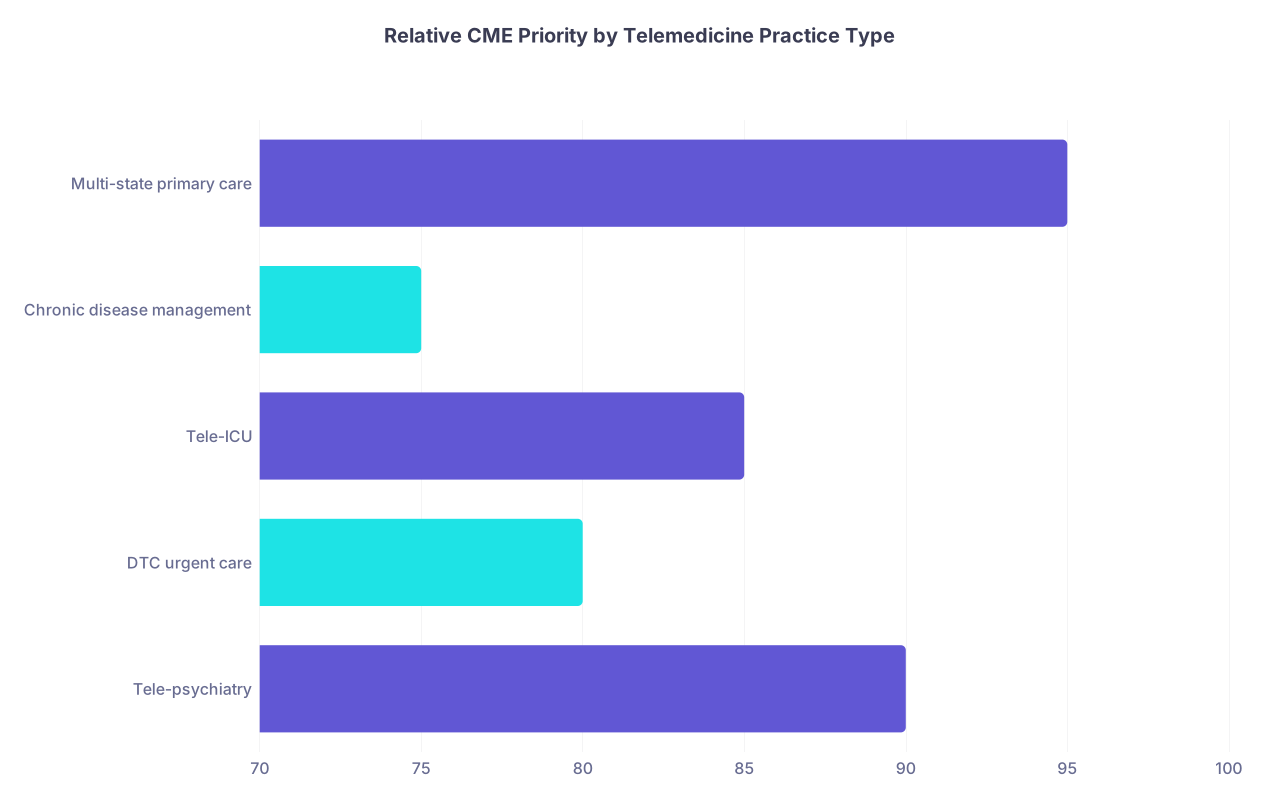
| Category | Value |
|---|---|
| Tele-psychiatry | 90 |
| DTC urgent care | 80 |
| Tele-ICU | 85 |
| Chronic disease management | 75 |
| Multi-state primary care | 95 |
(Think of the values as “how aggressively you should prioritize telemedicine-specific CME on a 0–100 scale.”)
4.1 Multi-state primary care telemedicine
This is the highest-risk profile from a CME-compliance perspective.
You absolutely should:
- Maintain a state-by-state CME spreadsheet:
- Total hours
- Specific required topics
- Renewal cycle dates
- Align at least 25–40% of your CME each cycle with:
- Telehealth law/ethics
- Tele-prescribing and opioids
- Chronic disease management via remote care
- Choose CME offerings that explicitly mention:
- Virtual chronic disease programs
- Remote monitoring integration
- Tele-triage and escalation pathways
If an auditor sees that you run a 90% telehealth hypertension clinic and your last 3 years of CME have nothing remotely related to remote hypertension management, technology, or telehealth risk, expect more questions.
4.2 Direct-to-consumer urgent care telemedicine
Here, the focus shifts slightly:
High-yield CME themes:
- Tele-triage safety:
- Identifying who must go to ED or in-person quickly
- Infection management remotely:
- Antibiotic stewardship without physical exam
- When to require in-person strep, UTI, or pneumonia evaluation
- Identity verification and fraud:
- Patients shopping for controlled substances
- Documentation to protect yourself when declining requests
This is also where payer audits and consumer complaints can spike, so risk-management oriented CME (especially with telehealth-specific malpractice case reviews) is worth the time.
4.3 Tele-psychiatry / behavioral health
Behavioral telehealth is its own beast. If you are tele-psych heavy:
Prioritize CME about:
- Suicide risk assessment and crisis management remotely
- State-specific requirements for:
- Involuntary commitment processes
- Coordination with local emergency services
- Prescribing controlled substances (e.g., stimulants, benzodiazepines) via telehealth
- Privacy and confidentiality in behavioral telehealth (e.g., patient in shared space, minors on telehealth)
Many psychiatry boards and state regulators are quietly more aggressive in scrutinizing tele-psych practices than other tele-specialties. Your CME portfolio needs to look a bit more robust here.
4.4 Tele-ICU and inpatient consult telemedicine
For hospital-based telemedicine programs, the CME sweet spot is:
- Interfacility communication and handoffs
- Documentation standards for remote consults
- Liability and responsibility division between bedside and remote teams
- Technology failure contingencies (e.g., what happens when the tele-ICU feed dies)
Some systems provide internal CME that is tailored to their tele-ICU program. If so, collect every certificate and tie it explicitly to privileging or renewal documentation.
5. Integrating Telemedicine into Existing CME Requirements You Already Have
Most state and specialty requirements can be satisfied with telehealth-focused content if you choose wisely. You do not need “extra” hours; you need smarter alignment.
Examples:
Opioid/pain CME requirement
Instead of a generic in-person opioid course, choose:- “Safe Opioid Prescribing in Telehealth and Hybrid Care”
- Or a risk-management CME that includes remote prescribing case law.
Ethics/law/professionalism requirement
Take courses like:- “Ethical Challenges in Cross-Border Telemedicine”
- “Documentation and Informed Consent in Virtual Care”
Patient safety / risk management
Target:- “Avoiding Diagnostic Error in Telemedicine”
- “Malpractice Lessons from Telehealth Litigation”
This way, you check mandatory boxes while building a defensible telemedicine profile.
6. Documentation and Audit-Readiness for Telemedicine CME
You can do all the right CME and still be exposed if your documentation is sloppy.
For telemedicine-heavy clinicians, I tell people to behave as if they will be audited in 3 years and asked two questions:
- Prove you met the formal CME requirements for every state license you held.
- Show that your education reasonably matched the way you practice (heavily virtual).
That means:
Keep a single centralized CME log.
Not just what your board portal shows. A personal spreadsheet or portfolio with:- Course title
- Provider
- Date
- Hours (Category 1 vs 2, or state equivalent)
- Topic tags (e.g., “telehealth law,” “opioid/tele-prescribing,” “privacy/security”)
Tag anything telemedicine-relevant.
Even if the course was not branded as telehealth, if the content included:- Remote assessment
- Virtual workflows
- Tele-prescribing mark it as part of your telemedicine education track.
Save certificates in a structured way.
Folder system by year, then subfolder for “Telemedicine & Risk,” “Opioids & Tele-prescribing,” etc. When credentialing asks, you do not want to dig through email or vendor portals.Document employer-based telehealth training.
Many large telehealth organizations and hospital systems give internal modules:- Telehealth onboarding
- Platform updates
- Policy changes These often qualify as Category 2 or even Category 1 if accredited. Get proof. Save it.
Here is a simple structure that works well in practice.

| Step | Description |
|---|---|
| Step 1 | Identify CME needs |
| Step 2 | Select courses with telehealth focus |
| Step 3 | Complete activity |
| Step 4 | Save certificate to CME folder |
| Step 5 | Log details in CME spreadsheet |
| Step 6 | Tag course as telehealth relevant |
| Step 7 | Review alignment before license renewal |
If you actually follow something like this, your future self will owe you.
7. Common Mistakes Telemedicine-Heavy Practices Make With CME
I have seen the same errors repeated in group after group.
Let me call them out:
Treating telemedicine as “just another setting,” not a risk domain.
So their CME looks generic and disconnected from the actual care they deliver.Ignoring secondary state license requirements.
They meet their home-state hours and assume that covers Florida, Texas, etc. It does not.Lumping all employer training under “orientation,” never logging it as CME.
This is wasted value. Many telehealth onboarding programs are exactly what regulators want to see.Over-focusing on technology tools but under-focusing on law and ethics.
You do not get credit (or protection) for spending 6 hours learning advanced platform features while skipping telehealth law, prescribing rules, and documentation.Letting vendors or platforms dictate all their CME.
Vendor-provided material tends to be self-serving: usage tips, features, adoption. You still need neutral, risk-focused CME from medical societies, boards, or independent providers that will stand up in court or before a board.
8. How to Build a Telemedicine-Heavy CME Plan That Actually Works
If I had to design a 2-year CME plan for a typical multi-state, primary care telemedicine physician, it would look something like this:
| CME Category | Approx Hours / 2 Years | Telemedicine Emphasis Example |
|---|---|---|
| Clinical telehealth risk & triage | 8–10 | Courses on remote assessment, escalation criteria |
| Telehealth law, ethics, compliance | 6–8 | State law, consent, cross-border practice |
| Opioid/controlled substance CME | 4–6 | Tele-prescribing, PDMP use, case law |
| Documentation, coding, billing | 6–8 | Telehealth E/M updates, audits, fraud and abuse |
| Privacy & cybersecurity | 3–5 | HIPAA in telehealth, remote-work security |
| Specialty-specific clinical topics | 20–25 | Chronic disease, preventive care, but with remote care lens |
That portfolio will:
- Satisfy virtually all state general CME requirements.
- Cover opioid/pain obligations in most jurisdictions.
- Provide a clear defense file showing you took telemedicine risk seriously.
To track your progress and adjust, a simple periodic review helps.
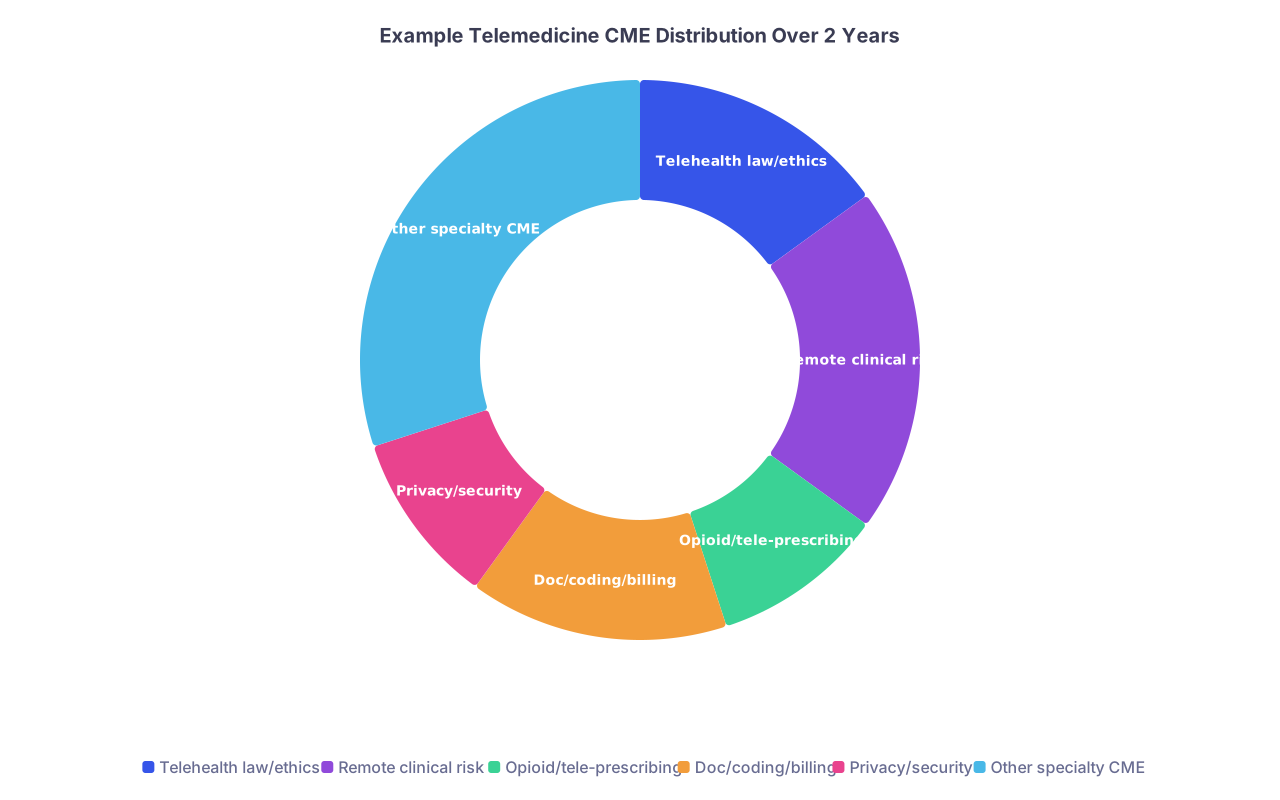
| Category | Value |
|---|---|
| Telehealth law/ethics | 15 |
| Remote clinical risk | 20 |
| Opioid/tele-prescribing | 10 |
| Doc/coding/billing | 15 |
| Privacy/security | 10 |
| Other specialty CME | 30 |
If your actual chart looks like 90% “generic cardiology update” and 10% “telehealth something,” yet your job is 80% telemedicine, you have a mismatch.
Two things to remember:
- Heavy telemedicine use turns CME from a bureaucratic checkbox into part of your legal and malpractice defense strategy.
- The smartest clinicians are not doing “extra” CME; they are choosing required hours that double as telehealth-specific protection.