
You are three weeks from your state license renewal deadline. You log in to the board portal, confident you are fine. Then you see it: “CME deficiency – 12 hours short. Missing required topics.” Your stomach drops. You have “plenty” of CME certificates in your email. But half of them do not count the way you thought they did.
This is how people get burned by CME vendors. Not because they are lazy. Because vendors market aggressively, label things in confusing ways, and gloss over key details regulators actually care about.
Let’s walk through the most common CME vendor traps that leave physicians short on required credits—and how to avoid getting ambushed at renewal time.
Trap #1: “Accredited” – But Not By the Body That Matters to You
The first major trap is assuming the word “accredited” equals “this will count.”
It does not.
There are at least four different “layers” of accreditation/approval that matter:
- National CME accreditation (e.g., Joint Accreditation, ACCME)
- State medical board acceptance rules
- Specialty board MOC requirements
- Hospital / employer internal rules
Many vendors talk loudly about #1 and quietly ignore #2–4. That is where you get nailed.

Common mistake:
You see: “This activity is accredited for 30 AMA PRA Category 1 Credits™.”
You assume: “Great, that will satisfy my state and my board and maybe my hospital too.”
Reality: Not necessarily. At all.
Watch for these specific red flags in vendor language:
- “May be accepted by your licensing board.” Translation: We have no idea; you are on your own.
- “Designed to meet the needs of…” but no explicit statement about your board or state.
- “Approved for AMA PRA Category 1 Credits™” but nothing about MOC, nothing about state-specific mandates.
Before you spend a dollar, you need to know exactly which regulator you are trying to satisfy.
Here is how the same activity can be “useless” for one doctor and perfect for another:
| Physician Type | What They Need | Does Generic AMA PRA Cat 1 Help? |
|---|---|---|
| CA internist with DEA registration | CA-specific CME + opioid training | Only if it meets CA & DEA rules |
| Texas family physician | Texas CME with ethics requirement | Only if ethics is clearly stated |
| ABIM-certified cardiologist | ABIM MOC Part II | Only if activity offers MOC |
| Employed hospitalist | Hospital’s internal CME rules | Depends on hospital policy |
Do not rely on vendor claims alone. Always cross-check:
- Your state medical board’s CME page
- Your specialty board’s MOC / continuing certification rules
- Your hospital’s medical staff office policy (yes, the boring PDF)
If a vendor cannot clearly show how their accreditation maps to those requirements, you are gambling.
Trap #2: Bundles That Look Huge But Deliver Little of What You Actually Need
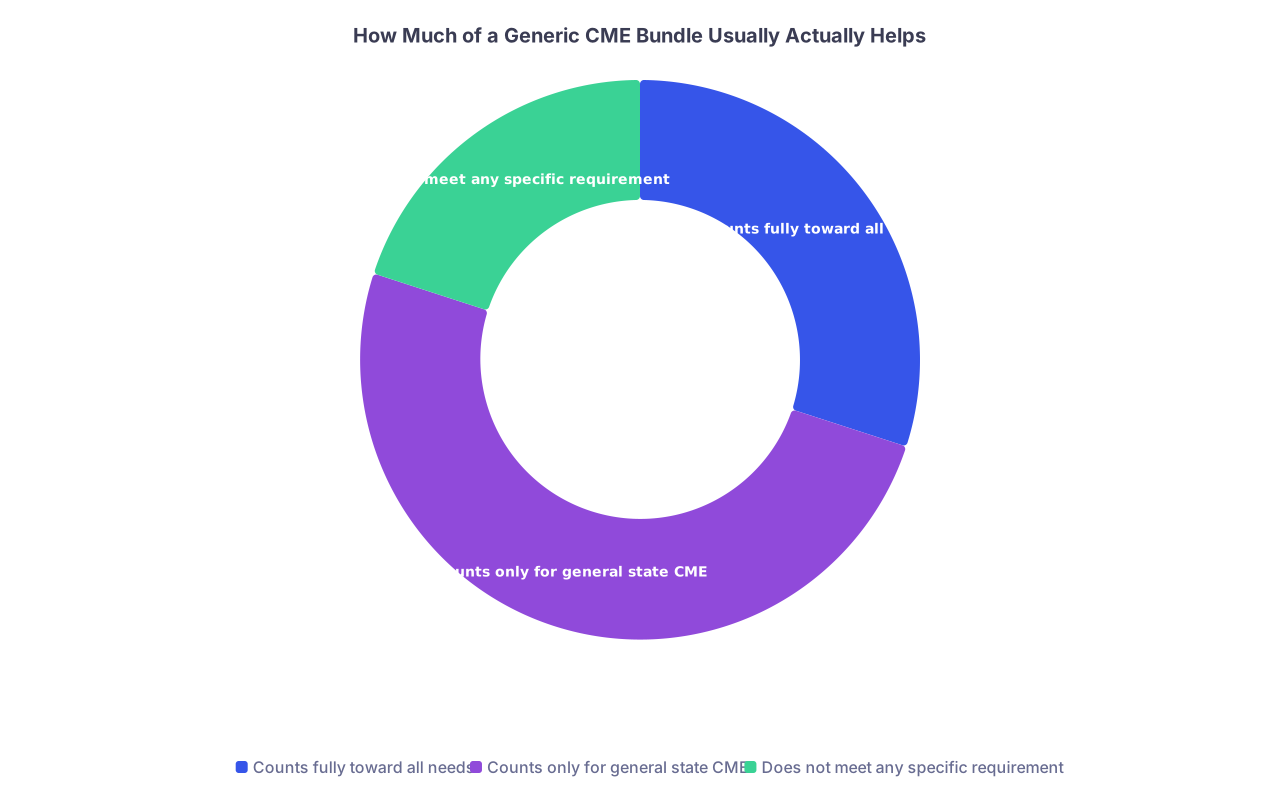
The “unlimited CME bundle” is a classic trap. You see “300+ hours!” or “500+ credits!” and think, fantastic, I am set for years.
Then, three months before renewal, you realize:
- You still need a controlled substances / opioid course that meets a very specific state or DEA standard.
- You still need a certain number of live or “live-interactive” credits.
- You still need board-specific MOC points.
- Many hours are duplicate topics that your board caps or ignores.
| Category | Value |
|---|---|
| Counts fully toward all needs | 30 |
| Counts only for general state CME | 50 |
| Does not meet any specific requirement | 20 |
Typical mistakes with bundles:
- Buying a massive internal medicine bundle when your main gap is 8 hours of risk management and 3 hours of opioid prescribing.
- Assuming a “one-price, unlimited CME” subscription will automatically include all state-mandated topics. It often does not.
- Ignoring the format requirement. Many boards still require a certain number of “live” or synchronous credits—your self-paced video bundle does not qualify.
Before buying any bundle, do a 10‑minute audit:
- List your actual requirements by category: general CME, topic-specific CME, live vs enduring, MOC, DEA, state-specific.
- Map the bundle’s included activities to those categories. Not by vibes. By reading the actual course descriptions.
- Ask the vendor, in writing, “Which activities in this bundle meet [X board / Y state] opioid / risk management / ethics / whatever requirements?”
If they cannot answer clearly—or respond with marketing fluff—you are about to waste money and time.
Trap #3: Assuming “All Online CME Is Fine” When Format Rules Still Matter
Many physicians get blindsided because they forgot regulators care about how you learned, not just how many hours you did.
You see “online CME” and assume that counts everywhere. Wrong in many states and for some boards.
Common format pitfalls:
- State requires “live, in-person or live-interactive” hours. Your on-demand videos do not qualify.
- MOC requires “participatory” or “performance improvement” CME, not just passive viewing.
- Some hospital bylaws require a minimum number of live conferences or in‑person grand rounds.

| Step | Description |
|---|---|
| Step 1 | Need CME Credits |
| Step 2 | Look for Live or Live Virtual CME |
| Step 3 | Enduring Online CME OK |
| Step 4 | Counts as Live |
| Step 5 | May Not Count |
| Step 6 | Check Topic and Accreditation |
| Step 7 | State or Board Require Live? |
| Step 8 | Does Vendor State Live Interaction? |
Vendor trap language to watch:
- “Online CME course” with no statement about format category (enduring vs live).
- “Interactive” meaning there are quiz questions, not real-time interaction with faculty.
- “Virtual CME conference” that is actually just pre-recorded videos.
Your checklist for format:
- Look specifically for words like “live,” “live-interactive,” “synchronous,” “in-person.”
- For on-demand: expect “enduring material” in the accreditation statement.
- For MOC: check whether the activity offers “MOC Part II,” “Self-Assessment,” or “Performance Improvement,” as applicable.
If the vendor cannot name the format the way your board describes it, do not assume equivalence.
Trap #4: “MOC Available” That Does Not Actually Post or Count the Way You Expect
Board certification maintenance is another minefield. Vendors slap “MOC” all over their materials, but that single word hides several traps.
I have seen physicians do 60+ hours of “MOC-eligible” CME and then discover:
- The vendor never reported completions to the board.
- The activity only counted for CME credit, not MOC points.
- The MOC questions were optional; they skipped them, so they earned zero MOC.

Understand these distinctions:
- CME credit ≠ MOC credit. Many MOC programs require special questions, additional attestations, or passing scores.
- “MOC available” is meaningless unless the course clearly states:
- Which board (ABIM, ABFM, ABS, etc.)
- How many points
- How points are reported (automatic vs self-report)
- Some boards require completion by a certain date annually, not just by your major renewal year.
Questions you must ask vendors:
- “Is this approved for [my specific board] MOC, and how many points?”
- “Do you report MOC completions automatically to the board? How often?”
- “Do I need to complete any extra questions or modules for the MOC component?”
Also, double-check on the board side:
- Log in to your board portal and confirm the vendor is listed as an approved MOC provider or activity.
- After completing one short course, verify that points actually appear before you commit to a big bundle from the same vendor.
If you do not see the board name, number of MOC points, and reporting method spelled out, treat that “MOC” label as marketing fluff, not a guarantee.
Trap #5: Topic-Specific Requirements Hidden in Footnotes
The fastest way to get burned is to ignore the fine print on topic requirements.
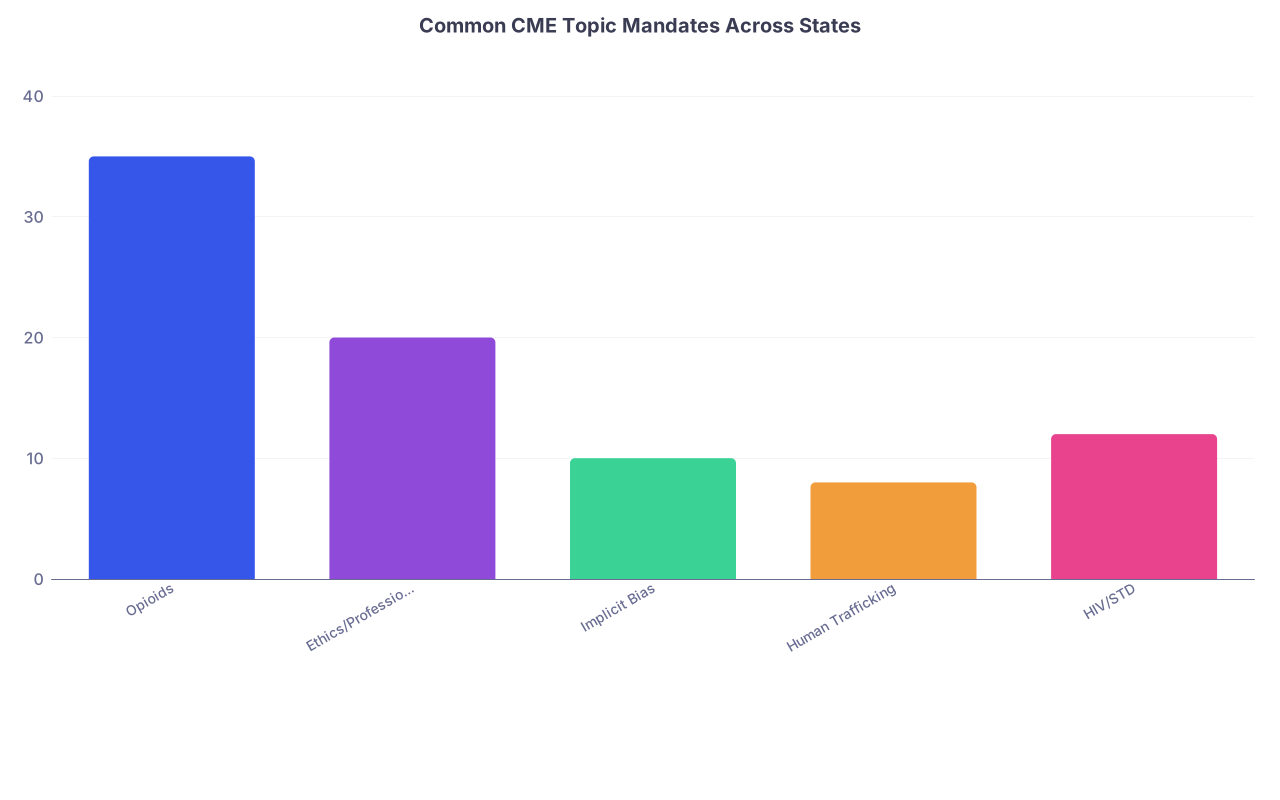
States and the DEA now have a long list of very specific CME mandates:
- Opioid prescribing / pain management
- Addiction medicine or substance use disorder
- Ethics / professionalism / boundary issues
- HIV / domestic violence / geriatrics / cultural competency (varies by state)
- Human trafficking training
- Implicit bias, health equity topics
Here is the painful scenario I have seen repeatedly:
A physician in a state with a specific 3‑hour opioid requirement takes a 1‑hour general “opioid safety” webinar and assumes that counts. The board does not agree. Because the course was never designed to meet that state’s mandate.
| Category | Value |
|---|---|
| Opioids | 35 |
| Ethics/Professionalism | 20 |
| Implicit Bias | 10 |
| Human Trafficking | 8 |
| HIV/STD | 12 |
Vendor traps include:
- Slapping “opioid” in the title without being aligned with any regulatory language.
- Claiming “meets many state requirements” without listing which states.
- Offering “ethics” CME that does not meet a state’s specific “professional responsibility” or “risk management” definition.
Your defense strategy:
- Always start from your regulator’s language, not the vendor’s marketing. If your board says “3 hours of Board-approved Prescribing Controlled Substances CME,” you need either:
- A course explicitly approved/listed by your board, or
- A course whose description matches the board’s approval criteria line by line.
- Look for statements like “This activity meets the [State X] requirement for [Y hours] of [specific topic].”
- When in doubt, email your board with the course description and ask if they will accept it. Keep their written response.
Do not wait until the month before renewal to figure this out. Topic-specific credits are harder to find last minute and more likely to be misrepresented by vendors.
Trap #6: Counting Duplicate or Overlapping Credits Twice
Another subtle way vendors mislead you (and sometimes themselves) is by encouraging you to think in raw hours, not usable hours.
You see a promotion: “Earn 50 credits with this conference!”
The reality: many regulators cap how many credits from a single type or source will count toward specific requirements.
Common problems:
- Boards capping self-assessment, journal-based CME, or certain “easy” formats.
- State boards limiting how many credits can come from industry-supported activities.
- Only a portion of a long conference actually addressing the required topic (e.g., 2 hours of ethics within a 25‑hour meeting).
| Activity | Hours Earned | Hours That Actually Count for Requirement |
|---|---|---|
| Big virtual IM conference | 30 | 15 (state cap on enduring online) |
| Journal CME subscription | 20 | 10 (board cap on self-assessment) |
| Ethics session within 3‑day meeting | 4 | 2 (state only recognizes certain talks) |
Vendors rarely track these caps for you. They will gladly sell you your 5th “opioid” course even if your board only recognizes 3 hours total and you already have them.
You need to:
- Track your own CME portfolio with basic categories: general, topic-specific, live, enduring, MOC, state-mandated, etc.
- Periodically compare against your board / state caps. Do not rely on a vendor’s “progress tracker” alone—they track what you bought and did, not what your regulator will recognize.
- Be skeptical of huge single-source solutions that “cover everything.” Regulators often intentionally require variety.
Trap #7: Sloppy Documentation and Certificates That Do Not Prove What You Need
Here is the most boring trap—and the one that burns people at audits.
You completed the right CME. It technically counts. But the certificate is missing key elements your board requires:
- No learner name, or mismatched name.
- No date of completion.
- No activity title that reflects the required topic.
- No statement of AMA PRA Category 1 Credit™ or similar.
- No accrediting body listed.
- No breakdown of topic hours when one conference spans multiple areas.

Vendor pitfalls:
- “Certificates of participation” without clear credit designation.
- Single generic certificate for a multi-day meeting that does not show how many hours you actually attended or what topics you covered.
- Portals that only keep your data for 1–3 years, shorter than your audit exposure window.
Your preventative checklist:
- After each activity, download the certificate immediately and make sure it includes:
- Your full name
- Course title
- Date(s)
- Number and type of credit(s)
- Name of accredited provider and accreditor
- Any special topic designation (e.g., opioid, ethics) if applicable
- Save certificates in a structured folder: /CME/[Year]/[Board or State]/[Topic] rather than one massive dump.
- For conferences with multiple tracks, confirm whether they provide a transcript of attended sessions; if not, keep your own session log.
If the vendor’s certificate is inadequate, ask them—early—to fix it. Waiting until you are under audit is how small documentation problems become big legal headaches.
Practical Workflow: How to Avoid Vendor Traps From the Start
You do not have time to become a full-time CME compliance officer. But you can build a simple, low-friction system that keeps you out of trouble.
Here is a pragmatic approach that works:
Once a year (or at the start of a new cycle), spend 30–45 minutes reading:
- Your state board CME page
- Your specialty board’s continuing certification / MOC requirements
- Your hospital’s CME policy if applicable
Create a short personal requirement summary:
- Total hours needed per cycle
- Topic-specific requirements
- Format requirements (live vs enduring)
- MOC points and types (Part II, PI, etc.)
Before buying from any vendor:
- Check if they clearly address your specific state and board, not just “doctors” in general.
- Look for explicit language: “[Board X] MOC Part II, [Y] points,” “Meets [State] requirement for [topic].”
- Avoid vendors that only use vague marketing buzzwords about “compliance” or “requirements” without naming them.
After your first completed course with a vendor:
- Confirm the certificate looks audit-ready.
- If MOC is offered, verify points show up in your board portal.
Mid-cycle (not last minute), do a self-check against your requirements and avoid assuming the vendor dashboard equals regulatory compliance.
You do this consistently, you will stop being the person frantically hunting for “3‑hour opioid CME that counts in [your state]” at 11:30 pm before renewal.
FAQs
1. If a CME activity is AMA PRA Category 1, does it always count for state license renewal?
No. AMA PRA Category 1 Credits™ are the baseline most states accept, but some states:
- Require that at least a portion of hours come from certain topics (e.g., opioid prescribing, ethics).
- Limit how many hours can be from enduring online formats versus live.
- Require board- or state-approved courses for specific mandates.
You should always confirm: “Does my state accept general AMA Category 1 for my total hours, and are there additional topic or format rules?” Your state board website answers that faster than any vendor’s marketing copy.
2. How can I tell if an online “live” CME course really counts as live for my board?
Do not trust the banner; read the accreditation details. It should clearly state something like “live, internet-based,” “live-interactive,” or similar language used by your board. There must be real-time interaction (Q&A, chat, polling with faculty present), not just pre-recorded lectures. If the course is available on-demand at any time, it is almost certainly “enduring,” not live, no matter what the vendor’s ad says.
3. What is the safest way to handle opioid / controlled substance CME requirements?
Start from your regulator’s wording, not from vendors’ course titles. Identify exactly what your state and the DEA (if applicable) require: number of hours, topics, time frame, and any approved course lists. Then pick activities that explicitly say “meets [State] requirement for [X] hours of [topic],” or that are listed on your board’s approved course list. When in doubt, email your board the course description and ask for confirmation—then save their reply.
4. Can I rely on my CME vendor’s transcript at audit time, or do I need individual certificates?
You should keep both. Vendor transcripts can be useful, but many boards and hospitals still expect formal certificates showing accreditation statements, dates, hours, and topics. Portals change, companies get acquired, and access disappears. Download certificates as you go and save them in your own system. Treat vendor dashboards as helpful but not legally sufficient on their own.
5. I already bought a big CME bundle and now realize it does not meet a key requirement. What should I do?
Stop throwing good time after bad. First, salvage what you can: identify which activities do count for general CME or any applicable requirements. Second, contact the vendor; some will credit or swap if they misrepresented coverage for a specific board or state. Third, fill the remaining gap with targeted CME from a vendor that explicitly serves your state/board needs, even if it costs a bit more. The real mistake is trying to force a generic bundle to satisfy a specific mandate it was never designed to meet.
Key points: Do not confuse “accredited” or “MOC available” with “this definitely meets my board/state/hospital rules.” Always start from your actual regulatory requirements, then evaluate vendors against that—not the other way around. And never assume vendor dashboards equal compliance; you are the one the board will hold responsible, not the CME company.