
It’s 10:45 p.m. You just finished sign-out. You’re half-thinking about dinner, half-thinking about sleep. Then the department email dings:
“Reminder: All faculty expected to complete at least 25 hours of specialty-specific CME this academic year, including X conference, Y M&M, and mandatory DEI module…”
You sigh. Because you already did your state-required CME. You already logged your licensure hours. But this has nothing to do with the state board. This is the real CME game: what your hospital and your department quietly expect if you want good evaluations, promotions, or partnership.
Let me walk you through how this actually works—especially the difference between academic and community hospitals—because nobody explains this honestly. Not your PD, not your chair, and definitely not HR.
They’ll talk about “lifelong learning.” They won’t talk about the unspoken scoreboard they’re all keeping on you.
The Official Line vs the Real Game
On paper, CME is simple.
- State license: X hours per renewal cycle
- Board: Y credits in Z years, maybe some self-assessment or MOC
- Hospital: a couple of mandated things—opioid prescribing, infection prevention, maybe abuse reporting
That part’s boring and visible. The checkbox stuff.
Where people get blindsided is the informal expectations. These are not written. They live in:
- Annual faculty evaluations
- Promotion and tenure files
- RVU bonuses and quality incentives
- Partner votes in community groups
- Quiet comments in hiring and renewal meetings
At academic centers, CME is code for “are you an academic citizen?”
At community hospitals, CME is code for “are you keeping up and not making us liable?”
Different cultures. Different stakes. Same word.
Academic Hospitals: CME as Currency
Here’s what nobody tells you: at an academic center, “CME” is less about your license and more about your identity. Are you a “serious” academic or just a body filling a schedule?
The Unwritten Tiers of CME in Academia
In academic medicine, not all CME is valued equally. Let me rank it the way department chairs actually think, even if they’ll never say this out loud.
| CME Activity Type | Real Perceived Value |
|---|---|
| National invited talk | Extremely high |
| National conference presentation | Very high |
| Subspecialty/niche conferences | High |
| Departmental grand rounds (speaker) | Moderate-High |
| Online CME modules | Low |
| Free pharma dinners | Near zero |
If your CV is full of cheap online modules, technically you’re compliant. But promotion committees don’t care. Your chair doesn’t boast, “Dr. Smith did 65 hours of UpToDate CME last year.” They brag about talks, abstracts, invited sessions.
I’ve sat in faculty evaluation meetings where someone says, “He’s got his CME hours, but he’s not really engaged.” Translation: he’s doing the bare minimum, mostly online, no visible academic footprint.
The Quiet Expectations That Aren’t in the Handbook
Nobody will hand you this list, but here’s what academic departments implicitly expect from attendings over a 2–3 year window:
- Attend your specialty’s big national meeting (or at least one major meeting)
- Present something at least every 2–3 years: poster, abstract, talk
- Show up at your own institution’s grand rounds more often than not
- Participate in quality-improvement or MOC-type activities that can be spun as scholarship
- Have at least some CME that looks “prestigious”—the known conferences, the brand-name courses
Mandatory hospital modules (HIPAA, compliance, diversity training) do not count in their mind. That’s background noise.
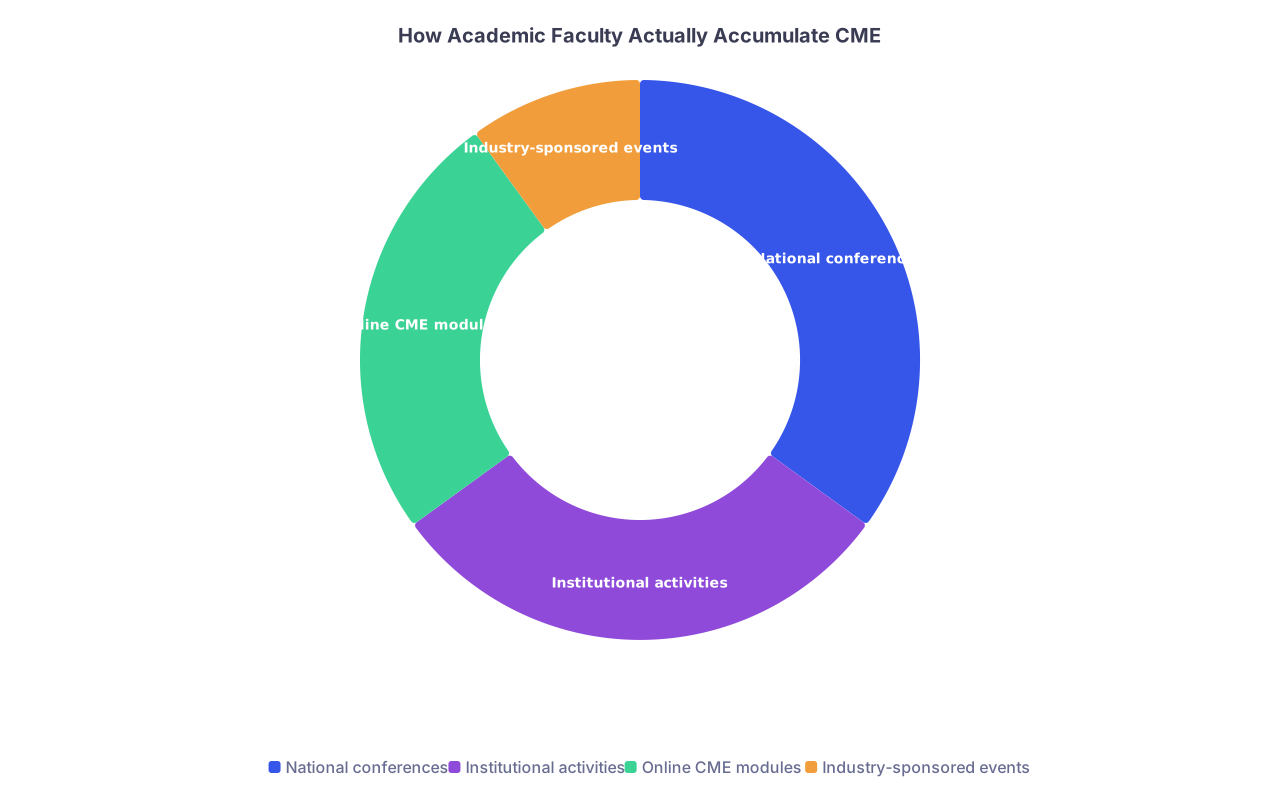
| Category | Value |
|---|---|
| National conferences | 35 |
| Institutional activities | 30 |
| Online CME modules | 25 |
| Industry-sponsored events | 10 |
When your section chief reviews you, they look for patterns. Are you consistently present at academic activities? Are your CME activities aligned with your supposed niche? Are you visible nationally?
No one says, “You must have 10 hours of national-meeting CME.” But if you don’t, your file feels thin.
Promotion Committees Read CME Differently
Here’s the dirty secret: promotion committees don’t care about CME hours; they care about CME narrative.
Your file either tells a story like:
- “Breast oncologist with annual attendance and talks at SABCS/ASCO, involved in institutional tumor board CME, co-director of a CME course.”
or like:
- “Generic internist who did 50 hours of random online CME modules and a couple of local talks.”
Both have the same number of hours. Only one looks like a credible academic.
I’ve watched people get held back at promotion with comments like:
- “Limited evidence of regional or national reputation”
- “CME participation is appropriate but not distinguished”
They will not say, “Your CME is low-yield and unimpressive.” But that’s what they mean.
Community Hospitals: CME as Risk Management and Politics
Now, shift to a community hospital. Completely different energy.
The hospital does not care if you go to the hot national meeting, unless they can use your attendance in marketing. They care about:
- Liability
- Standard of care
- Contractual compliance (especially in employed groups)
- Your visibility with administration and partners
They want you “current enough that you don’t get them sued” and “visible enough that you aren’t seen as checked-out.”
The Real Unspoken Rules in Community Settings
The expectation matrix is simpler but just as real.
At most community hospitals, the unwritten rules look like this:
- Meet your state and board requirements without anyone chasing you
- Do the hospital’s mandatory CME/education quickly and on time
- Attend at least some hospital-sponsored CME (tumor board, journal club, grand rounds, whatever they brand it as)
- Don’t be the one guy who never shows up to anything non-clinical
I’ve heard variations of this in MEC (Medical Executive Committee) meetings:
- “His charts are fine, but he’s never at any educational sessions. Hard to call him a leader.”
- “She doesn’t engage outside the clinic; I’m not sure she’s invested here.”
Nobody is docking your pay for skipping tumor board once. But if your reputation becomes “never engages,” that follows you into:
- Leadership selection
- Contract renewals
- Partnership votes
- Who gets protected time (if that even exists)
For private groups, there’s one more layer: optics with payors and hospital admin. Group leaders love being able to say, “Our physicians average X hours of specialty-specific CME annually, including regular participation in tumor boards and quality conferences.” That bragging point assumes you’re quietly feeding that average.
What CME Really Signals in Each Environment
Strip away the politics and committees. On the ground, CME is shorthand for different traits in different settings.

At an academic hospital, CME choices signal:
- Ambition: big-name courses and conferences tell people you’re trying to play at a higher level
- Alignment: your CME should match your claimed niche (stroke, breast, advanced heart failure, etc.)
- Seriousness: presentations and course leadership show you’re not just passively absorbing content
At a community hospital, CME choices signal:
- Reliability: you get your credits without prompting, do mandatory modules early
- Integration: you show up to local educational stuff, at least occasionally
- Safety: you’re up-to-date with locals standards and protocols
Here’s how leadership typically reads two fictional attendings:
Dr. A (Academic):
- 30 hours/year, with ASH/ASCO attendance, one national talk every 2–3 years, directs local CME course
vs
Dr. B (Academic):
- 50 hours/year, all through random online modules at 11:30 p.m. between shifts, never at grand rounds, no presence at national meetings
On paper, B has more hours. In real life, A is getting promoted faster, given more opportunities, and described as “highly engaged.”
Dr. X (Community):
- 25 hours/year, always completes hospital modules early, appears at grand rounds a couple times a quarter, shows up at tumor board regularly
vs
Dr. Y (Community):
- 25 hours/year, all offsite online, often late with hospital modules, never at tumor board, always “too busy” for any in-house event
Again, identical numbers. Very different reputations.
The Hidden Tracking Systems You Don’t See
Stop imagining nobody’s watching. They are.
Even if there isn’t a visible “CME scoreboard,” there are three kinds of tracking:
Credentialing files
Your CME certificates are there. When leadership is annoyed with a physician and starts looking for patterns, this file comes out. More often than you think.Committee memory
Department chairs, chiefs, and committee members may not know your exact hours, but they absolutely know who’s always in the room and who vanishes the second clinic ends.Annual review templates
Many academic centers and large systems now have explicit or implicit “professional development” and “educational engagement” sections. You either have specifics or you write some vague fluff. Chairs notice.
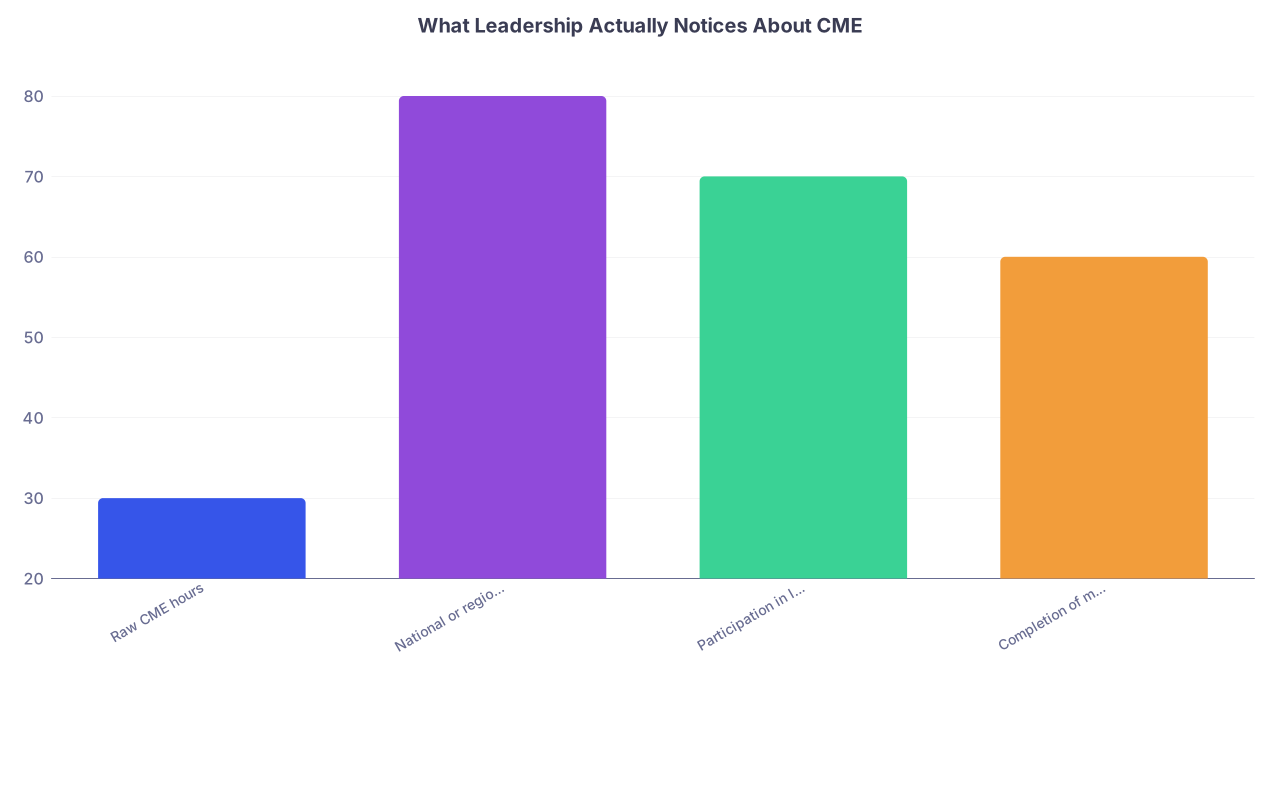
| Category | Value |
|---|---|
| Raw CME hours | 30 |
| National or regional presence | 80 |
| Participation in local CME events | 70 |
| Completion of mandatory modules on time | 60 |
The pattern is obvious: the hours matter for the state and the board. The type of CME and your engagement pattern matters for your reputation and career.
How Expectations Shift by Career Stage
A first-year attending is not judged the same way as a 15-year veteran. The unspoken bar moves.
| Stage | Academic Expectation | Community Expectation |
|---|---|---|
| Early (0–3 yrs) | Show up, start national presence | Be current, reliable with modules |
| Mid (4–10 yrs) | Present, lead sessions, course roles | Become local expert, join committees |
| Senior (10+ yrs) | Direct CME, mentor, visible leadership | Be standard-setter, QI and teaching |
Early Career
At an academic center, early on they’re asking:
- Does this person actually attend anything?
- Do they have any national involvement at all?
- Are they building a niche?
You do not need 3 national talks in year one. But if, by year 3, you’ve never set foot at a national meeting and your only CME is generic online modules, the quiet read is: “There’s no trajectory here.”
In a community job, early on they’re watching:
- Do you blow off mandatory education?
- Do you ignore local standards discussed at CME?
- Are you a black-box clinician or part of the clinical community?
I’ve heard more than once: “He’s clinically fine, but we never see him at anything. I don’t think he’s staying long.”
Mid-Career
This is where expectations sharpen.
At academic centers, by mid-career, they expect:
- Regular fellowship with your specialty’s big meetings
- Some kind of recurring role (session chair, workshop, course faculty, etc.)
- Documented QI or educational projects that double as CME
At community hospitals:
- You’re expected to be at least occasionally front-and-center: give a CME talk, run a journal club, lead a guideline implementation
- Your absence from educational activities starts to read like disengagement, not just “busy”
Late Career
For senior people, you either become:
- The respected educational anchor (“She runs the best CME series,” “He always updates us after ACC”)
or
- The cautionary tale (“He hasn’t changed how he practices in 15 years,” “She refuses to come to anything”)
The CME story you write over decades decides which one you become.
How to Quietly Play the CME Game Well
This is where the “insider” piece actually matters. Because you can meet requirements and optimize your positioning with just a little strategic thinking.
If You’re at an Academic Hospital
Prioritize visible, high-yield activities:
- Anchor your year around 1–2 major meetings in your field. Even if you present something small early on, get on the program. That line on your CV matters more than 20 hours of random online modules.
- Aim to speak locally at least once a year: grand rounds, division conference, interdisciplinary CME. These count for hours and reputation.
- Collect certificates, but track the story: “I’m the X niche person; I attend and present at X meetings; I help update X guidelines and run X local CME related to it.”
When you hit annual review, don’t just say, “Completed 45 hours CME.” Say, “Co-directed institutional CME course in X; attended and presented at [major conference]; contributed to ongoing CME-based QI project in Y.”
That’s promotion language. And chairs love that.
If You’re at a Community Hospital
Play to the culture and politics:
- Do mandatory stuff early. Being the one person always overdue on compliance modules is a red flag. It reads lazy and disorganized, fairly or not.
- Pick 1–2 hospital-based CME venues to show up at consistently: tumor board, specialty conference, occasional grand rounds. You want your face seen.
- Once a year, volunteer (or “agree” when asked) to give a CME talk in your area of interest. Suddenly you’re not just compliant—you’re a local expert.
You can still do your online modules at 11 p.m. Just make sure your CME log doesn’t look like a random scatter of cheap credits with nothing connected to your actual practice or your hospital.
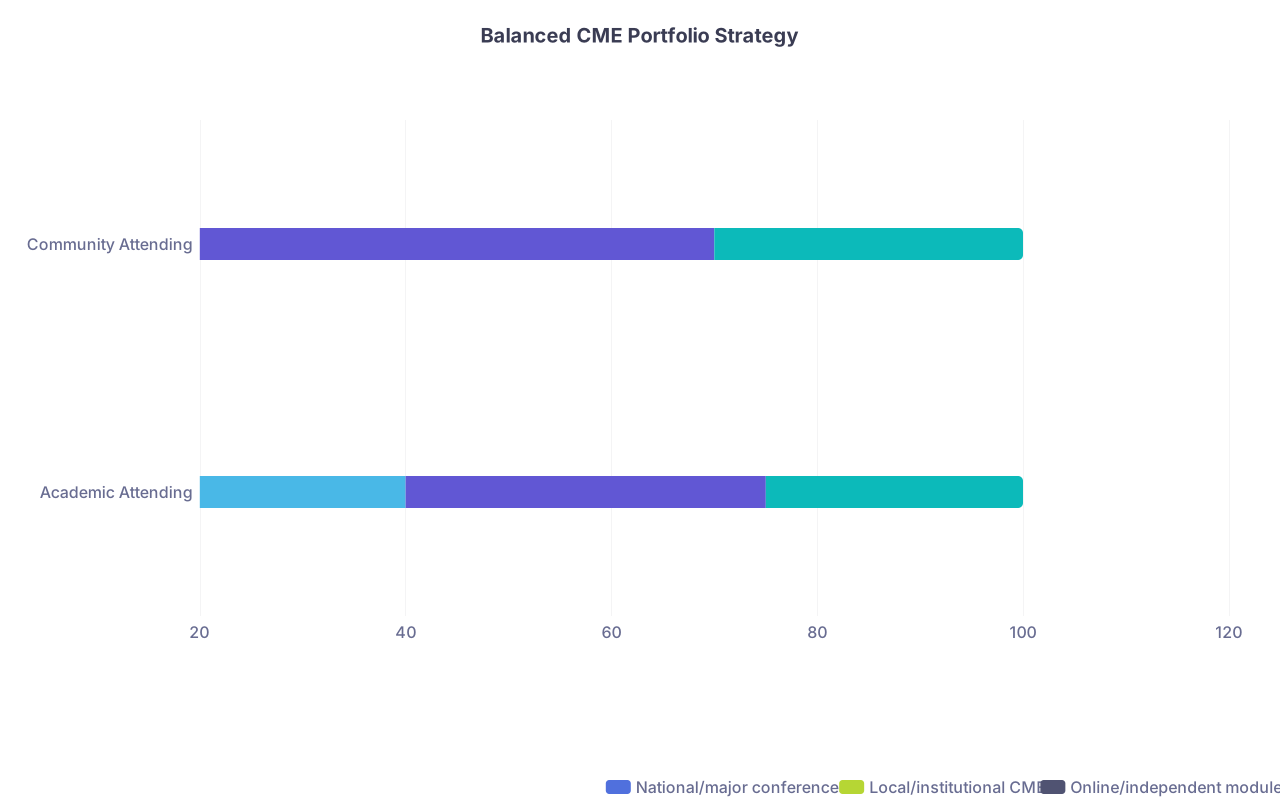
| Category | National/major conferences | Local/institutional CME | Online/independent modules |
|---|---|---|---|
| Academic Attending | 40 | 35 | 25 |
| Community Attending | 20 | 50 | 30 |
See that pattern? The numbers can vary, but the structure matters: some national or high-level stuff, some visible local engagement, and some background modules to top off your hours.
The Trap of “Cheap” CME
A quick word on the seductive stuff: free dinners, easy online quizzes, pharma-sponsored “education.”
At both academic and community hospitals, these are treated as CME calories. Cheap and filling, but nobody’s proud if that’s all you eat.
I’ve heard faculty reviewers say:
- “His CME is entirely drug-dinner talks and online modules. I’m not convinced he’s leading in his field.”
- “She never attends our own internal education, but racks up hours at external industry courses. It doesn’t reflect engagement here.”
I’m not saying avoid them. I’m saying don’t build your entire CME footprint out of them. Sprinkle, don’t anchor.
FAQs
1. Do program directors and department chairs actually look at specific CME activities, or just total hours?
They absolutely look at the type of CME when they care about your trajectory—promotions, leadership roles, reappointments, or performance concerns. For routine credentialing, they just need proof of hours. But in serious reviews, I’ve seen chairs flip through line-by-line: which conferences, what talks, what roles. Total hours keep your license. Specific activities shape your career.
2. Is it a problem if most of my CME is online?
Not automatically. For a busy clinician, a solid chunk of online CME is normal. The problem is when it’s only online and there’s zero evidence of engagement with your institution’s educational activities or your specialty’s major meetings. If you’re academic, that makes you look unserious. In community practice, it makes you look peripheral and disengaged. Mix in at least some live, local, or national events.
3. How many conferences do I “need” to attend at an academic job?
Nobody will state a number. But here’s the reality: if you’re at a major academic center and never show up at your specialty’s big meeting, eyebrows go up. Hitting one major meeting every 1–2 years, especially if you present, is a solid baseline. For highly academic tracks, yearly attendance at the main conference in your field is common and expected.
4. Does giving talks at my own hospital really matter for CME expectations?
Yes. More than people realize. In both academic and community settings, internal talks (grand rounds, tumor board presentations, CME lectures) do double duty: they meet requirements, and they brand you as a contributor and local expert. Someone who occasionally teaches is viewed very differently from someone who only ever consumes CME.
5. What’s the biggest CME mistake early-career attendings make?
They treat CME as a pure checkbox and chase quantity over narrative. They hoard random online credits without thinking how their CME footprint looks to leadership. The smarter move is to choose CME that aligns with your niche, your institution’s priorities, and your long-term goals—then make sure that pattern is obvious on paper and in person.
Key points to keep in your head:
- The state and your board care about CME hours. Your hospital and leadership care about what your CME says about you.
- Academic hospitals read CME as a marker of academic engagement and trajectory. Community hospitals read it as a marker of reliability, safety, and local buy-in.
- Stop playing the minimum-hours game alone. Build a CME pattern that makes you look like the kind of physician you actually want to be seen as.