
It’s a Tuesday afternoon and your “dream job” hospital has just finished your interview day. You think you nailed the clinical questions, got along with the group, even laughed with the department chief about an OR disaster story. You walk out feeling pretty good.
Upstairs, in a small windowless conference room, your fate is being decided.
The CMO, a service line director, and someone from HR have your packet open. CV, references, malpractice history—and another section you probably never think about:
Your CME record.
Not the glossy “I did 50 hours this year” line. The actual detail: What you chose. How consistently you did it. Whether it matches the story you sold them. Whether it quietly flags you as a risk.
This is the part nobody explains to you. So let’s pull the curtain back.
What Hiring Committees Actually See From Your CME
Here’s the first myth to kill: “They only care that I hit the minimum hours.”
That’s what you’re told in residency and by credentialing offices. Check the box, move on. That’s only half true.
For hiring, especially at larger systems, the picture is different. They rarely get a raw CE Broker dump or an ACCME portal printout. What they do get, depending on the institution and state, looks like this:
- A summary of total CME hours over a set window (often 2–3 years)
- A breakdown of Category 1 vs Category 2
- In many systems, a categorized summary: clinical, risk management, quality/safety, opioid prescribing, leadership, etc.
- Sometimes, a highlight of “flagged” areas required by the system (opioid training, abusive behavior remediation, documentation training, etc.)
At some places, especially big corporate systems (think HCA, Tenet, large academic-affiliated networks), credentialing will send the service chief a short “professional profile” with a line or two on CME patterns:
- “Maintains 60–70 hrs/year; strong focus on cardiology imaging and quality improvement.”
- Or, more ominously: “Completed multiple mandated professionalism and documentation CME after prior complaints.”
Nobody puts that in writing as “red flag.” But the clinical leaders know what they’re looking at.
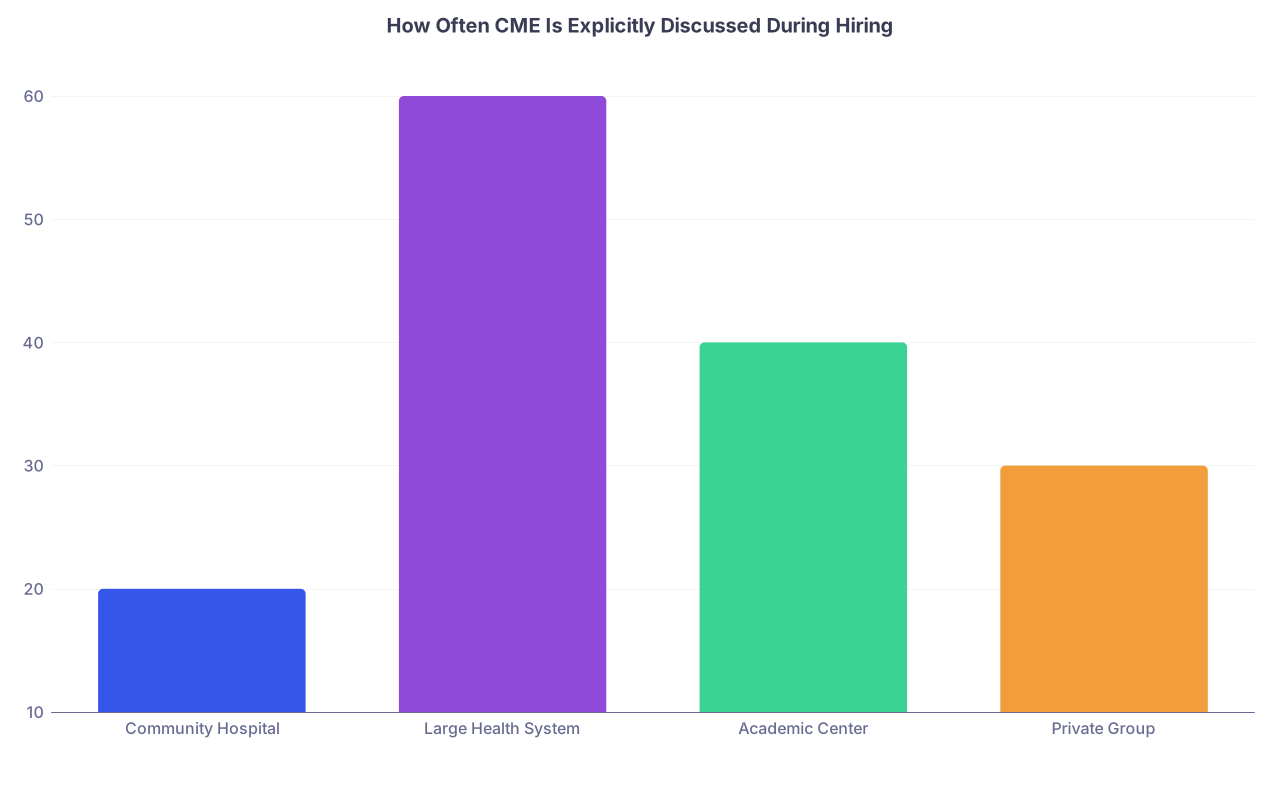
| Category | Value |
|---|---|
| Community Hospital | 20 |
| Large Health System | 60 |
| Academic Center | 40 |
| Private Group | 30 |
Now the key point: even where CME is not formally scored, it’s often informally interpreted. I’ve sat in those meetings. The phrase you hear is:
“Does their CME match what they say they are?”
This is where people get burned.
The Hidden Narrative Your CME Record Tells
Your CME history tells a story even if you never meant it to.
You walk in saying, “I’m a bread-and-butter general internist with a strong interest in quality and teaching.” They nod. Then someone quietly glances at your CME summary.
If your last three years of CME are 90% “Concierge Medicine Business Models,” “Financial Independence for Physicians,” and “Cosmetic Procedures for the Internist”… there’s a mismatch.
Let me break down the main storylines committees pull from CME records:
1. Consistency vs. Procrastination
Hiring leaders look at patterns, not just totals.
The classic pattern that raises eyebrows: A massive CME spike right before state/license renewal and almost nothing the first 18–24 months.
Translation in the room: “They cram everything into the last second. Probably like their documentation and charting.”
Some systems do not care. Others absolutely do. Especially ones obsessed with throughput, documentation timeliness, and “physician engagement.”
I’ve heard this exact line from a medical director:
“Look, if they treat CME like taxes, we’re gonna feel it in their charts and quality metrics.”
2. Alignment With Claimed Expertise
Say you market yourself as a “procedural hospitalist” or “complex ACHD cardiologist.” The group is recruiting because they need that niche.
If your last few years of CME are almost entirely generic “Hospital Medicine Updates” and nothing procedural, it triggers doubt. Not always enough to kill the hire—but enough to bump you below another candidate whose CME clearly reflects that subspecialty.
On the flip side, candidates win battles this way. I’ve seen committees move a borderline applicant up the stack simply because:
“Look at the last four years—consistent EP-focused CME, device management, ablation updates. They’re clearly living in that world.”

3. Professionalism and “Remediation” Footprints
This one nobody tells you about in training.
Certain CME courses scream “this was disciplinary.” Examples:
- “CME on Professional Boundaries and Workplace Conduct”
- “Anger Management in the Medical Workplace”
- “Medical Record Documentation: Avoiding Fraud and Abuse”
- “Safe Opioid Prescribing” in a physician with a known DEA or prescribing issue
When these appear suddenly clustered, and especially when they correlate with prior job changes or gaps, leaders notice.
There is usually no note attached saying “this was mandated after an incident.” But senior faculty and directors have seen enough to infer it.
Here’s what really happens:
In the hiring meeting, someone flips through the file and says, “They’ve done some professionalism remediation courses in the last year. Anyone know the backstory?”
If your references and your narrative do not preempt or explain that, the story gets written for you.
How Different Settings Use CME in Hiring
Not all employers treat CME the same. The range is wide, from “pure checkbox” to “soft signal we heavily weigh.”
| Setting | CME Role in Hiring |
|---|---|
| Small private practice | Minimal; license compliance |
| Community hospital | Moderate; red-flag scanning |
| Large health system | High; pattern and alignment |
| Academic center | High; content & scholarly fit |
| Locums agencies | Hours checked, content rarely examined |
Community Hospitals
Community hospitals mostly want to know:
- Are you current and in good standing with license and board?
- Any glaring risk-management or professionalism CME clusters that suggest past trouble?
If the answer to both is acceptable, CME rarely decides between candidates. It’s more a background risk screen.
But here’s the trick: if there’s a “tie” between two decent candidates, and one has clear, high-quality clinical CME relevant to the hospital’s needs, guess who seems more serious and engaged?
Large Health Systems
This is where CME records get weaponized, in both good and bad ways.
Big systems are terrified of:
- Quality metrics tanking
- Lawsuits
- DEA or prescribing scandals
- Public reputational hits
So they quietly like candidates whose CME shows:
- Regular risk management / quality improvement content
- Opioid and controlled substance stewardship
- EMR optimization and documentation quality
- Leadership or team dynamics, especially for potential future chiefs
I sat in on a discussion at a large midwestern system where a director said, “I like that they’ve clearly invested in quality and safety CME. Makes me think they won’t be a cowboy.”
That’s code for: “I think this person will not blow up our metrics or create a federal case.”
Academic Centers
Academics care less about the sheer number and more about what you do and whether it matches the package:
- Subspecialty CME in your niche? Good.
- Education-focused CME or teaching workshops for a clinician-educator track? Very good.
- Leadership CME for someone aiming at program director or division chief? They love it.
Some departments basically ignore CME content for junior hires. Others absolutely use it to confirm your claimed academic identity.
What they don’t like: A “future academic leader” whose last three years of CME are all generic, no advanced content, no real evidence of niche development.
Locums and Staffing Agencies
For pure locums, CME matters almost only for license and credentialing.
But occasionally, when you’ve had problems, they’ll ask: “Have you completed CME related to X?” That’s not academic curiosity. That’s them building a paper defense in case they get sued for placing you.
Red Flags in CME That Really Hurt Candidates
Nobody hands you this list. You’re supposed to “just know.”
Here are patterns I’ve seen tank or significantly weaken otherwise competitive candidates:
1. Repeated “Remedial” Topics Without a Story
One professionalism or boundaries course after a bad incident that you explain? Fine. Two or three across multiple years and multiple jobs? That looks like a pattern.
If you have this history and you do not own the narrative, hiring committees will assume the worst.
2. Zero Specialty-Relevant CME for Years
This hits mid-career especially hard.
Example: A cardiologist going for an advanced HF job, and the last 4 years of CME are all “General Internal Medicine Update,” “Coding and Billing,” “Physician Wellness,” and nothing HF or devices.
The whispered comment: “Have they actually kept up? Or are they coasting?”
For procedurally heavy fields (GI, IR, ortho, EP), lack of procedural or technique-related CME is an even bigger problem.
3. Chronically Bare-Minimum Behavior
If your record shows exactly the minimum required hours, taken in one or two big, last-minute blocks, year after year, that does not scream “intellectually engaged physician.”
Some leaders do not care. Others see it as an attitude issue.
One department chair put it bluntly to me:
“I don’t want the person who does the bare minimum legally required to maintain competence. I want the one who still cares enough to go beyond.”
Unfair? Maybe. But that’s the lens.
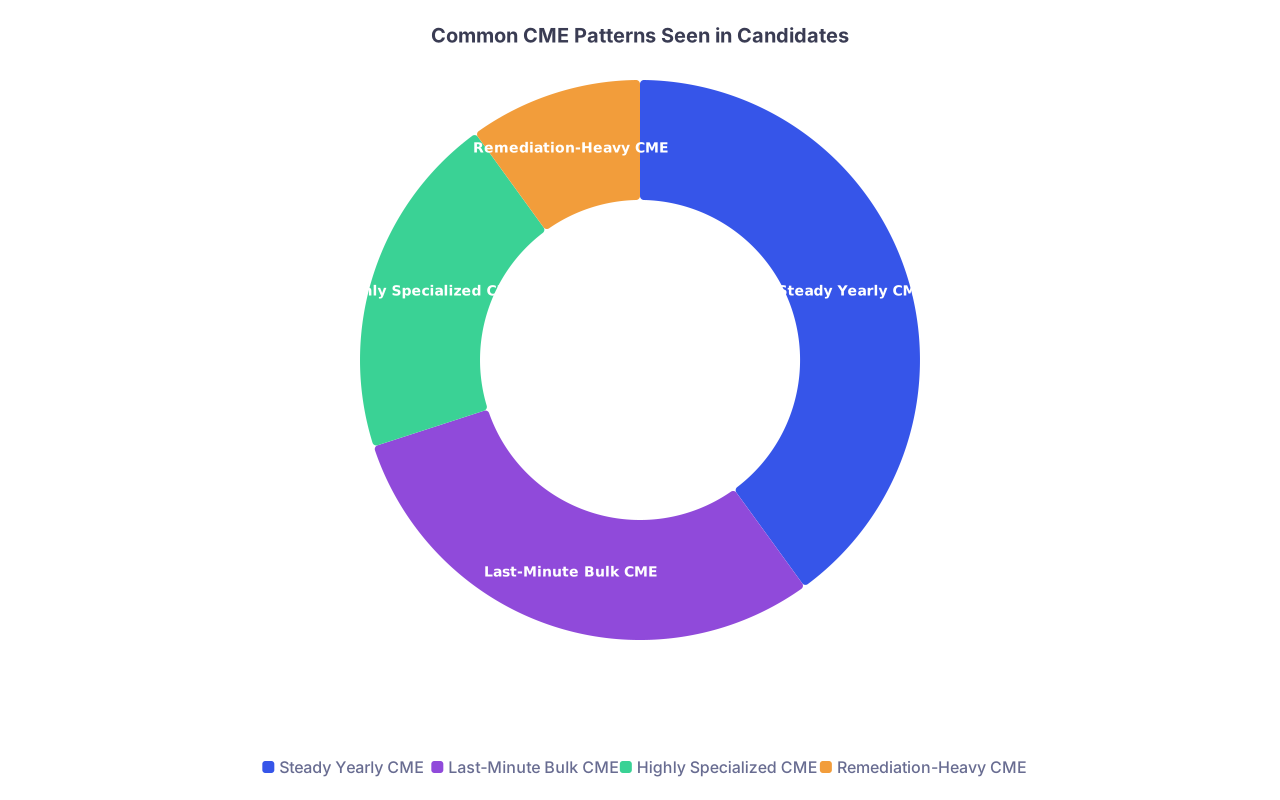
| Category | Value |
|---|---|
| Steady Yearly CME | 40 |
| Last-Minute Bulk CME | 30 |
| Highly Specialized CME | 20 |
| Remediation-Heavy CME | 10 |
4. Overemphasis on “Escape” Content
If most of your CME is about nonclinical topics—real estate, wealth building, exit planning, telemedicine entrepreneurship—and you’re applying for a demanding clinical job, people will raise an eyebrow.
No one will say it on email, but in the room you’ll hear something like:
“They’re clearly halfway out of clinical already. Are we just a bridge for them?”
If you are building a side path, fine. But balance your record. At least show credible clinical engagement in the window before you apply.
How Smart Candidates Use CME as a Strategic Asset
Here’s the part almost no one uses well: CME can actually sell you if you treat it as part of your professional brand instead of a yearly chore.
Build a Coherent Academic or Clinical Identity
Decide what “version” of yourself you want to be on paper 2–3 years before a major job move:
- Complex hospitalist with an interest in quality and patient safety
- Breast imager with a focus on screening equity
- EM doc with a niche in ultrasound and resuscitation
- PCP with addiction medicine and chronic pain expertise
Then make your CME reflect that. Not once, consistently. Year over year.
When a hiring committee sees your CV, your references, and then a CME record that all tell the same story, they trust it. Trust shortens the distance between you and an offer.
Use CME to Patch Perceived Weaknesses Before Anyone Brings Them Up
If you know you’ve got a soft spot—say, documentation or coding, or you’re coming from a low-volume setting—stack some solid CME in those areas a year before you move.
Then, in your interview, you can say:
“I realized my prior system was not strong on structured quality work, so I took X, Y, and Z CME on QI methodology and data-driven care. I’ve already started applying some of that.”
Now your CME record backs up your narrative of growth instead of exposing gaps.

Show Maturity With Nonclinical CME—In Moderation
Leadership, communication, conflict management, diversity/equity, wellness—these can all signal that you get the bigger picture.
The trap is looking like all you do is “soft” CME. The sweet spot: mostly clinically relevant CME, with a visible sprinkling of leadership and professionalism courses that support your story.
For example, if you’re pitching yourself as a future medical director:
- Clinical CME in your specialty
- Quality and patient safety CME
- One or two solid leadership/management CME offerings from reputable institutions
That combination makes chairs think:
“Yeah, I can see this person running a service in a few years.”
How to Talk About Your CME During Interviews
Most candidates don’t mention CME at all. That’s a mistake.
You do not need to hand them your CME transcript. But you should strategically reference it when it supports your story.
A few ways to do it without sounding contrived:
- When asked how you keep up to date: “I structure my CME around [subspecialty/problem], so the last few years I’ve focused on X conferences and Y online modules. That’s where I picked up [specific change you implemented].”
- When discussing a prior issue (like documentation or communication complaints): “After that feedback, I did a couple of specific CME offerings on [topic], and I changed how I handle [concrete behavior]. It’s made a big difference.”
- When they ask about your future goals: “I’ve started taking CME courses in [leadership/QI/education] because I see myself moving into [specific role] over the next 5–7 years.”
What you’re doing is forcing them to interpret your CME as intentional, not random.
One more quiet truth: when someone walks in clearly aware of their CME content and able to discuss it intelligently, it gives an immediate impression of professionalism. Most candidates can’t remember half of what they did to get those hours.
If You Already Have a “Messy” CME Record
Some of you reading this have the nightmare history:
- Disciplinary CME
- Gaps where you barely did anything
- Random, desperate credits from whatever free email link you got
You cannot erase the past, but you can shape what comes next.
Three things you should do right now:
- For the next 1–2 years, build a clean, coherent CME arc. Subspecialty aligned, quality and safety, maybe one or two clear remediation-type courses framed as proactive rather than punitive.
- Be ready with a calm, non-defensive explanation if asked about those older courses. Brief, factual, with emphasis on changed behavior—not excuses.
- Make sure your references and your actual performance now support the “new you.” If your CME says “mature, improving physician” but your references say “still a problem,” committees believe the humans, not the certificates.
A lot of people come back from early-career mistakes. But they do it by owning the narrative and backing it with consistent behavior. CME can be part of that evidence if you use it intentionally.
FAQ: Behind-The-Scenes CME Questions You’re Probably Thinking
1. Do hiring committees really have time to look at my CME in detail?
Not line-by-line, usually. They see summaries, categories, timelines, and sometimes key flagged courses. The more competitive the spot and the higher the risk (procedural, high-liability fields), the more likely someone actually scrutinizes it instead of just checking the total hours.
2. Will one professionalism or boundaries course automatically sink me?
No. One course—especially if it’s several years back and you have clean references and recent behavior—won’t kill your chances. A cluster of such courses, or more recent ones without a clear narrative, will absolutely make people nervous unless you address it head-on and demonstrate growth.
3. Do they compare my CME to other candidates directly?
Sometimes, yes. Especially when two candidates look similar on paper and in interviews, a chair might say, “Who seems more invested in X?” and your CME record becomes objective-ish evidence. The person with a clear pattern aligning with the department’s needs usually wins that comparison.
4. How far back do hiring committees usually look in CME?
Commonly 2–3 years, sometimes 5 for deeper due diligence or higher-level roles. Ancient history rarely matters unless it’s tied to prior board actions, DEA issues, or big scandals. Recent patterns carry the most weight—good and bad.
5. If my state only requires minimal CME, does doing more actually help me?
Yes—if what you do is coherent and relevant. Nobody’s impressed by random padding. But if your CME pattern strongly supports the role you’re applying for—procedurally, academically, or in quality/safety—it makes you look intentional, serious, and lower risk. In a close decision, that can be the edge.
Key points to walk away with:
- Your CME isn’t just a licensing checkbox; it quietly tells hiring committees who you are, what you care about, and how seriously you take your craft.
- Patterns matter more than totals—alignment with your claimed role, consistency over time, and avoidance (or smart handling) of “remedial” clusters.
- If you treat CME as a strategic tool instead of a yearly annoyance, it can move you from “generic candidate” to “obvious fit” behind those closed doors.