
The worst mistake physicians make after failing a CME audit is freezing.
You do not have that luxury.
If you failed a CME (Continuing Medical Education) audit—state board, specialty board, hospital medical staff, or maintenance of certification—the clock is already ticking on your license, privileges, and reputation. The good news: most CME audit failures are fixable if you move fast, document correctly, and stop guessing.
This is your playbook.
Step 1: Get Completely Clear on What You Actually Failed
Do not start emailing apologies or buying random CME packages yet. You need precision.
Pull out the actual notice and dissect it. If you do not have the full letter, get it. Call or portal-message the auditing body and ask for:
- The specific time period audited
- The exact CME requirements for that period
- The shortfall identified (hours, categories, formats)
- Any deficiencies in documentation (missing certificates, unacceptable proof, late completion)
- The deadline for response or remediation
- Possible sanctions listed if you do not comply
Now, rewrite their findings in your own words in a simple one-page summary. Something like:
- Audit body: Texas Medical Board
- Audit period: 11/01/2021 – 10/31/2023
- Requirement: 48 hours CME, including
- 24 AMA PRA Category 1 Credits
- 2 ethics / professional responsibility
- 2 pain management / opioid prescribing
- My deficiency (per board):
- Only 32 total hours submitted
- Only 14 Category 1
- No ethics hours documented
- Several activities completed after the end of the audit period
If anything above is unclear, you do not guess. You clarify.
Send a brief, targeted message (email or portal):
“I received your CME audit findings dated [date]. To ensure a complete and accurate response, can you please confirm:
- The exact CME requirements for my audit period
- The specific shortfalls identified
- Whether CME completed after [audit end date] can be used toward remediation
Thank you.”
You want their rules in writing. That becomes your boundary conditions.
Step 2: Build a Reconstructed CME Ledger for the Audit Period
You are not just collecting certificates. You are building a defensible audit package.
Create a simple spreadsheet (Excel, Google Sheets, whatever you use). Columns should include:
- Date of activity
- Activity title
- Provider / Sponsor
- Credit type (Category 1, Category 2, state-specific categories)
- Number of credits
- Format (live, enduring online, journal-based, etc.)
- Topic tags (ethics, opioids, risk management, etc.)
- Location (conference, online platform name)
- Proof available? (Yes/No)
- Notes (e.g., “certificate pending,” “attendance roster,” “program cancelled”)
Now reconstruct everything you did in the audited window. Sources:
- Email inbox (search “CME certificate,” “AMA PRA Category 1,” “CME credit,” “CE certificate”)
- Main CME platforms:
- AMA, CMEonline, UpToDate, AudioDigest, specialty society sites
- Conference providers:
- ACCME-accredited meetings (local hospital systems, specialty conferences)
- Maintenance of Certification (MOC) portals:
- ABIM, ABFM, ABS, ABP, etc.—many activities double-count for CME
- Hospital/health system education portals
- Journal-based CME (print or online)
Do not filter yet. Dump everything into the sheet if it occurred in the audited date range.
When you are done, sum the hours by:
- Total hours
- Category 1 vs Category 2
- Required subcategories (ethics, opioid prescribing, risk management, state-mandated topics)
Now compare your real reconstructed totals against:
- What you originally attested/renewed with
- What the audit body says you submitted
- Their required numbers
This is where you see: is it a documentation problem, a real hours deficit, or both?
Step 3: Separate Problems into Three Buckets
You fix audits faster when you stop treating everything as one big mess. Sort your issues into three buckets:
Bucket A: Hours You Have and Can Prove
These are activities within the audit period that:
- Match an approved credit type
- Are from accredited providers
- Have acceptable documentation
Proof that usually passes:
- Certificate of completion with:
- Your name
- Activity title
- Provider
- Date completed
- Number and type of credits
- Official transcript from a major CME provider or specialty society
- MOC transcript that explicitly lists CME credits granted
You will re-submit or newly submit these in your response package.
Bucket B: Hours You Have but Documentation Is Weak or Missing
Examples:
- You attended a hospital grand rounds but only have your own notes, no sign-in log
- You completed a journal CME but never downloaded the certificate
- Provider’s website portal access expired
- Provider no longer exists or merged, and their old portal is gone
For each of these, decide:
Can you reasonably reconstruct acceptable proof?
- Contact provider for duplicate transcripts or certificates
- Ask medical staff office for attendance records
- Log back into the CME platform if still active
Is it faster to replace the hours with new CME?
- If the provider is slow or non-responsive, do not bet your license on them
You do not argue about these unless you can get proper documentation. Boards rarely accept “I swear I attended.”
Bucket C: Hours You Truly Did Not Earn
This is the painful one.
Maybe you:
- Misunderstood Category 1 vs Category 2
- Assumed internal hospital training counted but it did not
- Thought MOC automatically populated CME and it did not
Own it. Quietly. This is where you plan targeted remediation.
Step 4: Confirm What Counts for Remediation—Do Not Assume
Before you start blasting through online CME modules at 1.5x speed, get clarity on what the auditor will accept as remediation.
Common questions you need answered:
- Can CME completed after the audit period count, if designated as “remedial”?
- Are there limits on online CME vs live CME?
- Are there caps on how many hours can be in a single domain?
- Must remedial CME be completed by specific providers (e.g., board-approved courses)?
- Does extra CME apply only to the audit period or also satisfy current renewal?
If they have published guidance, read it. If they do not, you send another short, precise question set.
You are trying to avoid this scenario: you do 30 online hours in a panic, then find out only 15 of that type can be applied.
Step 5: Design an Aggressive but Realistic Remediation Plan
Now you know:
- The required totals
- What you already have and can prove
- The actual deficits
Your next move: build a remediation plan that looks intentional, not desperate.
Break your deficit down:
- Total hour deficit (e.g., 12 hours)
- Specific category deficits (e.g., 2 ethics, 3 opioid/pain, 4 risk management)
- Format constraints (if any)
Then pick CME sources that plug these gaps with minimal complexity. You want a small number of high-yield activities, not 40 random 0.25-credit modules.
| Need | Solution Type |
|---|---|
| Fast Category 1 hours | Online ACCME-accredited CME |
| State-specific topics | State medical society courses |
| Ethics / professionalism | Specialty board or state CME |
| Opioid / pain | State-mandated opioid courses |
| Risk management | Malpractice carrier CME |
A simple plan structure:
- Core deficit fill
- Example: 10 Category 1 hours general CME from an ACCME-accredited online platform
- Targeted requirement fill
- 2 hours ethics from state medical society course
- 3 hours opioid prescribing from state-approved program
- Buffer
- Add 10–20% extra hours beyond the minimum requirement to avoid borderline disputes
Document this plan in a one-page “Remediation Action Plan” that you will attach to your response. It shows you are methodical, not scrambling.
Step 6: Execute CME Remediation Like a Project, Not a Hobby
Once you have the plan, treat it like a procedure:
- Block calendar time
- Batch similar activities
- Capture certificates immediately
Use a simple checklist approach:
- Schedule exact days/times to complete each course
- After each course:
- Download certificate
- Save as PDF with consistent naming:
2025-01-10_Ethics_CourseName_2h.pdf - Update your CME ledger with completed status
- Back up everything in at least two locations (local + cloud)
To stay honest with yourself, build a weekly status:
- Hours remaining (by category)
- Courses still pending
- Time left before your audit deadline
You do not want to be clicking through a 3-hour opioid course at 11:47 pm on the day your response is due.
Step 7: Build a Clean, Professional CME Audit Response Packet
You now need to present your case like a competent professional, not like someone throwing PDFs at a regulator.
Your response packet should have:
- Cover letter (1–2 pages)
- Reconstructed CME ledger (spreadsheet or table printout)
- Copies of CME documentation (organized, labeled)
- Remediation plan and proof of completion
1. Cover Letter Structure
Keep it factual, concise, and respectful. No drama. No excuses.
Suggested structure:
- Acknowledge receipt of the audit findings
- Briefly summarize your understanding of the deficiencies
- Explain, in neutral language, the cause (if appropriate)
- Outline what you did to correct and prevent recurrence
- Indicate that supporting documentation is attached and organized
Example tone:
“I am writing in response to your CME audit notice dated [date].
For the audited period [dates], your initial review identified a shortfall in documented CME, including [summary of specific deficits].
After reviewing my records and reconstructing my CME activities for that period, I identified both documentation gaps and an actual deficit in [specific categories]. I have since completed the necessary CME to fully satisfy and exceed the requirements for that period, as outlined in the enclosed CME ledger and supporting documentation.
I have also implemented the following changes to prevent recurrence: [brief bullet list—centralized tracking, quarterly reconciliation, etc.].
Enclosed please find:
- Updated CME ledger for the audited period
- Certificates and transcripts for all applicable activities
- Documentation of additional remedial CME completed
Thank you for your consideration.”
Do not over-apologize. You are fixing a compliance problem, not confessing a crime.
2. Organizing Documentation
Think like the person on the other side of the desk who has 200 of these cases.
- Group documents by year or activity type, matching your ledger
- Number each activity in your ledger (1, 2, 3, …)
- Name your PDF files and/or put a small “Activity #” at the top of each certificate
Example structure:
- Tab 1: CME Ledger
- Tab 2: Certificates 1–10 (Audit period activities)
- Tab 3: Certificates 11–20 (Remedial activities)
- Tab 4: Provider transcripts
If submitting electronically, bundle into a single bookmarked PDF or a clearly labeled folder structure.
Step 8: Submit Early and Confirm Receipt
Do not flirt with the deadline. If they gave you 30 days, aim to submit in 10–14.
When you submit:
- Follow their instructions exactly (portal upload vs email vs paper mail)
- Keep proof of submission (portal confirmation, email sent receipt, certified mail receipt)
If you send it electronically, ask for a confirmation of receipt if not automatically provided.
Short, to the point:
“I am confirming that my CME audit response, submitted on [date], was received and is under review. Please let me know if any additional information is needed.”
Then stop pestering. But track your own follow-up timeline. If their standard review time passes, one polite follow-up is reasonable.
Step 9: Handle Potential Sanctions or Conditions if They Do Not Clear You Cleanly
Sometimes, even with remediation, the board or institution may:
- Issue a formal or informal warning
- Add monitoring or probationary periods
- Require periodic CME reporting for a defined time
- Impose a fine
If that happens, your job is twofold:
- Protect your license and privileges
- Protect how this looks on future applications (jobs, credentials, insurance panels)
If the letter uses words like “probation,” “public order,” or “reportable to NPDB,” talk to a health care attorney experienced with licensing boards. Not your cousin who does real estate closings.
For milder outcomes (e.g., “we consider this resolved with your remediation, but you will be re-audited next cycle”), you:
- Document every step you took
- Keep a permanent CME archive for that period
- Make sure you fully understand what must be disclosed on future credentialing applications
Do not lie by omission. Credentialing committees see these patterns all the time. A well-managed past CME issue usually matters far less than a later discovery that you hid it.
Step 10: Build a No-Drama System So You Never Fail a CME Audit Again
You are not done until you fix the underlying system. Otherwise, you will be back here in 2–4 years, older and more tired.
You need three things:
- A single source of truth for CME tracking
- A repeatable workflow every time you complete CME
- A scheduled audit of yourself before the board ever contacts you
1. Single Source of Truth
Pick one of these and commit:
- A dedicated CME management app/platform
- A well-designed spreadsheet in your cloud drive
- Your specialty board’s CME/MOC portal (if it reliably tracks external CME)
Rules:
- No more random sticky notes, folder of PDFs on your desktop, and emails buried somewhere between spam and newsletters
- Every CME activity goes into this system within 24–48 hours of completion
2. Repeatable Workflow
Here is a simple workflow that works:

| Step | Description |
|---|---|
| Step 1 | Complete CME Activity |
| Step 2 | Download Certificate |
| Step 3 | Save to CME Folder |
| Step 4 | Log in CME Ledger |
| Step 5 | Tag Topic and Credit Type |
| Step 6 | Backup to Cloud |
Your personal rules:
- No CME counts until it is logged and documented
- Certificates are named and filed the same way every time
- If a provider does not give clear documentation, avoid them in the future
3. Pre-Emptive Self-Audits
Once a year—mark it in your calendar—you perform your own mini audit.
What you check:
- Current cycle requirement vs hours completed
- Category-specific requirements vs what you have (ethics, state topics, opioids, etc.)
- Gaps in documentation (any activities without certificates or proof)
If you are in a 2-year cycle, your self-audit at 12–18 months is where you correct course, not two days before renewal.
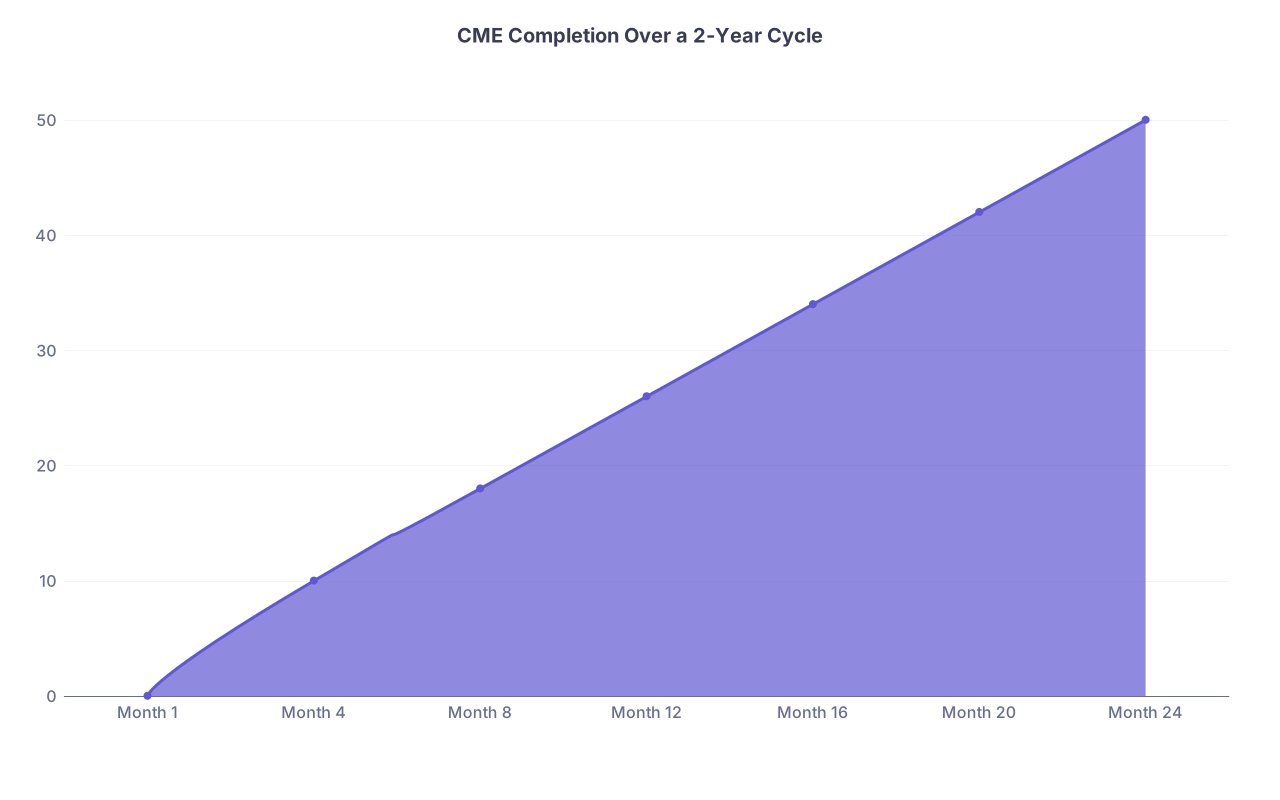
To visualize this, think of it as your own internal “CME pressure curve”:
| Category | Value |
|---|---|
| Month 1 | 0 |
| Month 4 | 10 |
| Month 8 | 18 |
| Month 12 | 26 |
| Month 16 | 34 |
| Month 20 | 42 |
| Month 24 | 50 |
You want that line steady, not flat for 20 months then vertical at the end.
Special Cases: State-Specific Landmines You Cannot Ignore
Some boards and systems are far less forgiving. A few examples where you must be extra careful:
- Texas, Florida, California, New York – often have specific mandates on prescribing, pain, ethics, or domestic violence
- DEA-related training – new federal requirements for opioid/substance use CME affect many prescribers
- Hospital medical staff bylaws – conditional privileges, focused professional practice evaluation (FPPE) triggers, or “automatic relinquishment” if CME not documented
If your audit failure involves any of these, you ensure your remediation specifically names and addresses:
- The exact requirement
- The provider accreditation
- The hours and content description matching the language of the requirement
Do not submit a generic “online pain course” when the rule requires a “state-approved opioid risk mitigation training.”
When to Bring in Help (And What Kind)
You do not need a consultant for every minor CME hiccup. But you should not manage serious risk alone.
Get expert help if:
- Your board letter mentions potential public discipline
- Your hospital privileges are already suspended or about to be
- There is any mention of NPDB reporting
- You have prior compliance issues (CME, charting, prescribing)
Types of help:
- Health care attorney – for board and licensure implications
- Medical staff office or credentialing specialist – for hospital and payer implications
- Professional organization – many specialty societies have resources or guidance for CME compliance
Bring them in early, with your reconstructed ledger and the audit letter ready to review. Do not show up saying, “I think I messed up, but I do not know how.”
Cement the Habit: Turn CME from a Chore into a Strategic Tool
You got into trouble because CME was treated as:
- A checkbox for license renewal
- Something to “catch up on” every two years
- A background annoyance, not a defined part of your professional life
Flip that.
Use CME to do two things at once:
- Maintain and easily prove compliance
- Build real expertise in areas you actually care about
The way you do that:
- Choose 1–2 core CME providers or platforms that track everything cleanly
- Pick yearly CME themes tied to your practice (e.g., diabetes tech, perioperative medicine, leadership)
- Make quarterly CME blocks part of your schedule instead of occasional panic marathons
And above all: do not click through mindless modules just for credit. That is how people lose track, mis-document, and end up audited.
Your Next Step Today
Do one concrete thing now, not “later this week.”
Open your latest CME audit notice or your last renewal confirmation, and write down—on one page—the exact CME requirements for your current cycle, including subcategories. Then start a fresh CME ledger (spreadsheet or app) and log every activity you can document from the current cycle.
That single page and that ledger are the foundation that keeps your next audit from turning into a crisis.