
The way most physicians treat CME is lazy and expensive: a box-checking exercise that wastes time you could be using to advance your career.
You can flip that completely. Mandatory CME can become one of your strongest promotion tools—if you stop treating it as an obligation and start treating it as a strategic project.
Below is a practical blueprint for doing exactly that.
Step 1: Redefine What CME Is For You
CME is not primarily about credits. It is about leverage.
For your institution, CME is risk management and compliance. For you, CME can be:
- A documented record of focused growth in the direction you want your career to go.
- A source of visible wins that your chair or CMO can put into a promotion packet.
- A way to build reputation outside your institution (which later pressures your own place to promote you).
So you stop asking: “What is the easiest way to get 25 credits this year?”
You start asking: “What promotion story do I want my CME record to help me tell in 3–5 years?”
Define your “Promotion Story”
Pick one promotion narrative, not five. Scattered effort kills advancement.
Common, promotable lanes:
- Clinical excellence with a niche focus
- Quality improvement / patient safety leadership
- Medical education and teaching
- Research / outcomes and implementation science
- Administrative / operational leadership
- Digital health / informatics
You should be able to say one sentence like:
“I am becoming the go-to person in our system for [X], and here is my documented trajectory.”
Write that sentence down. Everything that follows will aim directly at it.
Step 2: Map CME to Your Promotion Criteria
Your promotion committee does not care that you completed “27.5 AMA PRA Category 1 Credits.” They care about evidence that you are progressing on specific criteria.
You need to reverse-engineer those criteria and then weaponize your CME to hit them.
Pull the actual promotion document
Not the vague summary. The real rubric or guidelines. Every reasonable institution has one.
Common buckets:
- Clinical excellence
- Scholarly activity
- Teaching and mentoring
- Service / leadership
- Reputation (local, regional, national)
Now connect those buckets to specific CME choices.
| Promotion Bucket | High-Leverage CME Choice |
|---|---|
| Clinical excellence | Subspecialty courses, case-based workshops |
| Teaching / education | CME on curriculum design, assessment |
| Scholarship | QI methodology, implementation science CME |
| Leadership / service | Physician leadership, operations, health policy |
| Reputation building | Speaking at CME conferences, presenting posters |
You should see immediately that:
- Generic “update” web modules = low leverage
- In-person or live virtual work with deliverables, projects, or presentations = high leverage
From this point on, “low leverage CME” is guilty until proven otherwise.
Step 3: Design a 3-Year “Promotion-Focused CME Plan”
Promotion is multi-year. Your CME should reflect that. One-off random conferences will not move a committee.
Set a 3-year arc with clear themes.
1. Pick your focus domain
Examples:
- “Perioperative patient safety and QI”
- “Undergraduate medical education and assessment”
- “Hospital throughput and operations”
Lock it in. This is the spine of your CME plan.
2. Build a basic 3-year structure
You want compounding value:
Year 1 – Learning and exposure
Year 2 – Implementation and visible projects
Year 3 – Dissemination and external recognition
Let us make this concrete with an example: Path toward promotion using CME for a QI-focused hospitalist.
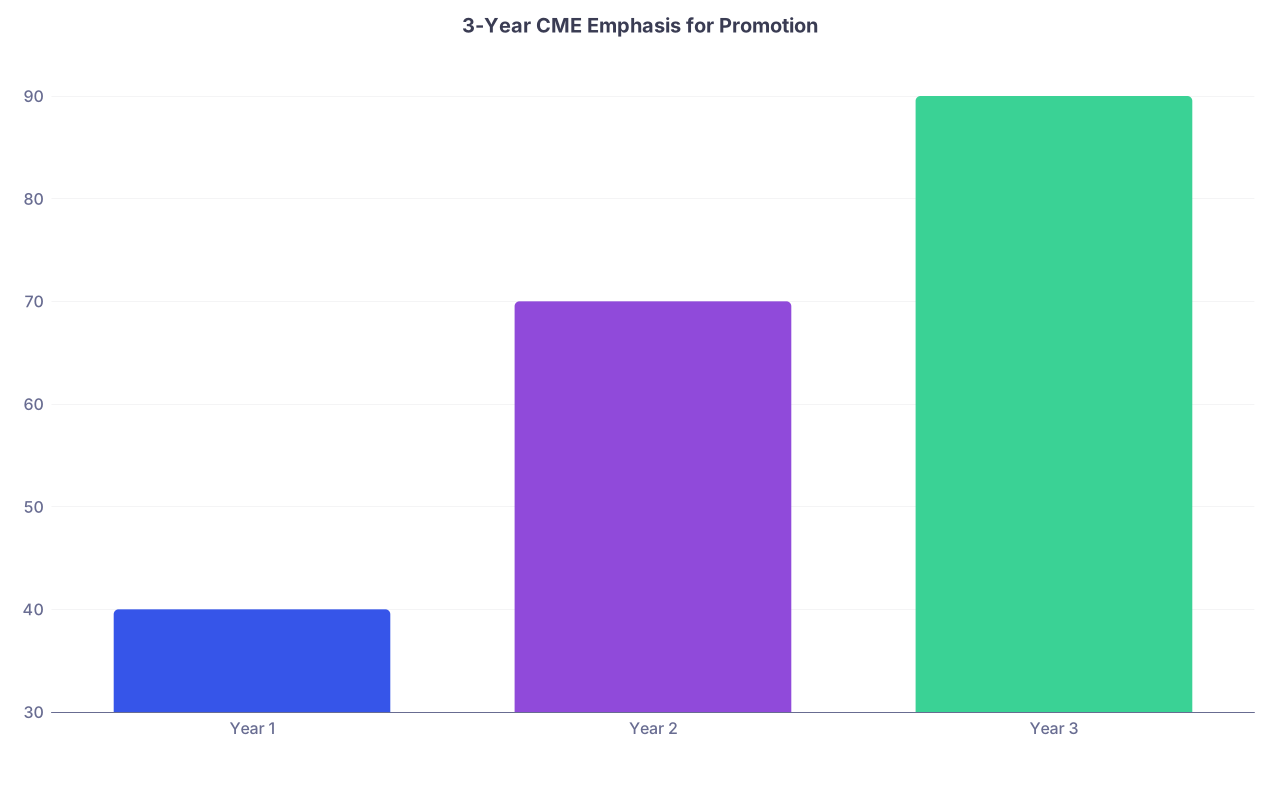
| Category | Value |
|---|---|
| Year 1 | 40 |
| Year 2 | 70 |
| Year 3 | 90 |
Interpretation (not printed on the chart): growing “leverage” of CME each year as you move from passive learning to visible impact and dissemination.
Year 1: Learn and position yourself
- CME choices:
- Intro or intermediate QI/PS courses (IHI Open School, ASQ, local system programs)
- Specialty-specific safety courses (periop safety, sepsis management, etc.)
- Leadership “fundamentals” CME
Deliverables you intentionally create from these:
- A completed QI training certificate
- A draft QI project proposal relevant to your service line
- A short internal presentation summarizing key learning (to your group or department)
Year 2: Execute projects
- CME choices:
- Project-based QI courses where you implement a real initiative
- CME on data analysis, run charts, PDSA cycles, implementation science
- Communication and change management CME
Outputs tied to promotion:
- One or two implemented QI projects with:
- Baseline and post-intervention data
- Documented reduction in errors, LOS, readmissions, etc.
- Poster or abstract submitted to a regional or national meeting
- Internal recognition: present at department grand rounds or a hospital QI forum
Year 3: Disseminate and step into visible leadership
- CME choices:
- Conferences where you can present (quality congresses, specialty QI tracks)
- Advanced leadership CME (physician executive programs, AAPL, etc.)
- Education-focused CME if you want to teach QI to learners
Deliverables:
- Accepted presentation(s) at regional/national meetings
- Co-authored paper, toolkit, or protocol shared within or beyond your system
- Documented leadership roles:
- Chair of a QI committee
- Advisor on a hospital safety initiative
- Faculty in a local QI curriculum for residents
Now you have a 3-year CME trail that screams: “This person is a QI leader” rather than “This person did the minimum credits.”
Step 4: Turn Each CME Activity into Artifacts You Can Use
The credit certificate is the least valuable output of CME. Treat it as a receipt. The real assets are the artifacts you deliberately pull out of each activity.
For every CME event or course, aim to create at least one of the following:
- A slide deck
- A protocol or checklist
- A short written summary or guide
- A micro-project or pilot in your clinic / unit
- A teaching session for learners or colleagues
- An abstract or poster
Here is a simple rule: No CME without at least one artifact.
How to systematize this
After any significant CME (conference, multi-hour course, workshop):
Block 30–60 minutes on your calendar within 72 hours.
Ask three questions:
- What is one thing I can implement this month?
- What is one thing I can share with others?
- What is one way I can document this for promotion?
Then create:
- A 1-page summary with:
- Title of CME, date, provider
- 3–5 high-yield takeaways
- One specific application to your local environment
- A short email or slide deck for your team or trainees
- A note in your promotion file (I will get to that system shortly)
- A 1-page summary with:
You are turning passive hours into tangible outputs that committees can see, touch, and cite.
Step 5: Choose CME Formats That Actually Promote You
Not all CME is created equal. Some types are basically invisible to a promotions committee. Others make their job easy.
Here is the rough hierarchy of impact.
| Impact Level | CME Format Example |
|---|---|
| Very High | Speaking at CME events, course faculty roles |
| High | Workshop participation with project requirement |
| Medium | In-person / live virtual conferences |
| Low | Passive online modules, pharma dinners |
High-yield CME formats and how to exploit them
Project-based CME programs
These are gold. Examples:
- Longitudinal QI collaboratives
- Teaching academies that include curriculum projects
- Leadership development programs with capstone initiatives
How to use them:
- Choose a project that solves a real problem your chair cares about.
- Collect data before and after.
- Present results internally. Then externally.
- Put the certificate, the project report, and the presentation in your promotion file.
Conferences with presentation opportunities
Any CME that allows or encourages:
- Abstract submissions
- Poster presentations
- Oral presentations
Strategy:
- Use your CME-inspired projects and protocols as the basis for abstracts.
- Even a simple resident teaching innovation can become a poster at a medical education meeting.
- Each accepted presentation doubles: CME hours + academic productivity.
Faculty development and teaching CME
If teaching is your promotion lane, lean hard into:
- Simulation instructor training
- Curriculum design CME
- Assessment and feedback workshops
Then:
- Build or co-build a teaching module.
- Run it regularly for residents or students.
- Track numbers: how many learners, how often, any evaluations.
Leadership CME
Things like:
- AAPL courses
- “Physician in Management” programs
- Health system leadership academies
Use these to:
- Qualify yourself for formal titles: medical director, section chief, course director.
- Show a narrative: “First I took X, then I led Y, then I was appointed Z.”
Low-yield CME (generic modules, passive lunch lectures) still have a place. They fill leftover credit needs. They should not form the backbone of your record.
Step 6: Build a Simple Promotion-Focused CME Tracking System
Most physicians keep their CME tracking in a shambles and then panic when academic affairs asks for a packet.
You can fix this with a one-hour setup and five minutes a month.
Set up a “Promotion Engine” folder
Digital. Cloud-based. Named something that reminds you what it is:Promotion – CME and Outputs
Inside, create:
01_CME_Certificates02_Artifacts (Slides, Protocols, Tools)03_Projects and Outcomes04_Presentations and Publications05_Promotion Narrative Notes
Every time you complete a meaningful CME activity:
- Drop the certificate PDF into
01_CME_Certificates. - Save any materials you created (slides, summaries) into
02_Artifacts. - If it launched or supported a project, track that in
03_Projects and Outcomeswith:- 1-page description
- Baseline data
- Follow-up data
- Key dates and people involved
- Note any external outputs (posters, talks) in
04_Presentations and Publications.
Then, once a quarter, open 05_Promotion Narrative Notes and add a few bullet points:
- “Spring 2026 – Completed 3-month QI CME, used to launch sepsis project, LOS down 0.4 days, presented to department.”
- “Fall 2026 – Presented at regional hospitalist meeting, invited to join system-level sepsis task force.”
When promotion time comes, you are not inventing a story from scratch. You are pulling a story you have been writing in real time.
Step 7: Make Your CME Visible to the People Who Decide Promotions
If your chair never hears about your CME-linked work, it might as well not exist.
You do not need to brag. You need to report progress.
Use brief, structured updates
Twice a year, send your chair or section chief a focused email. Something like:
Subject: Update – QI Work and CME-Related Projects (Jan–Jun)
I wanted to share a brief update on the QI and safety work I have been focusing on, much of which came out of the CME/leadership programs the department has supported.
- Completed [Name of CME] (X credits) – applied lessons to our sepsis pathway.
- Led a pilot on [brief description], which resulted in [key metric change].
- Presented this work at [forum/conference].
- Next steps: expanding the project to [area] and preparing an abstract for [meeting].
I appreciate the department’s support for CME – it is directly contributing to these outcomes.
This does three things:
- Links CME funding to tangible departmental benefit.
- Reinforces your chosen lane (QI, education, leadership, etc.).
- Plants the idea of you as “the person who is progressing and adding value” long before a promotion packet appears.
Use annual reviews intelligently
When your chair asks about goals for next year, you do not say “Keep up with CME.” You say:
- “Complete [specific CME course] to support my role as X.”
- “Use that training to lead Y project with Z measurable goals.”
- “Aim to present that work at [target meeting].”
You are pre-authorizing your future accomplishments.
Step 8: Leverage CME to Move into Formal Roles
Promotions often hinge on titles:
- Course director
- Committee chair
- Medical director
- Program director
- Track leader
You can use CME as a pretext to get those roles instead of waiting for them magically.
Concrete playbook
Identify a small, realistic role you want:
- “Co-director for resident QI curriculum”
- “Lead for our clinic’s access improvement project”
- “Physician champion for a new protocol”
Take targeted CME that makes you obviously qualified:
- Teaching CME for education roles
- QI CME for project leadership
- Leadership CME for administrative roles
Go to your chair with a proposal, not a plea:
“I completed [specific CME] focused on [topic]. One area I see opportunity is [specific clinic/unit issue]. I would like to lead a small pilot over 6 months to [clear goal], using what I just learned. I can provide metrics and a brief report at the end.”
Once you are doing the work, make sure the title exists on paper:
- “Physician Champion for [Project]”
- “Co-lead, [Curriculum/Initiative]”
Put that formally into your CV and promotion documentation.
Now you have:
- CME credit
- A leadership role
- A project with data
- Possible presentations/publications
All from one well-chosen CME activity plus a conversation.
Step 9: Optimize CME Funding and Time Without Burning Out
You are probably doing all this while overloaded.
So you need to be ruthless:
Use a “3-filter test” before saying yes to any major CME
Before signing up for anything over 3–4 hours, ask:
- Does this clearly advance my chosen promotion narrative in the next 2–3 years?
- Can I realistically extract at least one artifact or project from it?
- Does it justify the time away from clinic or family this month?
If the answer is not a strong “yes” to at least two of the three, skip it. Fill basic regulatory requirements with the most efficient online option you can find and save your serious time for high-yield options.
Batch low-yield CME
Compliance stuff (opioid prescribing updates, HIPAA refreshers, etc.):
- Schedule a half-day once or twice a year.
- Power through all of them.
- Get them out of your cognitive space.
Keep your real energy for the CME that ties into your promotion blueprint.
Step 10: Align CME with Institutional Priorities to Get Support
Hospitals and schools spend on what makes them look good on dashboards and for accrediting bodies.
If you point your CME toward those same targets, you get institutional tailwind.
Look for alignment with:
- System-wide QI priorities (sepsis, readmissions, throughput, patient experience)
- Institutional education goals (competency-based curricula, new assessments)
- Equity and DEI initiatives
- Digital transformation and telehealth
Then when you ask for CME time or funding, you are not just asking for yourself. You are proposing:
“If I attend this CME and run this follow-up project, we can likely improve [metric] that is already on the system scorecard.”
That is very hard for leadership to say no to. And it makes them more invested in your eventual promotion, because they become partially responsible for your trajectory.

| Step | Description |
|---|---|
| Step 1 | Define Promotion Story |
| Step 2 | Map Promotion Criteria |
| Step 3 | Plan 3 Year CME Arc |
| Step 4 | Select High Yield CME |
| Step 5 | Create Artifacts and Projects |
| Step 6 | Track Outputs in Promotion Folder |
| Step 7 | Report Progress to Leadership |
| Step 8 | Secure Roles and Titles |
| Step 9 | Build Strong Promotion Packet |

Quick Example: Turning a Single CME Course into Promotion Material
Let me walk through a tight, realistic scenario.
You are a general internist. You want promotion as Clinician-Educator.
You enroll in: “Certificate in Health Professions Education” – a year-long CME program with modules on curriculum design, assessment, and feedback.
Here is how you convert that one course into promotion fuel:
Curriculum project requirement (built into the course):
- You design a 4-session workshop series for interns on “High-Value Care on the Wards.”
Local implementation:
- You run the series during July–August.
- You collect:
- Pre/post confidence ratings from interns.
- Basic utilization data (unnecessary labs or imaging) before and after.
Artifacts:
- Slide sets for the 4 sessions.
- Facilitator guide (handout).
- 1-page summary of curriculum and outcomes.
Internal visibility:
- You present the curriculum and results at:
- Department education conference
- GME committee
- You present the curriculum and results at:
External dissemination:
- You submit an abstract to a national meeting (e.g., SGIM, APDIM).
- You co-author a brief “innovation in education” article.
Formal roles:
- You ask to be named “Block curriculum lead – High-Value Care” for interns.
- You are later asked to adapt it for medical students.
From one CME program, you now have:
- 30–40 CME credits
- A formal teaching curriculum you direct
- Documented outcomes
- Internal presentations
- A national presentation or publication
- A named educational leadership role
That is promotion material. And you did not add a separate job. You simply designed the CME to demand these outputs.

Summary: Turning CME into a Promotion Engine
Cut through the noise and remember three things:
CME is leverage, not a chore.
Choose a promotion story, then make every serious CME decision serve that story. Stop random-box-checking.Documents and artifacts are the real currency.
Certificates are receipts. What promotes you are projects, curricula, metrics, presentations, and titles that grow from those CME experiences.Visibility matters as much as work.
Track your outputs, tie them to institutional goals, and give your leaders structured updates. You are not bragging. You are handing them the evidence they need to argue for your promotion.
Do this consistently for 2–3 years and your mandatory CME stops being a headache and starts looking suspiciously like a career accelerator.
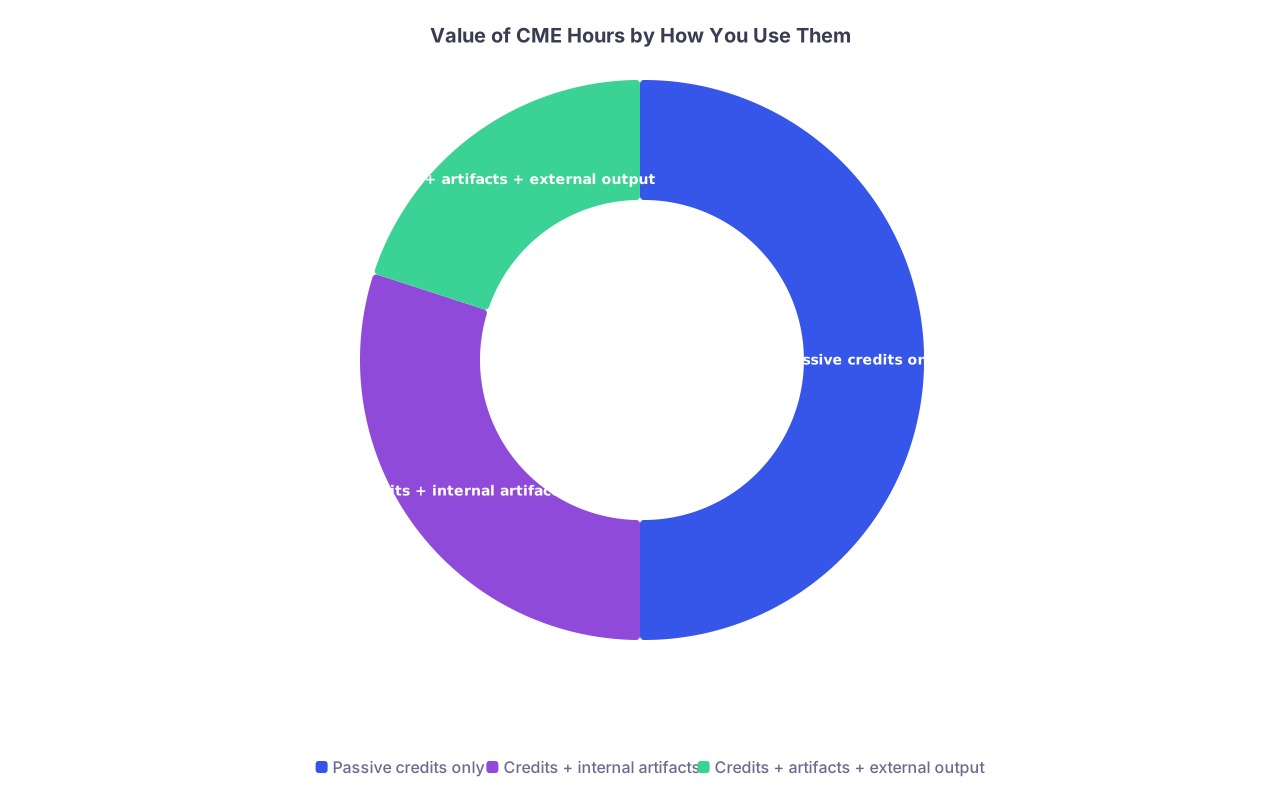
| Category | Value |
|---|---|
| Passive credits only | 50 |
| Credits + internal artifacts | 30 |
| Credits + artifacts + external output | 20 |