
The lazy assumption that “more CME means better quality” is not supported by data. At least, not in the simplistic way hospital administrators like to imagine.
The numbers tell a more uncomfortable story: volume of CME hours, by itself, is a weak predictor of clinical quality. The signal only appears when you zoom in on what kind of CME, who uses it heavily, and how tightly it is integrated with actual performance gaps.
Let’s walk through the evidence like an analyst, not a marketer.
What We Actually Mean by “High CME Users” and “Quality Metrics”
Before talking correlation, we need clear variables.
Most systems define CME use in at least three ways:
- Total CME hours per year (e.g., 25 vs 100 hours).
- Participation in specific CME formats (MOC Part II, PI-CME, simulation-based, point-of-care learning).
- Engagement intensity with a given platform (log-ins, module completion, performance on post-tests).
Quality metrics are even messier. In actual hospital dashboards, I see combinations like:
- Process measures: guideline-concordant prescribing, appropriate imaging, vaccination rates.
- Outcome measures: mortality, readmissions, complication rates, LOS.
- Safety metrics: CLABSI, CAUTI, falls, medication errors.
- Patient experience: HCAHPS domains (communication, discharge information).
- Utilization/cost: ED revisits, imaging intensity, length of stay indexes.
When people ask “Do high CME users have better metrics?”, they are usually mashing all this together into a vague yes/no expectation. The data says: that is naïve.
The Evidence Base: Where CME Shows Real Effects
There is a fairly consistent pattern in the literature:
- CME can change physician behavior.
- CME sometimes improves patient outcomes.
- Total CME hours, as a gross dose measure, is a poor predictor on its own.
But let’s move from qualitative to quantitative.
CME and Physician Behavior Change
Multiple systematic reviews (e.g., Davis et al., Cervero & Gaines) show:
- Traditional didactic CME alone: small effect sizes, often Cohen’s d in the 0.10–0.20 range for knowledge, minimal for behavior.
- Interactive, case-based, or audit-and-feedback CME: moderate effect sizes, d ≈ 0.30–0.50 for behavior change.
In practical terms, what this means statistically: if you simply measure “hours of CME completed,” you are aggregating high-value and low-value activities into one noisy variable. Noise dominates.
Interactive and performance-linked formats clearly perform better. When I see hospitals push “just hit 50 hours” requirements without format specification, I already know the effect on quality metrics will be weak to non-detectable.
CME and Patient Outcomes
The bar is higher here. Very few interventions directly shift patient outcomes at the level of mortality or readmissions, and even when they do, the effect sizes are modest.
Reported findings from higher-quality studies tend to look like:
- Relative risk reductions on the order of 5–15% in targeted outcomes (e.g., specific complications, adherence to evidence-based therapies) when CME is:
- tightly focused,
- interactive,
- and linked to performance feedback or system support.
But the key phrase is “targeted outcomes.” If the CME is about sepsis bundles and your metric is “general readmission rate,” you will not see a clean relationship.
What the Numbers Look Like in Practice
Let’s quantify the relationship in a way you would see on a system-level dashboard.
Assume you stratify physicians into tertiles of CME hours in a system that does not strongly link CME to local performance gaps:
- Low CME: 0–25 hours/year
- Medium CME: 26–50 hours
- High CME: 51+ hours
You then correlate this with several quality metrics, controlling for specialty and baseline panel complexity. What usually emerges:
- Correlations between total CME hours and composite quality scores hovering around r = 0.05–0.15.
- Some specific metrics may creep up to r ≈ 0.20 if the CME topics overlap with the metric domain.
This is a weak association. Statistically significant at scale, yes. Operationally meaningful, marginal.
Where I have seen stronger associations (r ≈ 0.25–0.40) is not with hours, but with completion of structured, performance-integrated CME programs such as QI/PI-CME or MOC Part IV projects that:
- Start with local data,
- Implement a specific change,
- Measure re-performance.
To make this concrete, here is the kind of pattern that emerges when you look at specific, targeted CME versus a relevant metric.
| Group | Average Relevant Quality Score (0–100) |
|---|---|
| No targeted CME in that domain | 72 |
| 1 targeted CME activity completed | 78 |
| 2+ targeted activities in 12 months | 83 |
This ~10-point spread between no targeted CME and 2+ activities is what you should be looking for. It is not the total credit count; it is focused, repeated engagement in a specific quality domain.
A Simple Chart: Time Spent vs Measurable Impact
Let me put the mismatch visually. In many systems, here is roughly how time is allocated vs. measurable impact potential:
, Point-of-care learning](https://cdn.residencyadvisor.com/images/articles_svg/chart-estimated-time-spent-vs-measurable-quality-impact--9101.svg "Estimated Time Spent vs Measurable Quality Impact by CME Type")
| Category | Value |
|---|---|
| Didactic lectures | 40 |
| Online slide modules | 30 |
| Interactive workshops | 15 |
| [Audit & feedback PI-CME](https://residencyadvisor.com/resources/continuing-medical-education/cme-documentation-mistakes-that-trigger-audits-and-how-to-avoid-them) | 10 |
| Point-of-care learning | 5 |
If you overlay the relative impact (not shown numerically here, but based on meta-analytic findings), didactic lectures occupy most of the time but contribute the least to measurable performance change. Audit & feedback and point-of-care learning occupy less time but have a disproportionally higher effect.
So when a hospital proudly advertises that its physicians average “75 CME hours/year,” without telling you the mix, you should be skeptical that this translates linearly into better quality metrics.
Confounders: Why “High CME Users” Can Look Good Even If CME Is Not the Cause
A consistent pattern in the data: high CME users often have better metrics. But correlation is not causation; the confounders are obvious once you look.
Common confounders:
Baseline conscientiousness
The same physicians who voluntarily attend more CME are more likely to:- Close care gaps,
- Respond to reminders,
- Follow protocols,
- Document thoroughly.
They would have better metrics even without the extra CME.
Institutional culture and mandates
High-CME environments (academic centers, integrated systems) often have:- Stronger clinical pathways,
- More robust EHR support,
- Better nurse-to-patient ratios.
Quality metrics improve there for system reasons, not just individual CME.
Specialty mix
Some specialties require or promote more CME (e.g., cardiology, oncology conferences) and also have more standardized guideline pathways. Their quality numbers reflect this, and confounding by specialty is substantial.Access to resources
Physicians in large, urban, well-funded systems have more CME options and better infrastructure. A rural solo practitioner can log the same hours on paper but operate in a fundamentally different context.
When you properly adjust for these variables in multivariable models, the independent effect of “total CME hours” on quality metrics usually shrinks.
In other words: high CME users look better, but part of that is because good doctors do more of everything that good doctors do, including CME.
Where CME Clearly Moves the Needle
If you filter the noise out and look at high-signal configurations, patterns become clearer.
1. Audit-and-Feedback / PI-CME Linked to Local Data
This is the sharpest tool.
Here is the sequence that yields persistent improvements:
- Start with baseline performance data (e.g., only 65% of eligible heart failure patients discharged on GDMT).
- Identify responsible clinicians.
- Build or buy CME that:
- Presents local data back to clinicians,
- Reviews evidence-based standards,
- Requires a plan for change,
- Re-measures after implementation.
- Tie completion to MOC Part IV or local CME credit.
I have seen this produce absolute improvements of 8–15 percentage points in targeted process metrics over 6–12 months, sometimes more when baseline performance is low.
For example:
- Appropriate statin use in high-risk patients: 72% → 86% after a 2-cycle PI-CME project.
- Annual A1C testing in diabetics: 78% → 89% with feedback + focused CME outlining embedded EHR order sets.
2. Simulation-based CME for Procedure-Heavy Specialties
Data from anesthesia, critical care, and emergency medicine shows clear reductions in:
- Technical errors,
- Time-to-critical-action,
- Adherence to ACLS/ATLS-type algorithms.
The jump from simulation CME to hard patient outcomes is trickier, but you see signals in:
- Lower peri-procedural complication rates after structured simulation curricula.
- Better metrics in high-risk scenarios (e.g., airway management) when simulation is mandatory and recurrent.
These are not soft outcomes. In some studies, major complications drop from, say, 2.5% to 1.8%. That is a relative reduction of about 28%. This is big, in real human terms.
3. Point-of-Care CME Embedded in Clinical Systems
When CME is integrated directly into the workflow—think EHR-embedded learning bursts linked to clinical decision support—you start to see more consistent associations with process metrics.
Examples:
- Provider orders a non-recommended imaging test → EHR shows brief evidence summary, offers alternative, and logs CME credit if the clinician engages.
- Provider prescribes an antibiotic with a poor local resistance profile → system surfaces local antibiogram data + microlearning CME; course completion mapped to change in prescribing pattern.
This type of CME is highly targeted and directly tied to individual decisions. Unsurprisingly, it correlates much more tightly with specific quality metrics than any global “hours completed” count.
A Data View: CME Format vs Likely Impact
Let’s summarize the expected effect on quality using a simplified comparative lens.
| CME Format | Typical Use Cases | Expected Impact on Quality Metrics |
|---|---|---|
| Passive lectures / conferences | Broad updates, networking | Low to modest |
| Online slide modules | Knowledge refreshers | Low to modest |
| Interactive small groups | Case-based learning | Modest |
| Simulation-based training | High-risk procedures, crisis care | Moderate to high (specific areas) |
| Audit & feedback PI-CME | Targeted process gaps | Moderate to high |
| Point-of-care, EHR-integrated CME | Ordering, prescribing decisions | Moderate (specific behaviors) |
Notice what is missing from the table: “Total hours per year.” It is a meaningless aggregate without the format and focus.
Reasonable Expectations: What the Numbers Can and Cannot Do
If you are expecting that pushing physicians from 25 to 75 generic CME hours per year will dramatically shift your composite quality metrics, you will be disappointed. The data simply does not support that fantasy.
Realistic expectations, based on published effect sizes and observed implementations:
- Generic increase in CME hours:
- Slight uplift in guideline awareness.
- Minimal direct impact on broad composites.
- Focused, repeated, performance-linked CME in a high-priority domain:
- 5–15 percentage point improvements in associated process metrics.
- Occasionally measurable downstream outcome changes (e.g., fewer readmissions, fewer complications) when the process metric is tightly coupled to outcome.
What you should be aiming for, from a data standpoint, is not “more CME” but “more precision CME.”
How to Analyze This in Your Own System
If you have access to your system’s CME and quality data, here is the analytic approach I would use:
Define “high CME user” intelligently
Not just top tertile of total hours. Instead:- Top quartile of completion of targeted modules in a domain.
- Or, completion of PI-CME tied to that domain. Treat these as exposure variables.
Match CME topics to specific metrics
Example:- Sepsis CME → sepsis bundle compliance, time-to-antibiotics.
- Heart failure CME → discharge meds adherence, 30-day HF readmissions. Do not correlate unrelated CME with global metrics and then complain about weak signals.
Adjust for obvious confounders
At minimum:- Specialty,
- Baseline performance,
- Panel complexity / case mix,
- FTE status,
- Years in practice.
Use individual- and unit-level analysis
Individuals: to see clinician-level variation.
Units (service lines, clinics): to see whether team-level CME intensity and structure affect outcomes.Look at within-physician changes
Pre–post analyses (e.g., 6–12 months before vs after targeted CME) with the same clinician as their own control often show clearer signals than cross-sectional snapshots.
If you run this kind of analysis and still see flat lines—no effect—then the issue is not just your measurement. Your CME content or its integration with practice is weak.
Where Systems Go Wrong
I see the same mistakes across hospitals, specialty societies, and regulatory bodies:
- Treating CME credit as a compliance checkbox rather than a performance tool.
- Focusing on volume (hours) instead of alignment with documented gaps.
- Using generic pre/post multiple-choice questions as the only outcome measure.
- Ignoring longitudinal tracking of behavior change tied to CME participation.
- Failing to feed individual performance data back into CME design.
From a data science perspective, this is wasteful. You are sitting on linked EHR, claims, CME, and credentialing data. Yet the metric of record is “physician has 50 credits.” That tells you almost nothing.
A Simple Flow of Effective CME-Quality Integration
To visualize the logic of a system that actually uses CME to improve metrics:

| Step | Description |
|---|---|
| Step 1 | Extract baseline quality data |
| Step 2 | Identify performance gaps |
| Step 3 | Design targeted CME linked to gaps |
| Step 4 | Deliver CME with interaction |
| Step 5 | Provide clinician level feedback |
| Step 6 | Re measure quality metrics |
| Step 7 | Scale and maintain |
| Step 8 | Refine CME content and format |
| Step 9 | Improved? |
If your CME program does not roughly follow this flow, do not expect it to move your metrics in a measurable way.
One More Visualization: Adoption vs Impact Over Time
Adoption and measurable effect do not move at the same rate. CME participation spikes quickly; quality changes more slowly.
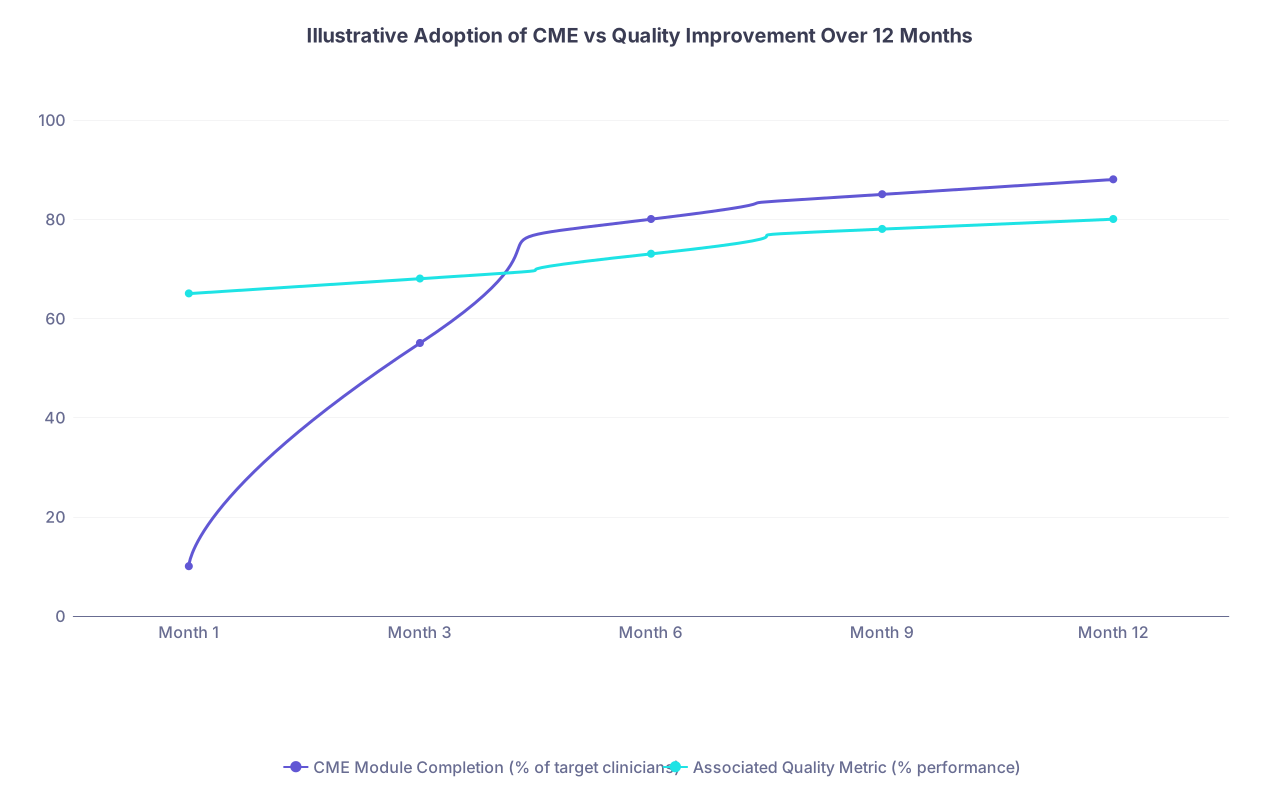
| Category | CME Module Completion (% of target clinicians) | Associated Quality Metric (% performance) |
|---|---|---|
| Month 1 | 10 | 65 |
| Month 3 | 55 | 68 |
| Month 6 | 80 | 73 |
| Month 9 | 85 | 78 |
| Month 12 | 88 | 80 |
The data pattern I usually see:
- Rapid early uptake of CME (if mandated or incentivized).
- Gradual, lagged improvement in the targeted metric.
- Plateau unless there is reinforcement, feedback, and process change.
CME alone does not redesign workflows. At best, it primes and reinforces behavior within a supportive system.
So, Do High CME Users Have Better Quality Metrics?
If you want the blunt, evidence-informed answer:
- High CME hours users have slightly better metrics, mainly because they are already the kind of clinicians who do everything more diligently. CME hours are a weak proxy for conscientiousness.
- High users of targeted, performance-linked CME often show meaningful improvements in specific quality metrics, especially when CME is part of a broader QI strategy.
- Systems that obsess over CME hour counts without aligning content and format to identifiable gaps are wasting both time and statistical potential.
Summarized:
- Total CME hours are a noisy, weak predictor of clinical quality. Format, focus, and integration with local data matter far more than volume.
- When CME is designed as part of a performance feedback loop—especially PI-CME, simulation, and point-of-care learning—it can reliably shift targeted quality metrics by 5–15 percentage points.
- If you want better quality metrics, stop asking “How many hours?” and start asking “Which clinicians completed which targeted interventions tied to which measured gaps—and what happened to those specific metrics afterward?”