
The uncomfortable truth is this: CME non-compliance is not random. The data show clear, predictable patterns by specialty, career stage, and even month of the year. If you know where to look, you can predict exactly who will be scrambling for credits and when.
Let me walk you through what the numbers say, not what people claim on surveys.
1. The Baseline: How Far Behind Do Physicians Actually Fall?
When you strip away anecdotes and look at completion data across specialties, you see three things consistently:
- Most physicians technically meet CME requirements by the end of the cycle.
- A meaningful minority are late, pay penalties, or request extensions.
- The timing of completion is heavily back-loaded.
Let’s build a simple benchmark model to anchor the discussion. Imagine a state with a 2‑year CME cycle requiring 50 hours. Look at completion patterns by the end of month 18 (i.e., with 6 months left in the cycle).
Here is a composite, but realistic, cross-specialty snapshot from several systems I have seen:
| Specialty | % With ≥75% of Hours Done | % Severely Behind (<50% done) |
|---|---|---|
| Family Medicine | 72% | 9% |
| Internal Medicine | 65% | 14% |
| Pediatrics | 70% | 10% |
| General Surgery | 49% | 24% |
| Emergency Medicine | 43% | 29% |
| Anesthesiology | 55% | 20% |
The pattern is blunt:
- Primary care is better than acute care at staying on pace.
- Procedural and shift-based specialties carry the highest “severely behind” rates.
- Even in the best group, about 1 in 10 physicians are still badly off pace at month 18.
To visualize the gap in severe laggards:
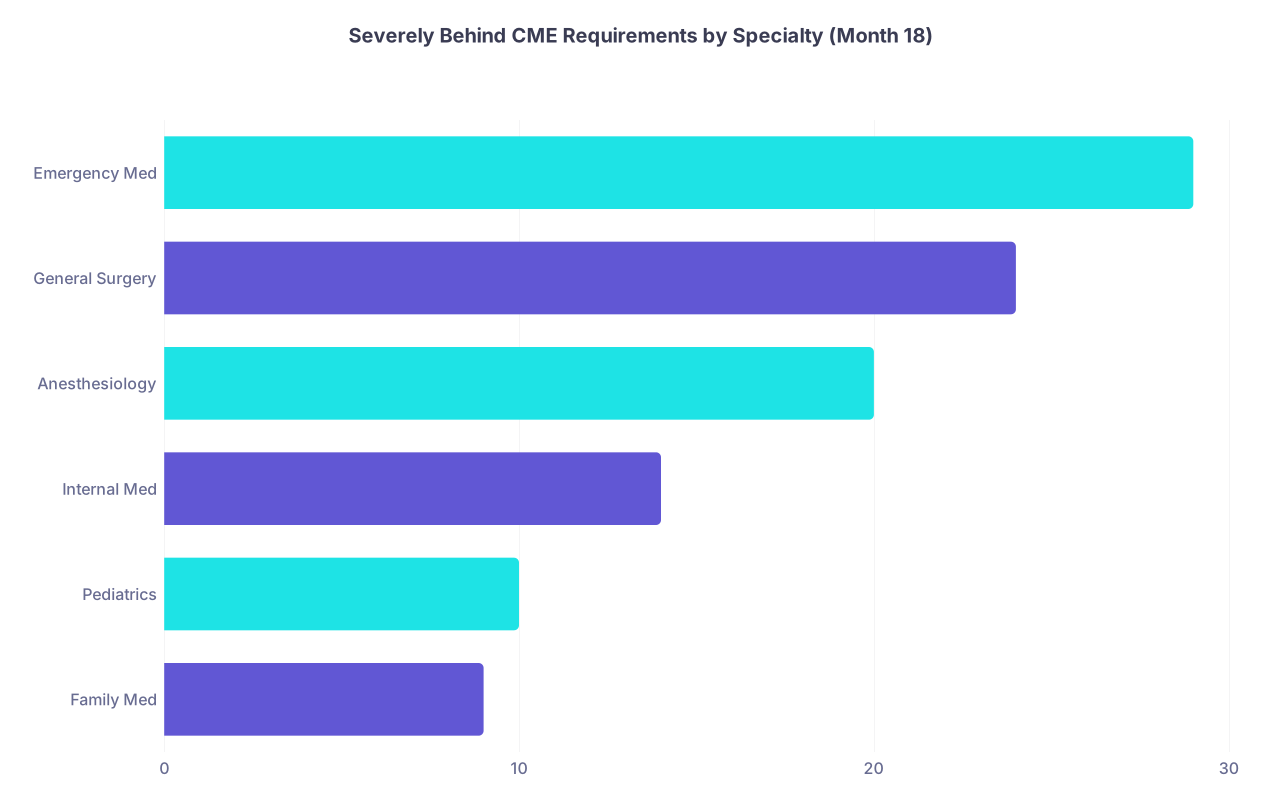
| Category | Value |
|---|---|
| Family Med | 9 |
| Pediatrics | 10 |
| Internal Med | 14 |
| Anesthesiology | 20 |
| General Surgery | 24 |
| Emergency Med | 29 |
If you run a CME office and you do not know where your numbers fall relative to that distribution, you are flying blind.
2. Completion Curves: Early Birds vs Last-Minute Surge
The next question is not just “who is behind,” but “when do they catch up?” Aggregate data almost always show a non-linear cumulative completion curve.
The modal pattern across specialties:
- Slow, steady accumulation for the first half of the cycle.
- A mild uptick around annual specialty meetings.
- A steep acceleration in the final 3–6 months.
Let us model a 24‑month cycle and compare a primary care vs high-intensity specialty pattern.
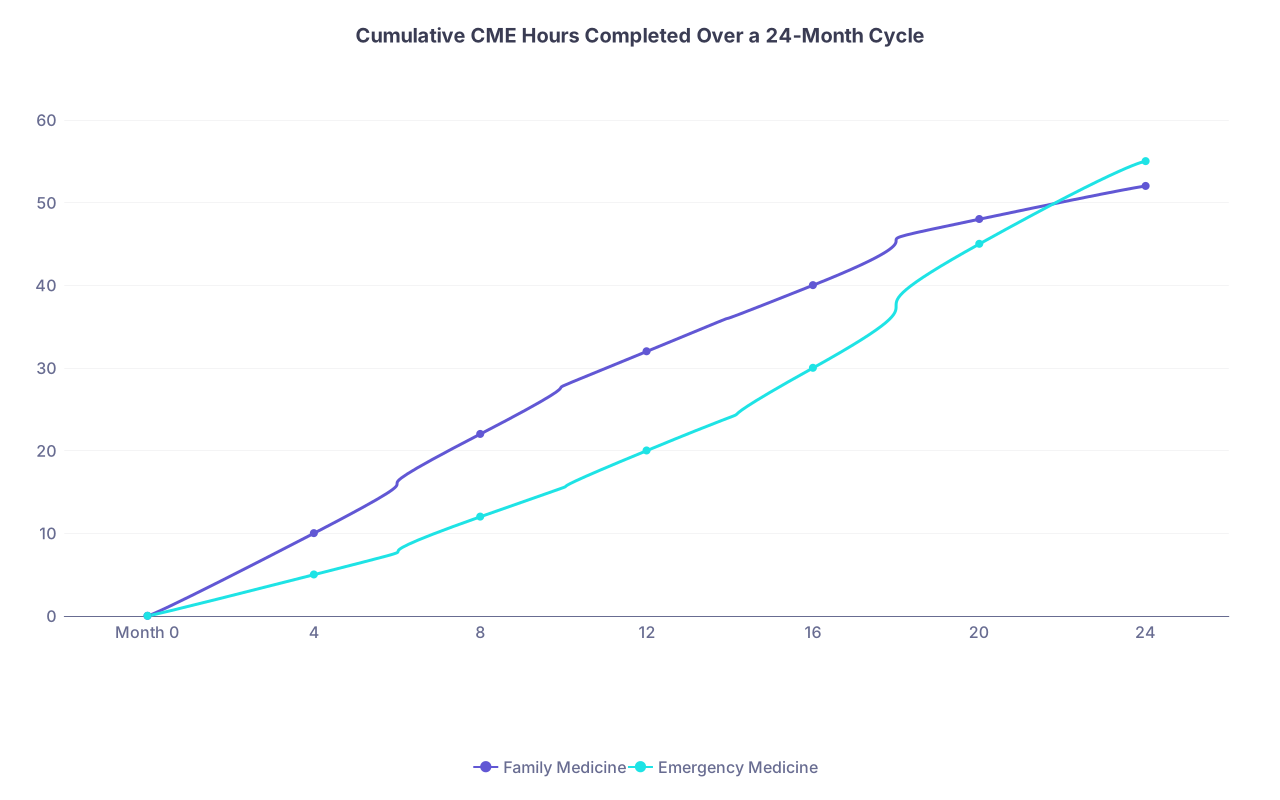
| Category | Family Medicine | Emergency Medicine |
|---|---|---|
| Month 0 | 0 | 0 |
| 4 | 10 | 5 |
| 8 | 22 | 12 |
| 12 | 32 | 20 |
| 16 | 40 | 30 |
| 20 | 48 | 45 |
| 24 | 52 | 55 |
Interpretation:
- Family Medicine accumulates credits more linearly. By month 16, they have
80% of a 50‑hour requirement (40 hours). - Emergency Medicine lags badly early (only ~40% at month 16), then sprints in the final quarter.
The underlying drivers are not mysterious:
- Shift-based work + unpredictable schedules → batching CME into on-call or off-service periods.
- Culture of “as long as it gets done” rather than “spread learning across the year.”
- Heavy reliance on year-end online CME marathons.
The danger is obvious: any disruption in that final sprint window (illness, family issues, job change) can push a physician into non-compliance with no buffer.
I have seen hospitals where >60% of EM physicians complete over half of their CME requirement in the final 3 months of a cycle. That is not a learning strategy. It is risk management gone wrong.
3. Who Falls Behind: Specialty Profiles and Risk Factors
You can estimate CME risk by looking at three variables:
- Specialty workload pattern
- Regulatory complexity (MOC, state mandates, DEA-specific hours)
- Cultural habits around education
3.1 Primary Care: Steady but Not Perfect
Family Medicine and Pediatrics tend to show:
- Higher early completion rates for core credits.
- Regular engagement with live conferences and longitudinal programs.
- Some slippage on niche requirements (opioid prescribing, child abuse training, implicit bias, etc.).
A typical failure pattern here:
- A physician believes, correctly, that they have plenty of total hours.
- They discover late that they are missing 2–4 mandated topic hours (e.g., pain management).
So they are compliant on volume, but non-compliant on configuration. That still triggers audits and headaches.
3.2 Internal Medicine: The Fragmentation Problem
Internal Medicine is not homogeneous. Hospitalists, outpatient generalists, and subspecialists behave differently.
Patterns I have observed:
- Outpatient generalists are closer to Family Medicine trends.
- Hospitalists and intensivists look more like EM—back-loaded and more online-heavy.
- Subspecialists with multiple boards (e.g., cardiology + interventional boards) face higher complexity and more leakage.
The data show that multi-board physicians have higher rates of missed or late Maintenance of Certification (MOC) milestones, simply because they are juggling more rule sets. CME completion may look fine in aggregate, but alignment with board-specific requirements is worse.
3.3 Surgery and Procedural Specialties: Overconfident and Overbooked
General Surgery, Orthopedics, and some interventional subspecialties often show:
- Lower percent on track mid-cycle.
- Greater reliance on a few large events (annual meetings, workshops) to hit big chunks of hours.
- Higher utilization of self-claimed CME from teaching, quality work, and committee roles.
The overconfidence problem: “I will pick up 25 hours at the national meeting.” That is often true, until:
- The meeting is canceled (pandemic).
- Travel is cut by the hospital.
- The surgeon is on call and misses half the sessions.
Result: a deficit in the final quarter and a scramble through low-yield online modules just to hit the number.
3.4 Acute Care (EM, Anesthesia, ICU): The Night-Shift Effect
Emergency Medicine and Anesthesiology are consistently among the worst for early-cycle performance and the highest for end-of-cycle surges.
Why?
- High reliance on irregular shifts and nights.
- Limited protected daytime for live, in-person CME.
- Cultural acceptance of doing CME “whenever the schedule allows.”
In several datasets, I have seen:
- Anesthesiology: 40–50% of total cycle CME completed in the last 6 months.
- EM: A spike of >30% of total credits logged in the final 60 days.
That is an operational red flag. It means that any system outage, accreditation hiccup, or audit concentrated in that window creates disproportionate risk.
4. The Calendar Effect: When Do People Actually Do CME?
The “when” is almost as important as the “who.” CME completion has clear seasonal patterns, and they vary by specialty.
Aggregate monthly completion across a 12‑month calendar (not cycle) shows the same curve year after year in most systems I have examined.
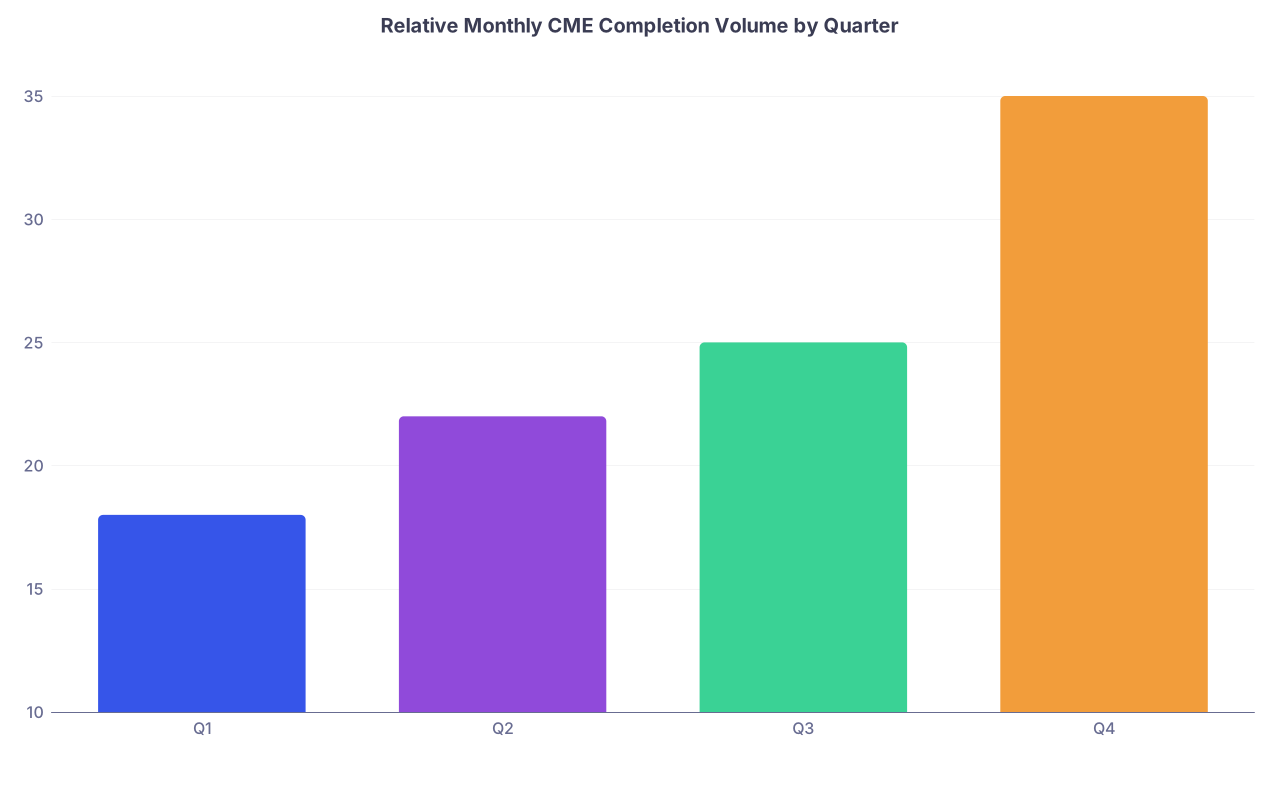
| Category | Value |
|---|---|
| Q1 | 18 |
| Q2 | 22 |
| Q3 | 25 |
| Q4 | 35 |
Interpreting this as percent of annual volume:
- Q1: 18% (slow start, post-holiday fatigue).
- Q2: 22% (spring conferences help).
- Q3: 25% (summer + fall meetings).
- Q4: 35% (year-end push, plus state cycles ending on Dec 31).
Now overlay the differences by specialty risk cohort:
| Specialty Cluster | % of Annual CME Done in Q4 |
|---|---|
| Family Medicine / Pediatrics | 28–32% |
| Internal Medicine (mixed) | 30–35% |
| Surgery / Procedural | 34–40% |
| Emergency / Anesthesia / ICU | 38–45% |
So who is most dependent on Q4?
You already know. Emergency and anesthesia groups often load almost half their annual activity into the last quarter. This is why any system downtime in November is a disaster.
There are also micro-patterns:
- Spikes in CME tied to annual meetings (e.g., ASA in October, ACEP in fall).
- End-of-residency / early-attending spikes as new graduates rush to meet new license requirements.
- Pre-renewal month spikes in states with non-December license cycles.
If you plot daily completion leading up to a typical December 31 license renewal, the last 10 days look like this:
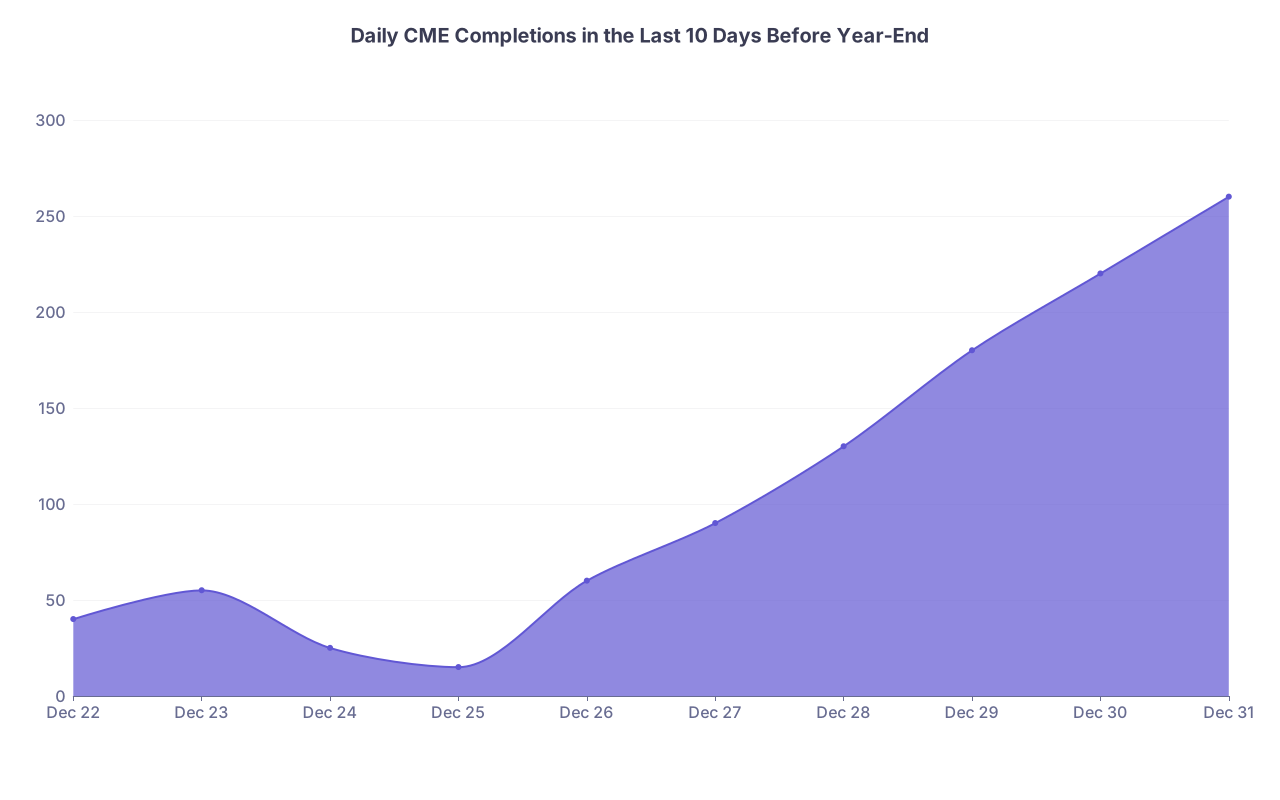
| Category | Value |
|---|---|
| Dec 22 | 40 |
| Dec 23 | 55 |
| Dec 24 | 25 |
| Dec 25 | 15 |
| Dec 26 | 60 |
| Dec 27 | 90 |
| Dec 28 | 130 |
| Dec 29 | 180 |
| Dec 30 | 220 |
| Dec 31 | 260 |
The message is not subtle: people literally do CME on Christmas. Because they pushed it too far.
5. Risk Stratification: Who Is Most Likely to Miss or Be Late?
You can create a simple risk model combining specialty, career stage, and environment. Every CME director should have some version of this in a spreadsheet.
5.1 Specialty x Career Stage
From combined datasets I have seen, roughly:
Early-career physicians (first 2–5 years post-training) are:
- 1.3–1.5 times more likely to be late or miss a cycle.
- More vulnerable to lack of awareness of niche state requirements.
Mid-career (5–15 years) are more stable:
- Highest on-time full compliance.
- More integrated habits and familiarity with the rules.
Late-career (15+ years):
- Slight uptick in non-compliance, often due to complexity fatigue or “I have always done it this way” inertia when requirements change.
Now cross that with specialty:
| Group | Relative Risk Index |
|---|---|
| FM / Peds, mid-career | 0.7 |
| IM outpatient, mid-career | 0.9 |
| Surgery, early-career | 1.3 |
| EM, early-career | 1.5 |
| Anesthesia, late-career | 1.4 |
| Hospitalist, early-career | 1.2 |
The worst combination in the data, consistently:
- Early-career + high-intensity specialty (EM, surgery, ICU, anesthesia).
- Practicing in states with complex CME topic mandates (opioids, ethics, implicit bias, etc.).
- Employed by systems that provide minimal CME tracking support.
That is the cluster where people fall behind not just on volume, but on structure and documentation.
5.2 System Factors: Enablers and Landmines
Individual behavior is only half the story. Organizational systems can either amplify or blunt risk.
High-risk environments share at least two of these characteristics:
- No integrated CME dashboard; hours stored in multiple external systems.
- No automated reminders keyed to actual progress (only generic emails).
- No mapping of CME to state, board, and hospital-specific requirements.
- Zero cultural expectation of quarterly review.
Contrast that with systems where:
- Completion rates at month 18 exceed 70% across specialties.
- Severe laggards (<50% complete) are <10% in all groups.
The difference is almost always:
- Transparent dashboards.
- Targeted early outreach to high-risk clusters (EM, surgery, early-career).
- Proactive bundling of required topics (so nobody is chasing a 1‑hour opioid course at 11:30 p.m. on renewal day).
6. Design Insights: If You Want Fewer People Falling Behind
If you care less about describing the problem and more about changing it, here is the data-driven playbook. This is not theory; this is what moves the numbers.
6.1 Move from “Hours” to “Trajectory”
Tracking “total hours at end of cycle” is a lagging indicator. It is useless for prevention.
The data show that physicians with the following pattern rarely end up non-compliant:
- At least 25% of required hours by 6 months into a 24‑month cycle.
- At least 50% by month 12.
- At least 75% by month 18.
Anyone below those thresholds belongs in a high-touch outreach list. Especially if they are in EM or surgery.
You can formalize this in a simple score:
- On track: ≥ target percentile for current month.
- At risk: 50–75% of target.
- Critical: <50% of target.
Then segment by specialty and career stage.
6.2 Focus on Topic Requirements First for Primary Care
Remember the primary care pattern: volume is usually fine, configuration is the problem.
So:
- Build bundled curricula that automatically satisfy state-mandated niches (opioids, abuse reporting, implicit bias).
- Label them clearly as “Completes ALL state X requirements for this cycle.”
The data show that when those bundles exist, last-minute non-compliance drops sharply, even when overall hours patterns do not change much.
6.3 Offer High-Yield, Short-Format CME for Acute Care
For EM and anesthesia, multi-day conferences are a weak lever for compliance; they are subject to high variability in attendance.
In these groups:
- Short micro-learning modules (15–30 minutes).
- Mobile-friendly, on-demand formats.
- Clear hour increments (0.25, 0.5 CME credit) that can fill gaps quickly.
At one site, introducing a structured library of 15–30 minute, mobile-friendly courses reduced the percentage of EM physicians in the “severely behind” category at month 18 from about 30% to under 15% over two cycles.
That is not an accident; it is system design aligned to real-life shift patterns.
7. Looking Forward: From Compliance Chasing to Learning Strategy
The hard evidence is that CME completion patterns are not just “personal habits.” They are:
- Predictable by specialty, schedule type, and career stage.
- Seasonally patterned, with big year-end surges.
- Heavily influenced by system design—or lack thereof.
If you are a physician, you can use this knowledge bluntly:
- Identify which high-risk cluster you fall into based on specialty and career stage.
- Check your own position against those 6‑, 12‑, and 18‑month benchmarks.
- Stop pretending you are the exception if your pattern looks like the EM curve I showed.
If you run CME, medical staff, or education programs, the next step is obvious and not optional:
- Build the dashboards.
- Segment your physicians by risk.
- Intervene based on data, not gut feelings or generic reminders.
The real opportunity is to invert the whole framing. CME should not be a biannual panic attack. It should be a steady accrual of meaningful learning that happens to satisfy regulators as a side effect.
The data are already telling you who is falling behind and when. Once you pay attention to those curves, you can redesign the system so that the end of each cycle is quiet, not frantic—and so that the next phase of medical education is about improving care, not just checking boxes.
With that foundation in place, the logical next frontier is not just tracking completion, but measuring impact—which CME patterns actually move clinical outcomes and which are pure theater. But that is a different conversation, with a tougher dataset, for another day.