
The biggest mistake new attendings make with CME is assuming it works like residency. It does not. And the system will not forgive you for learning that late.
You have moved from a world where someone else tracked your ACLS expiration and conference days… into a world where a missed spreadsheet cell can get your license held, your hospital privileges suspended, or your board certification flagged. I have watched very smart new attendings get burned by this. Not because they were lazy. Because they underestimated how unforgiving CME logistics can be.
Let me walk you through the main traps so you do not become a cautionary story someone else tells.
1. Treating CME Like a Last-Minute Box to Check
Residents live in “finish the module the night before” mode. That habit will wreck you as an attending.
Here is the faulty assumption:
“I have 2 years to get 50 CME credits. I will just do some courses later.”
What actually happens:
- You underestimate how fragmented your credits are.
- You misread how many need to be “live,” “ethics,” “opioid,” or “risk management.”
- You do not realize some boards require annual activity, not just by-cycle totals.
- You hit year 2 with 18 random credits and impossible gaps.
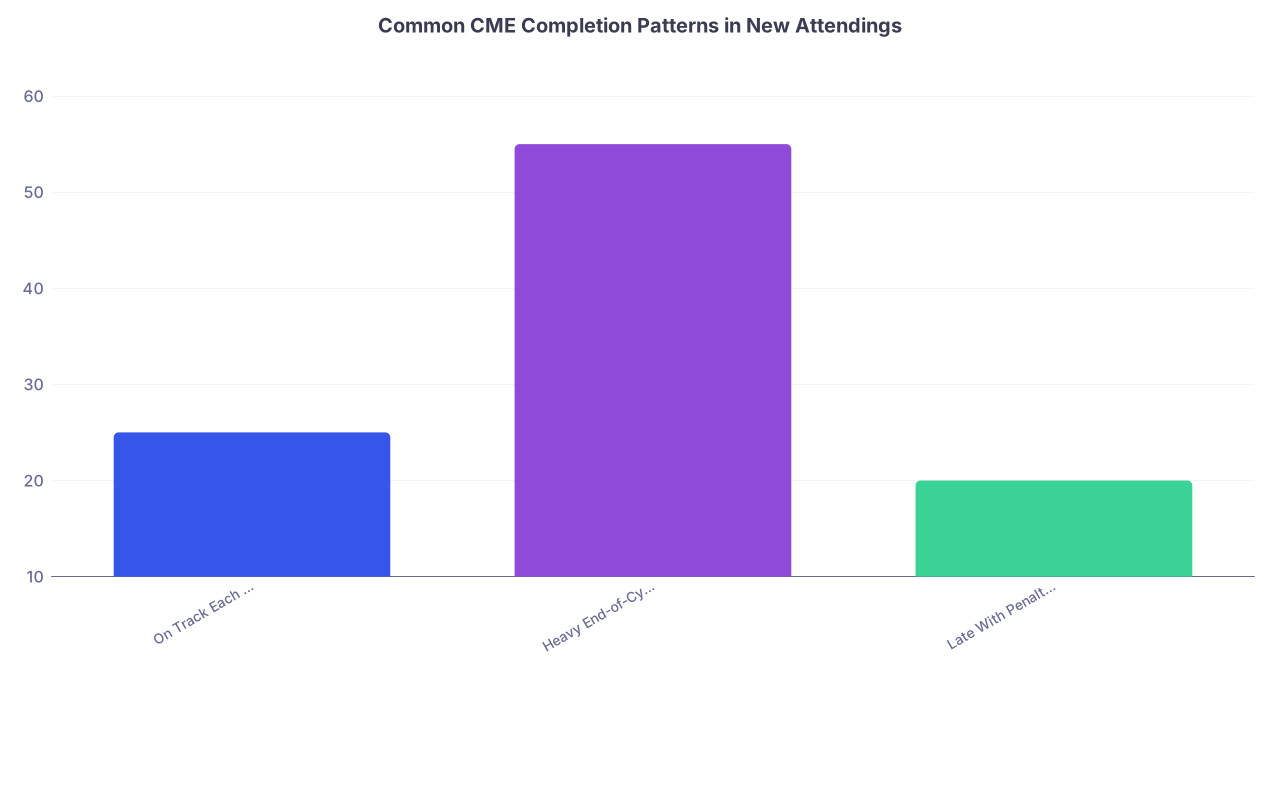
| Category | Value |
|---|---|
| On Track Each Year | 25 |
| Heavy End-of-Cycle Rush | 55 |
| Late With Penalties | 20 |
The mistake is not doing CME late. The mistake is not building structure around it.
Avoid this by:
- Setting quarterly credit targets (for example: 12–15 credits every 3 months).
- Front-loading your first year as an attending; you will never be “less busy” later.
- Picking 1–2 “anchor” activities per year (major conferences, board review, etc.) that generate a big credit chunk.
If you are saving everything for the last six months of your cycle, you are gambling your license on your future bandwidth. That is naïve. Future-you will be tired, charting late, and dealing with an unexpected credentialing email that says: “We need your CME log by Friday.”
2. Not Realizing Your Requirements Are Multi-Layered
Residents tend to think “CME” as one bucket. As an attending, you do not have one requirement. You have several, and they do not line up cleanly.
Typical layers:
- State medical license CME
- Specialty board maintenance of certification (MOC/MOL) or equivalent
- DEA / controlled substance prescribing mandates
- Hospital / health system–specific modules (compliance, safety, EHR updates)
- Sometimes insurer or malpractice carrier requirements
These often have different:
- Time cycles (2 years vs 3 years vs 5 years)
- Required hours
- Topic mandates (opioids, ethics, cultural competency, child abuse, etc.)
- Definitions of “Category 1” vs “Category 2”
| Requirement Source | Cycle Length | Total Hours | Special Topic Hours |
|---|---|---|---|
| State License | 2 years | 50 | 2 opioid, 1 ethics |
| Specialty Board MOC | 5 years | 100 | 1 patient safety |
| DEA/Controlled Substances | 3 years | 8 | All opioid-related |
| Hospital Privileges | 2 years | 25 | 2 risk management |
| Malpractice Carrier | 1 year | 5 | Risk/claims prevention |
The common rookie mistake: tracking only the state license hours and assuming that covers everything. Then a board MOC audit hits, and your carefully hoarded “ethics CME” does not count for the board, or your opioid course does not meet the DEA spec.
What you need to do early in your attending life:
Create a one-page requirements map.
- One row per requirement source.
- Columns: cycle dates, hours, specific topic needs, online/ live rules.
Highlight overlaps.
- Example: a live opioid prescribing course that gives Category 1 credit may satisfy state + DEA + hospital.
Identify the strictest requirement in each domain.
- If your board is more rigid than your state, plan around the board first, then see what spills over.
Physicians who skip this mapping step pay for it in duplicated work, panic scrambling for niche modules, or worst case, formal non-compliance notices.
3. Ignoring Deadlines Until Credentialing Blocks You
You can technically be “only a little late” on CME. Your hospital and board may not see it that way.
I have seen this play out:
- A new attending finishes fellowship, gets hired, starts strong.
- Their first state license renewal as an attending comes up.
- They assume: “I am practicing, my charts look good, they will not actually hold anything up over a few CME hours.”
- The licensing board does not care about your RVUs. They care about checkboxes.
And credentialing offices are even less sentimental. They will send emails that read like:
“Your privileges will lapse on X date if proof of CME is not received.”
They mean it.

| Step | Description |
|---|---|
| Step 1 | Skip Tracking CME |
| Step 2 | Near Renewal Date |
| Step 3 | Scramble for Online CME |
| Step 4 | Credentialing Delay |
| Step 5 | Privilege Lapse Risk |
| Step 6 | Enough Credits? |
| Step 7 | Documentation Ready? |
Contours of the problem:
- License renewal dates do not always match job start dates, fellowship end dates, or board cycles.
- Some systems need CME reported weeks before expiration so they can process paperwork.
- If you practice in multiple states, misalignment multiplies your risk.
Avoid the trap:
- Put every renewal/recert date into a calendar the day you sign your first attending contract.
- Set reminders 9, 6, and 3 months before each.
- Do not wait until you are under 3 months to fix a big deficit.
The painful stories almost always start with “I thought I had more time.”
4. Wasting Time on CME That Does Not Count
New attendings often grab the first CME email that hits their inbox and assume it is “good enough.” Sometimes it is not.
Typical errors:
- Doing enduring materials when your state requires a certain number of live or “interactive” hours.
- Completing a high-quality (but unaccredited) course or podcast and realizing it gives zero usable credit.
- Taking opioid education that does not meet the specific DEA/state description.
- Using “Category 2” activities when your board or state wanted Category 1.
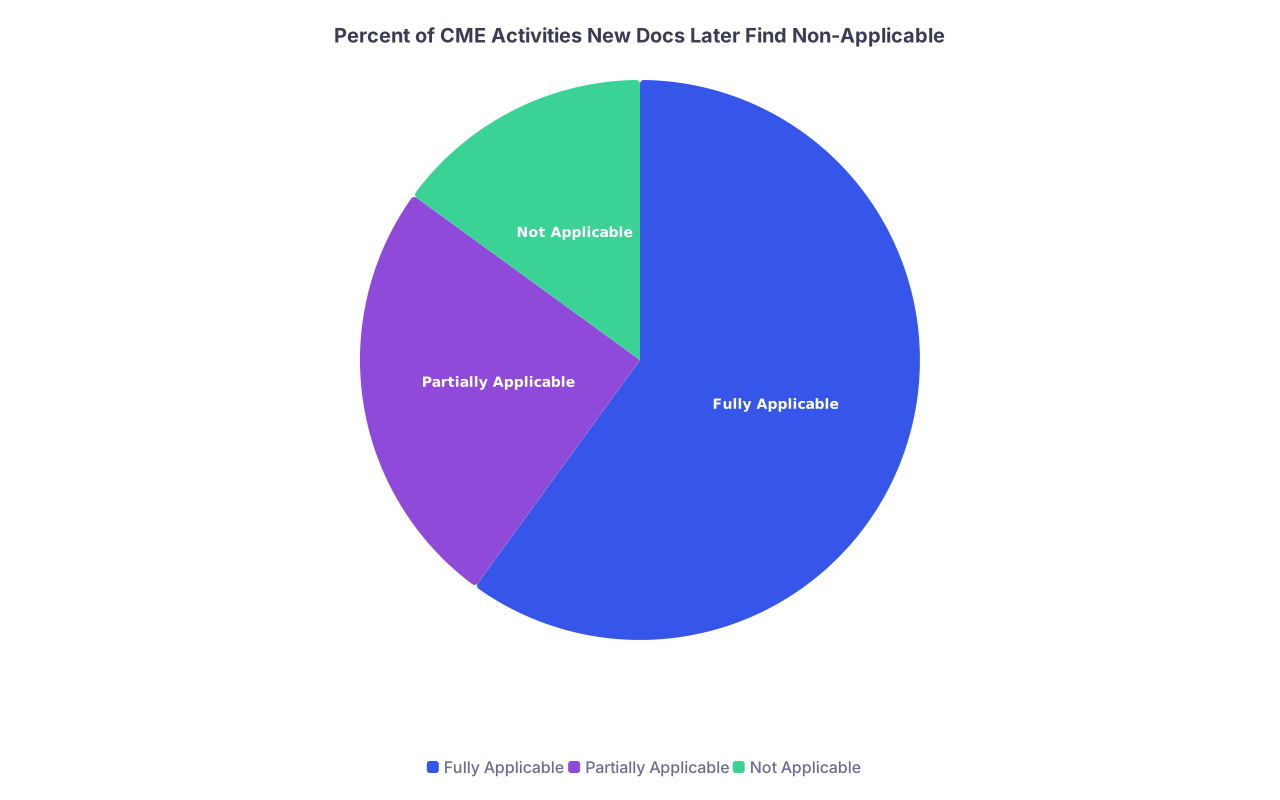
| Category | Value |
|---|---|
| Fully Applicable | 60 |
| Partially Applicable | 25 |
| Not Applicable | 15 |
Biggest time-waster: engaging content that is not properly accredited for your needs. Fun to learn, useless for compliance.
Before you enroll or pay, check:
- Is it accredited (ACCME or equivalent)? What category?
- Does it specify “live,” “enduring,” “online,” “self-paced,” etc.?
- Does it explicitly state it satisfies your board/state/DEA requirement?
- Is there a hard expiration date for claiming credit after completing?
New attendings sometimes log a full weekend conference, only to realize they missed the deadline to claim CME in the portal. The system does not care that you were physically in the lecture hall.
You want high-yield CME:
- Relevant to your practice.
- Accredited in a way that satisfies multiple layers of your requirements.
- Easy to document and retrieve later.
If it does not check those boxes, think twice before spending time or money.
5. Treating CME Documentation as an Afterthought
Residency shields you. GME offices track your ACLS, BLS, modules. You sign a roster and forget about it.
As an attending, no one is quietly doing that for you.
The common mistake: relying on scattered evidence.
- PDF in an old email.
- Some credits in a random vendor portal you barely remember.
- Paper certificate left in a conference bag.
- Verbal reassurance that “the CME will be sent to the board automatically.”
Then an audit hits. Or a credentialing office asks for a detailed log. Suddenly you are trying to reconstruct three years of activities with half the receipts missing.
You need a single source of truth for your CME.
At minimum:
A spreadsheet or running log with:
- Date
- Activity name
- Provider / accreditor
- Credit hours (and type/category)
- Topic flags (opioid, ethics, etc.)
- Proof location (file name / portal)
A digital folder system:
- /CME/
- /Year_1_Attending/
- /Year_2_Attending/
- /Conferences/
- /Online_Modules/
- /Licensure_Documents/
- /CME/

Rookie problem I see often: “I assumed the hospital’s LMS tracked everything and would generate a report.” Sometimes they will. Sometimes their system archives old data, changes vendors, or only tracks internal modules.
You want your own dataset, not a patchwork of third-party portals.
If you cannot, within 5 minutes, produce a current tally of:
- Total credits this cycle
- Breakdown by required topic
- Documentation for at least 3 random activities
you are setting yourself up for panic later.
6. Underestimating How CME Interacts With MOC (and New Formats)
If you trained during the era when “boards are once and done,” you are already behind.
Many specialties have moved to:
- Longitudinal assessment (quarterly questions, ongoing knowledge checks).
- Annual or biennial “MOC points” requirements separate from pure CME hours.
- Performance improvement activities (QI projects, chart reviews).
- Patient safety or professionalism modules.
New attendings sometimes treat MOC as something to worry about “close to recertification.” That used to be semi-true. It is wrong now in many fields.
The mistake:
- Logging CME but ignoring whether it counts as MOC points.
- Missing repeated windows for longitudinal questions and then getting shifted into more intensive pathways.
- Not linking your CME providers to your board so credit transfer happens automatically.

| Step | Description |
|---|---|
| Step 1 | Do CME Activity |
| Step 2 | Eligible For CME Hours |
| Step 3 | Counts For CME and MOC |
| Step 4 | CME Only |
| Step 5 | No CME Credit |
| Step 6 | ACCME Accredited? |
| Step 7 | MOC-Eligible Tag? |
Pay attention to:
- Whether activities are labeled as MOC Part II, Part IV, etc., if your board uses that language.
- Whether your board has a portal where you must claim or accept transferred credits.
- Whether there are annual minimums, not just per-cycle totals.
New attendings often wake up three years into practice and realize they have been doing plenty of CME, but almost none of it was set up to count for MOC because they never toggled a setting or connected accounts.
That is fixable. But annoying. And occasionally expensive.
7. Letting Employers or CME Vendors Drive Your Choices Blindly
Hospitals, pharma, device companies, and third-party CME vendors each have an angle. Sometimes their angle aligns with your needs. Sometimes it does not.
Typical mistakes:
- Letting a rep or vendor convince you to sign up for an overpriced “all-in-one CME solution” that does not actually map cleanly to your state/board requirements.
- Going to conferences mainly because “my group always goes,” regardless of whether the credit type/amount/format is what you actually need.
- Assuming employer-provided CME modules alone will cover your licensure and MOC obligations.

Red flags to watch for:
- “Unlimited CME hours!” with no clear statement about accreditation type and MOC eligibility.
- “Meets licensing needs” without specifying which states or boards.
- Heavy focus on travel perks, minimal clarity on how credits align with your real gaps.
Your CME plan should start with:
- Your requirement map.
- Your clinical interests and weaknesses.
- Your schedule constraints.
Then you pick vendors and events that fit. Not the other way around.
A common subtle mistake: letting your CME stipend dictate your choices. You feel pressure to “use it or lose it,” so you chase expensive conferences instead of targeted, efficient online offerings that actually cover your deficits.
CME money is nice. Compliance and sanity are more important.
8. Failing to Integrate CME With Real Clinical Learning Needs
One of the saddest ironies: new attendings drown in mandatory modules while still feeling clinically underpowered in key areas.
Why? Because they treat CME as a compliance chore, not as part of a deliberate learning strategy.
You see this in people who:
- Take the easiest, shortest courses just to rack up hours.
- Repeat the same basic topic year after year because “the interface is fast.”
- Ignore areas where they feel shaky (complex imaging, updated guidelines, new therapeutics) in favor of low-effort credits.
Over time, that creates a gap:
- On paper, you look “up to date.”
- In practice, your knowledge decays in places that matter.
The mistake is thinking of “compliance CME” and “real learning” as separate universes. You can, and should, overlap them aggressively.

Do not do this:
- Logging whatever is easiest, then separately trying (and often failing) to carve out time for serious clinical reading.
- Letting your CME be chosen by your inbox instead of your weaknesses.
Better pattern:
- Identify 2–3 clinical domains each year where you want to level up.
- Find CME offerings that target those: longitudinal courses, case-based series, journal-based CME in your subspecialty.
- Use mandatory or employer-provided modules to pick up the odd required topic hours (ethics, safety), but do not let them dominate your portfolio.
Your future self will care far more about whether you used CME to actually improve your practice than whether you shaved 30 minutes off a module this quarter.
9. Not Planning for Multi-State or Job Changes
If you are in academics, telemedicine, or certain hospital groups, you may hold licenses in multiple states. Each with its own quirks.
Common traps:
- Assuming your “home state” rules apply everywhere.
- Meeting the strict requirements of State A but forgetting State B wants, say, child abuse training or HIV education specifically.
- Changing jobs and discovering your new institution has additional CME or compliance expectations not recognized by your previous employer.
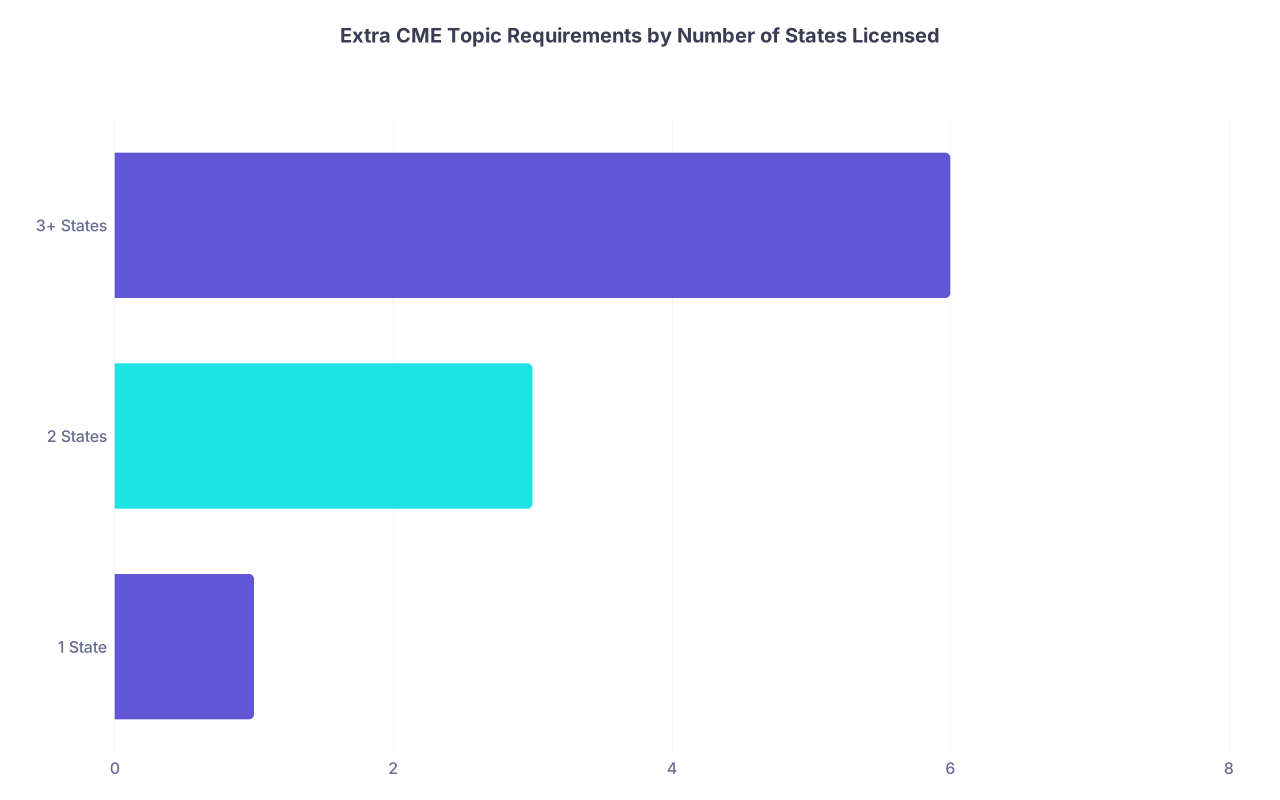
| Category | Value |
|---|---|
| 1 State | 1 |
| 2 States | 3 |
| 3+ States | 6 |
You will kick yourself if:
- You are fully compliant for your main license.
- You go to add a second state license for a new opportunity or telehealth work.
- You find out you are missing a very specific, annoying mandated course that now delays your credentialing.
Solution is simple, but almost no one does it early:
- The moment you get a second license, build a combined requirement grid.
- Identify common topics (opioid, ethics) and extra niche items.
- For niche items, knock them out ASAP with short targeted courses, then forget about them.
And when you change jobs:
- Ask explicitly: “Do you have any CME or educational requirements beyond state/board/DEA?”
- Get those in writing, preferably in your onboarding packet.
- Add them to your master tracker. Do not assume HR or Medical Staff Services will spoon-feed you every deadline.
10. Treating CME as a Solo Memory Project
Relying on your own memory and discipline for this entire ecosystem is reckless.
The mistake: “I’ll remember. I’ll just make a note.”
You will not. You will be on call. Your kid will be sick. Your inbox will explode.
You need systems, not willpower:
- Calendar reminders (multiple, early).
- A simple tracking sheet you update immediately after each activity.
- Regular (brief) check-ins: once a quarter, you look at your numbers and gaps.
- Auto-sync where possible: connect your board, state, and major CME providers if integration exists.
And yes, sometimes you need to drag your group along with you:
- Ask your practice or department to schedule a yearly “CME and credentialing review” meeting.
- Share templates for tracking.
- Push back on a culture where everyone pretends this stuff can be winged indefinitely.
If you are the only one in your cohort who gets this right, you will be the only one not panicking when the audit letters roll in.
Key Things to Remember
- Do not treat CME like residency modules you can clear at the last minute. Map your real, multi-layered requirements early and hit them steadily.
- Do not assume any given course “counts.” Verify accreditation, topic match, and MOC eligibility before you spend time or money.
- Do not trust memory or scattered portals. Build your own simple, ruthless tracking system so deadlines and audits become boring, not catastrophic.