
The typical approach to CME budgeting is financially blind. Most physicians treat CME like a box-checking exercise, not an investment decision. The data suggests that is a mistake.
Below I will walk through the numbers: what physicians actually spend on CME, what they get back in compensation across different career stages, and where the return on investment (ROI) is real versus just marketing fluff.
1. The Basic Math: What Does CME Actually Cost?
Let us anchor the problem. CME is not just course fees. It is:
- Direct course/registration fees
- Travel and lodging
- Time cost (lost clinical revenue or foregone opportunities)
Based on recent survey data from large US physician associations and compensation reports, the spending distribution looks approximately like this for employed physicians:
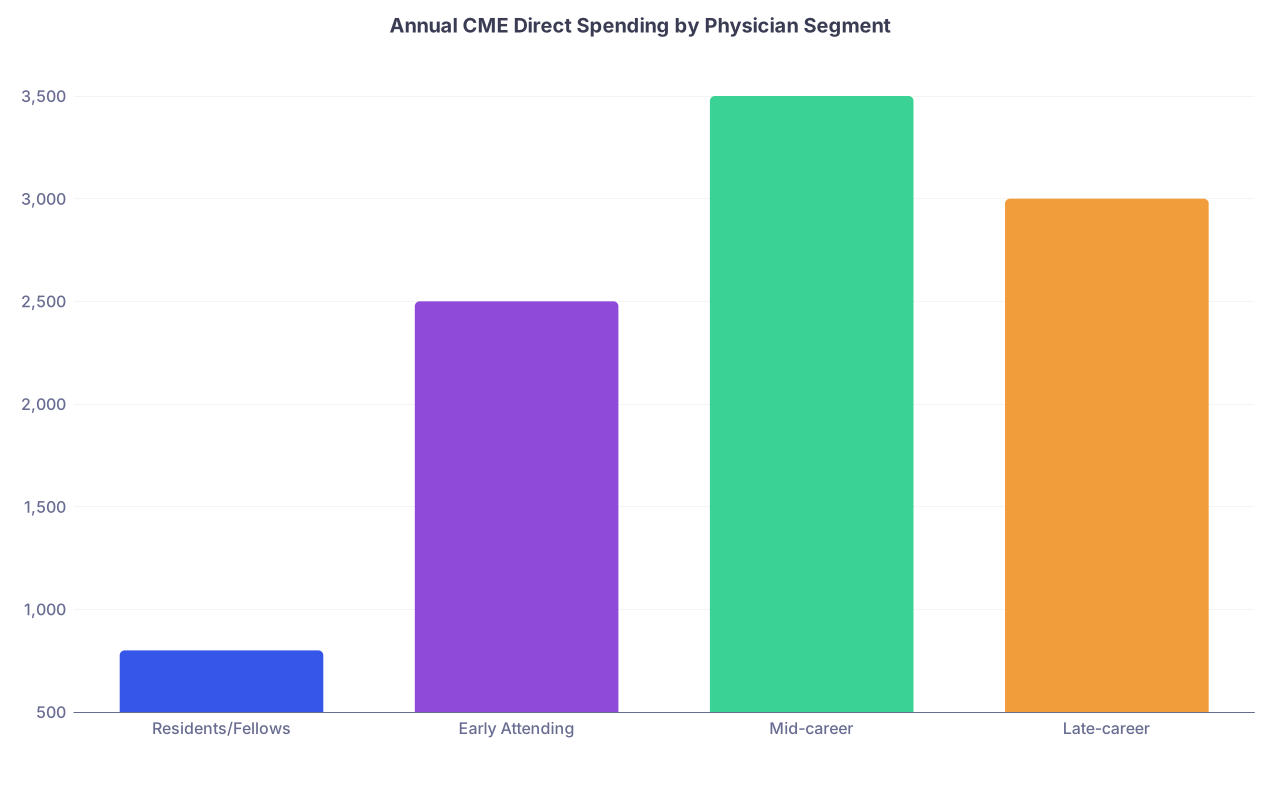
| Category | Value |
|---|---|
| Residents/Fellows | 800 |
| Early Attending | 2500 |
| Mid-career | 3500 |
| Late-career | 3000 |
Now layer on time cost. Assume:
- Residents/fellows: no direct RVU loss, but opportunity cost is career development time
- Attending physicians: average clinical revenue rate of roughly $250–$500/hour (varies by specialty and payer mix)
For a typical 3-day CME conference:
- 3 days × 8 hours/day = 24 clinical hours
- At $300/hour in revenue: about $7,200 in potential production value lost
So the all-in economic cost of a “$1,500 conference” for a full-time attending can easily be:
- $1,500 registration
- $1,500 travel/lodging
- $7,200 time cost
Total economic cost ≈ $10,200.
If that conference does not shift your income, promotion trajectory, or referral base in a measurable way, the raw financial ROI is poor.
2. CME and Compensation: What the Data Actually Suggests
There is no single dataset that tracks “CME course X led to salary Y,” but you can infer patterns from:
- Compensation survey data (MGMA, Medscape, specialty societies)
- Certification/credentialing requirements
- Observed pay differences for certain added skills or certifications
The cleanest way to think about it: CME has very different ROI profiles depending on career stage.
To keep this concrete, assume a representative attending physician making $320,000/year in a non-surgical specialty and working 48 weeks/year, 4.5 days/week. We will model incremental income changes tied to CME-driven skills, credentials, or role changes.
3. Residency and Fellowship: CME as Future Earnings Multiplier
Residents and fellows do not see direct pay bumps from CME. They are locked into fixed salary structures. The “return” here is career-positioning.
What the data shows
Programs rarely track “CME vs income,” but we do have:
- Match data (NRMP)
- Fellowship fill rates
- Long-term specialty compensation differences
Example: Suppose a PGY-2 internal medicine resident considers:
- Path A: Minimal external CME, standard residency curriculum
- Path B: Invests ~$1,500–$2,000 over 2–3 years on targeted CME: ECG mastery, point-of-care ultrasound (POCUS) courses, critical care workshops, research methodology short courses
The direct effect is on competitiveness for high-paying fellowships or hospitalist roles with added skills. Look at the median US compensation numbers (rounded):
| Career Path | Median Annual Compensation |
|---|---|
| General Outpatient IM | $260,000 |
| Hospitalist (standard) | $300,000 |
| Hospitalist with POCUS focus | $320,000–$340,000 |
| Pulm/CC (after fellowship) | $420,000–$480,000 |
CME is not the only factor, obviously. But real program directors repeatedly say some version of:
“I notice the resident who spent their own time mastering ultrasound or critical care concepts. That is the person we rank high.”
If $2,000–$3,000 of targeted CME over training nudges you from a $260,000 role into a $320,000+ trajectory, the lifetime ROI is enormous. Even discounting heavily, you are looking at:
- Incremental income: $60,000/year over a 25-year career
- Undiscounted total: $1.5M additional gross earnings
Even if only 5–10% of that delta is realistically attributable to your additional skills and signaling via CME, you are looking at $75,000–$150,000 of value generated by a few thousand dollars in spending.
ROI here is not subtle. The problem is that most residents do not think in those terms.
Where early-career CME pays off
High-ROI resident/fellow CME patterns I see repeatedly:
- Courses that directly support board scores or key exams (in-boards, USMLE Step 3, specialty boards). Passing on first attempt preserves momentum and expansion of job choices.
- Skill-building courses that are scarce in your residency but valued in practice: POCUS, advanced airway, advanced endoscopy techniques, complex imaging interpretation, coding/billing fundamentals.
- Research methods, biostatistics, or QI design courses that lead to first-author publications or high-visibility QI projects.
The return is not your resident paycheck. The return is what job offers and fellowships you unlock.
4. Early-Career Attending (Years 1–5): CME as a Revenue and Leverage Tool
This is where the ROI begins to translate into annual dollars, not just long-term potential.
Let us assume a new attending making $300,000/year in a hospital-employed setting, with standard CME allowance:
- CME stipend: $3,000–$4,000/year
- CME days: 3–5 days/year protected
The crucial observation: when your employer funds CME, your personal cash ROI looks different from the practice’s ROI.
Employer-funded vs self-funded
There are two distinct buckets:
Employer-funded CME (stipend, paid days off)
- Your out-of-pocket direct cost: usually zero
- Your time cost: minimal if days are protected and do not reduce RVU targets
- Your upside: salary changes, bonus potential, leadership roles
Self-funded CME (outside employer budget)
- Out-of-pocket cash and time costs
- Should be reserved for moves with clear income or promotion implications
If your employer will pay $3,000/year for courses, and one year of a targeted skill boosts your bonus by $10,000, your personal ROI is effectively infinite. You invested $0. The practice funded the asset.
Concrete early-career scenarios
Take an early-career cardiologist, GI doc, or ortho surgeon. Real data from compensation surveys show that:
- Adding high-RVU procedures (e.g., advanced endoscopy, structural heart, specific spine techniques) can bump total collection and RVU volume by 10–25%.
- In RVU-based plans with 40–45% collection-to-compensation ratio, that can translate into $40,000–$150,000/year.
Say an early-career gastroenterologist:
- Baseline: 9,000 RVUs/year → $550,000
- After advanced endoscopy-focused CME and proctoring over 2 years:
- Volume: 10,500 RVUs/year (≈17% increase) → $640,000
Let us approximate the CME-related cost over two years:
- Courses and workshops: $6,000
- Travel/lodging: $6,000
- Time cost (if partially self-funded time): say another $5,000 in lost income opportunities
Total 2-year investment ≈ $17,000.
Annual income increase: ≈ $90,000. Even if only half of that is attributable to skill expansion via CME, the payback period is measured in months, not years.
The data pattern is similar (though less dramatic) in non-procedural fields:
- Hospitalists who get adept at POCUS and lead sepsis bundles or ultrasound programs often secure stipends or leadership bonuses of $10,000–$30,000/year.
- Primary care physicians who invest in chronic disease management, obesity medicine, or office-based procedures can increase panel efficiency and downstream referrals, often tied to bonus structures.
So for early attendings, high-ROI CME usually involves:
- New billable services you can document and code
- Documented quality improvements tied to incentive pools
- Leadership or niche expertise that employers will pay for
Low-ROI CME? Generic conferences where you sit in a ballroom for 3 days and come home with a tote bag and no change in your CPT mix.
5. Mid-Career (Years 6–15): CME for Promotion, Leadership, and Negotiation Power
By mid-career, base salaries begin to flatten for many employed physicians. The data from large compensation surveys shows:
- Most physicians see the steepest earnings growth from PGY to about year 10 in practice.
- After that, annual increases slow unless they change roles, add responsibilities, or move markets.
This is when CME ROI typically shifts away from pure clinical skill-building to:
- Leadership and management education
- Niche specialization
- Certification that supports formal titles
Leadership CME and compensation
Look at typical differentials:
| Role | Incremental Annual Compensation |
|---|---|
| No formal leadership role | Baseline |
| Medical Director, small service | +$20,000–$40,000 |
| Section/Division Chief | +$40,000–$80,000 |
| Service Line Director/CMO track | +$80,000–$150,000+ |
Hospitals and large groups frequently signal preference (or outright requirement) for physicians with:
- Health care management or administration CME
- Certificates in quality improvement, patient safety, or healthcare leadership
- Formal CME-based programs from reputable institutions (e.g., Harvard CME in medical education, MHCI-style programs, Lean Six Sigma).
Now tie that back to cost. A 6–12 month blended CME-style leadership program might cost:
- Tuition/fees: $8,000–$15,000
- Travel: $3,000–$5,000
- Time: part-time, often supported by employer
Call it a $15,000–$20,000 all-in investment over 1–2 years.
If that program materially improves your odds of landing a role with +$50,000/year leadership stipend, the ROI is obvious:
- Year 1–2: payback of principal
- Years 3–10: net incremental earnings of $300,000–$400,000
I have seen physicians do a $7,000 “physician leadership” course, then immediately leverage that certificate plus one quality project into:
“Given my added training and the metrics we improved, I want to formalize this as Assistant Medical Director with a $20,000 stipend.”
They often get at least part of what they ask for.
Mid-career skill expansion
Clinical skill CME still matters here, especially:
- New procedures that prevent plateauing of RVUs
- Sub-specialized niche (e.g., headache clinic, advanced heart failure, high-risk obstetrics) that increases referral density and job security
But the ROIs tend to be smaller than the early-career leap, unless you pivot into a very high-value skill set.
A realistic mid-career scenario:
- Baseline: $350,000/year internist with modest bonus structure
- CME investment: $5,000 over 2 years to become obesity medicine focused (CME, exam prep, conferences)
- Resulting compensation: +$25,000/year bonus or salary bump due to higher-valued visits, ancillaries, and program leadership
Payback period: well under 1 year. Plus higher negotiating leverage if you ever change employers.
6. Late-Career (Years 16+): CME as Risk Management and Exit Strategy
By late-career, raw earnings growth slows for most physicians. Yet CME does not become irrelevant. It just shifts to:
- Maintaining credentialing and avoiding negative financial shocks
- Preparing for alternative roles (teaching, consulting, part-time leadership)
- Avoiding clinical obsolescence that pushes you out of desirable jobs earlier than necessary
Maintenance vs growth
Let us be blunt. At 20+ years in practice:
- A random $2,500 conference is unlikely to boost your salary by 10%.
- A lack of current knowledge that leads to a lawsuit or credentialing loss can absolutely wipe out years of income.
So CME ROI moves from:
“Can this add $X to my salary?”
to
“Does this prevent a $300,000 lawsuit hit or job disruption?”
Risk-avoidance ROI is harder to quantify, but not imaginary. Malpractice carriers and health systems quietly watch:
- Participation in relevant CME for high-risk fields
- Uptake of new guidelines, therapies, and safety measures
A pattern of non-engagement raises your risk profile, even if no one says it to your face.
Exit strategy CME
The late-career phase is also when physicians start:
- Moving into teaching roles (med school faculty, program director, simulation center)
- Consulting for industry, payers, or health systems
- Taking part-time medical director roles, utilization review, or telemedicine leadership
Here, targeted CME can extend your peak-income years by opening non-clinical or less-clinical roles.
Example scenario:
- 62-year-old physician planning to downshift clinical time from 1.0 FTE to 0.6 FTE over 5 years.
- Baseline: $360,000/year at full time.
- Without alternative roles: dropping to 0.6 FTE → ~$216,000/year.
Now add:
- $8,000 of targeted CME in medical education and quality improvement over 2–3 years.
- Secures 0.4 FTE academic/medical education/quality role at $120,000/year as clinical time reduces.
Result:
- Combined 0.6 clinical ($216,000) + 0.4 non-clinical ($120,000) = $336,000/year for several extra years instead of a sharp drop.
That CME effectively preserves ~$120,000/year for 3–5 years: $360,000–$600,000 incremental late-career earnings for a one-time $8,000–$10,000 investment.
7. Comparing ROI by Career Stage
Let us put the patterns side by side with rough, representative figures. These are illustrative ranges based on actual trajectories I have seen and available compensation data—not hard guarantees.
| Career Stage | Typical Annual CME Spend (Direct) | Realistic Incremental Earnings Linked to High-ROI CME | ROI Pattern |
|---|---|---|---|
| Resident/Fellow | $500–$1,500 | $50,000–$150,000+ lifetime (via better job/fellowship) | Massive long-term multiplier |
| Early Attending | $2,000–$4,000 (often employer-paid) | $20,000–$150,000/year potential | Highest short- to medium-term income gain |
| Mid-career | $3,000–$5,000 | $20,000–$80,000/year (leadership, niche) | Strong, especially for role expansion |
| Late-career | $2,000–$4,000 | Value in risk reduction + $20,000–$120,000/year alt. roles | Protection + smoother glide path |
You do not need a complex spreadsheet. Just discipline. And honesty about whether you are chasing sun and sand or income and influence.
9. Summary: Where the Numbers Point
Strip away the marketing and the hotel conference buffets. The compensation data and observed trajectories suggest three big truths:
- The highest ROI CME is tightly linked to either new billable skills or formal leadership/administration roles. Generic conferences rarely move the needle on income.
- Career stage matters. Early-career CME is a huge long-term multiplier; mid-career CME pays via leadership and niche expertise; late-career CME’s financial return is mostly about risk management and creating smoother, higher-paid exit ramps.
- When your employer funds CME, your personal financial ROI can be enormous. You are getting capital to build an asset—your skills and credentials—that you can monetize in your next negotiation or job, not just your current one.
Treat CME like any other investment: clarify the expected return, quantify the likely upside, and stop pretending that “it might help someday” is a strategy.