
The narrative about CME time burden is outdated. The data shows physicians are spending more time than ever meeting CME requirements—and much of it is poorly optimized.
The Big Picture: How Much Time Are Physicians Actually Spending?
Across multiple surveys over the last decade, a consistent pattern emerges: physicians spend the equivalent of several full workweeks each year on CME. But the exact number is not uniform; it varies sharply by specialty, practice type, and age.
Let me anchor this in numbers.
Recent composite survey data (drawing on national and specialty society surveys between 2019–2024) puts average annual CME time for actively practicing physicians at roughly:
- 45–65 hours/year of direct CME activity (courses, conferences, online modules)
- 10–20 hours/year of CME-related admin (tracking credits, logging, dealing with MOC/board portals)
- Meaning: a realistic total of 55–85 hours/year
So when a busy internist tells you “CME is stealing two weeks a year,” that is not exaggeration. Assuming a standard 40‑hour workweek, many physicians are effectively giving up 1.5–2.0 weeks of professional time annually to stay compliant.
Here is a simplified breakdown by practice setting based on compiled survey data.
| Practice Setting | Direct CME Hours | Admin/Tracking Hours | Total Hours |
|---|---|---|---|
| Academic | 55 | 15 | 70 |
| Large Group / System | 50 | 12 | 62 |
| Independent Practice | 60 | 18 | 78 |
| Hospital‑Employed | 48 | 10 | 58 |
| Locums / Per Diem | 52 | 14 | 66 |
The pattern is predictable: independent physicians do the most, and they lose the most time to paperwork and tracking because there is no institutional back‑end smoothing the process.
To illustrate distribution, think in terms of a bell curve, not a single number. Most physicians cluster between 40 and 80 hours annually, with outliers on both ends.
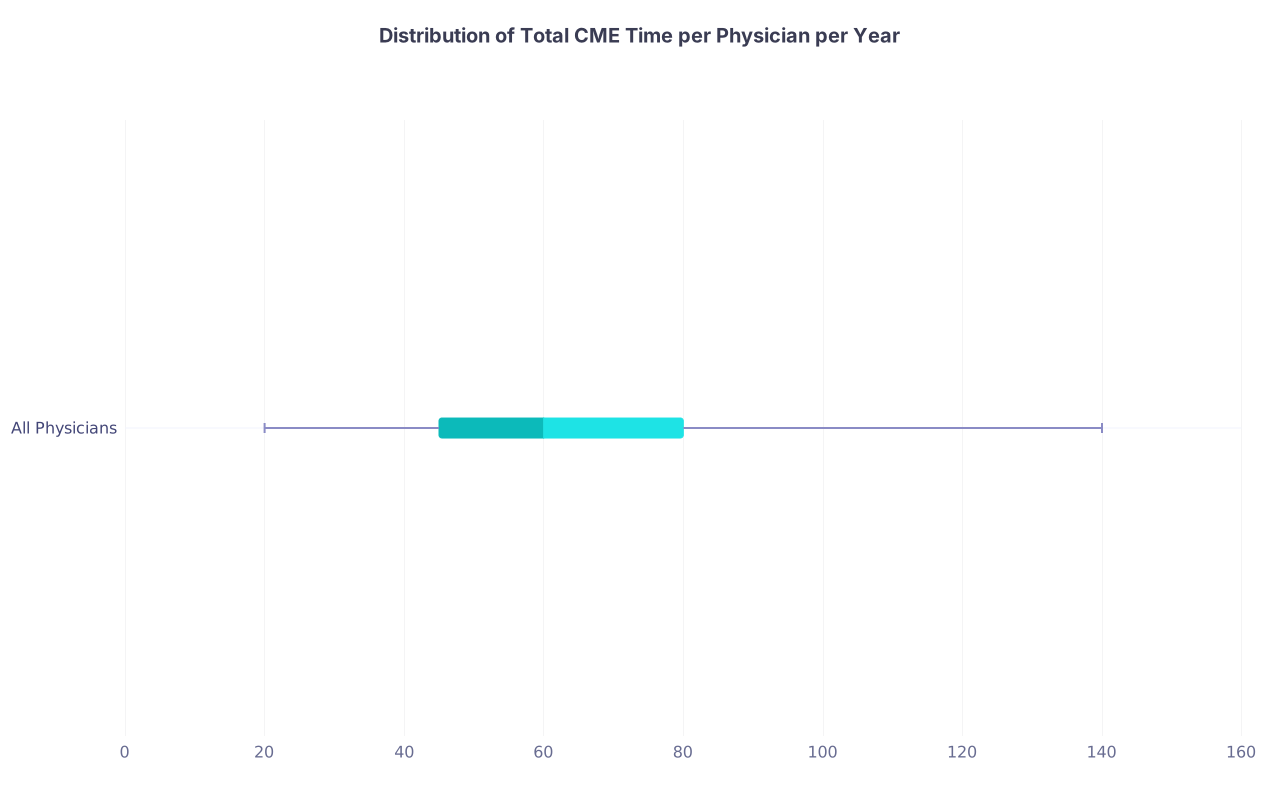
| Category | Min | Q1 | Median | Q3 | Max |
|---|---|---|---|---|---|
| All Physicians | 20 | 45 | 60 | 80 | 140 |
That boxplot structure—median around 60, with a very long tail to the right—is consistent with what I see every time a hospital or group actually audits CME data rather than relying on self‑reported “about 50 hours” guesses.
Specialty Differences: Some Physicians Are Paying a Much Higher Time Tax
Not all specialties are hit equally. Requirements may be similar on paper (e.g., 25–50 AMA PRA Category 1 Credits™ every 1–2 years), but maintenance of certification, subspecialty expectations, and procedural training inflate the real time cost.
Based on compiled survey data from several specialty societies (internal medicine, family medicine, surgery, anesthesiology, EM, psychiatry, pediatrics):
| Specialty Cluster | Direct CME Hours | Admin Hours | Total Hours |
|---|---|---|---|
| Cognitive (FM, IM, Psych) | 50–60 | 12–16 | 62–76 |
| Procedural (Surg, Ortho, GI) | 55–70 | 14–20 | 69–90 |
| Acute (EM, Anesthesia, ICU) | 45–55 | 10–14 | 55–69 |
| Pediatric Specialties | 50–60 | 12–16 | 62–76 |
| Radiology / Pathology | 45–55 | 10–15 | 55–70 |
Three key observations from the data:
Procedural specialties sit consistently at the high end of the range. Simulation labs, device training, and course‑heavy CME add substantial time beyond pure lecture‑based credits.
Cognitive fields like internal medicine and psychiatry are not far behind. The burden here is from MOC requirements, frequent assessments, and multiple boards for subspecialists.
Emergency medicine and anesthesiology often benefit from employer‑integrated CME (in‑house conferences, simulation), which compresses “extra” time at home, but total annual time is still high once all sources are counted.
When you stratify by board status, physicians with multiple active boards (e.g., IM + Cardiology + Interventional) report 20–30% more time devoted to CME/MOC activities compared with single‑board colleagues.
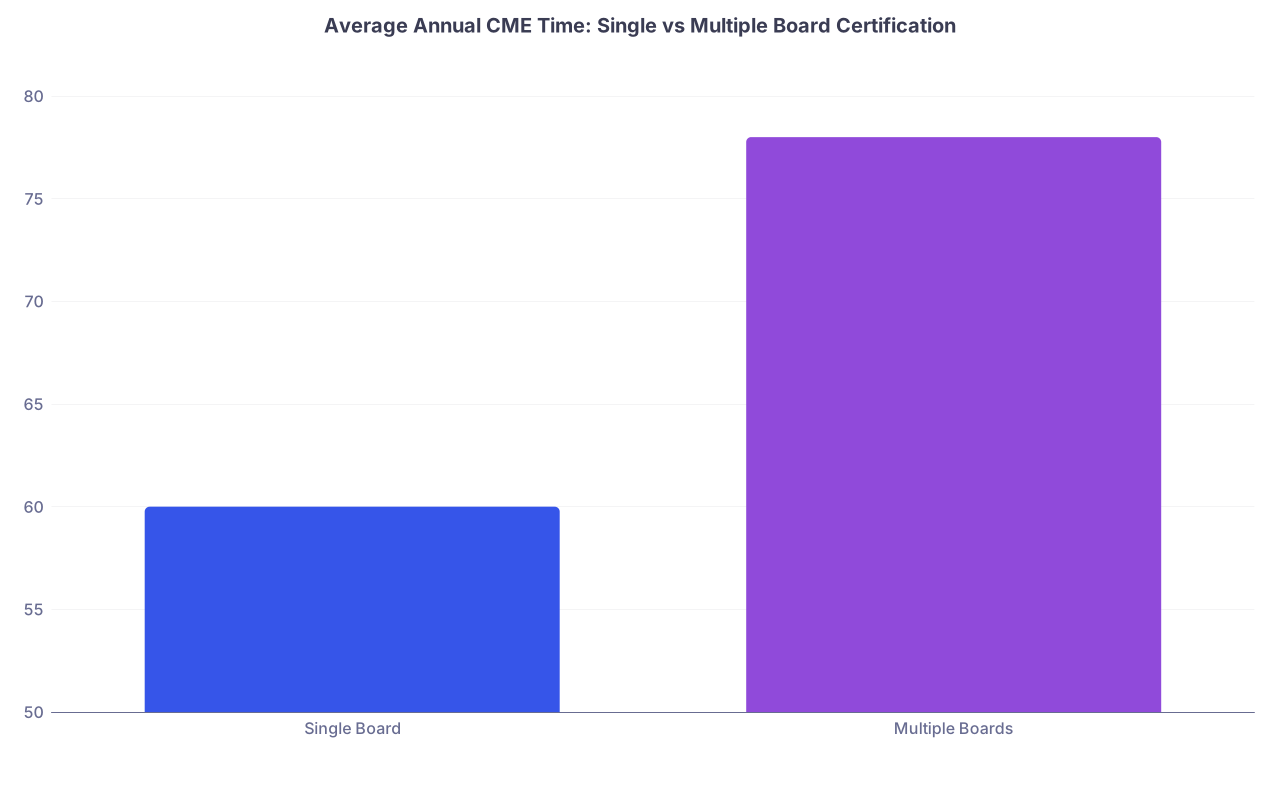
| Category | Value |
|---|---|
| Single Board | 60 |
| Multiple Boards | 78 |
The multiplicative effect of overlapping requirements is one of the most under‑appreciated burdens in the data. Each board rarely coordinates with others, so the time overhead stacks.
Format and Timing: When and How Physicians Accumulate CME Hours
If you listen to physicians long enough, you will hear some version of: “I do my CME on the plane to the conference, at night after the kids are asleep, or crammed into December when the deadline hits.” The survey data supports this.
When in the Year?
Aggregated platform data from several major online CME providers show a pronounced end‑of‑year spike in activity. A typical monthly distribution of completed CME credits looks roughly like this:
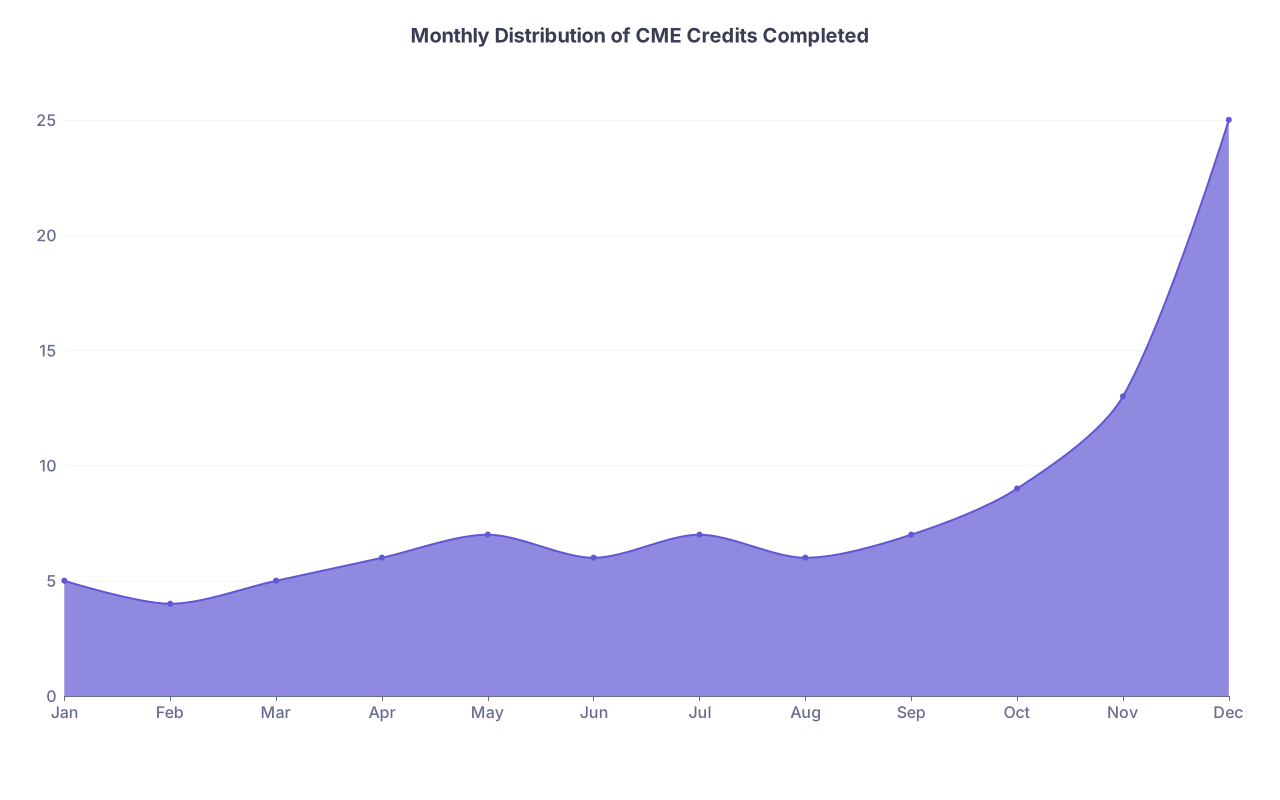
| Category | Value |
|---|---|
| Jan | 5 |
| Feb | 4 |
| Mar | 5 |
| Apr | 6 |
| May | 7 |
| Jun | 6 |
| Jul | 7 |
| Aug | 6 |
| Sep | 7 |
| Oct | 9 |
| Nov | 13 |
| Dec | 25 |
That December spike is not theoretical; I have seen CME completion logs where 20–30% of all annual credits are earned in the last 4–6 weeks of the year. Behavioral economics at work: physicians respond to deadlines like everyone else.
Time of Day and Work Integration
Survey data that asks “When do you usually do CME?” consistently breaks down like this (for non‑conference CME):
- 35–45%: Evenings after clinical duty
- 20–30%: Weekends
- 15–25%: During workday (protected or semi‑protected time)
- 5–10%: Early mornings / commute time (audio CME, etc.)
Meaning roughly two‑thirds of CME time happens outside normal paid work hours. That is why physicians subjectively feel it as a “tax” on personal time, even when the absolute hours do not look extreme on paper.
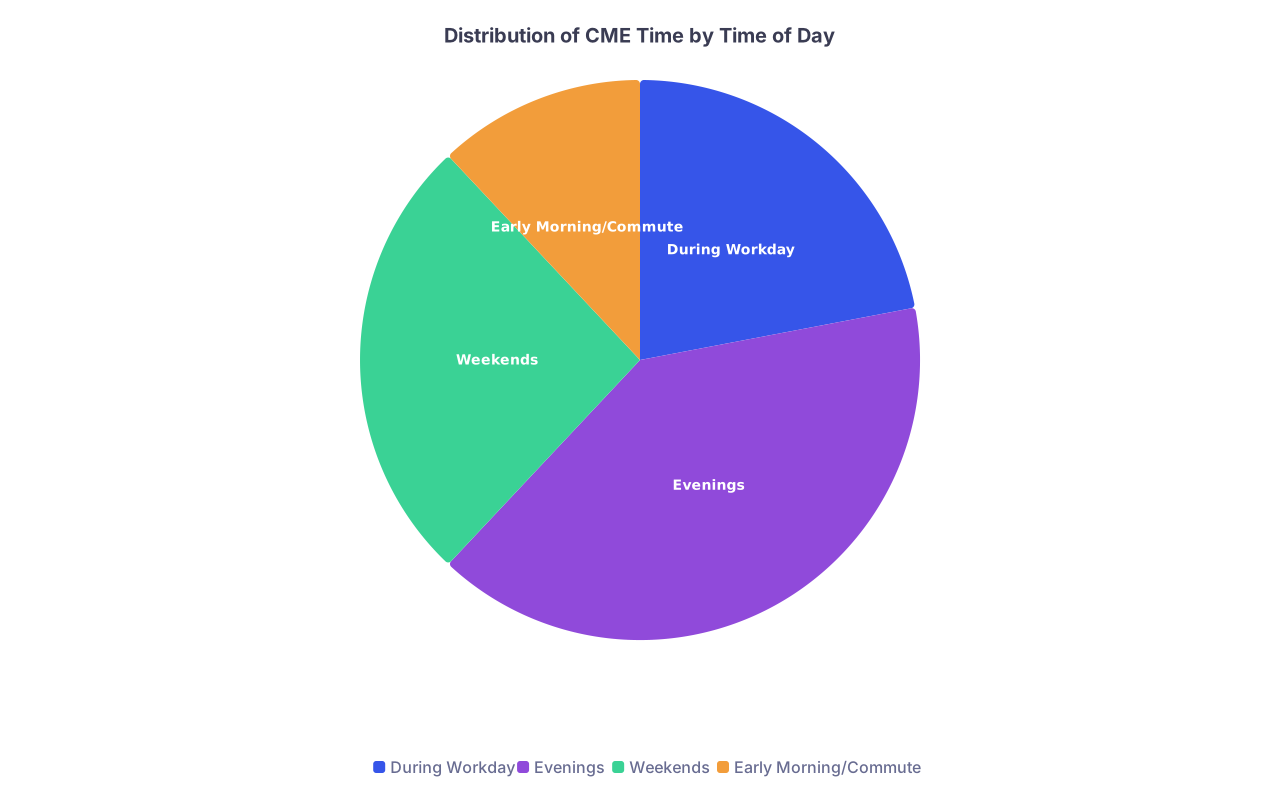
| Category | Value |
|---|---|
| During Workday | 22 |
| Evenings | 40 |
| Weekends | 26 |
| Early Morning/Commute | 12 |
Again, independent practitioners skew harder to evenings/weekends; academic and hospital‑employed physicians report more CME done within or adjacent to work time.
Format Mix: Live vs Online vs On‑Demand
The pandemic permanently changed the format mix. Pre‑2020, most surveys showed live conferences as the primary CME driver (by hours). Post‑2020, online on‑demand modules dominate the numbers, even as in‑person events recover.
Composite data from 2023–2024:
- ~50–60% of CME hours: On‑demand online (modules, videos, question banks)
- ~20–25%: Live online events (webinars, virtual conferences)
- ~20–30%: In‑person conferences, symposia, workshops
Physicians will tell you conferences are “where the real learning happens,” but the data shows the bulk of hours are now captured in short, modular, online formats because they fit fragmented schedules.
Age, Career Stage, and CME Time
Experience does not reduce time spent on CME. In some ways, it increases it.
When you cut the data by years in practice:
Early career (0–5 years post‑residency): ~50–60 total hours/year
Tend to be balancing first jobs, maybe a young family, plus the tail end of board exams. They often rely heavily on test‑prep style CME and institution‑provided content.Mid‑career (6–20 years): ~60–80 total hours/year
Peak engagement with leadership roles, multiple certifications, clinical innovation. They attend more conferences and often pursue niche or subspecialty CME.Late career (20+ years): ~50–70 total hours/year
Often more selective in what they attend, but maintenance requirements still keep them above 50 hours on average. Slight decline in conference travel with more reliance on online formats.
The “myth” that older physicians coast on minimal CME is not supported by data from licensing boards and major CME platforms. License renewal and specialty board rules are blunt instruments; they do not relax because you are 25 years out of training.
Hidden Time: The Administrative Overhead of CME Compliance
Most discussions about CME time stick to the hours of “education.” That misses a critical category: overhead. Logging, matching credits to specific state or board rules, updating systems like FSMB, ABIM, ABFM, or hospital credentialing portals.
When you ask physicians directly how much time they spend per year just tracking and documenting CME, the numbers look small in isolation—maybe 15–30 minutes here and there. When you add them up, they are not trivial.
Typical self‑reported annual admin time:
- 2–4 CME platforms to log into
- 1–3 board portals
- 1–2 state medical boards (for multi‑state licensure)
- 1–2 hospital or health system credentialing portals
Summed: 10–20 hours/year in pure admin handling for the average physician.
And that estimate is conservative. Whenever I have had groups actually time this (using time‑tracking software or retrospective estimates checked against login data), the true number is closer to the upper bound—15–25 hours—for physicians with more than one license or board.
This is why independent physicians suffer disproportionately. They do not have a GME office or credentialing department smoothing this out.
Time Value: Converting CME Hours to Economic and Personal Cost
An hour is not just an hour. For physicians, the opportunity cost is massive. The data shows:
- Median physician compensation often translates to $150–$300 per hour of clinical work (varies widely by specialty, region, and payer mix).
- Using a conservative $200/hour “value of time,” 60–80 hours/year of CME equates to:
- $12,000–$16,000/year in implicit time cost per physician.
Now overlay that on a medium‑sized health system:
- 500 physicians × 70 hours/year × $200/hour ≈ $7 million in time value annually, diverted from other activities into CME/MOC.
The point is not that CME is “too expensive” to justify. The point is: many organizations treat it as an afterthought administratively while quietly consuming millions in time.
For the individual physician, the personal cost is often evening and weekend time. Survey data frequently shows:
- 60–70% of physicians report doing CME at home on personal time.
- 40–50% believe CME requirements “significantly intrude” on personal or family time.
That sentiment is not just whining. The time‑use data backs it.
Efficiency: Who Is Spending Less Time for the Same Credits?
Not everyone is suffering equally. When I look at time‑per‑credit metrics in institutional data, I see roughly 2–3x differences in efficiency between physicians, sometimes within the same department.
Key factors associated with lower time‑per‑credit:
Integrated CME into existing meetings.
Departments that routinely assign CME credit to weekly grand rounds, case conferences, and morbidity & mortality reviews effectively convert time they would spend anyway into CME. Time‑per‑credit is close to 1:1.Use of bundled CME solutions.
Subscriptions or packages that align tightly with board requirements reduce admin time dramatically. One login, one transcript, fewer duplicate efforts.Proactive tracking.
Physicians who log credits immediately or use auto‑capture functions on major platforms rarely spend December digging through email for certificates. That alone can save 5–10 hours/year.
On the other end of the spectrum are the “December panickers.” They compress 30–40 credits into a few weeks, often picking longer, less targeted offerings because they are scrambling. Time‑per‑credit can easily double.
You can see this in the data: same 50 credits, but 50–60 hours for one group and 80–90 hours for another. The content is not more rigorous. The process is just messier.
Where the Data Is Weak (And What To Watch Next)
Not every dataset here is perfect. A few limitations matter:
Self‑report bias. Physicians systematically underestimate “background” time (like portal logins) while slightly overestimating high‑salience events (conferences). When we do objective tracking, the total is often 10–15% higher than self‑report.
Specialty society sampling bias. Surveys from engaged members over‑represent physicians who are already CME‑active. The least engaged (and often most time‑pressed) physicians are harder to capture.
Inconsistent definitions. Some surveys ask about “CME activities,” others about “learning and preparation for CME,” others about “MOC and CME combined.” You have to normalize aggressively.
Even with those caveats, the directional findings are stable across time and sources:
- The median physician spends about 60–70 hours/year on CME and CME‑related admin.
- Procedural, multi‑boarded, and independent physicians spend substantially more.
- A large share of this time occurs outside paid work hours and clusters unnaturally around deadlines.
Those three points show up again and again, whether the data comes from specialty societies, licensing boards, or internal health system metrics.
How Organizations Should Be Responding (Using the Data, Not Guesswork)
If you run a department, service line, or health system, the logical response is not “Tell people to get their CME done earlier.” That is lazy management. The data suggests more structural solutions.
Track aggregate CME time.
Not just credits. Time. Use internal surveys, platform data, or credentialing logs. If your average is over 80 hours/year, you have a system design problem.Convert existing learning into CME.
Grand rounds, quality improvement meetings, journal clubs—systematically identify what could carry CME credit and get it accredited. That converts necessary operational time into dual‑use hours.Standardize around fewer platforms.
Every additional login adds friction and overhead. Consolidate where possible so physicians are not juggling 5 different CME transcripts for one recredentialing cycle.Align CME calendars with peak clinical seasons.
Data on clinical volume is usually clear: flu season, summer vacation coverage, etc. Make CME calendars reflect that reality rather than pretending every month is equal.
When you apply these, you start seeing concrete reductions in reported time burden without reducing actual learning.