
It’s 11:47 PM on a random Tuesday. You log into your state medical board portal to upload that last CME certificate, feeling weirdly proud you actually did the hours this cycle. You click around. Then your stomach drops.
Your license renewal deadline was… three days ago.
Now your brain is screaming:
“Am I practicing illegally?”
“Do I have to stop seeing patients tomorrow?”
“Is this going to follow me forever, like some permanent scar on my record?”
Let’s walk through this like someone who’s also had that oh-my-god-I-missed-a-deadline cold sweat. Because the reality is: missing a CME deadline by a few days is almost never the end of your career. But pretending it didn’t happen? That can snowball into something ugly.
First: Are You Actually Late, Or Just Panicking?
Half the time, what freaks people out is misunderstanding what the deadline actually is.
Some states tie CME to the license renewal date. Others give you a full renewal period (like every 2 years) and you just have to have the CME done by the end of that cycle, even if you submit proof a little later.
Check three things immediately (before you spiral):
- Your license expiration date
- Whether CME must be completed by that date, or reported by that date
- Whether your state allows any grace period or late renewal
| State Example | License Expiration | CME Timing | Grace / Late Option |
|---|---|---|---|
| California | Last day of birth month | CME must be completed by expiration | Late renewal allowed with fee |
| Texas | Every 2 years on birth month | CME completed during 2-year cycle | Short delinquent period, then inactive |
| Florida | Every 2 years, fixed dates | CME tied to biennium, report at renewal | Some late options, but penalties possible |
You might discover you:
- Finished all CME on time, just uploaded late → usually fine
- Are inside a “delinquent” or “grace” period → annoying, but still fixable
- Actually let your license go expired while practicing → this is the situation you don’t ignore
But you need to know which bucket you’re in before catastrophizing.
The Big Distinction: CME Late vs. License Lapsed
Here’s the brutal but necessary distinction:
You’re late filing CME / short a few credits, but license still active
Much more common. Usually fixable with some combination of: late fee, make-up CME, documentation, and a mildly annoyed board.Your license actually expired and you kept practicing
This is where words like “unlicensed practice” and “disciplinary action” start popping up. Still not career-ending in most first-time, honest cases, but you can’t just click “renew” and move on.
Most people reading this are in the first group and spiraling like they’re in the second.
Let’s go through what usually happens step-by-step.
Scenario 1: You Missed the CME Deadline by a Few Days, But Your License Is Still Active
This is honestly the most common version of this story.
You realize you’re late. Maybe you’re short a couple of hours. Maybe you did the CME but didn’t have the certificates uploaded or organized.
What boards usually care about:
- Do you have the required hours?
- If not, are you correcting it quickly and honestly?
- Is this a pattern or a one-off?
Many boards build in mechanisms for people like us who don’t live in spreadsheet perfection world.
Typical things you’ll see:
- A late renewal window with a fee
- An option to attest you’ve completed CME and then upload documents later
- A short “cure” period where you can complete missing CME and still keep the license active
If you’re only a few days late and you already have the hours done, the board usually doesn’t care about the timestamp on your certificate to the day. They care about the CME cycle boundaries.
If you’re a tiny bit short (like 2–5 hours), a lot of states allow you to:
- Complete the missing hours quickly
- Pay any late or administrative fee
- Possibly count “extra” CME next cycle if they allow carryover (some do, some don’t)
Where people get in trouble is not the being-a-few-days-late part. It’s the:
- “I attested I had the hours when I didn’t”
- “I ignored board notices for months”
- “I did this multiple cycles in a row” thing
So if you’re just a few days off, and it’s your first time, and you’re proactively fixing it? You’re in the “annoying administrative hiccup” category, not the “career doom” category.
Scenario 2: Your License Expired, And You Kept Practicing
This is the nightmare scenario people imagine. And sometimes it’s… kind of real.
Here’s the thing I’ve seen: a physician realizes a week (or month) late that their license actually expired. But they’ve been seeing patients every day. Billing. Prescribing. Signing charts.
Cue panic.
How bad this is depends on:
- State law on practicing with a lapsed license
- How long it was lapsed
- Whether this is self-reported and quickly corrected
- Whether anyone was harmed (rarely the issue; it’s more regulatory/technical)
Possible consequences can include:
- Having to stop practicing immediately until the license is renewed or reinstated
- Paying fines and late fees
- Formal board investigation
- A public disciplinary action or reprimand on your board profile (varies widely)
- Required extra CME (ethics, professionalism, regulatory stuff)
Is everyone who misses a deadline by a few days doomed to public discipline? No. Many boards use informal processes, especially if:
- You realize it quickly
- You self-report honestly
- You show you’ve already fixed CME deficiencies
- There’s no pattern of neglect or dishonesty
Is there a risk? Yes. That’s why you don’t sit on it and hope it disappears.
What You Should Do Immediately (Not Three Weeks From Now)
Here’s where the anxiety can actually help you: channel it into being annoyingly proactive.
Step 1: Log into your state board portal
Check:
- License status: active, expired, delinquent, inactive?
- Any messages or alerts?
- Exact wording around CME requirements and deadlines?
Step 2: Pull your CME records now
Even if they’re a mess. Gather:
- Certificates
- Transcripts from major CME providers (like your specialty society)
- Online course completion records
Step 3: Figure out how short you are (if at all)
Are you missing:
- Total hours?
- Specific content (opioids, ethics, pain management, human trafficking, etc.)?
- Category types (Category 1 vs Category 2)?
Step 4: Call or email the board (yes, really)
I know this sounds terrifying. But boards generally hate surprises more than they hate honest, nervous doctors.
You can say something like:
“I realized I may have missed my CME deadline by a few days / might be a few hours short. My license is currently listed as [status]. I want to correct this as quickly and appropriately as possible. What’s the correct way to proceed?”
This does a few things:
- Shows honesty
- Creates a record that you’re not hiding
- Gets you actual, state-specific instructions instead of Reddit guesses
Step 5: Do the missing CME yesterday
If you’re short, fix it fast. Many boards are more flexible if the deficiency is already remedied when they look at your file.
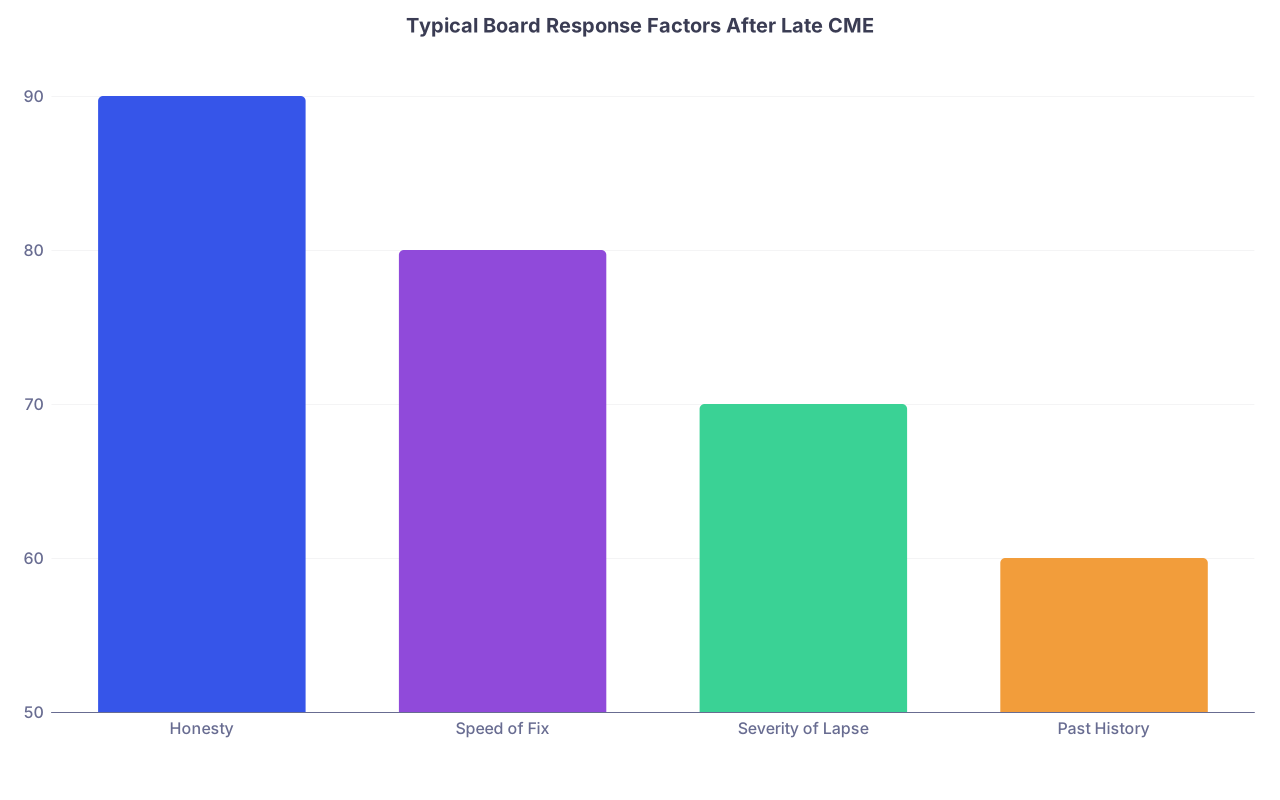
| Category | Value |
|---|---|
| Honesty | 90 |
| Speed of Fix | 80 |
| Severity of Lapse | 70 |
| Past History | 60 |
(That’s not real data, just a visual way of saying: honesty and speed matter a lot.)
Will This Ruin Future Credentialing, Jobs, or Privileges?
Here’s what you’re actually scared of: not today’s problem, but the “Have you ever been disciplined by a regulatory body?” box on every future form.
Real talk:
- A formal public disciplinary action (like a reprimand) will follow you around. Credentialing committees see it, hospitals see it, some employers will ask about it.
- A quiet administrative correction (late fee, documentation, maybe an internal warning) often doesn’t show up as public discipline.
Most boards reserve formal public action for:
- Repeated or willful noncompliance
- Dishonest attestation
- Longer unlicensed practice
- Refusal to respond or cooperate
For a one-off “I was a few days late, I fixed it, here’s all my proof, I’m sorry and it won’t happen again” situation, I’ve seen boards resolve it with:
- A note in their internal file
- Possibly a confidential letter of concern
- Worst case for some: a minor public notation with no big restrictions
That’s not me saying “don’t worry at all.” It’s me saying the horror-movie version in your head (you’ll never work again) is wildly out of proportion to how these cases usually end.
Will I Have to Stop Practicing Immediately?
If your license is still active: probably not. You might be dealing with a documentation / compliance issue, not an active-licensure issue.
If your license is expired: yeah, you might. Some states require you to cease practice immediately until:
- You renew in delinquent status
- Or complete a reinstatement process
People hate hearing that, but it’s better than quietly continuing to practice illegally and having that come out later when someone audits your file, or you apply for a new license, or a malpractice case dredges up timelines.
Short-term pain now > long-term three-page explanation letter later.
How To Keep This From Ever Happening Again (Because You Know Your Brain)
You can’t fix being human and overloaded, but you can build guardrails.
Practical, low-friction stuff:
- Put your license renewal date and CME cycle end date in your phone calendar with like 3 months of reminders beforehand. Not just one. Multiple.
- Use one main CME tracker: your state society, specialty society, or a CME app that aggregates reports.
- Knock out any “weird” mandated CME (opioid, suicide prevention, implicit bias) early in the cycle, not in the last 48 hours.
- Every time you do CME that seems important, save the certificate immediately into a folder named “State CME [Year–Year].”
You’re not trying to become a spreadsheet god. You’re trying to prevent “oh god, did I ever do that opioid module?” at 11:47 PM.

| Step | Description |
|---|---|
| Step 1 | Start of CME cycle |
| Step 2 | Add renewal date to calendar |
| Step 3 | Do major mandated CME early |
| Step 4 | Quarterly check CME hours |
| Step 5 | 3 months before deadline - compare to requirements |
| Step 6 | Complete remaining hours |
| Step 7 | Upload and verify in board portal |
The Part You Probably Need to Hear
Missing a CME deadline by a few days doesn’t mean:
- You’re irresponsible
- You’re unsafe
- You’re doomed to have a ruined professional reputation
It means you’re doing what almost every physician is doing: juggling too many fires, with licensing/CME as the boring one that doesn’t scream the loudest—until it does.
Boards aren’t sitting there eager to destroy you for a small, fixable misstep. They do, however, get very annoyed when people lie, delay, or ghost them.
If you show up, own it, fix it, and build a better system for next time, this is almost always a hiccup, not a defining event.
FAQs
1. If I’m only missing 1–2 CME credits, will the board really care?
Yes, they can. Some states are rigid. You’re either compliant or you’re not. But if you’re only missing a couple of hours and you complete them immediately after realizing it, many boards will let you cure the deficiency, sometimes with a late fee or a warning. The part that gets people in trouble is pretending they’re fully compliant when they’re not, not the “I was 2 hours short but fixed it immediately” scenario.
2. Do boards actually audit CME, or is it just an honor system?
It’s mostly an honor system with spot audits. Some boards randomly select a percentage of licensees, others target people based on risk factors or prior issues. I’ve seen people sail through multiple cycles never audited, and then suddenly get a letter asking for detailed proof. This is why you don’t lie on the attestation. If you’re picked and you can’t back it up, that becomes a much bigger problem than being a little late.
3. If I get a minor board action for late CME, will hospitals or employers care?
They might ask about it, but context matters. A small administrative action for late CME, especially if it’s clearly a one-time thing and already resolved, usually gets an eye-roll and a “tell us what happened” conversation during credentialing, not an automatic rejection. Repeated regulatory issues, dishonesty, or any pattern of noncompliance raises a lot more red flags than a single late CME cycle.
4. Can I use CME from after the deadline to “backfill” the previous cycle?
Sometimes. Some states explicitly allow you to apply CME completed shortly after the end of a cycle to the previous period as part of a cure/deficiency plan; others don’t and strictly assign CME to the date it was completed. This is where calling or emailing your board is key. Ask them directly: “Can these credits count toward the prior cycle to correct my deficiency?” Don’t assume, and don’t quietly backdate in your own head—that’s how small mistakes turn into honesty problems.
Key points to walk away with:
- Being a few days late on CME is usually fixable, especially if you act fast and don’t lie.
- The real danger isn’t the lateness itself; it’s unlicensed practice and dishonesty with the board.
- Get clear on your exact status, contact the board, fix any gaps immediately, and put better reminders in place so you never have to feel this particular panic again.