
The CME record you think “doesn’t really matter” is exactly what people quietly weaponize against you in promotion meetings.
Not in your face. Not in the policy documents. But behind closed doors, when your file is up and nobody wants to say “I just don’t like working with them,” they reach for the objective-looking thing that feels safe to criticize: your CME pattern.
Let me walk you through how that actually plays out, because it’s not what HR slides or faculty development workshops tell you.
How CME Really Shows Up in Promotion Meetings
Promotion meetings are not philosophical debates about your educational growth. They’re risk management and reputation management exercises disguised as academic deliberation.
Your CME record is rarely the star of the show, but it’s a very convenient supporting actor.
Most committees look at some combination of:
- Clinical performance / RVUs / quality metrics
- Teaching evaluations
- Scholarship / publications / QI work
- Service and leadership roles
- And then, somewhere in there… “CME and professional development”
Here’s the truth: nobody is impressed that you “met the CME requirement.” That’s assumed. The question in the room is:
Does this person look like a safe bet for more responsibility, more independence, more visibility?
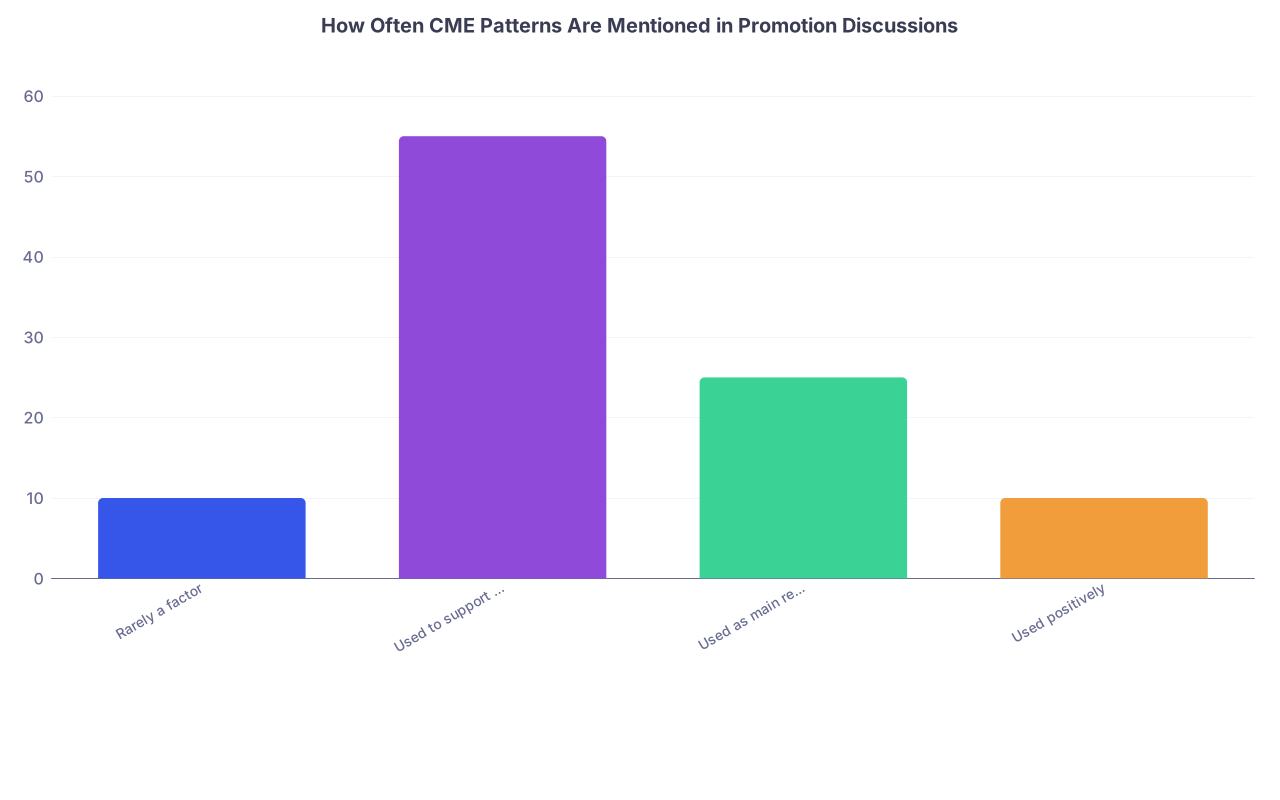
When the answer is “I’m not sure,” CME patterns become the justification to stall you. I’ve watched it happen at three different institutions.
| Category | Value |
|---|---|
| Rarely a factor | 10 |
| Used to support a concern | 55 |
| Used as main reason to delay | 25 |
| Used positively | 10 |
That bar you see in the middle—“used to support a concern”—that’s the quiet killer. Nobody fails you just for CME. They use CME to turn vague unease into a “documented issue.”
The CME Red Flags That Actually Get Talked About
I’m going to be blunt: there are patterns that reliably raise eyebrows. You may think they’re harmless. Your division chief does not.
1. The “Just In Time Panic” Pattern
You ignore CME all cycle. Then, two months before your license or board certification deadline, suddenly you’re vacuuming up any trash CME you can find.
What the transcript shows:
- 40–60 CME credits completed in a 6–8 week window
- Mostly low-quality, generic online modules
- Multiple “1.0 credit” activities finished on the same day
How it sounds in the room:
“They’re technically compliant, but this looks like last-minute box-checking.”
“If this is how they handle maintenance of certification, what else are they doing at the last minute?”
It becomes a personality proxy: disorganized, reactive, maybe careless. No one’s saying that out loud on your face. They are saying it when you’re not there.
This pattern especially hurts you if:
- You’re up for leadership (section chief, program director, committee chair)
- You’ve had any paperwork or documentation issues before
- You’re in a high-risk specialty (OB, anesthesia, interventional anything)
Leaders do not want to promote someone the institution might have to defend in court with a CME record that screams procrastination.
2. The “Click CME” Problem: Low-Substance Topics
You know those easy “opioid prescribing basics,” “HIPAA refresher,” “hand hygiene” modules you do half-asleep? They’re fine in moderation. But when 70–80% of your annual CME is that kind of content, it reads badly.
What the transcript shows:
- Heavy emphasis on compliance-type modules
- Very few specialty-specific or advanced clinical topics
- Almost no diversity in learning formats (no conferences, no workshops, no grand rounds credit)
How it gets translated:
“I don’t see evidence they’ve pushed their knowledge in their field.”
“They meet the bare minimum but this isn’t someone seeking mastery.”
Again, nobody will say “they’re lazy.” They’ll say “I’m not convinced about their commitment to ongoing professional development.” That’s promotion-speak for the same thing.
This is especially dangerous if:
- Your specialty is rapidly evolving (oncology, cardiology, ICU, EM, ID)
- You’re a midcareer doc asking for full professor or a major title
- You’ve had a significant clinical miss or complaint in the last few years
The committee wants to see a story: “After that issue, they engaged in targeted CME and improved.” If what you did instead was three generic risk-management videos, it looks like you learned nothing.
3. The “Random Walk” CME Pattern
Some of you are CME omnivores. You click whatever lands in your inbox, attend whatever’s free, and your transcript looks like the clearance bin at a bookstore.
On paper, it looks like:
- Scattered across dozens of disconnected topics: sleep, obesity, coding, dermatologic pearls, pediatric emergencies—none of which are your field
- Almost no coherent through-line connected to your role or career goals
- No recognizable “narrative” of professional growth
I’ve heard versions of this in real promotion conversations:
“They’re in cardiology but I don’t see much cardiology here.”
“Lots of things, but nothing sustained. What are they actually developing expertise in?”
For promotion, committees like patterns. They want to say:
- “She’s clearly developed as an educator—look at the CME on assessment, feedback, simulation, curriculum design.”
- “He’s doubled down on quality and safety—see the consistent series of QI, patient safety, systems CME.”
If your CME choices look like chaos, that makes it hard to pitch you as an expert with a trajectory.
4. The “Zero Leadership or Education” Signal
You’re asking for associate or full professor. Or a new title: Vice Chair, Medical Director, Program Director. The committee flips to your CME page and sees:
- All clinical
- Zero leadership, management, or education-focused CME
- Nothing on coaching, feedback, conflict management, systems-based practice, or DEI
Quiet but brutal translation:
“They want a leadership role but have not done a single thing to prepare for it.”
At one institution I worked with, a strong candidate for program director got kneecapped exactly this way. Someone leaned back and said:
“I see no GME-related development. No faculty development retreats, no assessment workshops, no ACGME-related CME. Are we sure they understand what they’re getting into?”
The committee ended up delaying the appointment a year. On paper, the reason was “further development in educational leadership.” In reality, people were uneasy and used CME as the clean, documentable excuse.
5. The “Weird Gaps After Incidents” Problem
This one is sensitive, but it comes up more than you think.
You had:
- A major complication
- A complaint to risk management
- A disruptive behavior issue
- A remediation plan for professionalism or clinical skills
If your CME in the following 1–2 years doesn’t show anything targeted to that area, your advocates are left with nothing to work with.
I’ve heard:
“We had that central line infection cluster two years ago and I don’t see any procedural or infection control CME afterward.”
“They’ve had multiple communication complaints but no CME on communication, bias, or professionalism.”
It looks like either denial or disinterest in growth. Promotion committees hate that combination.
The smart move is the opposite: make your CME visibly, deliberately responsive to your weak spots. Let it be the evidence you present that you didn’t just “move on,” you improved.
6. The “All Industry, All the Time” Look
Nobody’s going to punish you for attending a pharma-sponsored dinner. But when your transcript—and your CV—start to look like a sales rep’s travel log, it becomes a problem.
The record that makes people nervous:
- Heavy markup of industry-supported symposia and sponsored events
- Very few independent, society-led, or academic CME conferences
- Multiple programs from a single company associated with a product line you use a lot
How it gets framed:
“I would like to see more independent CME; this looks a bit imbalanced.”
In plain language: “I’m not sure your practice decisions are as unbiased as we want in a promoted faculty member.”
For leadership roles in formulary committees, guideline groups, or quality leadership, this hits even harder. They want you squeaky clean or at least balanced.
7. The “Bare Minimum, Every Year” Pattern
You hit 25 credits. Or 50. Or whatever your board requires. Every. Single. Year. No more.
No big conference attendance. No certificate programs. No deep dives. Just exactly enough to renew everything and not a single credit beyond.
This is the quiet stuff people mutter:
“They do the minimum in every domain.”
“There’s not a lot of evidence of going above and beyond.”
Nobody expects you to sit at 200 hours of CME annually. But for promotion to higher ranks, a multi-year record of “exactly 25” doesn’t help your case when you’re fighting for distinction, not survival.
What Committees Like To See In CME
Let me flip it. Because the standards are not mysterious once you’ve sat in that room enough times.
Promotion committees like transcript patterns that support a narrative:
- “This person is deepening in their clinical niche.”
- “This person is clearly developing as an educator or leader.”
- “This person responds constructively when things go wrong.”
- “This person looks like a safe, thoughtful, future-facing faculty member.”
| Pattern Type | How It’s Interpreted |
|---|---|
| Last-minute binge CME | Disorganized, check-the-box mentality |
| Specialty-focused progression | Deepening expertise, career trajectory |
| Targeted CME after problems | Insightful, coachable, growth-oriented |
| Leadership/education CME before promotion | Prepared, intentional about role |
| Industry-heavy CME | Potential bias, reputational risk |
If they can map your CME to one of those positive narratives, they relax. Your other flaws become tolerable.
If your CME screams “random,” “minimal,” or “reactive,” then every other concern in your file gets amplified.
How To Quietly Fix Your CME Profile Before Anyone Notices
You don’t need more hours. You need a different pattern.
Build A Coherent Storyline
Ask yourself: “If someone who doesn’t know me looked only at my CME for the last 3–5 years, what story would they tell?”
Now, pick a storyline you actually want:
- Master clinician in X
- Emerging educational leader
- Systems and quality expert
- DEI and communication champion
- Future section chief / medical director
Then, over the next 12–24 months, make 60–70% of your CME reinforce that story.
That means:
- Annual or biannual major meetings in your field
- A couple of formal courses or certificate programs related to your lane (leadership, education, quality)
- Fewer random “whatever’s in the inbox” click-CME activities

Stop The Panic Binge Pattern
If your transcript currently shows huge bursts of CME every 2–3 years, you’re not going to erase that. But you can dilute it going forward.
Practical approach that doesn’t wreck your life:
- 1–2 credits per month of intentional CME (journal-based modules, high-yield online courses, or grand rounds with credit)
- One bigger event each year (conference, workshop, certificate program)
That alone turns your pattern from “binge and starve” to “steady, ongoing development.” It looks like a different person, even if your total annual hours barely change.
Use CME To Patch Known Vulnerabilities
Look at your own record honestly:
- Have there been complaints or whispers about your communication, documentation, or professionalism?
- Have you had an adverse event that was big enough to reach risk management or M+M?
- Have you been told “your evaluations are inconsistent,” “residents struggle with you,” or “patients complain about your bedside manner”?
If yes, your CME over the next 1–2 years should explicitly show work in those areas.
Examples that play very well in committees:
- “Communication in High-Stakes Encounters”
- “Implicit Bias in Clinical Decision-Making”
- “Documentation and Risk Reduction in [Specialty]”
- “Coaching and Feedback for Trainees”
- “Managing Difficult Team Dynamics”
Then you (or your chair) can say in the meeting:
“After that issue in 2023, she did a series of CME on communication and bias, and her evaluations have improved noticeably.”
Now your CME is not just neutral. It’s your defense exhibit.
Add A Few High-Signal Items
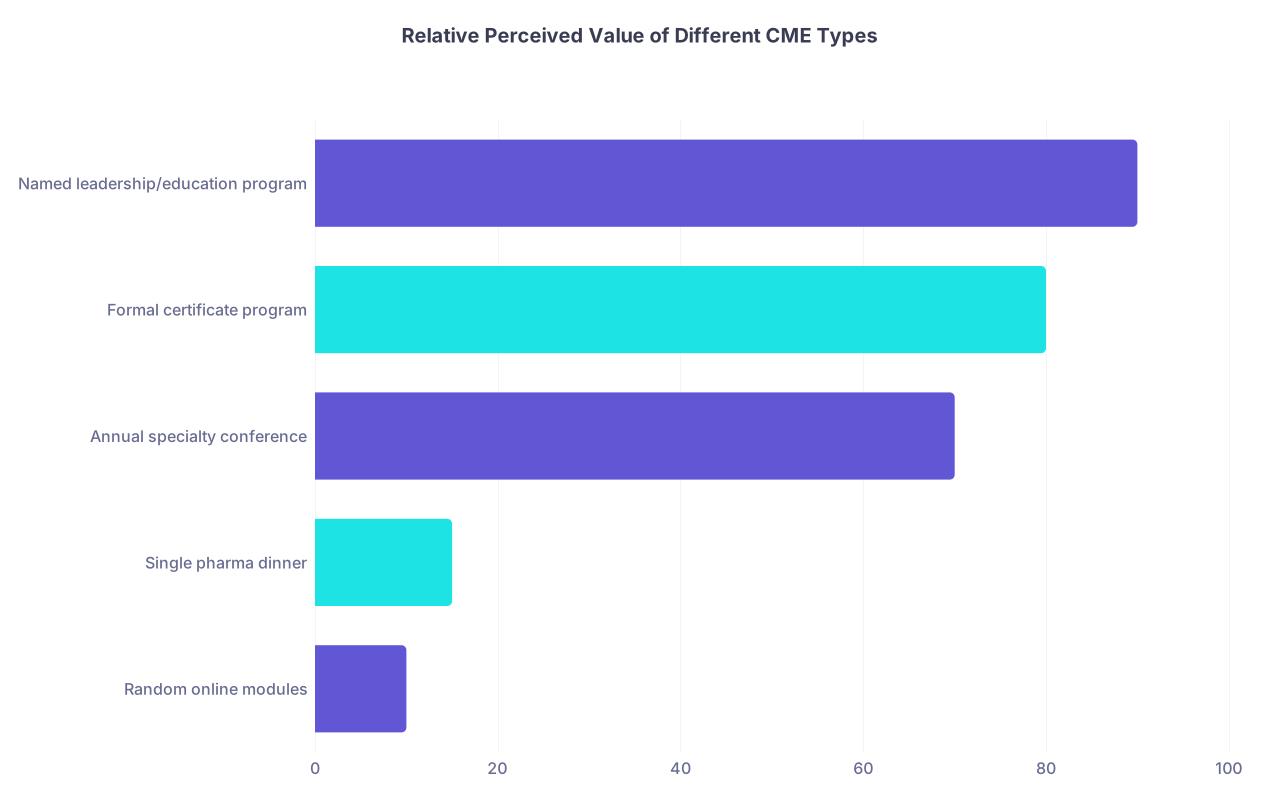
Not all CME is created equal in the eyes of a committee. There are “big signal” items that change how everything else is interpreted.
High-signal examples:
- Named society conferences in your specialty (not obscure, not fringe)
- Well-known leadership programs (Harvard Macy, AAMC, academy courses, local leadership institute)
- Formal QI/patient safety certificates
- Medical education fellowships or longitudinal faculty development programs
You do not need a dozen of these. One or two, at key stages, can completely shift the tone of the conversation:
“And they’ve completed the X Leadership Program last year, which focused on conflict management and strategic planning.”
That sentence softens a lot of other concerns.
| Category | Value |
|---|---|
| Random online modules | 10 |
| Single pharma dinner | 15 |
| Annual specialty conference | 70 |
| Formal certificate program | 80 |
| Named leadership/education program | 90 |
Make It Easy For Your Chair To Use Your CME In Your Favor
Remember: your chair or division chief is often your advocate in that room. They’re not going to forensically analyze your transcript. They’ll skim.
Your job is to make that skim tell a clean story they can repeat.
You can even spoon-feed them language. In your personal statement or annual review, write a line like:
“Over the past three years, my CME has focused on advanced [specialty] care and the development of my skills as a clinical educator, including X, Y, and Z programs.”
Now when your file hits the room, someone can say:
“You can see that in their CME—note the consistent focus on [theme].”
You’ve given them the script.
The Uncomfortable Truth: Promotion Is As Much About Risk As Achievement
Let me be clear: CME alone rarely gets anyone promoted or blocked.
But when your file hits the table, there are always undercurrents:
- “She’s great clinically but kind of scattered.”
- “He’s solid but I’m not sure about his judgment.”
- “Residents don’t always feel safe with her.”
- “He’s good, but is he leadership material?”
Your CME record is one of the few semi-objective things people can point to when they’re trying to justify a feeling without making it personal.
You can either let it quietly undercut you. Or you can make it one of the strongest pieces of your case.

| Step | Description |
|---|---|
| Step 1 | Your File Reviewed |
| Step 2 | Minor flaws tolerated |
| Step 3 | Look for objective concerns |
| Step 4 | Risk seems lower |
| Step 5 | Risk seems higher |
| Step 6 | More likely promotion |
| Step 7 | Delay or conditional promotion |
| Step 8 | Committee Confidence |
| Step 9 | CME Pattern |
You do not need more hours. You need a pattern that makes you look like the kind of physician and educator committees are comfortable betting on.