
The way program directors think about CME is not what your faculty brochure says. CME isn’t just a checkbox for “lifelong learning.” It’s a quiet signal about who is serious, who is coasting, and who is safe to put in front of trainees.
Let me tell you what really happens behind the scenes when CME engagement is used to rank faculty mentors.
The Unspoken Link: CME → Reliability → Mentorship
Program directors rarely say this out loud in meetings, but the thought process is blunt: if a faculty member cannot reliably keep up with their own education, they’re a risk as a mentor.
Nobody cares whether Dr. X has exactly 50 or 75 AMA PRA Category 1 Credits™ this cycle. That’s not the point. What they care about is pattern and attitude.
On call rooms and in PD offices, I’ve heard versions of this line more times than I can count:
“If she’s still doing the minimum online modules at 11:30pm on December 31st, I’m not assigning her a vulnerable intern.”
That’s how CME gets translated into mentor ranking. Not as a number, but as a behavioral marker.
There are three core questions PDs and associate PDs are really asking when they look at CME behavior:
- Does this faculty member actually engage with specialty-relevant CME, or just churn through hospital-required clickbait modules?
- Do they complete things proactively, or under duress and past deadlines?
- Do they choose CME that overlaps with education, teaching, or assessment?
Faculty who score well on those three – they quietly move to the top of the “safe mentor” pile.
And yes, there is a pile. Often a spreadsheet. Sometimes a whiteboard with initials, color-coded.
How CME Data Actually Reaches the Program Director
You probably assume CME logs are some private thing between the physician and the state board. That’s naïve.
At most academic centers there’s some version of this pipeline:

| Step | Description |
|---|---|
| Step 1 | Faculty complete CME |
| Step 2 | Credit recorded in CME portal |
| Step 3 | Department HR or admin extract report |
| Step 4 | Annual review packets for division chief |
| Step 5 | Program director reviews mentorship candidates |
| Step 6 | Informal ranking of faculty mentors |
No, the PD usually isn’t running raw CME reports. But:
- Division chiefs see them during annual evaluations
- Department chairs see summary tables
- Some institutions push out “CME compliance dashboards” to all leadership
What matters is this: the PD has access to patterns, even if they don’t see every individual course.
I’ve watched a PD flip through an annual evaluation binder and stop on a page that showed three years of CME. No comment. Just a raised eyebrow and a mental note: “He barely squeaks by every year. Not putting him as primary mentor for any struggling interns.”
You will never see that written in a committee minute. But it happens.
The Quiet Scoring System: How Faculty Mentors Get “Ranked”
Programs don’t circulate a document titled “Mentor Rankings by CME Engagement.” They’d be sued within a week. But internally, faculty get sorted into tiers, and CME is part of the algorithm—even if no one calls it that.
Here’s roughly how it plays out.
| Tier | How PDs Describe Them | CME Pattern (Behind the Scenes) |
|---|---|---|
| A | Go-to mentors | Consistent, specialty-focused, early completion |
| B | Safe, adequate | Meets requirements, occasional relevant activities |
| C | Use sparingly | Just-in-time, hospital-mandated CME only |
| D | Avoid if possible | Bare minimum, late, or chronic non-compliance |
Notice what is not here: “faculty with the highest total CME hours.” That’s meaningless. A desperate end-of-year binge on random online modules doesn’t make you an A-tier mentor.
What PDs actually look for when assigning mentors
When a new class of residents comes in and someone asks, “Who gets formal mentors this year?” the PD or APD typically pulls from memory and informal notes, not a scoring rubric.
CME engagement shows up in those informal judgments in a few ways:
Stability and professionalism
“She’s always got her CME and MOC knocked out in the first half of the cycle. She pays attention to details. She can probably track a resident’s milestones without us chasing her.”Educational alignment
“He keeps doing those simulation and assessment CME courses. Let’s have him handle the residents who need remediation in procedures.”Specialty depth
“She was at that national subspecialty course again this year. Good person for fellows interested in that niche.”
Program directors won’t say “her CME puts her in Tier A.” They say, “She’s solid. Give her two mentees, she’ll follow through.” The CME trail is part of the evidence.
The Patterns That Quietly Lower Your Mentor Rank
Let me be clinical about this. These patterns hurt you far more than any single missed lecture or average teaching eval.
1. End-of-cycle CME panic
This is the faculty member who:
- Ignores CME all year
- Declines or “can’t make” departmental journal clubs that offer CME
- Then spends December cramming online modules, grumbling about “this BS requirement”
I’ve sat in December division meetings where the administrator announced: “Reminder, CME deadline is coming up.” And three people immediately asked, “What’s the fastest way to get 20 credits online?”
You know what the PD wrote down mentally? Not the question itself, but who asked it. Those names don’t vanish. When the same people show up on issues reports (late evaluations, missing clinic notes, borderline professionalism events), CME procrastination just confirms a pattern.
Residents hear it too. They hear, “I did 8 hours of online CME this weekend because the board’s on my back.” That does not scream “role model.”
No PD is going to hand that person three PGY-1 mentees and hope for the best.
2. CME completely divorced from what they teach
Another quiet red flag: misaligned CME.
Think of the hospitalist who mentors interns but spends all of their optional CME on investment seminars, entrepreneurship courses, or random non-clinical topics. Meanwhile, their bedside teaching is stuck in 2010, and they haven’t read a major trial in years unless it was on Twitter.
PDs don’t begrudge people a few finance or wellness credits. But if your pattern is:
- You’re on the education committee,
- You mentor half the incoming class,
- And your transcript is nearly empty of education- or specialty-focused CME…
…it starts to look like you’re “playing academic,” not actually investing in being a better educator or clinician.
I sat in one promotion committee where a candidate touted being “deeply involved in resident education.” The committee chair quietly flipped to the CME transcript. It was heavy on random leadership retreats and ICU updates, zero education-focused CME over five years. The chair leaned back and said, “Interesting. No actual investment in education.”
That comment alone moved the needle against making him a key mentor for struggling residents.
3. Chronic non-compliance or grace-period dependence
Some faculty ride grace periods like a sport. They’re technically compliant, but barely:
- State license renewed in the last week
- CME attested right before audit letters would go out
- MOC parts done just under the wire
At several institutions, CPD (continuing professional development) offices now send departments lists of faculty who required extra nudging to complete mandated activities. Those lists migrate, informally, into leadership conversations.
I’ve heard PDs say things like:
“Every time there’s a mandatory patient safety CME, he’s one of the last three names on the non-compliant list. He’s not getting assigned as a core faculty mentor.”
Is that “fair”? Maybe not perfectly. But from a PD’s perspective, it’s risk management. If you’re unreliable when your own license is on the line, why would you be reliable when a resident quietly spirals?
Where CME Engagement Helps You Jump Tiers
Now the flip side. There are specific, very predictable ways CME can push you up the informal ranking – especially at places that actually care about education.
1. Education-focused CME as a flag for “real mentors”
Here’s the biggest secret: almost no one does CME specifically to become a better teacher. When someone does, it stands out.
Faculty who attend:
- “Assessment of Clinical Competence” workshops
- Conferences on milestones, EPAs, coaching
- Simulation-based CME tied to teaching and feedback
- Faculty development series on bias in assessment, remediation, or advising
These people get remembered. You’ll hear APDs say:
“She went to that national educator course and came back with new feedback tools. She should be a formal mentor for the PGY-1s on probation.”
Their CME choices tell leadership: “I take my role with trainees seriously enough to learn how to do it properly.” That message lands.
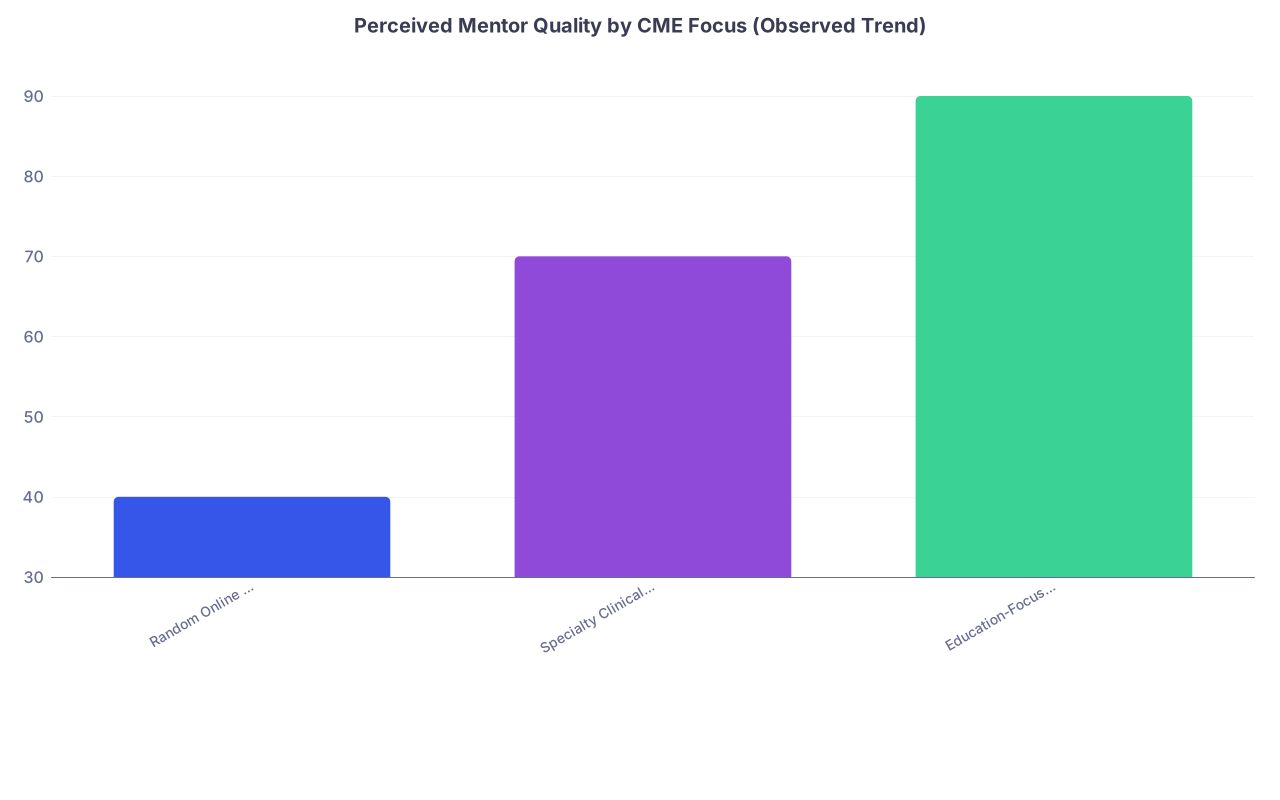
| Category | Value |
|---|---|
| Random Online CME | 40 |
| Specialty Clinical CME | 70 |
| Education-Focused CME | 90 |
No, those numbers aren’t from a published trial. They’re from the back-of-the-envelope perception scale I’ve watched PDs use in their heads.
2. Consistent engagement in specialty updates
Then there are the clinicians everyone trusts because they’re always current.
You know the type: they’ll say on rounds, “Let’s quickly pull up that new trial; it just came out last month, and I was at the session where they presented it.”
When those people have CME logs that show:
- Regular attendance at major national meetings
- Subspecialty courses relevant to what they supervise
- Occasional speaking or moderating at CME events
They get moved into “anchor mentor” category. Not because of the prestige, but because residents will not have to unlearn outdated medicine after working with them.
Program directors quietly stitch this together:
- Conference travel records
- CME certificates in annual reviews
- Word of mouth from residents who say, “She always knows the newest stuff”
And then they say: “If someone is applying for fellowship in that area, pair them with her.”
3. Stepping up for institutional CME that benefits trainees
There’s an underappreciated category: institutional or system-level CME that has direct impact on residents and students. Think:
- Developing or piloting QI/safety CME modules
- Leading morbidity and mortality conferences with CME credit
- Running simulation CME that residents attend
- Serving on CME committees that shape educational content
This is where faculty start to bleed into “core educator” territory. When the PD sees the same names repeatedly:
“He helped design our new sepsis CME module and incorporated resident feedback into it.”
That person is getting tapped for more formal mentoring, committees, and sometimes APD roles.
And once you’re seen as “someone who builds educational infrastructure,” your mentor ranking is effectively locked in at the top, unless you actively torpedo yourself.
How Residents Feel It (Even If They Never See the CME)
You might think none of this matters to trainees because they never see your CME transcript. That’s wrong.
Residents experience the downstream effects:
A-tier mentors
- Respond to emails
- Know current guidelines
- Give structured feedback
- Show up to teaching-related CME sessions residents are also forced to attend
C/D-tier faculty
- Vanish for weeks
- Give feedback like “you’re fine” or “you need to read more”
- Complain about “stupid mandatory modules” in front of interns
- Show visible resentment around anything related to education requirements
When residents fill out end-of-rotation evaluations and mentoring surveys, those patterns surface. PDs cross-reference, implicitly:
- Poor evaluations from trainees
- Minimal or grudging CME engagement
- Administrative complaints or professionalism flags
Three strikes. That faculty member might still exist in the department, but they’re no longer in the core mentor pool. At some programs, I’ve literally seen their names removed from the “available mentors” list that’s given to incoming residents.
The Political Layer: How CME Plays into Promotion and Titles
Here’s another insider piece people don’t connect: decisions about “Director of Resident Mentorship,” “Site Director,” or “Associate Program Director” often lean heavily on perceived educational commitment. CME is one of the few tangible things leadership can point to.
In closed-door meetings, I’ve heard dialogues like:
Chair: “Between Dr. A and Dr. B, who’s better for the Associate PD role?”
PD: “Dr. A has been at every education workshop we’ve run in three years. Dr. B is always ‘too busy.’ Dr. A also presents CME at grand rounds.”
Chair: “So Dr. A then.”
That’s it. Decision made.
The faculty who treated CME as bureaucratic noise just lost a multi-year leadership opportunity – and with it, the institutional credibility that would have made them a top-tier mentor automatically.
Once you carry one of those titles, you don’t need to ask to be assigned mentees. Residents get auto-assigned to you. Your mentor ranking is formalized in the org chart.
If You’re a Faculty Member: How to Quietly Climb the Mentor List
You do not need to become a CME zealot to win here. But if you want to be the person program directors trust with their residents, do a few specific things differently.
Stop the December scramble. Get half your required CME in the first 6 months of your cycle. Not dramatic, just disciplined. You’ll never end up on the “non-compliant” list that gets circulated to leadership.
Choose CME that matches what you supervise. If you’re the night float attending, do up-to-date sepsis, codes, end-of-life, and acute care CME. If you run a continuity clinic, invest in outpatient and chronic disease content.
Do at least one education-focused CME activity per year. Teaching, feedback, assessment, bias, remediation – take your pick. This is the “I care about my role with trainees” flag.
Be visible in at least one institutional CME activity. Lead a session, sit on a planning committee, run a workshop. Your name showing up on CME flyers does more for your mentor reputation than 20 hours of anonymous online modules.
Don’t trash-talk CME in front of residents. Vent in private if you must. But in front of trainees, frame it as: “This is part of staying current and safe for our patients – and for you.”
You do this for two or three years, and I guarantee your PD’s mental model of you shifts. Even if they don’t love you personally, they’ll see you as reliable, invested, and safe.
If You’re a Trainee: How to Read the Signals
You don’t have access to CME transcripts, but you can read the signs:
- Who always references recent conferences or guideline updates?
- Who attends teaching-related workshops or gives talks with CME attached?
- Who treats mandatory education as part of professionalism instead of a joke?
Those are the faculty you want in your corner.
When you see a PD strongly steering residents toward or away from certain faculty mentors, understand: CME engagement is often one of the invisible variables behind those decisions. You’re seeing the output, not the input.
If you ask for a mentor and the PD pushes you toward Dr. X instead of your first choice Dr. Y, sometimes it’s because they know Dr. X actually shows up, stays current, and values education – and Dr. Y barely remembers to renew his license.
They’ll never say it that bluntly. But that’s the calculus.
The Bottom Line
Three key truths you should walk away with:
- CME patterns are a proxy for professionalism and reliability. Program directors quietly use them to decide who is safe and serious enough to mentor trainees.
- Education- and specialty-focused CME boosts your mentor ranking. Faculty who invest in teaching-related and relevant clinical CME rise quickly in the informal tiers.
- Residents feel the impact even if they never see the data. The mentors they get paired with are filtered through this lens, whether anyone admits it or not.
You can ignore CME and still keep your license. But if you want real responsibility in medical education – if you want program directors to trust you with their residents – your CME habits are already writing your reputation.