
The way most physicians "do" CME is broken: random courses, last‑minute panic, and zero connection to actual career goals.
You can fix that in one year.
Below is a step‑by‑step, 12‑month CME strategy that does three things at once:
- Keeps you compliant.
- Moves your career forward.
- Protects your time and sanity.
I am not interested in abstract advice. This is a working playbook you can implement today.
Step 1: Get Brutally Clear on Requirements vs Goals
Before you even look at a single course, you need two numbers in front of you:
- What you MUST do (licensing, board, hospital)
- What you WANT to become (skills, roles, income)
A. Map your non‑negotiable CME requirements
Pull out:
- Your state medical board CME requirements
- Your specialty board MOC / recertification requirements
- Your hospital / health system credentialing expectations
- DEA requirements (if applicable for controlled substances)
Create one simple summary for the next 12 months. You are aiming for something like this, not a 14‑page PDF.
| Source | Credits Needed | Type / Notes |
|---|---|---|
| State License | 50 / 2 years | At least 20 Category 1 |
| Specialty Board (IM) | 30 / year | Includes QI / MOC points |
| Hospital Credentialing | 25 / 2 years | Must include ACLS renewal |
| DEA Requirement | 8 / renewal | Opioid and addiction training |
Now translate this into an annual target. If your cycle is two years, divide by two and round up. You want buffer, not a scramble.
For example:
- State board: 50 / 2 years → 25 per year
- Hospital: 25 / 2 years → 13 per year (round to 15)
So your baseline annual CME floor might be:
- 25 (state) + 30 (board) + 15 (hospital, overlaps allowed) + 8 (DEA, if due this year)
- Realistic annual target: 40–50 Category 1 credits, with specific content (opioids, ethics, etc.) flagged.
B. Decide your 12‑month career priorities
Now the part most physicians skip.
Pick 2–3 concrete career goals for the next 12 months. Not fantasies. Real, behavior‑changing goals.
Examples:
- Clinical depth:
- Become truly strong in heart failure, advanced diabetes management, or severe asthma.
- Role transition:
- Move into leadership (medical director, chief of service).
- Transition toward non‑clinical / hybrid work (consulting, informatics, quality).
- Academic / teaching:
- Develop a niche and become the “go‑to” lecturer on a topic.
- Business / practice:
- Learn the business side: coding, RVUs, contracts, negotiating.
Write them as outcome statements:
- “In 12 months, I want to be comfortable managing complex heart failure without reflexively referring.”
- “In 12 months, I want to be a realistic candidate for an associate program director role.”
- “In 12 months, I want 15–20% of my income from non‑clinical activities.”
C. Connect requirements to goals
Now you match the two lists.
Ask for each requirement: “How can this also serve my goals?”
Examples:
- Need opioid CME?
→ Choose a program heavy on chronic pain management and addiction medicine that elevates your clinical skill, not just a checkbox 2‑hour webinar. - Need QI credit for your board?
→ Choose or design a QI project that builds leadership and system‑level skills you can talk about when applying for a leadership role. - Need 30 Category 1 credits?
→ Do a focused certificate course (e.g., obesity medicine, leadership in healthcare) that gives 20–25 credits plus a marketable credential.
You are aiming for maximum overlap between:
- Required CME
- Career skill-building
- CV‑enhancing certifications
Step 2: Build a 12‑Month CME Architecture (Not a To‑Do List)
You do not start by booking courses. You start by designing a structure for the year.
Think of it like building a financial plan:
- Automatic baseline (monthly)
- Strategic investments (quarterly)
- Big moves (once or twice a year)
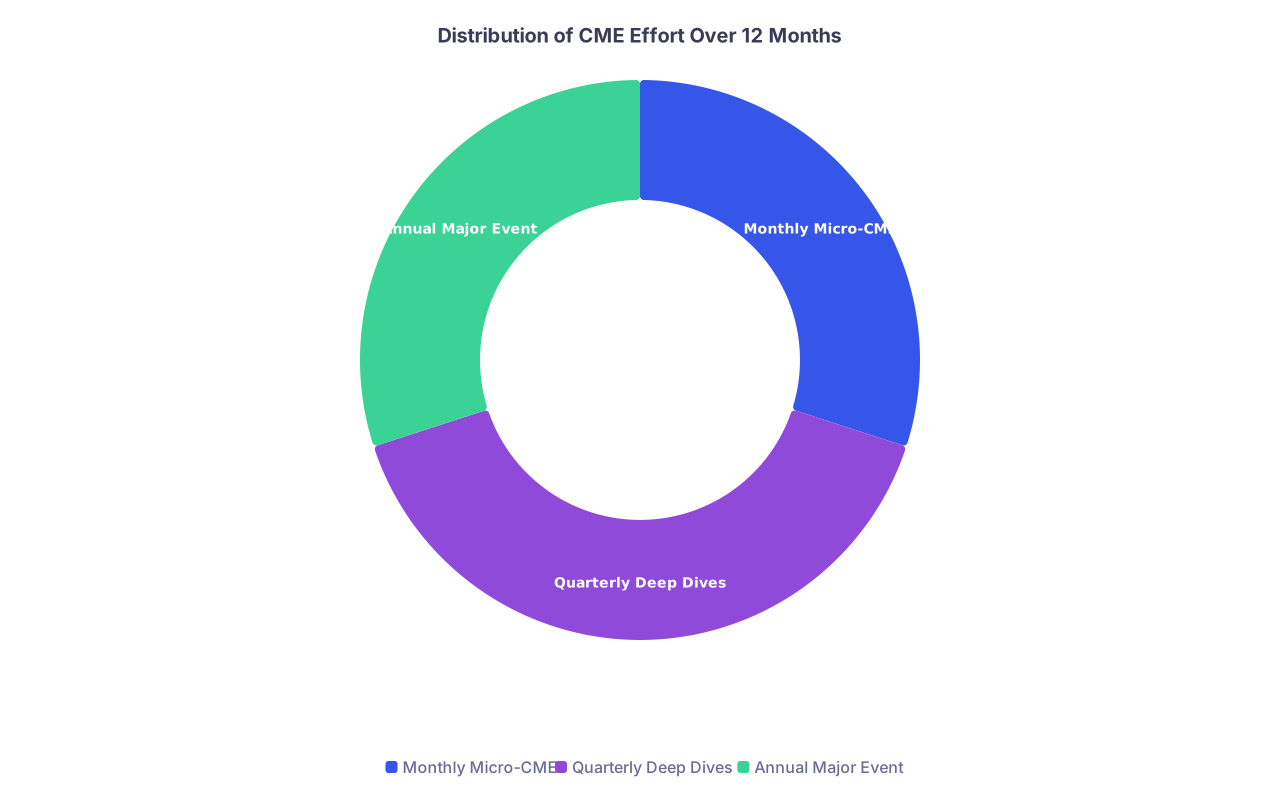
| Category | Value |
|---|---|
| Monthly Micro-CME | 30 |
| Quarterly Deep Dives | 40 |
| Annual Major Event | 30 |
A. Monthly “micro‑CME” backbone (5–7 credits/month)
Aim for:
- 1–2 hours per week of bite‑sized CME that:
- Fits your schedule
- Is mostly on‑demand
- Tracks automatically
Options:
- Subscription platforms (e.g., NEJM Knowledge+, AudioDigest, UpToDate CME, specialty‑specific journals with built‑in CME quizzes).
- On‑demand video modules from your specialty society.
- Mobile CME apps you can do between cases or during commute (audio).
Target:
- 3–5 credits per month from low‑friction sources.
- 1–2 credits from practice‑linked activities (chart review CME, point‑of‑care CME integrated into your EHR if your system has it).
B. Quarterly “deep dive” blocks (6–10 credits each)
Once a quarter, you dedicate real time (half‑day to full day) for:
- A focused online course series
- A mini‑fellowship style program
- A hospital‑sponsored workshop
These should map closely to your 2–3 career goals:
- Q1: Advanced heart failure management (10‑credit course).
- Q2: Medical leadership fundamentals (8–10 credits).
- Q3: Practical quality improvement for clinicians.
- Q4: Coding, documentation, and RVU optimization.
Block the time in your calendar at the start of the year. Half‑day on a Friday. Protected.
C. One major event (optional but powerful)
If your finances and schedule allow, one conference or major course can cover:
- 15–25 credits
- Networking
- Exposure to new ideas
- A clear “narrative” for your year (“I went deep into X”)
Examples:
- Specialty annual meeting
- Focused course: Harvard CME courses, Mayo Clinic branded courses, SCCM, ACC, etc.
- Leadership academies (e.g., AAPL, AMA leadership programs)
Anchor your year around this. Your monthly and quarterly work then becomes preparation and follow‑through, not disconnected noise.
Step 3: Translate Strategy into a Concrete 12‑Month Plan
Now you structure the year, explicitly. Not “I’ll do it when I can.”
Here is a template approach you can adapt.

| Step | Description |
|---|---|
| Step 1 | Define Requirements |
| Step 2 | Set Career Goals |
| Step 3 | Select Monthly Micro CME |
| Step 4 | Schedule Quarterly Deep Dives |
| Step 5 | Choose Annual Major Event |
| Step 6 | Build CME Calendar |
| Step 7 | Track and Adjust Quarterly |
| Step 8 | End of Year Audit and Recalibrate |
Sample 12‑Month CME calendar structure
Let us say you are a hospital‑based internist aiming to:
- Strengthen critical care skills
- Move toward a hospital leadership position
- Stay fully compliant with state and board
You might design:
Monthly (Jan–Dec)
- 2 hrs / month: AudioDigest Internal Medicine (commute listening).
- 2 hrs / month: NEJM or specialty journal CME articles.
- 1 hr / month: Point‑of‑care CME in EMR or UpToDate.
→ Roughly 5 credits/month × 12 = 60 credits (some duplicates, but strong baseline).
Quarterly
- Q1: 8‑credit online course in advanced hemodynamics + sepsis management.
- Q2: 8‑credit course: “Leading Change in Healthcare” or AAPL leadership fundamentals.
- Q3: 6‑credit QI project with CME/MOC credit (e.g., reduce 30‑day readmissions).
- Q4: 6‑credit course focused on documentation, coding, and billing.
Annual
- One 3‑day critical care or hospital medicine conference → 18–22 credits.
That single year, if executed, will:
- Crush your credit requirements.
- Give you actual skill improvements in critical care.
- Hand you real leadership‑relevant experience and stories for interviews.
- Increase your RVU accuracy and potentially your income.
Step 4: Choose CME Activities With a Ruthless Filter
Stop choosing CME because:
- It is convenient
- Someone sent you a flyer
- “Everyone goes to this meeting”
Use a filter with only four questions:
- Does this clearly align with one of my 2–3 yearly goals?
- Does it count toward required credit categories I actually need?
- Does it provide tangible outputs (certificate, project, abstract, presentation, new role)?
- Is the credit‑per‑hour and learning‑per‑hour ratio decent?
A. Prioritize high‑yield formats
You want:
- High credit density
- Deep learning
- Documentation that looks good on a CV
Examples of high‑yield formats:
- Certificate programs (e.g., obesity medicine, wound care, leadership certificates).
- QI/PI projects that give CME + MOC + leadership stories.
- Simulation‑based courses (airway, ultrasound, ACLS refreshers) if available.
- National / reputable society conferences.
Lower‑yield (still useful, but not center‑stage):
- Generic 1‑hour webinars.
- Industry‑sponsored dinners that barely meet your learning needs.
- “Filler” online modules with no strategic relevance.
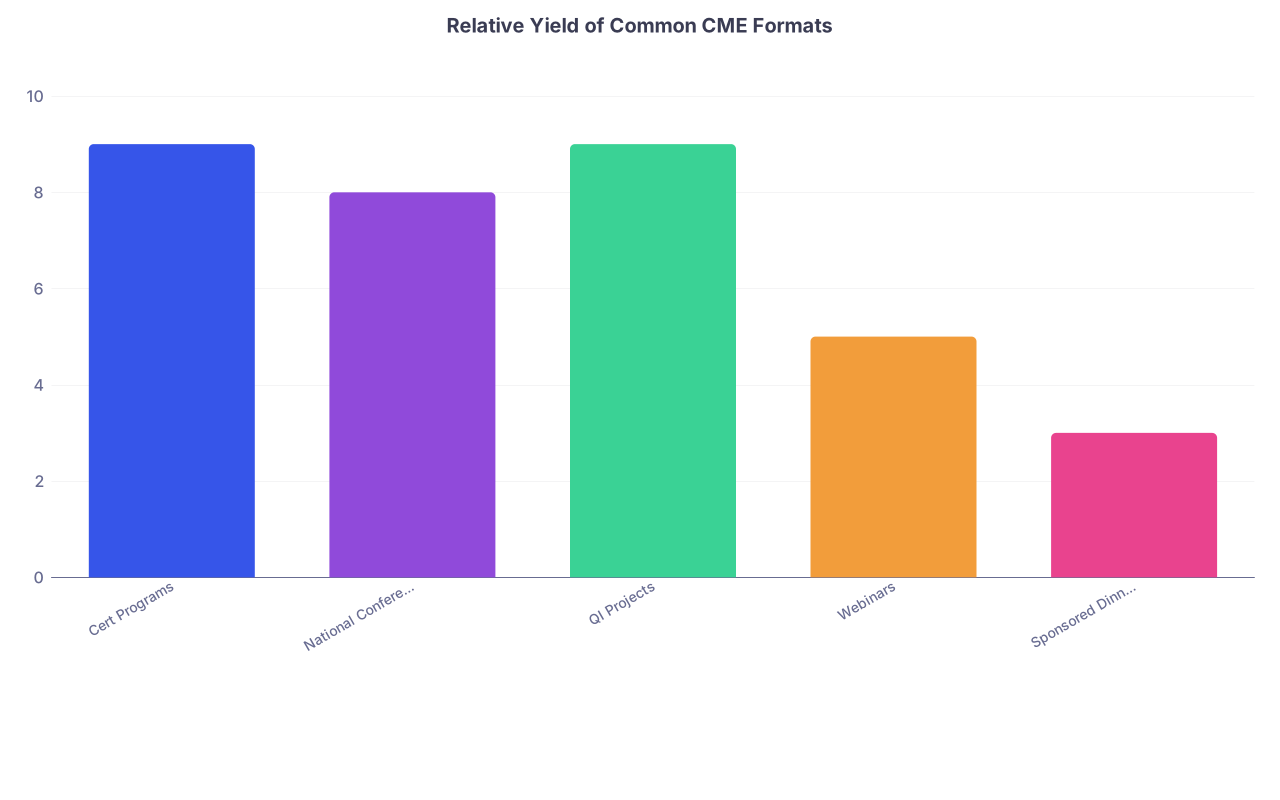
| Category | Value |
|---|---|
| Cert Programs | 9 |
| National Conferences | 8 |
| QI Projects | 9 |
| Webinars | 5 |
| Sponsored Dinners | 3 |
(Scale 1–10 for strategic value.)
B. Build “career narrative” through CME choices
Think like you are building a story for your CV and interviews.
Examples:
- “Over the last year, I completed a structured series of CME in hospital quality and safety, led a QI project on sepsis bundle compliance, and attended the SHM leadership academy.”
- “I pursued advanced CME in obesity medicine and metabolic disease, completed a certificate course, and am now leading our clinic’s obesity management pathway.”
Anyone reading that knows exactly where you are headed. That is what you want.
Step 5: Lock It Into Your Real Life (Scheduling and Systems)
A beautiful plan that lives in your head is useless. You need systems.
A. Put CME on your calendar like clinic
Concrete moves:
- Add a repeating 2‑hour block every other week: “Protected CME – no meetings.”
- At the start of each quarter, choose and calendar your deep‑dive activity date.
- For your major conference, book the days off and travel arrangements 3–6 months ahead.
Treat these blocks as:
- Not optional
- Not “if I’m not too tired”
- Not “I’ll squeeze it in after notes”
You will never “find time” for CME. You allocate it or you lose it.
B. Use one tracking hub
Stop scattering CME certificates across:
- Personal email
- Work email
- Random cloud folders
- Conference apps
Pick one of these:
- A simple spreadsheet + a single folder in your cloud drive.
- A dedicated CME tracker app (many exist; some specialties provide them).
- Your specialty board or society’s built‑in CME tracker if they have one.
Track for each activity:
- Date
- Provider / organization
- Title of activity
- Credits earned (Category 1/2, special categories like ethics, opioid, etc.)
- Which requirement(s) it satisfies (state, board, DEA, hospital)
- Proof location (PDF, emailed certificate, screenshot)
| Date | Activity | Credits | Type / Category | Requirement Tag | Proof Location |
|---|---|---|---|---|---|
| 2026-02-10 | Sepsis Management Course | 8 | Cat 1 / QI | Board, Hospital | /CME/2026/sepsis.pdf |
| 2026-03-05 | Opioid Prescribing Module | 4 | Cat 1 / Opioid | DEA, State | /CME/2026/opioid.pdf |
| 2026-04-20 | Leadership in Healthcare Series | 10 | Cat 1 / Leadership | Board elective | /CME/2026/lead.pdf |
Set a recurring monthly reminder: “Log CME from this month” (10 minutes).
Step 6: Build CME Around Your Future, Not Your Past
If your CME looks like random general refreshers every year, you are wasting a serious opportunity.
Use CME strategically to:
- Test potential career pivots.
- Build credibility in a niche.
- Make yourself promotable.
A. Use CME to explore or validate career pivots
Thinking about:
- Palliative care?
- Clinical informatics?
- Addiction medicine?
- Telemedicine leadership?
Then:
- Do a compact, 6–10 credit course in that area.
- Attend one focused conference session track.
- Join one relevant society and attend a virtual workshop.
If you finish that and feel energized → plan deeper CME for next year.
If you finish that and feel “meh” → good, you tested it cheaply.
B. Stack CME into visible credentials
Avoid a scattershot transcript. Instead, aim for clusters that look like this:
Cluster: Hospital Quality and Safety
- QI course (10 credits)
- QI project with CME/MOC (6–8 credits)
- Conference track in quality and safety (10 credits)
- Result: Ready to apply for quality committee leadership.
Cluster: Obesity / Metabolic Health
- Obesity medicine certificate course (20+ credits)
- Specialty society sessions at conference (10 credits)
- Regular journal CME on obesity, diabetes, metabolic syndrome (10–15 credits)
- Result: Credible internal expert and potential future board‑certification path.
This is how you turn CME into a career accelerator instead of a maintenance chore.
Step 7: Quarterly Check‑Ins and Mid‑Course Corrections
A 12‑month plan will break if you never revisit it. So you do four 30‑minute check‑ins per year.

| Step | Description |
|---|---|
| Step 1 | Quarter End |
| Step 2 | Review Credits Earned |
| Step 3 | Compare to Requirements |
| Step 4 | Check Against Career Goals |
| Step 5 | Lock Next Quarter Plan |
| Step 6 | Adjust Activities and Schedule |
| Step 7 | On Track? |
Each quarter, ask:
Credits
- How many credits did I actually earn?
- Am I on pace to meet or exceed requirements?
- Any specific categories lagging (ethics, opioid, risk management, etc.)?
Alignment
- Did this quarter’s CME clearly move me toward my 2–3 goals?
- What felt high‑value? What felt like a waste?
Time reality
- Which CME blocks did I actually protect?
- Where did things fall apart (clinic overran, fatigue, family obligations)?
Adjustments
- Do I need to scale back or up certain commitments?
- Do I need a lighter month next quarter?
- Should I swap an in‑person event for an online one, or vice versa?
You are not locked into January’s fantasy schedule. You are running a real‑time system.
Step 8: Align CME with Your Daily Clinical Work
The easiest CME is the kind that emerges from what you are already doing.
A. Turn real cases into CME and growth
Recurring pattern in your practice:
- Complex heart failure readmissions.
- Challenging chronic pain patients.
- Antibiotic overuse in your clinic.
- ICU delirium management confusion.
Turn each theme into:
- A short targeted review (up‑to‑date guideline module, course segment).
- A mini‑teaching session for residents or colleagues.
- A QI project with CME credit where possible.
You learn more because it is anchored to real patients and real frustration.
B. Leverage institutional resources aggressively
Many systems underutilize:
- Internal grand rounds with CME credit.
- Hospital‑sponsored specialty updates.
- Internal leadership development tracks.
Ask directly:
- Which of these carry CME?
- Is there a QI program that includes CME for project leaders?
- Can your institution cover costs for specific leadership or safety CME?
This moves cost off your personal budget and uses CME to support both you and the institution.
Step 9: Prevent the Classic Pitfalls
You have probably seen colleagues make these mistakes. Maybe you have done a few yourself.
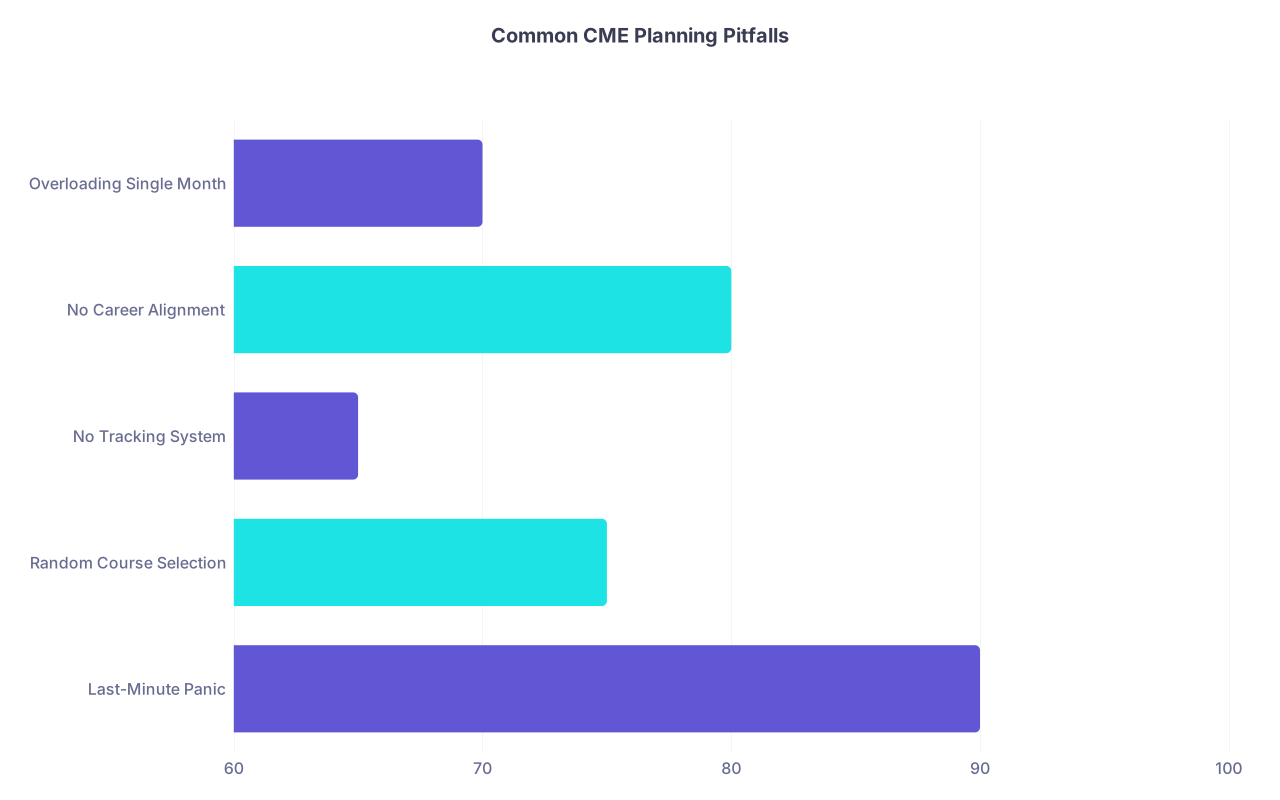
| Category | Value |
|---|---|
| Last-Minute Panic | 90 |
| Random Course Selection | 75 |
| No Tracking System | 65 |
| No Career Alignment | 80 |
| Overloading Single Month | 70 |
Pitfall 1: The “cram in November” strategy
Every cycle, same story:
- Realize you are 25 credits short.
- Grab whatever online CME you can find.
- No connection to what you actually need clinically.
Fix:
- Lock the monthly micro‑CME and quarterly deep dives.
- Aim to hit 100–120% of requirement by month 9–10, so the last quarter is optional, not desperate.
Pitfall 2: Letting admin surprises wreck you
You do not want to hear from credentialing:
- “We need your CME summary by Friday or you are off the schedule.”
Fix:
- Once a year (put it on your calendar), email yourself and save:
- A CME summary printout from your tracker or major CME portal.
- Key certificates (opioids, ethics, etc.) as a single merged PDF.
- Keep a ready‑to‑send CME packet always within a few clicks.
Pitfall 3: Confusing busyness with progress
A year of random one‑hour webinars on unrelated topics is not a strategy. It is motion without direction.
Fix:
- Re‑read your 2–3 career goals before committing to any paid CME.
- If a course does not hit at least one goal + one requirement, think twice.
Step 10: Make Next Year Easier – Close the Loop
By the end of your 12‑month cycle, you should not guess whether the strategy worked. You evaluate it.
Ask yourself three questions:
Compliance:
- Did I meet all licensing, board, and hospital requirements without last‑minute stress?
Capability:
- Do I feel clearly more competent in my chosen focus areas than 12 months ago?
- Could I handle a challenging case or leadership scenario now that would have rattled me last year?
Career trajectory:
- Did my CME choices produce tangible outcomes?
- New role or title?
- New responsibilities (committee, project lead)?
- New referral patterns or niche recognition?
- If not, is it because the CME was misaligned, or because I did not communicate my new skills to the right people?
- Did my CME choices produce tangible outcomes?
Then you:
- Keep what worked (monthly structure, specific platforms, preferred conference).
- Drop what did not (low‑yield webinars, unfocused topics).
- Level up your goals for the next cycle.
Your Next Action: Build a One‑Page CME Map Today
Do not start by booking a course. Start by getting control.
Today, take 30 minutes and create one page with:
- Your annual CME credit requirements, by source (state, board, hospital, DEA).
- Your 2–3 concrete career goals for the next 12 months.
- A rough outline:
- Monthly micro‑CME source(s)
- One quarterly deep dive for Q1
- One candidate major event for the year
Once that page exists, you are no longer reacting to CME. You are using it—deliberately—to shape the physician you want to be a year from now.