
You just missed a diagnosis you should have caught.
Maybe it was a subtle STEMI on a borderline ECG. Or a case of autoimmune encephalitis that sat in the “probable psych” bucket for two days. Or you fumbled a vent management decision and the RT quietly corrected you.
You went home, opened UpToDate or a review article, and fell into the usual pattern: skim, promise to “read more later,” move on. The gap stays. You feel it the next time a similar case rolls in.
Here is the truth: most physicians do CME to stay licensed, not to get better. That is backwards. If you use CME the way the average doctor does—random webinars, generic conferences, box-checking quizzes—you will keep your license and keep your knowledge gaps.
I am going to walk you through a different approach: using CME deliberately as a surgical tool to close specific clinical knowledge gaps, as fast as realistically possible, while still satisfying your CME requirements.
Step 1: Define the Gap Like a Diagnosis, Not a Vibe
“Feel rusty on cardiology” is useless. You cannot fix “rusty.”
You need to define your knowledge gap with the same precision you use for a differential diagnosis.
A. Start with trigger events
Concrete triggers are best. Think of the last 2–3 times you felt out of your depth clinically:
- You stalled on rounds when asked: “What would you do if this patient deteriorates in the next 6 hours?”
- You avoided taking a consult because “heme/onc stuff is not my thing.”
- You Googled something basic during a patient encounter and hoped no one noticed.
Write down 3–5 of these in a sentence or two each. Then translate each trigger into a targeted learning question.
Examples:
- Trigger: “Missed a subsegmental PE on a CT read that radiology later flagged.”
- Specific gap: “I am not confident identifying subtle PE findings and indications for anticoagulation vs surveillance in small PEs.”
- Trigger: “I keep guessing on DOAC dosing in CKD.”
- Specific gap: “Optimizing DOAC selection and dosing in CKD 3–5 and dialysis patients.”
- Trigger: “I am winging long COVID workups.”
- Specific gap: “Evidence-based evaluation and management of post-acute sequelae of COVID (PASC) in outpatients.”
If your gap cannot be stated in one focused sentence, you have not defined it tightly enough.
B. Convert questions to “CME-able” problems
CME offerings are designed around topics and competencies. Translate your gap into terms that match how CME is packaged:
- “Anticoagulation in CKD” → “Thrombosis / anticoagulation management” modules
- “Subsegmental PE decisions” → “Venous thromboembolism: special situations”
- “Long COVID workup” → “Post-viral syndromes / PASC outpatient management”
You are not dumbing it down. You are mapping your real problem to the labels CME platforms actually use.
C. Prioritize by risk, not annoyance
You do not fix everything at once. Rank your gaps using three criteria:
- Risk to patients
- Frequency in your practice
- How close you are to being unsafe
Give each from 1–5. Add them. Fix the highest scores first.
| Gap Description | Risk (1-5) | Frequency (1-5) | Proximity to Unsafe (1-5) | Total |
|---|---|---|---|---|
| DOAC dosing in CKD | 5 | 4 | 4 | 13 |
| Long COVID outpatient management | 3 | 4 | 2 | 9 |
| Autoimmune encephalitis recognition | 4 | 1 | 3 | 8 |
| New diabetes agents (GLP-1, SGLT2) in HF | 3 | 3 | 2 | 8 |
You start with the 13/15, not the topic you find “interesting.”
Step 2: Stop Random CME Grazing – Choose the Right Format for the Job
Once you know the exact gap, you pick the CME tool that will close it fastest. Different problems need different formats.
, Simulation / Procedural CME](https://cdn.residencyadvisor.com/images/articles_svg/chart-effectiveness-of-cme-formats-for-closing-specific--7706.svg "Effectiveness of CME Formats for Closing Specific Gaps")
| Category | Value |
|---|---|
| Big Conferences | 40 |
| Didactic Webinars | 55 |
| Interactive Cases | 80 |
| [Microlearning Modules](https://residencyadvisor.com/resources/continuing-medical-education/optimizing-cme-on-call-weeks-micro-learning-tactics-that-work) | 75 |
| Simulation / Procedural CME | 90 |
Here is how I match format to problem:
A. Procedure or skill decision-making → Simulation or case-based CME
If your gap involves what to do in real time (vent settings, sepsis escalation, STEMI decision pathways), you need case-based or simulation-style CME:
- Simulation centers (academic hospitals, specialty boards, societies)
- Interactive online cases (modules where you choose labs, orders, next steps and see consequences)
These force you to commit to decisions. Reading guidelines does not.
Use these for:
- Codes and resuscitation
- ICU decision-making
- Emergency triage and disposition
- Procedural sedation
- Stroke / STEMI pathways
B. Nuanced guideline interpretation → Focused guideline-based CME
If the gap is “I read the guideline but cannot operationalize it,” you want CME that:
- Walks case-by-case through the guideline
- Explicitly covers “gray zone” situations
- Includes Q&A or expert commentary
Think:
- American College of Cardiology guideline update webinars with case panels
- Infectious disease societies’ “how I treat” style CME
- Specialty-specific platforms (e.g., ASH, ASCO, IDSA offerings)
C. Breadth or updates in a focused niche → Microlearning CME
When you are behind on a narrow but deep area (e.g., new diabetes agents in HF, biologics in IBD), short modules beat a 3-day conference.
Look for:
- 10–20 minute bite-sized modules
- Single-topic focus (“GLP-1 agonists for obesity in HF patients”)
- Post-test questions that target common errors
This format is ideal for:
- Rapid updates after guideline changes
- New drug classes / indications
- Refresher on subspecialty topics you see weekly
D. Complex pattern recognition → Image/case libraries with CME credit
For radiology-like, dermatology-like, or ECG-like gaps, use CME that bombards you with pattern recognition:
- ECG case libraries with graded quizzes
- Derm image banks
- Radiology “unknowns” series
You improve not by reading more theory, but by seeing 100+ cases with feedback.
Step 3: Build a 2–4 Week “Gap Closure Sprint”
You do not need a year. You need an aggressive, time-limited plan for one gap.
Think of it as a learning sprint: focused, measurable, and scheduled.

| Step | Description |
|---|---|
| Step 1 | Define Specific Gap |
| Step 2 | Find Targeted CME Options |
| Step 3 | Select 1-2 High Yield Activities |
| Step 4 | Schedule Time Blocks |
| Step 5 | Complete CME With Notes |
| Step 6 | Test in Real or Simulated Cases |
| Step 7 | Measure Improvement |
| Step 8 | Move to Next Gap |
| Step 9 | Gap Closed Enough? |
A. Set a single, concrete outcome
Not “be better at anticoagulation.” That is vague.
Examples of good 2–4 week goals:
- “By the end of 3 weeks, I will correctly manage 90% of CKD patients needing anticoagulation, including drug choice, dose, and monitoring, as measured by a 20-question case-based CME pre/post-test and chart review of my next 10 patients.”
- “In 2 weeks, I will interpret 50 PE-related CT scans and correctly identify or rule out PE on at least 90% of them in a self-assessment program.”
You want a measurable target and a deadline.
B. Schedule real blocks, not “whenever”
If CME is “when I have time,” you have already lost. You carve out blocks exactly like you do for clinic or OR.
- 3–4 sessions per week
- 30–60 minutes each
- Protected: door closed, pager covered if possible, phone flipped
Block examples:
- Tuesday, Thursday 6:30–7:15 AM before work
- One weekend 90-minute block
- One post-call afternoon
For a 3-week sprint, you are looking at roughly 5–7 hours focused.
C. Choose 1–2 primary CME activities, not 10 mediocre ones
You do not need variety. You need depth.
Example for “DOAC in CKD” sprint:
- Core module: 2-hour accredited VTE/AF and CKD management course with case-based questions.
- Case practice: 1-hour online “Anticoagulation in special populations” case bank.
- Microlearning: 15-minute updates on 2 new DOAC studies including CKD sub-analyses.
That is it. Everything else is noise.
Step 4: Turn Passive CME Into Active Clinical Tools
The reason most CME does not stick is simple: you listen, nod, pass the quiz, and change exactly nothing.
You need a system for extracting clinic-ready tools out of every CME event you pick.
A. Create a “one-pager” for each sprint
During the CME, you are not transcribing. You are building a one-page, high-yield, practice tool:
Sections to include:
- Decision thresholds / numbers
- e.g., “eGFR cutoffs for each DOAC,” “BP targets in older adults with CAD”
- If–then decision rules
- e.g., “If CKD 4 with AF and prior GI bleed → prefer apixaban at X dose if weight / age criteria met”
- Common pitfalls and fixes
- e.g., “Do not use full-dose rivaroxaban in eGFR < 30; watch for drug–drug interactions with azoles”
- Template orders or phrases
- e.g., suggested note language, order sets, patient counseling points
You want something you can glance at in 30 seconds on a busy day.
B. Convert learning into checklists or order sentences
CME is useless if it does not show up in your orders or notes.
Examples:
“New suspected PE” checklist for yourself:
- Wells score documented
- D-dimer strategy decided
- Renal function and contrast risk considered
- Anticoagulation plan if scan delayed
Template for long COVID initial visit:
- Symptom inventory
- Basic labs and imaging
- Red-flag features for immediate escalation
- Follow-up interval and referrals
You can keep these as:
- Smart phrases in your EHR
- Printed index card on your workstation
- Quick note in your phone (HIPAA-safe, of course)
C. Use CME questions as your stress test
Always do the post-test questions seriously. Then:
- Flag any you got wrong or guessed
- Write a one-sentence “rule” or reminder for each miss on your one-pager
- If more than 20–30% wrong: you are not done with this gap
That is your feedback loop. Better than your memory, better than vibes.
Step 5: Integrate Real Patients Into the Learning Loop
You will not close a clinical gap in a vacuum. You have to run your new knowledge against actual patients.
A. Pre-select “learning cases” during your sprint
At the start of your sprint, tell yourself:
“For the next three weeks, every anticoagulation-in-CKD patient is a learning case.”
Then actually:
- Keep a small list (de-identified) of 10–20 consecutive relevant patients.
- For each, write:
- What you did
- What you would have done before this sprint
- Any feedback from consultants, pharmacists, or attendings
This forces you to notice change.
B. Use your one-pager at the point of care
During clinic or rounds:
- Pull up your one-pager while seeing those cases
- Explicitly walk through the steps you wrote
- Notice where reality conflicts with the guideline or module
If real life shows exceptions (“Our pharmacy will not cover X,” “Our lab cannot run Y quickly”), update your one-pager. CME lives in your hospital, not in a vacuum.
C. Debrief 2–3 cases with a trusted colleague
Pick someone sharp in that niche. A heme/onc friend. The ICU pharmacist. Your cardiology colleague.
Show them 2–3 anonymized cases and your plan. Ask two blunt questions:
- “What would you have done differently?”
- “What common pitfall am I still missing here?”
This is free CME with actual stakes.
Step 6: Use Data and Self-Testing to Prove the Gap Is Closing
You are not done until you can prove improvement to yourself. Not to the CME provider. To you.
A. Structure your sprint with a pre- and post-test
If your CME platform provides a pre-activity assessment and post-test, great. If not, you manufacture one:
- Before the sprint, answer 10–20 clinical questions (case-based) on that topic from:
- Board review banks
- Society self-assessment programs
- Record your score and where you struggled.
After the sprint:
- Repeat with a different but comparable set of questions
- Compare raw and topic-specific performance
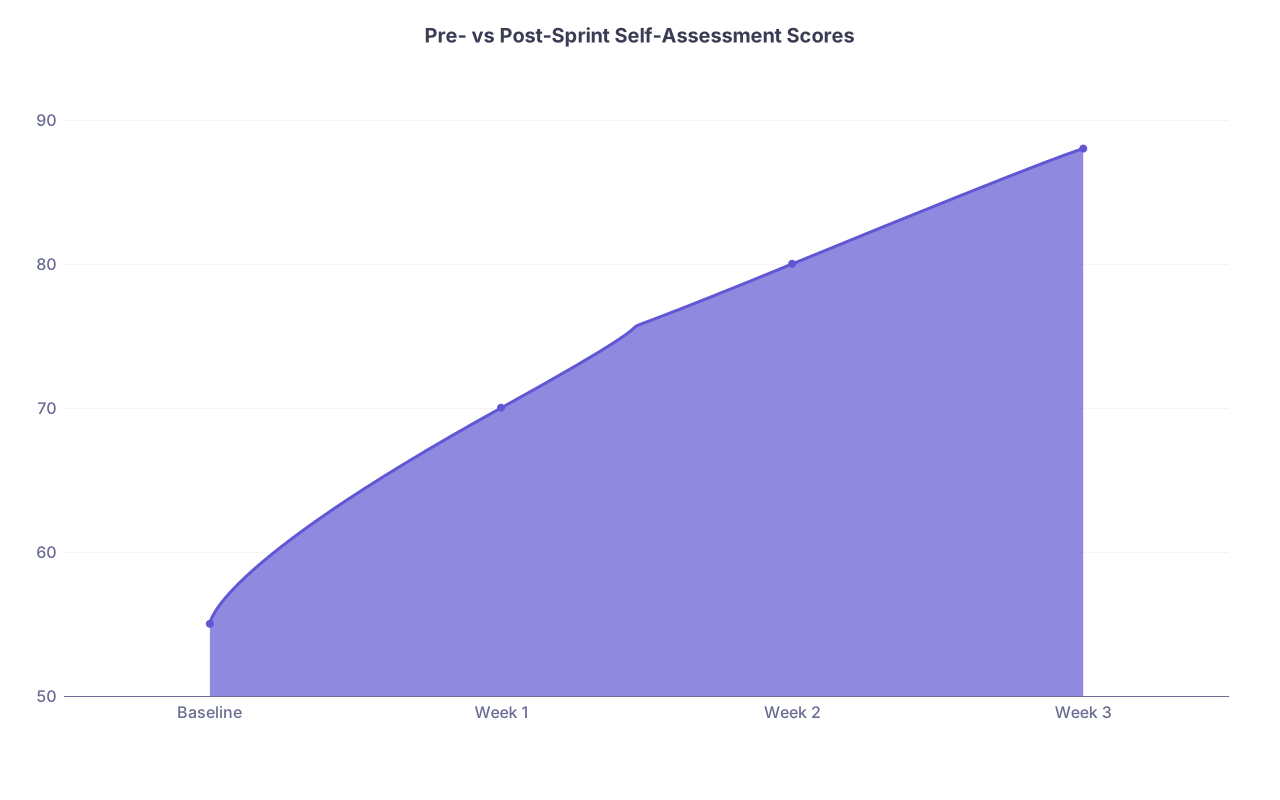
| Category | Value |
|---|---|
| Baseline | 55 |
| Week 1 | 70 |
| Week 2 | 80 |
| Week 3 | 88 |
If your score went from 55% to 88% on targeted cases, you are done for this iteration.
B. Look at a mini “chart audit” of your own patients
For your log of learning cases:
- Before the sprint:
- How often did you consult another service purely out of insecurity?
- How often did pharmacists or attendings change your plan?
- After the sprint:
- Has that frequency dropped?
- Are you documenting more clearly and confidently?
This is crude. It is also honest.
C. Decide explicitly: “Gap closed enough?”
You will never get to perfect. You are aiming for “safe, current, and confident in common scenarios; knows when to escalate or consult.”
At the end of 2–4 weeks, answer:
- Can I manage 80–90% of typical cases independently and appropriately?
- Do I know the ~3 situations when I should call for help early?
- Do I remember key numbers and thresholds without looking?
If yes: move the gap from “active” to “monitor.” Revisit with micro-CME every 6–12 months.
If no: either extend the sprint for 1–2 weeks with more case practice, or accept that this is an area where you will maintain a lower threshold to consult.
Step 7: Map This to Actual CME Requirements Without Wasting Time
You still have state / board requirements to satisfy. Fine. You use your targeted work to cover those boxes as efficiently as possible.
A. Know your numbers and types
Most physicians need:
- X total hours of CME over Y years (e.g., 50 hours/year)
- A certain number of category 1 credits
- Sometimes specific content (opioids, ethics, implicit bias, state-specific laws)
Do this once:
- Log into your board / state site
- Pull your exact requirements
- Write them in plain language
Then build your sprint CME to:
- Prefer activities that grant category 1 credit
- Use high-yield content that also meets mandated topics when possible
B. Favor CME platforms that support MOC, PI-CME, or self-assessment (SA) credit
Some boards (ABIM, ABP, etc.):
- Give Maintenance of Certification (MOC) points for self-assessment and improvement activities
- Recognize practice improvement CME (PI-CME)
If you can align your gap sprint with:
- A self-assessment (pre/post test)
- A documented change in practice
…you may cover:
- CME hours
- MOC Part II (self-assessment)
- Maybe even MOC Part IV (practice improvement) if structured through a recognized program
Same effort. Triple counted.

C. Avoid the “junk CME” trap
Yes, there are 0.25-credit click-and-guess-“learning” modules that technically count. They also do almost nothing for your practice.
Use these rules:
- If the activity description is generic (“Update on various topics in internal medicine”), skip unless you specifically need broad hours.
- If there is no structured assessment (questions, cases, simulations), expect minimal retention.
- If you cannot map the content to a real gap you care about, it is filler. Save those for when you are at 47/50 hours on December 20th and just need to close the gap.
For day-to-day, build your CME around your sprints. Let random conferences and online lectures be extras, not the core.
Step 8: Create a Simple, Repeatable System for Ongoing Gaps
Once you run one sprint successfully, you do not reinvent the wheel. You turn it into a low-friction loop.
A. Keep a running “gap list”
On your phone or in a small notebook, maintain a list titled: “Skills / Topics I am not happy with yet.”
Each time you feel that familiar discomfort clinically, add a line:
- “Acute liver failure – transplant criteria”
- “Biologic escalation in moderate-severe asthma”
- “Chronic opioid / benzo tapers in complex pain patients”
When you finish one sprint, pull the next target from this list.
B. Plan 2–4 sprints per year
That is it. You do not have to be constantly in “improvement mode.” Two to four solid sprints per year is enough to stay sharp and progressively patch real weaknesses.
Pattern:
- Q1: 3-week sprint on high-risk gap
- Q2: lighter, microlearning only
- Q3: another 3-week sprint, different topic
- Q4: state-mandated / compliance topics
That rhythm beats random bursts of panic CME in December.
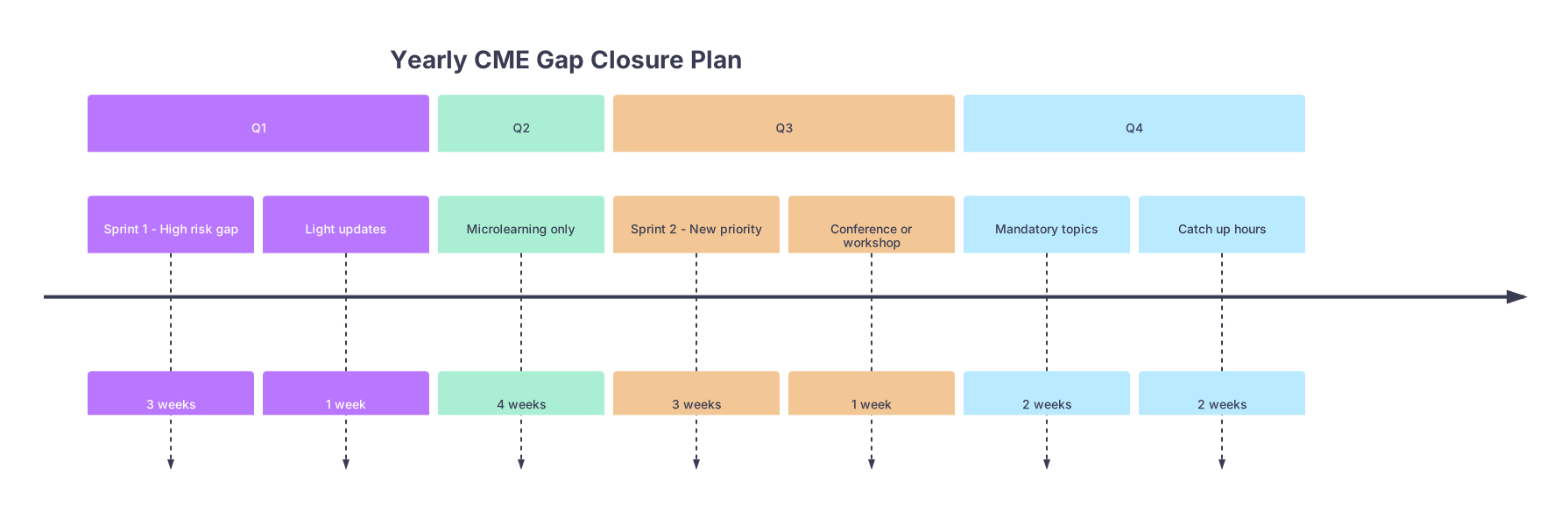
| Period | Event |
|---|---|
| Q1 - Sprint 1 - High risk gap | 3 weeks |
| Q1 - Light updates | 1 week |
| Q2 - Microlearning only | 4 weeks |
| Q3 - Sprint 2 - New priority | 3 weeks |
| Q3 - Conference or workshop | 1 week |
| Q4 - Mandatory topics | 2 weeks |
| Q4 - Catch up hours | 2 weeks |
C. Track only what matters
You do not need a spreadsheet with 20 variables. Track:
- Topic
- Dates of sprint
- CME activities used
- Pre- and post-test scores (or approximate)
- One-line “result” (e.g., “Now comfortable managing most CKD anticoag patients; still consult heme for eGFR < 15 + multiple comorbidities”)
That is enough to guide your future self.

What This Looks Like in Real Life: One Concrete Example
Let me stitch this together.
Scenario: You are a hospitalist. You recently had a 78-year-old with CKD 4, AF, and recent GI bleed. You felt completely unsure managing anticoagulation.
Step 1 – Define the gap:
“Appropriate choice, dosing, and monitoring of anticoagulants in patients with CKD stages 3b–5 (including dialysis), especially after recent bleeding events.”
Step 2 – Choose CME:
You select:
- A 2-hour accredited “Anticoagulation in CKD and ESRD” webinar from a reputable society, with 20 case questions.
- A 1-hour online case bank “Anticoagulation in special populations.”
- A 15-minute micro-module on a new DOAC CKD sub-analysis.
Total planned CME: ~3.25 hours.
Step 3 – Sprint plan:
- Duration: 3 weeks
- Schedule:
- Week 1: 1 hour Tuesday AM, 1 hour Saturday AM
- Week 2: 45 min Thursday AM, 30 min Sunday evening
- Week 3: 45 min Tuesday AM, 30 min Friday AM
Step 4 – One-pager:
While doing the webinar, you build:
- Table of each DOAC with eGFR cutoff, dose, and dose adjustment rules
- A 5-step approach:
- Confirm indication and CHA₂DS₂-VASc
- Assess eGFR and bleeding risk
- Select agent and dose
- Plan monitoring and follow-up
- Document risk/benefit discussion
- List of pitfalls: recent GI bleed, dual antiplatelet therapy, concomitant amiodarone, etc.
Step 5 – Real patients:
Over 3 weeks, you see 9 patients meeting “anticoag + CKD 3b–5.” You:
- Write down your initial plan
- Compare against your one-pager
- Ask pharmacy or cardiology for feedback on 3 of them
Step 6 – Measure:
- Pre-sprint self-test: 12/20 on anticoag cases (60%)
- Post-sprint different test: 18/20 (90%)
- PharmD only adjusted your plan once, for a very complex ESRD case.
You conclude:
“Gap sufficiently closed for typical CKD 3b–4 patients; will still call for help on advanced ESRD + multiple interacting meds.”
You log 3.25 CME hours and MOC SA points. Real-life decisions improve. Your stress level on call drops a notch.
That is how CME is supposed to work.

Your Next Step Today
Do not “plan to do this.” Do one concrete thing now.
Right now:
- Write down one recent clinical moment where you felt out of your depth. One sentence.
- Rewrite it as a clear gap statement:
“I am not confident in _______ for patients with _______.” - Open your usual CME platform or a major society site and search only for that gap in “Courses” or “Case-based learning.”
- Pick one activity that directly targets it and add it to your calendar for a 45–60 minute block in the next 7 days.
Once that block is on your calendar, you have started your first CME gap-closure sprint. The rest is just execution.