
The myth that “CME is low stakes” is dangerous. One badly chosen CME course can hurt you—but probably not in the dramatic way your anxiety is imagining.
Let me just say the quiet part out loud: you’re not crazy for worrying about this. Between hospital credentialing, MOC, random colleagues asking “Why on earth did you take that course?”, and the eternal fear that one weird decision will follow you forever… yeah, CME doesn’t feel as harmless as everyone pretends.
You’re asking, basically: If I pick one cringey, low-quality, or controversial CME course, can that stain my reputation long-term? Can this end up in some future credentialing meeting where someone says, “Look at this - they did that sketchy opioid webinar in 2022”?
So let’s unpack it. Honestly. No sugarcoating, but no catastrophizing for the sake of drama either. Your brain is probably doing enough of that on its own.
Where CME Actually Shows Up In Your Professional Life
First thing: where does your CME record even matter?
In real life, your CME choices typically show up in a few places:
- State medical license renewals
- Hospital or health system credentialing/recredentialing
- Maintenance of Certification (MOC) with your specialty board
- Occasionally, quality or risk reviews if something goes really wrong clinically
- Audits (state board, DEA, insurers) in rare situations
Most of the time, people are not reading through each individual course like they’re critiquing your Spotify playlist. They’re checking: did you hit the right number of hours, in the right categories, by the right date, with acceptable providers.
Still doesn’t totally calm that nagging voice, I know.
So let’s be specific: yes, there are scenarios where a badly chosen CME can look bad.
But they’re narrower and less dramatic than the worst-case reel in your head.
What “Badly Chosen CME” Usually Means (And What It Doesn’t)
When you say “badly chosen CME,” I immediately think of three categories:
- A low-quality, kind of embarrassing course
- A course from a sketchy or non-credible provider
- A course with content that’s ethically or legally problematic
The first one is where most people live. You pick some cheesy, pharma-adjacent webinar at midnight because you were behind on credits, the slides are 10 years out of date, and the speaker spends half the time selling their book. That’s annoying. It’s not career-ending.
The reputational risk starts creeping up with #2 and #3.
Like:
- CME from providers that aren’t ACCME-accredited, not recognized by your board, or on the fringes of pseudoscience
- Courses pushing non-evidence-based therapies as “cures,” especially in high-risk areas (oncology, psych, infectious disease)
- Opioid prescribing content that aggressively downplays risk, in a world where prescribing patterns are very much under a microscope
- “Alternative” medicine courses that cross the line from integrative into outright quackery
That’s the stuff that can raise eyebrows if anyone ever has to look closely at your record.
But here’s the key distinction: one questionable CME activity isn’t the same as a pattern.
Credentialing committees, hospital chiefs, and boards care way more about patterns than one-off blips.
The Realistic Worst-Case Scenarios (Not the Imaginary Ones)
Let me walk through the kinds of things I’ve actually seen cause problems.
Not theoretical. Actual physicians, real fallout.
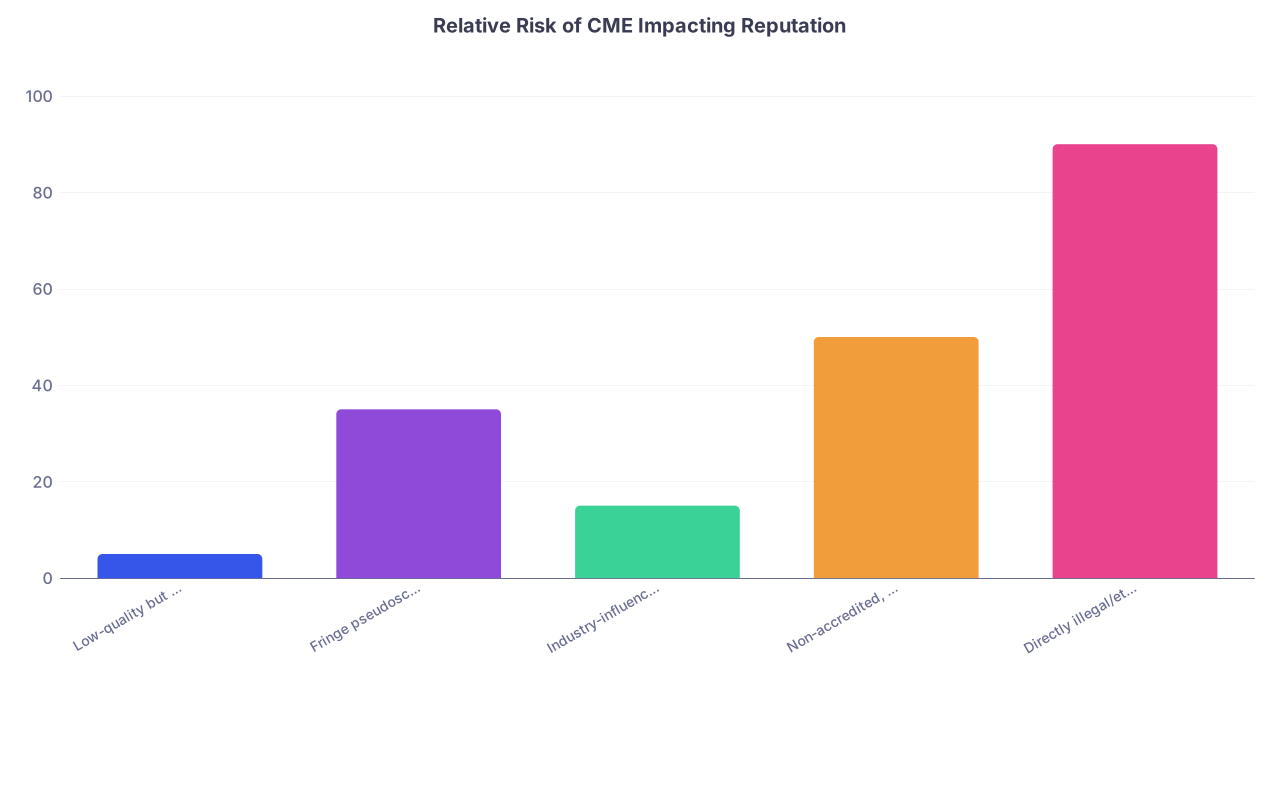
| Category | Value |
|---|---|
| Low-quality but benign | 5 |
| Fringe pseudoscience course | 35 |
| Industry-influenced but accredited | 15 |
| Non-accredited, controversial | 50 |
| Directly illegal/ethical issues | 90 |
If your anxiety brain wants numbers, think of it like this: the “career-destroyed-by-one-random-ACCME-course” scenario is basically near zero. The “someone raises a skeptical eyebrow at a weird choice” scenario? That’s more like your real risk.
Where trouble actually shows up:
Malpractice or adverse event review
There’s a bad outcome. Lawyers or risk management dig into your training. They look at your CME in that clinical area.
If you’re practicing in direct contradiction to established guidelines and your main “education” looks like a single sketchy course from a dubious provider? Yeah, that can look bad.
But again: it’s not the existence of one course. It’s when that course is your only justification for questionable practice.DEA or prescribing-related investigations
If someone’s patterns are flagged—opioids, benzos, stimulants—investigators may look at prescribing-related CME. If your only opioid education is from a course that was openly dismissive of safety, that’s not great optics.
Still, that’s a problem because of your prescribing pattern, not because you took one course. The course becomes supporting evidence, not the main issue.Credentialing at a very conservative or elite institution
Some places (big academic centers, high-profile systems) do look a little more carefully at your professional profile when you apply. They’re more likely to side-eye fringe CME focused on anti-vax content, extreme alternative therapies, or aggressively political medicine.
Even then—they care more about your practice, your publications, your reputation, and references. One weird course? That’s background noise, unless it matches a pattern.Pattern of quackery, not one-off curiosity
I’ve seen physicians dinged for repeated CME in homeopathy, anti-vaccine rhetoric, or conspiratorial COVID content—paired with corresponding clinic behavior (refusing evidence-based care, documenting misinformation, etc.).
Notice the theme again. Pattern + behavior, not “you once clicked on a weird webinar when you were half-asleep.”
If your nightmare is: “In 10 years, will a promotions committee reject me because I once did a cringe CME from a commercial-looking website?”
No. That’s not how this goes.
How CME Actually Gets Reviewed (No One’s Reading Every Title)
Let’s talk process, because sometimes anxiety calms down when you see how annoyingly bureaucratic this stuff really is.
Most of the time:
- State boards check totals and categories: “X hours category 1, Y hours in opioid risk, Z in ethics.” Not individual course-by-course philosophy.
- Hospitals do the same. They want to know you did CME, not obsess over each provider.
- Boards (ABIM, ABFM, etc.) track CME through their portals or through known providers. Again: total points, not micro-judgment on what you picked at 11:59 p.m. in December.
There are exceptions, but they’re triggered by something else:
- An audit
- A complaint
- Litigation
- An investigation
And even when they ask for more detailed CME records, they’re usually looking for proof you met requirements, stayed active, and didn’t lie.
They’re not running moral philosophy on each title.
Okay, But What If I Already Took a Dubious Course?
This is the part your brain keeps looping: “What if I already messed up?”
Maybe you:
- Took a sketchy-looking online course because it was cheap and fast
- Realized halfway through it was basically soft advertising
- Did a course that’s now associated with a controversial figure
- Took something COVID-related early in the pandemic that aged… poorly
First: you’re not the first person who’s done this. Half of CME is people clicking on whatever fits their schedule and meeting the hours in time.
You’ve got a few options, and none of them involve panicking:
Stop using it as your main “education” in that domain
If it was a weird pain management course, don’t let that be your only training in pain. Stack it with solid, mainstream, guideline-based CME. If anyone ever asks, your record shows you moved toward reputable, evidence-based content.Balance the record
Over the next couple of cycles, lean into clearly legitimate providers:
Academic centers, specialty societies, ACCME-accredited longstanding platforms.
When your overall CME history is 95% boring, traditional, and solid, that one oddball thing fades into statistical noise.Document your real practice standards
Your notes, your adherence to guidelines, your use of decision support—those are what really matter if you’re ever under the microscope. A questionable CME course + solid practice is less of a problem than pristine CME + reckless behavior.If it’s truly awful, don’t brag about it
Don’t volunteer it, don’t list it on a CV if no one asked, don’t cite it as justification for anything. Let it stay where it lives: as one line in a long list of credits that probably no one will ever drill into.
How One CME Course Can Hurt You (But Probably Won’t)
Let me be blunt: yes, there are edge cases where a single CME course becomes a problem.
For example:
- You testify as an expert witness and your credibility is challenged with, “Doctor, is it true much of your recent CME consists of courses from [insert fringe site]?”
- You promote yourself publicly (website, media, social) based on being “trained” via some discredited CME course.
- You practice in a way that is wildly outside guidelines, and the only referenced training in that area is a lone non-accredited, controversial CME course.
Those are the high-risk scenarios: where you elevate the course from “random requirement” to “core of my expertise.”
If you’re not doing that, the reputational damage from a single course is extremely limited.
How to Choose Future CME So This Stops Haunting You
If what you really want is a mental checklist that lets you sleep at night, here you go.
Keep life simple. When in doubt:
| Question | Safe Answer |
|---|---|
| Is the provider accredited? | Yes |
| Is the topic evidence-based? | Yes |
| Would I list this on my CV? | Yes/Maybe |
| Is there obvious commercial bias? | Minimal |
| Does it align with guidelines? | Yes |
If you can say yes to most of those, you’re fine.
And if you can’t? Then treat that course as a one-off curiosity, not the foundation of your practice.
The Hidden Truth: Most People Don’t Care About Your CME Like You Do
Here’s the part that kind of stings, but also might calm you: your colleagues, chiefs, boards—nobody is obsessively tracking which niche online platform you clicked on for a 1-hour ethics credit.
They care about:
- Whether your charts are decent
- Whether your outcomes are acceptable
- Whether you’re a disaster to work with
- Whether patients are complaining about you
- Whether you’re a malpractice magnet
CME is mostly a proxy for “this person is at least nominally keeping up.” It’s not a finely tuned reputation engine where one wrong click puts a black mark on your soul.
You, meanwhile, are sitting here spiraling over a one-time course you’re half-embarrassed you took.
You’re not alone in that. But you are probably over-assigning meaning to something other people barely glance at.
When You Actually Should Worry (Justified Anxiety)
Your anxiety isn’t always lying to you. Sometimes it’s a signal.
If any of this sounds familiar, then it’s worth genuinely reassessing your CME pattern, not just one course:
- Most of your recent CME is coming from non-mainstream, non-academic, or ideologically driven sources
- You’ve started changing your practice significantly based on isolated, fringe CME
- You’d be nervous if your department chair read your entire CME history
- Patients, colleagues, or staff have commented that your practice style seems more “alternative” or off-guideline lately
That’s less about “reputation from a single course” and more about drift. A gradual slide away from evidence-based medicine, where CME is both a symptom and amplifier.
If that’s you, then yeah, course selection matters a lot. And the fix is also clear: re-anchor yourself to guideline-based CME from boards, societies, major centers.
But if we’re talking about one badly chosen CME course in an otherwise pretty standard, boring educational life?
That’s not a career obituary. That’s a footnote.
A Practical Way To Stop Obsessing About This One Decision
Your brain loves unfinished loops. So close this one.
Do three concrete things:
- Pick and complete 2–3 high-quality, unquestionably solid CME activities in your field over the next few months. Society-based, board-supported, or major academic center.
- Make sure your overall CME record is clean, complete, and well-documented for this cycle. Upload certificates, keep a simple spreadsheet, whatever works.
- Decide—intentionally—that you’re categorizing that one weird course as “lesson learned in vetting CME,” not as “evidence I’m secretly reckless.”
You’re not erasing it. You’re contextualizing it.
And five years from now, when your CME transcript is 400 hours long and packed with normal, boring, respectable stuff, that one odd entry will look like what it is: noise.
Years from now, you won’t remember the title of the sketchy CME course that kept you up at night—you’ll remember whether you let that fear steer you toward better judgment, or let it convince you you were already ruined.