
What happens when you’re filling out credentialing paperwork and realize every single CME credit you’ve done in the last two years was free, online, and kind of random—are they going to quietly think you’re cheap, lazy, or not serious about your education?
Let me just say the fear out loud:
“Everyone else went to big-name conferences and I did a bunch of free webinars between call shifts. Am I about to look unprofessional, under-invested, or… poor?”
You’re not the only one thinking this. I’ve heard versions of this in hospital lounges, in late-night texts from co-residents, and whispered after M&M:
“I just do the free Medscape ones. Is that… bad?”
Let’s walk through what’s real, what’s in your head, and where this actually can hurt you if you’re not careful.
What Credentialing Committees Actually Look For (Not What You’re Imagining)
Here’s the unpleasant truth: credentialing committees are not sitting around psychoanalyzing how you got your CME. They’re mostly just trying to answer a few basic questions:
- Are you licensed and current?
- Are you board certified (if applicable) and are you maintaining it?
- Do you meet CME requirements for the state, hospital, and specialty board?
- Is there anything about your record that looks risky?
(Malpractice, disciplinary actions, big unexplained gaps, sketchy patterns.)
They are not ranking your CME by price tag.
In practice, what they care about is:
- Total CME hours: Do you have the minimum required?
- Type: AMA PRA Category 1 Credit™ vs “general” or non-accredited stuff.
- Any required specific content: opioid prescribing, ethics, risk management, state-mandated topics, etc.
- Time frame: Is it within the last 1–3 years as required?
The internal monologue you’re having—
“Ugh, all mine are free, no big conferences, no Harvard-branded anything”—
that’s your anxiety talking, not the committee.
That said, yes, there are a few ways you can shoot yourself in the foot, and they have nothing to do with “free” and everything to do with sloppy.
Is Free Online CME “Less Legit”? Here’s the Ugly Anxiety Logic vs Reality
The fear usually sounds like this:
- “If it’s free, it must be low quality.”
- “Paid national conferences must look better.”
- “If I never leave my town for CME, I’ll look unambitious.”
- “They’ll assume I couldn’t afford real CME.”
Let’s break that.
1. Free ≠ Low Quality in CME Land
Some of the most respected CME content out there is free or sponsor-supported. Big academic centers, specialty societies, and journals run free CME all the time.
| Source Type | Example Provider |
|---|---|
| Medical Journals | NEJM, JAMA Network |
| Specialty Societies | ACC, AAN, IDSA |
| Academic Centers | Mayo Clinic, Cleveland Clinic |
| Online Platforms | Medscape, CME Outfitters |
Nobody on a credentialing committee is flagging “Medscape CME” or “Cleveland Clinic Online CME” as suspicious. They see those names a thousand times.
What does look bad? Stuff like:
- Credits from obviously non-medical organizations (“Leadership Wizard Academy CME” type nonsense).
- Dubious or non-accredited “certificates” that don’t specify Category 1 or accredited provider.
- CME that “smells” like a predatory pharma-marketing front with no recognized accreditor.
If your free CME is from recognized medical institutions or ACCME-accredited providers, it’s fine. Really.
2. Paid Conferences Aren’t Automatically Better
I’ve seen doctors spend thousands to go to a resort “conference” where half the agenda is golf, spa time, and “optional” sessions, then log 25 CME hours.
On paper? Their credentialing record says: “25 Category 1 CME, [Nice-Sounding Conference Name].”
Your record with 25 hours of free, ACCME-accredited online webinars on current guideline updates will look… exactly as legitimate. No one is writing margin notes saying “But did they pay for a flight?”
The One Place Free-Only CME Can Look Weak
Now, here’s where I need to be honest, because this is where your anxiety is picking up on a kernel of truth.
If someone reviews your CV over time and sees:
- No conferences. Ever.
- No workshops, no in-person courses, no specialty meetings.
- No focused or advanced CME relevant to your niche.
It can suggest you’re not that engaged beyond doing the bare minimum to keep your license.
Not for credentialing specifically—those folks are mostly box-checking.
But for:
- Leadership roles
- Academic appointments
- Promotion committees
- Competitive group hires in fancy systems
In those settings, the conversation in the room might sound like:
“Does this person ever go to [major specialty meeting]? Any workshops? Any specialized training in the new stuff?”
If all you’ve got is a random scatter of free online CME and nothing more focused, yeah, that can read as:
“Meets requirements. Not obviously invested in growth.”
Not fatal. But not exciting either.
Will They Judge That I Didn’t Go to Conferences Because of Money?
Short answer? No. They won’t even know.
Most credentialing forms don’t ask for costs, only titles, dates, CME hours, and providers. Nobody is putting “(this one was free)” on the document. Lots of free CME is hosted by very prestigious places. It doesn’t look cheap. It looks efficient.
The other fear: “If I never went to big-name specialty meetings, they’ll think I’m behind.”
That depends more on your specialty culture than anything else.
- In some fields, big annual meetings are almost a social requirement: oncology, cardiology, certain surgical subspecialties.
- In others, especially community-heavy specialties, tons of people never leave their state but do local or online CME and are perfectly respected.
Even in conference-heavy specialties, you’re not going to get denied hospital privileges for not going to ESC or ASCO. But if your CV shows zero engagement in your field outside mandatory stuff, you might be less competitive for high-profile roles later.
So no, they won’t judge you for “not being rich” or “doing free stuff.” They’re too busy and they don’t care that much. But as your career grows, you probably will want to add at least a few things that look more deliberate than “I clicked on some links at 11:30 pm.”
The Only Times Free-Only CME Becomes a Real Problem
Let’s talk about the actual landmines, because these are the situations where anxiety stops being hypothetical and becomes “oh… this could actually bite me.”
1. You Don’t Have Enough Category 1 Credits
States and boards often specify a number of Category 1 CME hours, not just “CME in general.” Some free stuff is Category 1. Some is not.
If you’ve just assumed “if they gave me a certificate, it must count,” you could be short. That’s when credentialing or a board audit can absolutely nail you.
This is not about free vs paid. It’s about accredited vs “meh.”
You want the words:
- “AMA PRA Category 1 Credit™”
or - “ACCME accredited”
or - The equivalent recognized wording depending on your country/board.
If it just says “1 hour of educational activity” with no accreditor, be suspicious.
2. You Miss Required Topics
Some hospitals, states, or boards require specific CME content:
- Opioid prescribing / pain management
- Ethics / professionalism
- Risk management
- Domestic violence, child abuse recognition
- Cultural competency, implicit bias, health equity
If all your free stuff is random clinical updates and you never bothered to check those boxes, credentialing committees can absolutely hold that against you. Not as a character judgment. As a regulatory non-compliance problem.
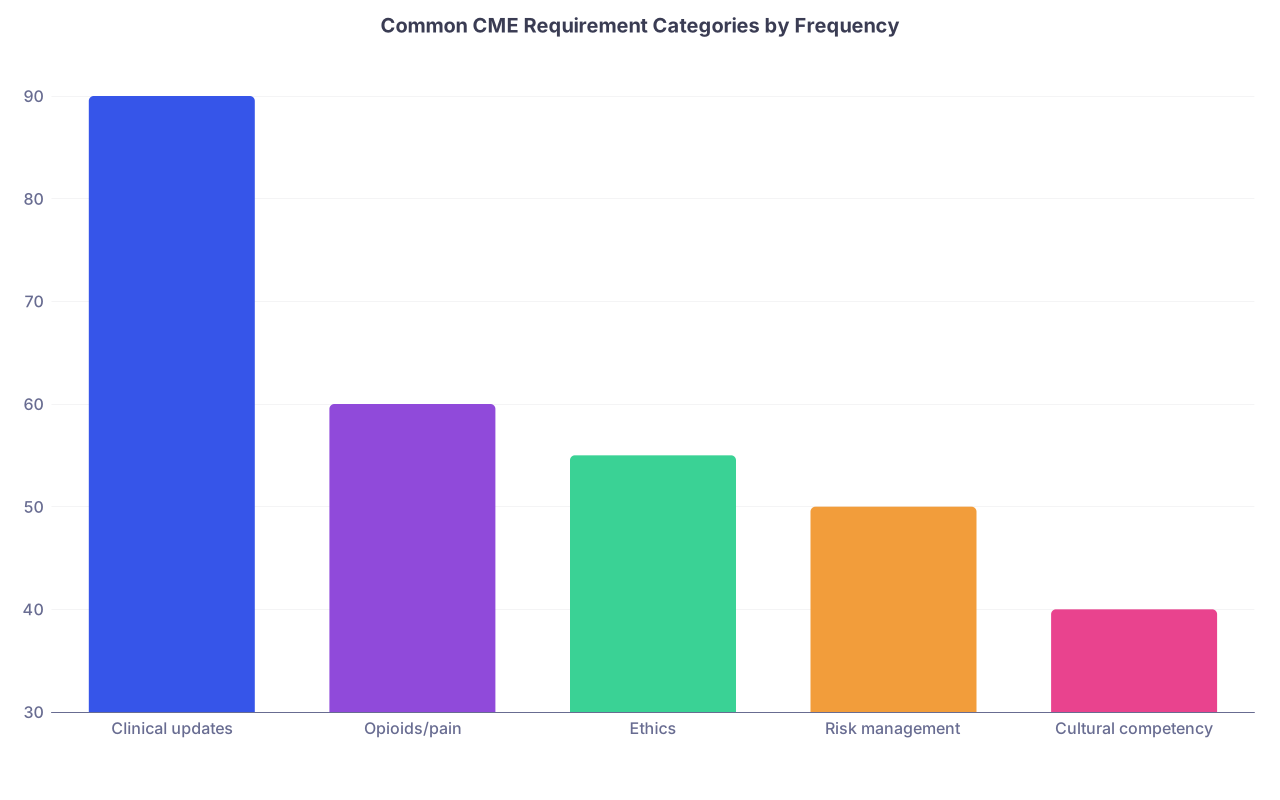
| Category | Value |
|---|---|
| Clinical updates | 90 |
| Opioids/pain | 60 |
| Ethics | 55 |
| Risk management | 50 |
| Cultural competency | 40 |
Again, free vs paid is irrelevant here. You just have to make sure you’ve picked the right free things.
3. Your Documentation Is a Mess
This one is huge and underappreciated.
You can do 100% free, excellent, accredited online CME and still look disorganized and unprofessional if:
- You didn’t save certificates.
- You can’t remember platforms or dates.
- The names are incomplete or vague.
- You list stuff that can’t be verified.
When you apply for credentialing, reappointment, or board audits, messy CME records make you look careless. Worst-case, they think you’re making stuff up.
That’s where anxiety about “looking bad” is valid. But it’s fixable.
How to Make a “Free-Only CME” Record Look Solid and Intentional
If you’re panicking reading this because your entire last cycle is free online CME, here’s how to make that look like a sane, grown-up choice instead of “I clicked whatever came to my inbox.”
First, tighten your story on paper.
Aim for CME that is:
- Clearly relevant to your specialty.
- Concentrated in a few reputable sources.
- Documented with full titles, dates, providers, and Category 1 status.
Don’t list vague stuff like “Various online modules – 25 hours.”
Write it like you expect an auditor to actually check.
Second, add some pattern.
If you’re in internal medicine/hospitalist world, a credentialer seeing:
- “Sepsis guidelines update – SCCM”
- “Heart failure management – ACC online CME”
- “Anticoagulation updates – ACCP”
- “Hospital medicine practice updates – SHM online series”
reads very differently than:
- “Random infectious disease webinar”
- “Wellness and burnout session”
- “COVID something something”
- “Obesity seminar”
- “4 modules – General medicine topics”
Same hours. Very different impression.
Third, be strategic for the next cycle.
If you’re already feeling self-conscious, use that. Don’t just keep doom-scrolling free webinars. Pick a lane.
- Choose 1–2 main platforms or societies and stick with them.
- Knock out your required topic CME early (opioids, ethics, etc.).
- Do at least one “bigger” thing every couple of years: a virtual conference, a focused course, a workshop, even if still free.
It’s not about impressing credentialing committees. It’s about not cringing at your own CME list.
What If They Ask Me About It in an Interview?
Honestly, they probably won’t. But if they do—usually in the context of a job interview or leadership role, not basic credentialing—you don’t want to sound defensive or embarrassed.
You don’t say:
“Yeah, I just did whatever was free because I was broke and exhausted.”
You do say something like:
- “I lean heavily on high-quality online CME from [X, Y, Z] because it fits my call schedule and lets me focus on very specific gaps in my practice.”
- “Over the last two years I prioritized updates on [core topics] through accredited online CME. I’m planning to add [major conference / focused course] in the next cycle to deepen my exposure.”
Translate what you did into something that sounds deliberate. Because honestly, that’s what it should be.

| Step | Description |
|---|---|
| Step 1 | Review last cycle CME |
| Step 2 | Fill gaps with targeted CME |
| Step 3 | Choose specialty focus areas |
| Step 4 | Select 1-2 main CME platforms |
| Step 5 | Schedule required topic modules |
| Step 6 | Add 1 larger course or meeting |
| Step 7 | Meet all requirements |
How to Calm the “They’re Secretly Judging Me” Spiral
Let me be blunt: most people on those committees are overworked clinicians skimming piles of paperwork. They are not running a psychological autopsy on your CME sources.
They’re asking:
- Does this meet legal requirements?
- Does this keep our hospital out of trouble?
- Does anything look blatantly missing or fake?
They are not asking:
- “Did this person spend at least $2,000 on airline tickets in the name of education?”
- “Did they attend the same sexy conferences I did?”
If you meet:
- The hours
- The type (Category 1 where needed)
- The required topics
and your documentation is clean and verifiable, you’re fine.
The part that’s making you squirm is internal. It’s that little voice saying, “Am I doing the bare minimum? Am I cutting corners? Am I… a little lazy about this?”
If the honest answer is no—you’re engaged, you’re reading, you’re updating your practice, you just happen to use online/free resources—then stop punishing yourself. That’s not a character flaw. That’s modern medicine.
If the honest answer is yes—you have been coasting—then fine. Don’t self-flagellate. Just use that discomfort to set up a better next CME cycle. Intentionally, not reactively.
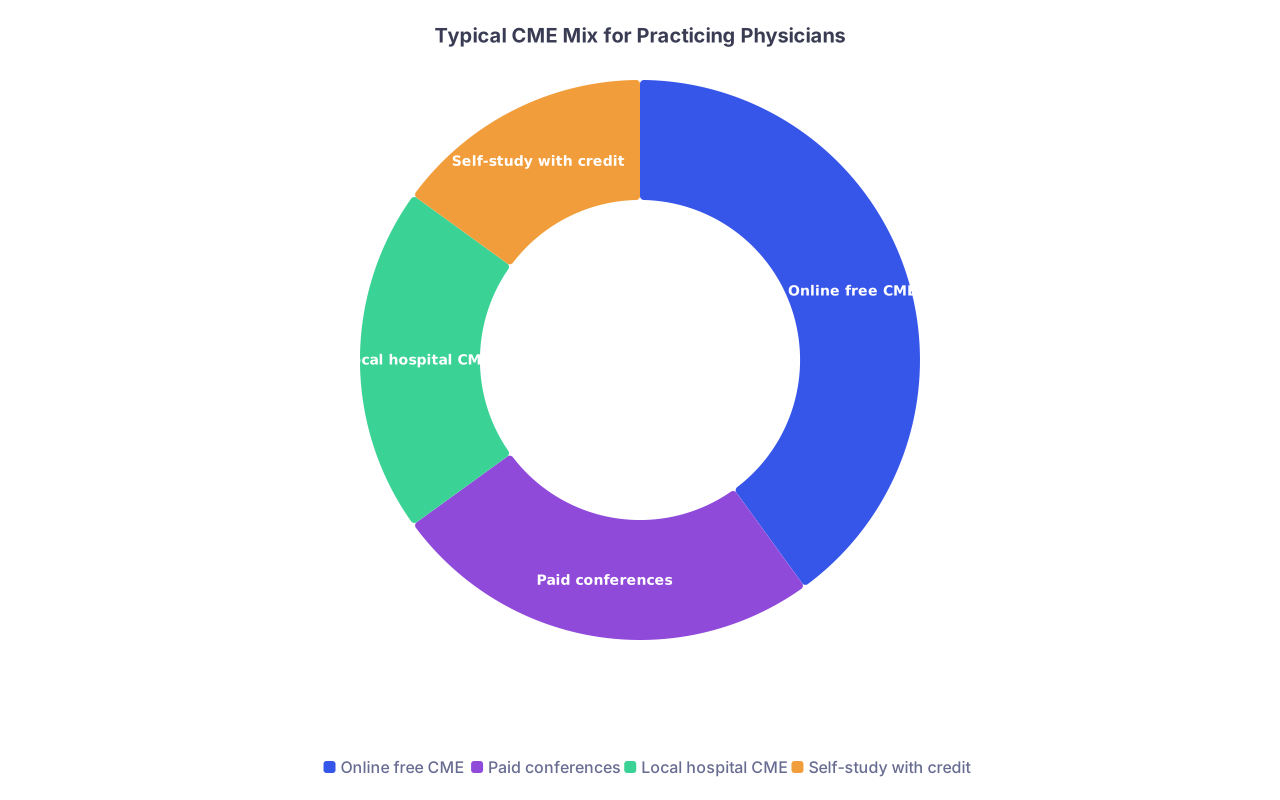
| Category | Value |
|---|---|
| Online free CME | 40 |
| Paid conferences | 25 |
| Local hospital CME | 20 |
| Self-study with credit | 15 |
You’re not an outlier for leaning heavily on free online CME. You’re pretty much normal.
FAQ (Exactly 5 Questions)
1. Can I be denied hospital privileges because all my CME was free and online?
Not if it’s legitimate, accredited CME and you meet the hour and topic requirements. Hospitals care about compliance and risk, not whether you paid for a plane ticket. You’d get denied for missing CME, not for free CME.
2. Do boards or states ever say CME must be “in-person” or “paid”?
Some boards or states occasionally require a certain percentage of “live” or “interactive” CME, but that often includes live webinars and virtual conferences. Very few require in-person travel. They almost never care if it was free vs paid—only if it was accredited and met the “live/interactive” definition if applicable.
3. Will using mostly Medscape/UpToDate/online platforms look bad on my CV?
No. Those names are everywhere. What might look weak is if your CME history is random, unfocused, and never includes anything more advanced or specialized over time. The solution isn’t “pay more,” it’s “plan better.”
4. Do I have to list every single CME activity on credentialing forms?
Often you only need to attest to total hours and upload supporting documentation or a transcript from a CME provider or tracker. Some hospitals want a summary list. Don’t lie or round up creatively. If you’re missing proof, do fresh CME now and document it well rather than inventing past credits.
5. I’m in fellowship / just finished residency and all my CME is free online. Is that a red flag starting out?
Not at all. Early-career physicians are not expected to have a glamorous CME portfolio. Committees mostly want to see that you’re licensed, board eligible/certified, and meeting basic requirements. As you get more established, you can gradually build a more intentional CME pattern—but you’re not behind because you didn’t hit a big national meeting yet.
Years from now, you won’t remember which webinars were free and which ones had a registration fee. You’ll remember whether you took your own growth seriously or just satisfied the checkbox.